} Crítica Retrô: Warner Brothers

Tradutor / Translator / Traductor / Übersetzer / Traduttore / Traducteur / 翻訳者 / переводчик

Showing posts with label Warner Brothers. Show all posts

Monday, March 31, 2025

O Cantor de Jazz (1927) / The Jazz Singer (1927)


É mentira que eu nunca assisti a “O Cantor de Jazz”. Uma vez eu assisti à metade dele numa aula. Com metade do spoiler, aqui estou eu para escrever sobre este filme que mudou a História. “Esperem um minuto, esperem um minuto! Vocês ainda não ouviram nada” foram as palavras que mudaram tudo. O cinema finalmente podia falar.

It’s a lie that I had never watched “The Jazz Singer”. I once watched about half of it in a class. Half-spoiled, here I am to review this movie that was a game changer. “Wait a minute, wait a minute! You ain’t heard nothing yet” were the words that changed everything. Cinema finally could talk.

Espera-se que Jakie Rabinowitz (Robert Gordon) se torne um Cantor como seu pai (Warner Oland) - seguindo cinco gerações na mesma profissão. Um Cantor ou Hazzan é um músico judeu que apresenta rezas na sinagoga na forma de canções. Para justificar a recusa do menino em se tornar um Cantor, sua mãe (Eugenie Besserer) diz “ele tem todos os hinos na cabeça, mas não no coração”. O pai encontra Jakie cantando ragtime num bar e, trazendo o garoto de forma violenta até em casa, bate nele. Jakie sai de casa e promete nunca mais voltar.

It’s expected that Jakie Rabinowitz (Robert Gordon) becomes a Cantor like his father (Warner Oland) - and five generations before him. A Cantor or Hazzan is a Jewish musician who presents prayers in the synagogue in the form of songs. To justify the boy’s refusal to step up as a Cantor, his mother (Eugenie Besserer) says “he has all the hymns in his head, but not in his heart”. The father finds Jakie singing ragtime tunes at a bar and, violently bringing him home, spanks his son. Jakie leaves home and vows to never return.

Anos depois, encontramos Jack Robin (Al Jolson) como cantor de jazz. Ele tem como fã e amante a bela Mary (May McAvoy), que descreve a maneira como ele canta como “com uma lágrima na voz”. Ela também é artista e arranja um lugar para Jack em seu show. Depois de uma turnê pelo país, eles voltam a Nova York, onde Jack enfrentará seu passado e tomará uma decisão que afetará seu futuro.

Years later, we find Jack Robin (Al Jolson) as a jazz singer. He finds a fan as well as a lover in Mary Dale (May McAvoy), who describes his singing as “having a tear in his voice”. She is an artist too and finds a spot for Jack in her revue. After touring the country, they go back ton New York, where Jack will face his past and make a decision that will affect his future.

Al Jolson, nascido Asa Yoelson no que hoje é a Lituânia, era conhecido como “o Maior Artista do Mundo” em seu auge. O homem que mudou para sempre a Broadway com sua maneira de cantar nos anos 1920, após o ataque a Pearl Harbor se tornou o primeiro cantor a se apresentar para as tropas no front. Al Jolson começou sua carreira no circo e logo galgou seu caminho no vaudeville, na Broadway e no cinema, quase fazendo seu primeiro filme em 1923: “Mammy’s Boy” de D.W. Griffith nunca foi completado. Sua segunda incursão no cinema foi “O Cantor de Jazz”. Influenciando cantores como Bing Crosby, Al Jolson transformava em ouro tudo em que tocava.

Al Jolson, born Asa Yoelson in what is now Lithuania, was known as “the World’s Greatest Entertainer” in his heyday. Forever changing Broadway with his singing style in the 1920s, after Pearl Harbor he became the first singer to entertain the troops overseas. Al Jolson started his career in the circus and quickly moved up to vaudeville, Broadway and cinema, almost making his first film in 1923: D.W. Griffith’s “Mammy’s Boy” was never completed. His second attempt at cinema was “The Jazz Singer”. Influencing crooners such as Bing Crosby, everything that Jolson touched became gold.

Num momento daqueles que você pisca e já passou, é possível ver Myrna Loy como corista no teatro, dizendo sobre Jack: “Ele não tem chance com Mary”. Nascida em 1905, Loy havia sido escalada quase que exclusivamente para interpretar vamps no cinema mudo, mas sua imagem mudou para a de “esposa perfeita” nos anos 1930, culminando com sua escolha como Rainha do Cinema em 1938. A estrela de “O Cantor de Jazz” tomou um caminho diferente: comumente citada como “a menos talentosa entre as protagonistas do cinema mudo”, May McAvoy detestou os papéis que a Warner Bros escolheu para ela após este filme, e se aposentou ao casar em 1929.

In a “blink and you miss it” moment you can see Myrna Loy as a chorus girl at the theater, saying about Jack: “He hasn’t a chance with Mary”. Born in 1905, Loy had been typecast as a vamp in silent movies, but her image changed to a “perfect wife” type in the 1930s, culminating with her being voted the Queen of the Movies in 1938. The lead of “The Jazz Singer” had a different path: often cited as “the least-talented leading lady in silents”, May McAvoy disliked the roles Warner Bros chose for her after this movie, and retired when she got married in 1929.

Parte filme silencioso, parte falado, não é de se espantar que o público enlouquecesse quando de repente ouvissem a voz de Al Jolson. Só que não foi essa a primeira coisa que o público ouviu, aos 22 minutos de projeção. Antes houve músicas interpretadas pelo jovem Jakie e o mais velho Jack, além de um hino judeu. O som sincronizado não era novidade - era possível encontrar efeitos sonoros em filmes anteriores, como em “Don Juan” de 1926 -, a novidade era o diálogo sincronizado à ação. Como curiosidade, devemos citar que tanto Myrna Loy quanto Warner Oland também estavam em “Don Juan”.

Part silent, part talkie, it’s no wonder that the audience would go crazy when suddenly they heard Al Jolson’s voice. Except that this wasn’t the first thing the audience heard, at the 22 minute mark. Before there were songs performed by the young Jakie and the older Jack, as well as a Jewish hymn. Synchronized sound was not new - you could find sound effects in previous films, such as 1926’s “Don Juan” -, the novelty was the synchronized dialogue. As a curiosity, we must sign that both Myrna Loy and Warner Oland also appeared in “Don Juan”.

Mas o plano não incluía ter diálogos sincronizados: só as canções deveriam ter sido gravadas no estúdio. Quando Al Jolson improvisou o “Esperem um minuto…” depois da primeira canção, o produtor Sam Warner gostou tanto que insistiu para manter a frase e mais um pouco de diálogo improvisado. Isso viria com um preço: a produção foi tão estressante para Sam Warner que ele faleceu um dia antes de o filme ser apresentado concluído para o elenco e equipe. O filme estreou nos cinemas muitos meses depois.

But the plan wasn’t to have synchronized dialogue as well: only songs were supposed to be recorded at the studio. When Al Jolson ad-libbed “Wait a minute…” after the first song, film producer Sam Warner liked it so much that he insisted on keeping the line and other improvised dialogue. This would come with a cost: production was so strenuous on Sam Warner that he died the day before the film was released to the cast and crew. The film premiered to the general public many months later.

Tudo é muito divertido até que chegamos a um ponto crítico: de repente lá está ela, a sequência com Al Jolson fazendo blackface. Essa prática deplorável não era condenada em 1927 e podia ser considerada uma forma de retratar a assimilação cultural. Jakie era judeu e, assim como a população negra, considerado um cidadão de segundo categoria. Jolson era um ativista pelos direitos civis em seu tempo - que era obviamente diferente de sê-lo nos anos 1960 - e vê-lo em blackface era como ver alguém se tornar completamente americano. Sim, em certo sentido o blackface definiu o que era a América durante um tempo.

Everything is fun and games until we reach a critical point: suddenly there it is, the infamous sequence of Al Jolson in blackface. This deplorable practice wasn’t frowned upon in 1927 and it could be seen as a way of portraying cultural assimilation. Jakie was Jewish and, like the black population, considered a second-rate citizen. Jolson was a civil rights advocate in his time - that is obviously different from the actors who were civil rights activists in the 1960s - and seeing him in blackface is seeing someone become truly American. Yes, in a sense blackface defined America in its time.

“O Cantor de Jazz” é um filme sobre a luta entre o velho e o novo, a tradição e a modernidade. Em breve, por causa deste filme, o cinema como um todo enfrentaria o mesmo dilema. Um comentário no Letterboxd disse que, se outro filme tivesse dado o passo em direção ao som sincronizado, “O Cantor de Jazz” seria hoje esquecido, e não estava errado. O filme seguinte de Jolson, “A Última Canção” (1928), foi um megassucesso de bilheteria, mas raramente se fala sobre ele hoje. Algumas coisas simplesmente têm que ser, e este filme teve de entrar para a História.

“The Jazz Singer” is a film about the fight between old and new, tradition and modernity. Soon, because of this film, cinema as a whole would face the same dilemma. A Letterboxd comment said that, if another movie had made the leap from silence to synchronized sound, “The Jazz Singer” would be forgotten today, and this is not wrong. Jolson’s subsequent film, “The Singing Fool” (1928), was a box office smash but is rarely talked about today. Some things are simply meant to be, and this film was meant to be enshrined in History.

Saturday, June 15, 2024

Rouxinol da Broadway (1951) / Lullaby of Broadway (1951)

 Quando, logo depois de vermos os créditos na tela tendo ao fundo a clássica melodia “Lullaby of Broadway”, somos introduzidos a uma Doris Day sapateando usando um smoking, sabemos quer vem coisa boa por aí. Afinal, trata-se de um filme de Doris Day como tantos outros da estrela: uma lufada de ar fresco e (quase) sem problemas por 90 minutos.


When, right after seeing the credits roll by the tune of the classic “Lullaby of Broadway”, we are introduced to a tap-dancing Doris Day wearing a tuxedo, we know we’re in for a treat. It’s, after all, another Doris Day movie like so many others from the star: a breath of fresh air and (almost) no problems for 90 minutes.

Doris Day é Melinda Howard, que é vista pela primeira vez cantando e dançando num espetáculo para a caridade num navio em alto mar. Ela está indo para Nova York visitar a mãe, Jessica (Gladys George), que é uma estrela da Broadway. Mas Jessica Howard não está vivendo dias de glória: ela bebe demais e pode ser encontrada cantando em clubes de quinta categoria. Para esconder esta realidade de Melinda, a ela é dito que a mãe está em turnê e lhe apresentam o Sr Hubbell, o proprietário da casa cujo endereço a mãe deu a ela.


Doris Day is Melinda Howard, who is first seen singing and dancing in a show for charity in a ship mid-sea. She is going to New York to visit her mother, Jessica (Gladys George), who is a Broadway star. But Jessica Howard isn’t living her most glorious days: she drinks too much and can be found singing at crappy clubs. To hide this reality from Melinda, she is told that her mother is on tour and introduced to Mr Hubbell, the owner of the house that matches the address her mother gave her.

A casa do Sr Hubbell (S.Z. Sakall) respire cultura. Seus criados foram estrelas do vaudeville. Ele patrocina shows da Broadway e dá festas para as estrelas. E é numa dessas festas que Melinda reencontra Tom Farnham (Gene Nelson), com quem ela tinha conversado no navio. Eles logo se dão bem e no momento seguinte são contratados para aparecerem juntos num show.


Mr Hubbell’s (S.Z. Sakall) house breathes culture. His servants were once vaudeville artists. He sponsors Broadway shows and throws parties for its stars. And it’s in one of those parties that Melinda meets again Tom Farnham (Gene Nelson), with whom she had spoken in the ship. They soon hit it off and the next thing we know they are appearing together in a show.

Gene Nelson não é o primeiro, segundo ou terceiro nome em que pensamos quando falamos de protagonistas de musicais. Nelson quis se tornar um cantor e dançarino porque via Fred Astaire - que é mencionado no filme quando uma garotinha pede um autógrafo para Tom e diz que ela o considera o melhor dançarino do mundo. Nelson havia acabado de ganhar o Globo de Ouro de Novato Mais Promissor quando foi escalado para “Rouxinol da Broadway”, num movimento da Warner Bros para testar protagonistas que pudessem substituir o pouco cooperativo Gordon MacRae. Em 1957 Gene Nelson se envolveu num acidente com um cavalo que acabou com sua carreira como protagonista, mas ele conseguiu uma segunda carreira como diretor de cinema e TV.


Gene Nelson isn’t the first, second or third leading man we think about when we talk about musicals. Nelson was inspired to become a song-and-dance man by watching Fred Astaire - who is mentioned in the film when a little girl asks Tom for an autograph saying she thinks he’s the greatest dancer in the world. Nelson had just received the Golden Globe for Most Promising Newcomer when he was cast in “Lullaby of Broadway”, in a Warner Bros move to test leading men who could replace uncooperative Gordon MacRae. In 1957 Gene Nelson was involved in a horse accident that ended his career as a leading man, but he started a new page as a director on film and TV.

O ator coadjuvante S.Z. Sakall tem uma chance de brilhar em “Rouxinol da Broadway”. Este foi o quarto filme que ele fez com Doris Day, que sempre se lembrou dele com carinho. Nascido em Budapeste, Hungria, ele começou a atuar na década de 1910 e trabalhou na Alemanha até a chegada dos nazistas ao poder. Ele voltou para a Hungria, onde seguiu trabalhando, mas migrou em 1940 quando o país se juntou ao Eixo fascista. Contratado da Warner Bros, apareceu em dezenas de filmes, mas seu mais famoso provavelmente é “Casablanca” (1942), num papel que ele quase recusou quando lhe foi oferecido.


Character actor S.Z. Sakall has a chance to shine in “Lullaby of Broadway”. This was the fourth film he made with Doris Day, who always remembered him fondly. Born in Budapest, Hungary, he started acting in the 1910s and worked in Germany until the Nazis took the power. He went back to Hungary, where he kept working, but left in 1940 when the country joined the fascist Axis. Under contract with Warner Bros, he appeared in dozens of films, but his most famous might be “Casablanca” (1942), in a role that he almost refused when he was offered.

Todos os números musicais são inseridos no context de algum tipo de apresentação, teatro, como ensaio ou outra coisa. As canções são bonitas e algumas delas podem até ser descritas como “memoráveis”. O disco de Doris Day com músicas deste filme ficou em primeiro lugar na lista da Billboard.


All the musical numbers are in the context of some kind of presentation, theatrical, as a rehearsal or other. The songs are sweet and some of them could even be described as “memorable”. Doris Day’s LP with songs from this movie was placed number one on the Billboard chart.

O título no Brasil para o filme é “Rouxinol da Broadway”. Um rouxinol é um pássaro cantor cujo canto pode ser ouvido tanto à noite - daí o nome em inglês, “nightingale” - quanto de dia. Rouxinóis são associados com a arte, a poesia em particular, por causa de seu canto criativo e espontâneo. Há apenas um problema: Doris Day não poderia ser um rouxinol porque apenas os machos da espécie cantam!


The Brazilian title for this film is “Broadway Nightingale”. A nightingale is a singing bird whose song can be heard both at night - which gives it the name in English - and day. Nightingales have been associated with the arts, poetry in particular, because of how creative and spontaneous their singing is. There is only one problem: Doris Day couldn’t be a nightingale because only male nightingales sing!

Doris Day fez, apenas em 1951, quarto filmes. Bem-sucedido e lucrativo, “Rouxinol da Broadway” mostra os talentos dela como cantora e dançarina e nos diverte como só Doris Day sabia fazer.


Doris Day appeared in four movies in 1951 alone. Succesfull and profitable, “Lullaby of Broadway” showcases her singing and dancing talents and entertains us like only Doris Day could do.


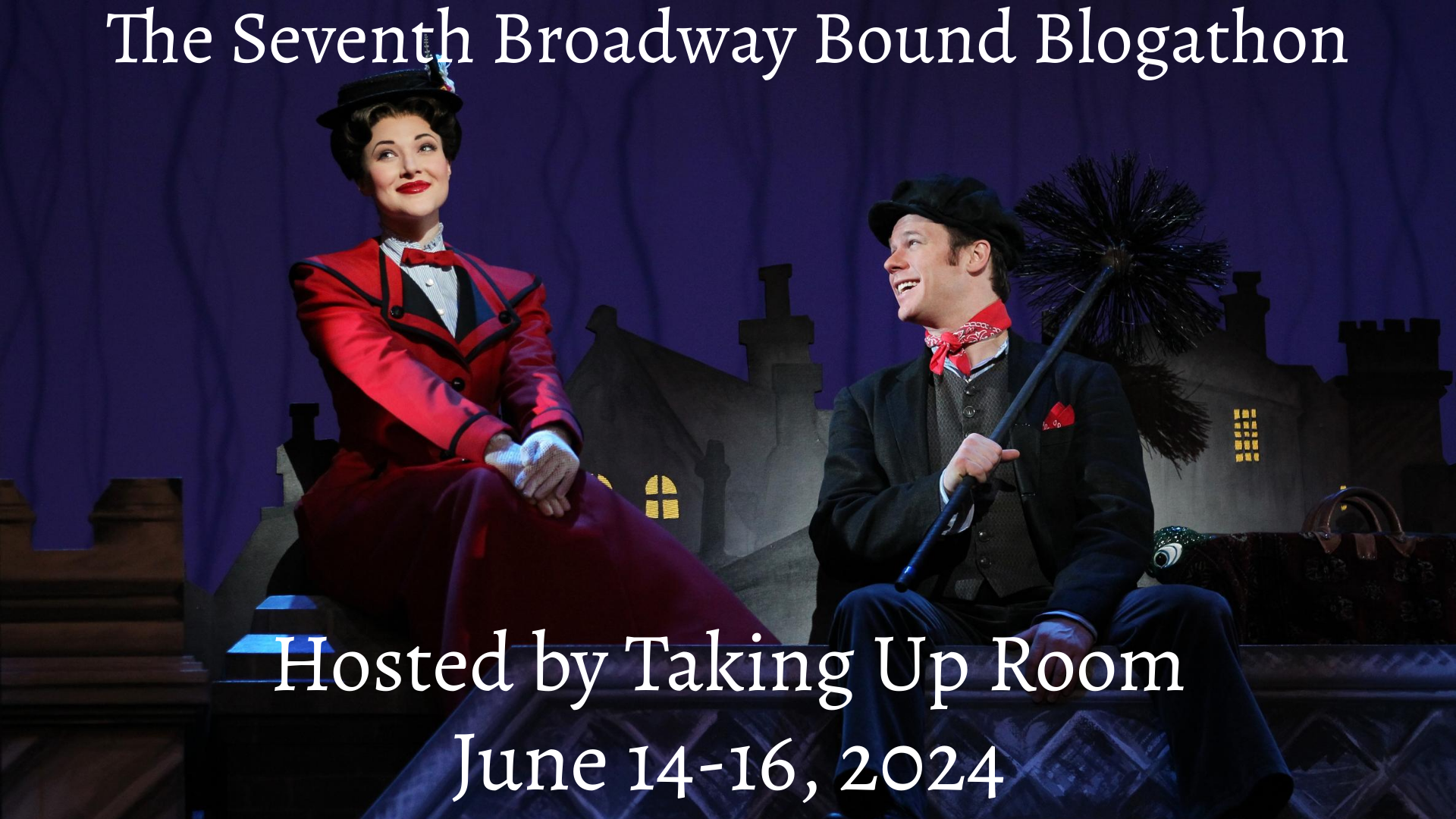
This is my contribution to the Seventh Broadway Bound Blogathon, hosted by Rebecca at Taking Up Room.

Tuesday, April 30, 2024

À Margem da Vida (1950) / Caged (1950)


Diz-se que a prisão muda um homem. Mas o que ela faz com uma mulher? Não importa se a pena é de alguns meses ou muitos anos, ir para a prisão é sempre uma experiência traumática, pois a prisão não melhora ninguém, é só um lugar de punições diárias. Eu nunca fui presa, mas graças aos filmes posso ter uma ideia de como é esta experiência. O filme que me mostrou isso é “À Margem da Vida” (1950).


It is said that prison changes a man. But what does it do to a woman? No matter if the penalty is a few months or many years, going to prison is always a traumatic experience, as prison doesn’t improve anyone, is just a place for daily punishment. I've never been to prison, but thanks to the movies I can imagine how it is to be there. The movie that showed me how is 1950’s “Caged”.

Marie Allen (Eleanor Parker) foi considerada cúmplice de assalto à mão armada, delito cometido pelo marido dela. Aos 19 anos, ela ainda é uma adolescente quando vai para a cadeia – Parker tinha na época 27 anos. A senhora Benton (Agnes Moorehead) diz a Marie que ela trabalhará na lavanderia, mas a senhora Harper (Hope Emerson) a coloca para esfregar o chão. Para piorar as coisas, Marie está grávida e seu marido está morto.


Marie Allen (Eleanor Parker) was considered an “accessory” to armed robbery, crime committed by her husband. At 19, she’s still a bobby-soxer when she goes to jail – Parker was in reality 27. Mrs Benton (Agnes Moorehead) tells Marie she’ll work in the laundry, but Mrs Harper (Hope Emerson) puts the girl to scrub floors instead. To make things worse, Marie is pregnant and her husband is dead.

Algumas mulheres foram presas porque homens fizeram com que elas se envolvessem em crimes, como aconteceu com a própria Marie e a detenta June (Olive Deerin). Outra detenta, a aparentemente bobinha Emma (Ellen Corby), está lá porque matou um homem, seu marido abusivo, após três tentativas. E há outras mulheres do lado de fora tendo problemas com homens, como a mãe de Marie com seu novo marido.


Some women were arrested because men got them involved in crimes, like it happened to Marie herself and fellow inmate June (Olive Deering). Another one, silly-sounding Emma (Ellen Corby), is there because she killed a man, her abusive husband, after three attempts. And there are other women outside having troubles with men, like Marie’s mother with her new husband.

Quando Marie pede um pente para pentear seus cabelos antes de tirar a foto oficial da prisão, aquela com números e tudo mais, a fotógrafa, outra mulher, diz que não há necessidade de ter pentes porque não há nenhum homem ali. Mas para Marie pentear o cabelo não era para sedução, mas sim para autoestima – se é que é possível cultivá-la num lugar como aquele.


When Marie asks if she can have a comb to comb her hair before taking the official prison photo, with numbers and all, the photographer, also a woman, says that there is no need for combs because there aren’t any men in there. But for Marie combing her hair wasn’t a matter of seduction, it was a matter of self-esteem – if any could be cultivated in a place like that.

A bondosa Ruth Benton, interpretada por Agnes Moorehead, só quer o melhor para “suas meninas” e as trata com respeito e até um tipo de amor materno. É por isso que ela entra em atrito com a grosseira e aproveitadora Evelyn Harper e Harper denuncia os métodos muito humanos da senhora Benton como inadequados para os superiores.


The kind Ruth Benton, played by Agnes Moorehead, only wants the best for “her girls” and treats them with respect and even some kind of motherly love. That’s why she clashes with rude and corrupt Evelyn Harper and Harper denounces Mrs Benton’s very humane methods as inadequate to their superiors.

Quase a última nos créditos é a ganhadora do Oscar Jane Darwell. Ela aparece por poucos minutos, como a responsável pela sala de isolamento. Nos Oscars, “À Margem da Vida” foi indicado em três categorias: Atriz para Eleanor Parker, Atriz Coadjuvante para Hope Emerson e Roteiro. Parker ganhou o prêmio de Melhor Atriz no Festival de Cinema de Veneza.


Almost the last billed, we find Oscar winner Jane Darwell. She is there for just a few minutes, as the matron responsible for the isolation room. At the Oscars, “Caged” was nominated in three categories: Actress for Eleanor Parker, Supporting Actress for Hope Emerson and Writing. Parker won the Best Actress Award at the Venice Film Festival.

A trilha sonora de Max Steiner permite alguns momentos sublimes num ambiente tão duro. A dureza era real porque, para escrever o roteiro, a jornalista investigativa Virginia Kellogg foi a muitas prisões de mulheres como parte do processo de pesquisa e foi inclusive mantida presa numa delas.


Max Steiner’s soundtrack allows a few moments of the sublime to emerge in such a raw environment. The rawness was real, because, to write the screenplay, investigative journalist Virginia Kellogg went to many women’s prisons as part of the research process and was even incarcerated in one of them.

A Warner Brothers ficou famosa por seus filmes realistas no começo dos anos de 1930. Embora numa escala menor, o estúdio continuou fazendo tais filmes, e “À Margem da Vida” é prova disso. O produtor Jerry Wald queria, com esse filme, gerar a mesma mudança – para as prisões femininas – que o estúdio gerou quase 20 anos antes, quando leis foram mudadas por causa do realismo de “O Fugitivo” (1932).


Warner Brothers became known for its films with gritty realism in the early 1930s. Although in a smaller scale, the studio kept doing these kind of movies, and “Caged” proves that. Producer Jerry Wald wanted, with this film, to create the same change – for women’s prison – the studio created almost 20 years prior, when laws were changed because of the grittiness of “I am a Fugitive from a Chain Gang” (1932).

Há uma cena muito interessante filmada em contra-plongée (de baixo para cima) na qual Harper humilha a detenta Kitty (Betty Garde). A sombra das grades é vista no teto, criando um efeito incrível. Outra ótima composição vem mais tarde após uma rebelião, quando a senhora Benton está toda coberta por sombras e somente Marie, dentre todas as detentas, tem seu rosto iluminado.


There is a very interesting scene shot in a contra-plongée (from bottom to top) in which Harper humiliates the inmate Kitty (Betty Garde). The shadow of the prison bars is visible in the ceiling, creating a great effect. Another great composition comes later after a rebellion, when Mrs Benton is all covered in shadows and only Marie, of all inmates, receives light in her face.

Como o Código Hays proibia assuntos como gravidez e parto de serem tratados de forma realista no cinema, temos aqui um desafio com Marie. Quando ela deveria estar grávida de oito meses, mal é visível a barriga, e o parto é filmado focando no rosto da senhora Benton, que está em outro quarto esperando para ouvir o choro do recém-nascido.


Since the Hays Code prohibited subjects such as pregnancy and childbirth to be realistically portrayed in movies, we have here a challenge with Marie. When she’s supposed to be eight months pregnant she barely has a bump, and the birth is filmed focused on Mrs Benton waiting in the outside room to hear the newborn’s cry.

Uma detenta conta para Marie que “nesta gaiola ou você fica forte ou você acaba morta”. Meses se passam e Marie diz que ela viveu “uma vida em apenas um ano nesta gaiola”. Marie ficou tão forte que endureceu, assim como acontece com muitas mulheres que vão presa, e isso não tem mais volta. Um excelente filme, “À Margem da Vida” prova o que hoje sabemos tão bem: a prisão muda uma mulher – para pior.


One fellow inmate tells Marie that “in this cage you get tough or you get killed”. Months pass and Marie says that she has lived “a lifetime in one year at this cage”. Marie got so tough that she became hardened, like most women do when incarcerated, and there is no going back. A great movie, “Caged” proves what we know so well today: prison changes a woman – for the worst.


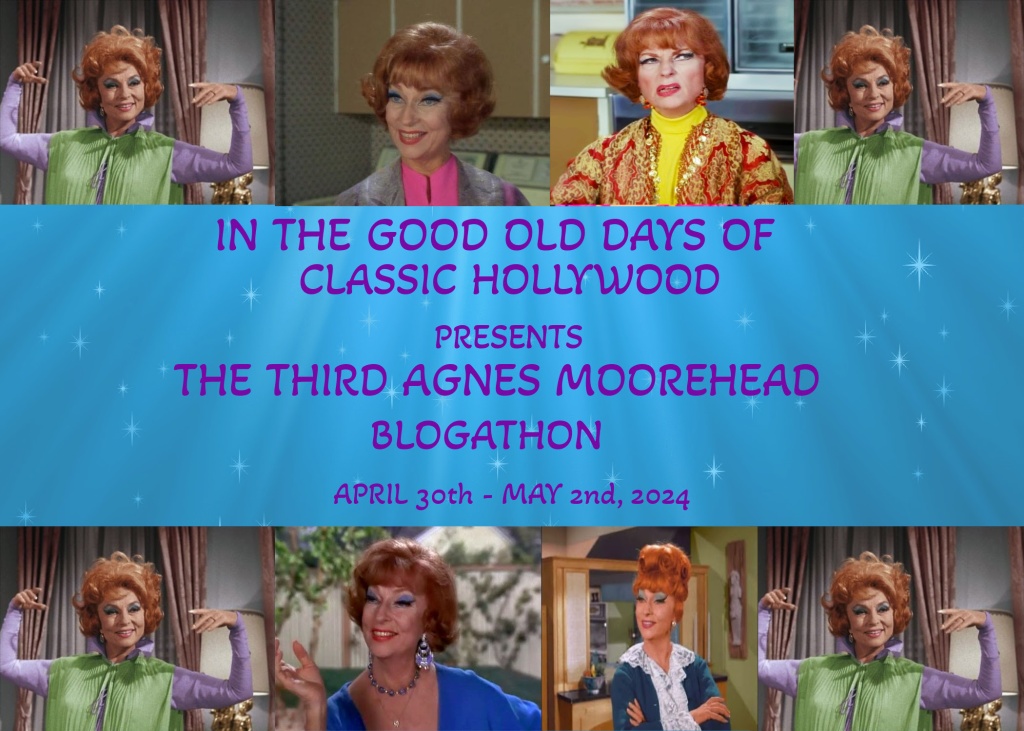
This is my contribution to The Third Agnes Moorehead blogathon, hosted by Crystal at In the Good Old Days of Classic Hollywood.

Saturday, December 16, 2023

Vendedor de Ilusões (1962) / The Music Man (1962)


Alguns musicais são tão bem sucedidos que deixam uma marca na cultura pop. Isso significa que você acaba conhecendo as músicas sem ter que assistir ao musical. Isso aconteceu comigo mais recentemente quando assisti a “Vendedor de Ilusões” pela primeira vez: percebi que já conhecia tantas das músicas de antemão. Apesar disso, ou talvez por causa disso, me diverti muito.


Some musicals are so enormously successful that they leave a mark in pop culture. This means you get to know the songs without having to watch the musical. This happened to me most recently when I watched “The Music Man” (1962) for the first time: I realized I already knew so many songs in it beforehand. Nevertheless, or maybe because of this, I had a great time.

O Professor Harold Hill (Robert Preston) é um caixeiro viajante que chega a River City, Iowa. Ele vende instrumentos musicais para formar bandas de jovens. Ele soluciona o problema de a cidade não ter uma banda de jovens ao encontrar um inimigo que poderia ser combatido com a música: a nova mesa de bilhar em um saloon.


Professor Harold Hill (Robert Preston) is a travelling salesman who arrives in River City, Iowa. He sells musical instruments to form boys’ bands. He solves the problem of the city not having a boys’ band by finding an enemy that could be fought with music: the new pool table at a saloon.

A organização de uma banda de jovens é, obviamente, uma maneira do Professor Hill ganhar dinheiro fácil e sair da cidade. Quase todos no local pareciam animados com a ideia da banda. Quase todos, menos a bibliotecária local e também professora de piano, Marian Paroo (Shirley Jones). Mas é exatamente a atenção dela que o Professor Hill quer obter. Ele conseguirá sucesso em seu esquema e também conquistar a garota?


The organization of the boys’ band is, of course, a way for Professor Hill to earn easy money and leave the town. Almost everybody from River City seemed to get excited about the band. Almost, except the local librarian and also piano teacher Marian Paroo (Shirley Jones). But it’s exactly her attention Professor Hill wants to win. Will he manage to be successful with his scheme and also get the girl?

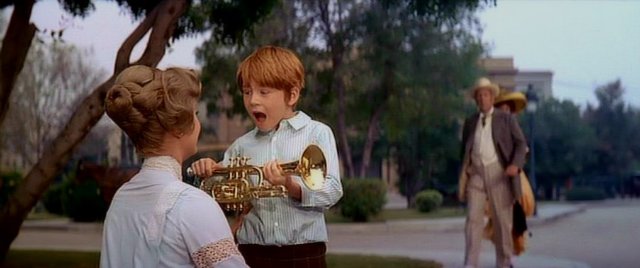
Creditado como “Ronny Howard”, lá está ele: o futuro megaprodutor Ron Howard, aos oito anos de idade, como Winthrop Paroo, irmão mais novo de Marian. Ele está muito bem no papel, e até consegue, de maneira convincente, fingir falar com a língua presa. De acordo com o IMDB, seu primeiro papel como ator foi em 1956 - quando ele tinha apenas dois anos de idade - e a partir daí Ronny fez diversos filmes e séries de TV.


Credited as “Ronny Howard”, there he is: future mega producer Ron Howard, aged eight, as Winthrop Paroo, Marian’s younger brother. He is very good in the role, and even manages to believably fake a lisp. According to IMDb, his first acting credit comes from 1956 - when he was just two years old - and from them on Ronny appeared steadily on film and TV.

Eu gostaria de destacar Pert Kelton, wue interpreta a mãe de Marian e Winthrop. Ela também esteve na produção da Broadway de “Vendedor de Ilusões”. Apesar de este ser seu mais conhecido papel no cinema, esta filha de artistas do vaudeville apareceu em 47 filmes e programas de TV, começando em 1929. Ela perdeu o papel de Alice Kramden na popular série de TV “The Honeymooners” porque seu marido, o também ator Ralph Bell, entrou para a lista negra durante a Ameaça Vermelha.


I’d like to highlight Pert Kelton, who plays Marian’s and Winthrop’s mother. She was also on the Broadway production of “The Music Man”. Although this is her best known movie, this daughter of vaudevillians appeared in 47 films and TV shows, starting in 1929. She lost the role of Alice Kramden on the popular TV show “The Honeymooners” because her husband, also actor Ralph Bell, was blacklisted during the Red Scare.

Também dignos de nota são os quatro membros do Conselho Escolar que se tornam um quarteto cantor - eles são todos muito talentosos! Eles são The Buffalo Bills e também estiveram na produção da Broadway. Eles foram os Medalhistas Internacionais de 1950 da Sociedade para Preservação e Encorajamento de Quartetos Cantores de Barbearia nas Américas. Tendo começado a carreira em 1947 na cidade de Buffalo - de onde vem o nome do quarteto - o grupo se manteve ativo até 1967 e seu concerto de despedida foi no famoso Hotel Waldorf-Astoria de Nova York.


Also worth noticing is the four School Board members who become a singing quartet – they’re all very talented! They are The Buffalo Bills and were also on the Broadway production. They were the 1950 International Champion Medalist Quartet of the S.P.E.B.S.Q.S.A., the Society for the Preservation and Encouragement of Barber Shop Quartet Singing in America. Having started in 1947 in the city of Buffalo - from where the group’s name came - they were active until 1967 and did their farewell concert at the famous Waldorf-Astoria Hotel in New York.

O cérebro por trás de “Vendedor de Ilusões” é Meredith Wilson. Ele criou River City tendo como inspiração sua cidade natal, Mason City, Iowa. Tendo sido flautista na banda de John Philip Sousa e na Orquestra Filarmônica de Nova York, Wilson já havia composto trilhas sonoras para filmes como “O Grande Ditador” (1940) e “Pérfida” (1941). Depois de uma década de trabalho no rádio, Wilson presenteou o mundo com “Vendedor de Ilusões”, tendo trabalhado no musical por oito anos e composto 40 músicas. A peça foi um sucesso com Robert Preston como o protagonista, um papel que a Warner Bros não queria que ele repetisse por não ser um nome conhecido. Meredith Wilson ameaçou cancelar a produção por completo se Preston não ficasse com o papel protagonista, o que aconteceu depois que nomes como Frank Sinatra, Bring Crosby e Cary Grant recusaram o papel.


The brain behind “The Music Man” is Meredith Wilson. He based River City on his hometown, Mason City, Iowa. A former flutist at both John Philip Sousa’s band and the New York Philharmonic Orchestra, Wilson had written scores for films such as “The Great Dictator” (1940) and “The Little Foxes” (1941). After a decade’s work on radio, Wilson gifted “The Music Man” to the world, after writing 40 songs in eight years of work. The play was a hit with Robert Preston as the lead, a role that Warner Bros was not willing to let him repeat on film, because Preston wasn’t a bankable star. Meredith Wilson threatened to cancel the production completely if Preston wasn’t cast as the lead, which happened after names like Frank Sinatra, Bing Crosby and Cary Grant refused the role.

“Vendedor de Ilusões”, a peça da Broadway, ganhou o prêmio Tony de Melhor Musical em 1957, vencendo “Amor, Sublime Amor” na disputa. Quando foram feitas as adaptações para o cinema, o jogo virou: em 1962 “Amor, Sublime Amor” ganhou 11 Oscars e um ano depois “Vendedor de Ilusões” venceu apenas um Oscar, Melhor Trilha Sonora Adaptada.


“The Music Man”, the Broadway production, won the Best Musical Tony Award in 1957, beating “West Side Story”. When they became movies, the game changed: in 1962 “West Side Story” won 11 Oscars and one year later “The Music Man” won only one, Best Music, Scoring of Music, Adaptation or Treatment.

O intervalo entre as músicas é mínimo e isto, junto com alguns truques de iluminação, ajudaram a criar uma aura teatral no filme. Quando a música para por um período maior, sequências icônicas acontecem, como aquela em que o Professor Hill fala com Marian sobre ela colecionar “ontens vazios” (“empty yesterdays”).


The interval between songs is minimal and this, together with some lighting tricks, help create a stagey aura in the film. When the music stops for a little longer, iconic sequences happen, such as the one where Professor Hill talks to Marian about her collecting “empty yesterdays”.

Os 151 minutos de duração do filme fluíram muito bem. “Vendedor de Ilusões” foi o terceiro maior sucesso de bilheteria de 1962, depois de “O Mais Longo dos Dias” e “Lawrence da Arábia”. Ele merece um lugar entre os mais divertidos musicais já feitos, e também um lugar entre os melhores filmes produzidos pela agora centenária Warner Bros.


The 151 minutes flew by. “The Music Man” was the third highest-grossing film of 1962, behind “The Longest Day” and “Lawrence of Arabia”. It deserves a spot among the most entertaining musicals ever made, and also among the best movies released by the now centenarian Warner Bros studio.


This is my contribution to the 100 Years of Warner Brothers blogathon, hosted by Constance and Diana at Silver Scenes.

Related Posts Plugin for WordPress, Blogger...