} Crítica Retrô: 1962

Tradutor / Translator / Traductor / Übersetzer / Traduttore / Traducteur / 翻訳者 / переводчик

Showing posts with label 1962. Show all posts

Saturday, December 16, 2023

Vendedor de Ilusões (1962) / The Music Man (1962)


Alguns musicais são tão bem sucedidos que deixam uma marca na cultura pop. Isso significa que você acaba conhecendo as músicas sem ter que assistir ao musical. Isso aconteceu comigo mais recentemente quando assisti a “Vendedor de Ilusões” pela primeira vez: percebi que já conhecia tantas das músicas de antemão. Apesar disso, ou talvez por causa disso, me diverti muito.


Some musicals are so enormously successful that they leave a mark in pop culture. This means you get to know the songs without having to watch the musical. This happened to me most recently when I watched “The Music Man” (1962) for the first time: I realized I already knew so many songs in it beforehand. Nevertheless, or maybe because of this, I had a great time.

O Professor Harold Hill (Robert Preston) é um caixeiro viajante que chega a River City, Iowa. Ele vende instrumentos musicais para formar bandas de jovens. Ele soluciona o problema de a cidade não ter uma banda de jovens ao encontrar um inimigo que poderia ser combatido com a música: a nova mesa de bilhar em um saloon.


Professor Harold Hill (Robert Preston) is a travelling salesman who arrives in River City, Iowa. He sells musical instruments to form boys’ bands. He solves the problem of the city not having a boys’ band by finding an enemy that could be fought with music: the new pool table at a saloon.
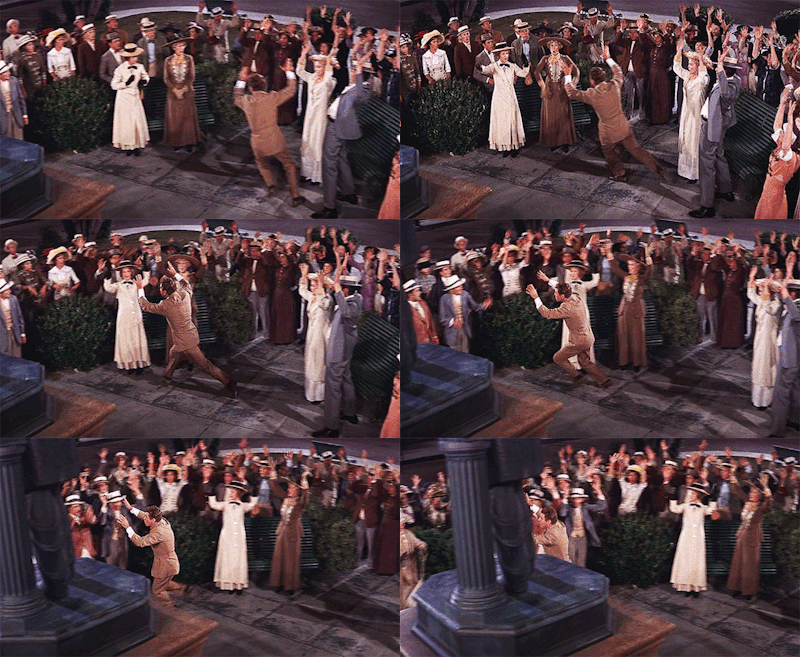
A organização de uma banda de jovens é, obviamente, uma maneira do Professor Hill ganhar dinheiro fácil e sair da cidade. Quase todos no local pareciam animados com a ideia da banda. Quase todos, menos a bibliotecária local e também professora de piano, Marian Paroo (Shirley Jones). Mas é exatamente a atenção dela que o Professor Hill quer obter. Ele conseguirá sucesso em seu esquema e também conquistar a garota?


The organization of the boys’ band is, of course, a way for Professor Hill to earn easy money and leave the town. Almost everybody from River City seemed to get excited about the band. Almost, except the local librarian and also piano teacher Marian Paroo (Shirley Jones). But it’s exactly her attention Professor Hill wants to win. Will he manage to be successful with his scheme and also get the girl?

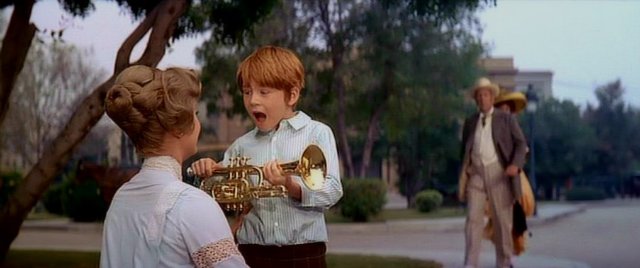
Creditado como “Ronny Howard”, lá está ele: o futuro megaprodutor Ron Howard, aos oito anos de idade, como Winthrop Paroo, irmão mais novo de Marian. Ele está muito bem no papel, e até consegue, de maneira convincente, fingir falar com a língua presa. De acordo com o IMDB, seu primeiro papel como ator foi em 1956 - quando ele tinha apenas dois anos de idade - e a partir daí Ronny fez diversos filmes e séries de TV.


Credited as “Ronny Howard”, there he is: future mega producer Ron Howard, aged eight, as Winthrop Paroo, Marian’s younger brother. He is very good in the role, and even manages to believably fake a lisp. According to IMDb, his first acting credit comes from 1956 - when he was just two years old - and from them on Ronny appeared steadily on film and TV.
Eu gostaria de destacar Pert Kelton, wue interpreta a mãe de Marian e Winthrop. Ela também esteve na produção da Broadway de “Vendedor de Ilusões”. Apesar de este ser seu mais conhecido papel no cinema, esta filha de artistas do vaudeville apareceu em 47 filmes e programas de TV, começando em 1929. Ela perdeu o papel de Alice Kramden na popular série de TV “The Honeymooners” porque seu marido, o também ator Ralph Bell, entrou para a lista negra durante a Ameaça Vermelha.


I’d like to highlight Pert Kelton, who plays Marian’s and Winthrop’s mother. She was also on the Broadway production of “The Music Man”. Although this is her best known movie, this daughter of vaudevillians appeared in 47 films and TV shows, starting in 1929. She lost the role of Alice Kramden on the popular TV show “The Honeymooners” because her husband, also actor Ralph Bell, was blacklisted during the Red Scare.

Também dignos de nota são os quatro membros do Conselho Escolar que se tornam um quarteto cantor - eles são todos muito talentosos! Eles são The Buffalo Bills e também estiveram na produção da Broadway. Eles foram os Medalhistas Internacionais de 1950 da Sociedade para Preservação e Encorajamento de Quartetos Cantores de Barbearia nas Américas. Tendo começado a carreira em 1947 na cidade de Buffalo - de onde vem o nome do quarteto - o grupo se manteve ativo até 1967 e seu concerto de despedida foi no famoso Hotel Waldorf-Astoria de Nova York.


Also worth noticing is the four School Board members who become a singing quartet – they’re all very talented! They are The Buffalo Bills and were also on the Broadway production. They were the 1950 International Champion Medalist Quartet of the S.P.E.B.S.Q.S.A., the Society for the Preservation and Encouragement of Barber Shop Quartet Singing in America. Having started in 1947 in the city of Buffalo - from where the group’s name came - they were active until 1967 and did their farewell concert at the famous Waldorf-Astoria Hotel in New York.

O cérebro por trás de “Vendedor de Ilusões” é Meredith Wilson. Ele criou River City tendo como inspiração sua cidade natal, Mason City, Iowa. Tendo sido flautista na banda de John Philip Sousa e na Orquestra Filarmônica de Nova York, Wilson já havia composto trilhas sonoras para filmes como “O Grande Ditador” (1940) e “Pérfida” (1941). Depois de uma década de trabalho no rádio, Wilson presenteou o mundo com “Vendedor de Ilusões”, tendo trabalhado no musical por oito anos e composto 40 músicas. A peça foi um sucesso com Robert Preston como o protagonista, um papel que a Warner Bros não queria que ele repetisse por não ser um nome conhecido. Meredith Wilson ameaçou cancelar a produção por completo se Preston não ficasse com o papel protagonista, o que aconteceu depois que nomes como Frank Sinatra, Bring Crosby e Cary Grant recusaram o papel.


The brain behind “The Music Man” is Meredith Wilson. He based River City on his hometown, Mason City, Iowa. A former flutist at both John Philip Sousa’s band and the New York Philharmonic Orchestra, Wilson had written scores for films such as “The Great Dictator” (1940) and “The Little Foxes” (1941). After a decade’s work on radio, Wilson gifted “The Music Man” to the world, after writing 40 songs in eight years of work. The play was a hit with Robert Preston as the lead, a role that Warner Bros was not willing to let him repeat on film, because Preston wasn’t a bankable star. Meredith Wilson threatened to cancel the production completely if Preston wasn’t cast as the lead, which happened after names like Frank Sinatra, Bing Crosby and Cary Grant refused the role.

“Vendedor de Ilusões”, a peça da Broadway, ganhou o prêmio Tony de Melhor Musical em 1957, vencendo “Amor, Sublime Amor” na disputa. Quando foram feitas as adaptações para o cinema, o jogo virou: em 1962 “Amor, Sublime Amor” ganhou 11 Oscars e um ano depois “Vendedor de Ilusões” venceu apenas um Oscar, Melhor Trilha Sonora Adaptada.


“The Music Man”, the Broadway production, won the Best Musical Tony Award in 1957, beating “West Side Story”. When they became movies, the game changed: in 1962 “West Side Story” won 11 Oscars and one year later “The Music Man” won only one, Best Music, Scoring of Music, Adaptation or Treatment.

O intervalo entre as músicas é mínimo e isto, junto com alguns truques de iluminação, ajudaram a criar uma aura teatral no filme. Quando a música para por um período maior, sequências icônicas acontecem, como aquela em que o Professor Hill fala com Marian sobre ela colecionar “ontens vazios” (“empty yesterdays”).


The interval between songs is minimal and this, together with some lighting tricks, help create a stagey aura in the film. When the music stops for a little longer, iconic sequences happen, such as the one where Professor Hill talks to Marian about her collecting “empty yesterdays”.

Os 151 minutos de duração do filme fluíram muito bem. “Vendedor de Ilusões” foi o terceiro maior sucesso de bilheteria de 1962, depois de “O Mais Longo dos Dias” e “Lawrence da Arábia”. Ele merece um lugar entre os mais divertidos musicais já feitos, e também um lugar entre os melhores filmes produzidos pela agora centenária Warner Bros.


The 151 minutes flew by. “The Music Man” was the third highest-grossing film of 1962, behind “The Longest Day” and “Lawrence of Arabia”. It deserves a spot among the most entertaining musicals ever made, and also among the best movies released by the now centenarian Warner Bros studio.


This is my contribution to the 100 Years of Warner Brothers blogathon, hosted by Constance and Diana at Silver Scenes.

Sunday, April 5, 2020

A Mais Querida do Mundo (1962) / Billy Rose’s Jumbo (1962)


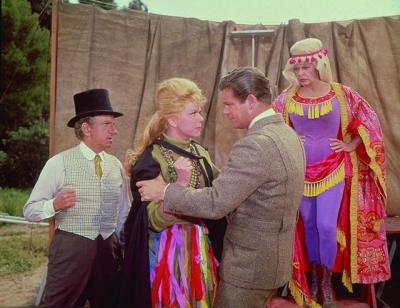
Um filme sobre o circo. Codirigido por Busby Berkeley, escrito por Sidney Sheldon, baseado numa peça escrita por Ben Hecht, estrelando Doris Day, Jimmy Durante e Stephen Boyd – sim, o Messala de “Ben-Hur”. E é um musical! O que poderia dar errado?

A movie about the circus. Co-directed by Busby Berkeley, written by Sidney Sheldon, based on a play written by Ben Hecht, starring Doris Day, Jimmy Durante and Stephen Boyd – yes, Messala from “Ben-Hur”. And it’s a musical! What could go wrong?


Um circo itinerante do passado está passando por dificuldades financeiras. Há muitas dívidas e o urso domesticado se demitiu por falta de pagamento. Não é só o urso que está de saída: alguns músicos, palhaços e um grande acrobata também vão embora. É neste momento que um belo estranho, Sam Rawlins (Stephen Boyd), chega à procura de trabalho – ele diz que pode fazer qualquer coisa. Num primeiro momento ele se desentende com Kitty (Doris Day), a gerente não oficial do circo e filha do dono do empreendimento circense.

An itinerant circus of days gone by is going through financial difficulties. There are lots of debts and the trained bear quit because it wasn’t paid. It’s not only the bear that’s leaving: some musicians, clowns and the star acrobat are also out. It’s in this moment that a tall dark stranger, Sam Rawlins (Stephen Boyd), arrives wanting work – he says he can do any kind of work. At first he clashes with Kitty (Doris Day), the circus’ unofficial manager and the owner’s daughter.


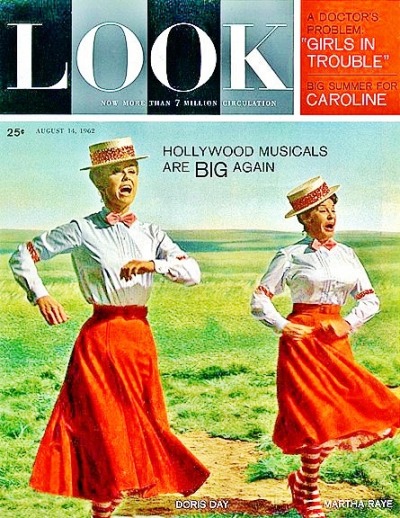
O dono do circo é Anthony Wonder (Jimmy Durante), que está noivo de Lulu (Martha Raye), a vidente do circo, há 14 anos. Entretanto, Anthony está mais apaixonado por Jumbo, o talentoso elefante do circo. Mas o principal concorrente de Anthony, John Noble (Dean Jagger), está de olho em Jumbo e mal pode esperar para comprar o elefante e todo o resto quando Anthony falir.

The owner of the circus is Anthony Wonder (Jimmy Durante), who has been engaged to Miss Lulu (Martha Raye), the circus’ fortune teller, for 14 years. However, Anthony is more in love with Jumbo, the circus’ talented elephant. But Anthony’s main competitor, John Noble (Dean Jagger), has an eye on Jumbo and can’t wait to buy the elephant and everything else when Anthony becomes bankrupt.


O número de Jimmy Durante na corda bamba é cheio de comédia física e eu tive de aplaudi-lo ao final. Ele também nos faz rir em muitos outros pequenos momentos, como quando ele diz que Jumbo se parece com ele, e também quando ele interage com Lulu. Se você pensou que Maurice Chevalier e Hermione Gingold foram a melhor coisa de “Gigi” (1958), espere até ver Jimmy Durante e Martha Raye em “A Mais Querida do Mundo”! Jimmy Durante não fez nenhum filme por 10 anos antes de “A Mais Querida do Mundo”, e não perdeu o jeito de fazer rir.

Jimmy Durante’s tightrope number is full of physical comedy and I couldn’t help but clap in the end. He also makes us laugh in many other small moments, like when he says Jumbo and him have an undeniable resemblance, and also whenever he interacts with Lulu. If you thought Maurice Chevalier and Hermione Gingold were the best thing in “Gigi” (1958), wait until you see Jimmy Durante and Martha Raye in “Billy Rose’s Jumbo”! Jimmy Durante hadn’t made any film for 10 years before “Billy Rose’s Jumbo” and didn’t lose his ability to make us laugh.


O circo é um meio muito visual. As ações importam muito mais que as palavras, e os movimentos dos acrobatas, palhaços e dançarinos são lembrados depois de muito tempo, enquanto as poucas palavras do mestre de cerimônias são logo esquecidas pelo respeitável público. Os números na corda bamba são os mais memoráveis – embora, obviamente, tenham sido executados por dublês e não por Jimmy Durante e Stephen Boyd. O coreógrafo que virou diretor Charles Walter faz maravilhas com sua câmera – ajudado por um idoso Busby Berkeley –, capturando toda a mágica de dias de glória do circo – melhor do que DeMille fez no oscarizado “O Maior Espetáculo da Terra” (1952).

The circus is a very visual medium. The actions matter way more than the words, and the movements of acrobats, clowns and dancers are remembered after a long time, while the few words of the master of ceremonies are soon forgotten by the public. The tightrope numbers are the most memorable ones – although, obviously, they were performed by stunts and not by Jimmy Durante and Stephen Boyd. Choreographer-turned-director Charles Walters does wonders with his camera – with the help of an old Busby Berkeley –, capturing all the magic of bygone circus’ glory days – better than DeMille did in his Oscar-winning “The Greatest Show on Earth” (1952).


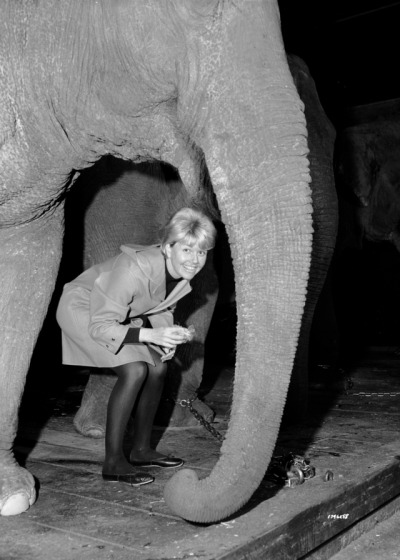
Atualmente, a maioria dos circos não tem mais animais – algo que eu considero certo, por muitas razões. É interessante perceber que a tradição circense europeia apresentava seus animais em números divertidos, enquanto a tradição norte-americana preferia mostrar um domador domando “feras selvagens”. Exotismo era a norma nos circos, e você pode ver muitos animais exóticos – como camelos – desfilando no filme. De toda forma, em “A Mais Querida do Mundo”, o elefante é tratado como parte da família por Anthony e, em especial, por Kitty. Doris Day, conhecida ativista pelos direitos dos animais, e o elefante Sidney se deram muito bem antes e durante as filmagens, e é possível ver como os elefantes são inteligentes através dos truques que Sidney / Jumbo aprendeu.

Nowadays, most circuses don’t have animal stars anymore – something I agree with, for a bunch of reasons. It’s interesting to notice that the European circus tradition presented their animals in playful acts, while the North American tradition preferred to show a trainer taming “wild beasts”. Exoticism was the norm is circuses, and you can see many exotic animals – like camels – on parade in the film. Anyway, in “Billy Rose’s Jumbo”, the elephant is treated as part of the family by Anthony and, in special, Kitty. Doris Day, a notorious animal rights’ advocate, and the star elephant Sidney formed a true bond before and during filming and you can see how intelligent elephants are by the tricks Sidney / Jumbo performs.


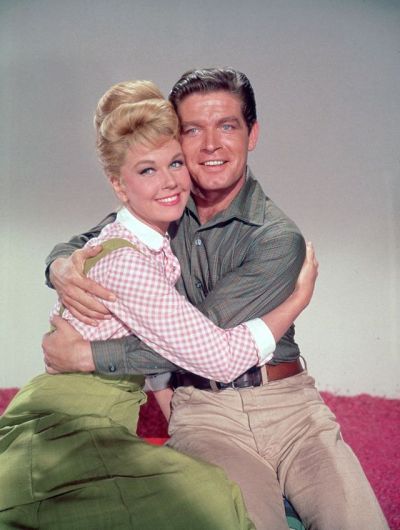
As canções não são particularmente memoráveis. Além disso, Stephen Boyd foi dublado cantando, mas ninguém sabe quem o dublou, pois as fontes da época não são claras sobre isso. Boyd está muito bonito no filme, apresenta uma química excelente com Doris Day e foi indicado ao Globo de Ouro por sua performance. Boyd havia abandonado a produção de “Cleópatra” (1963) e foi substituído por Richard Burton – e Burton havia sido a primeira opção de Charles Walters para interpretar Sam em “A Mais Querida do Mundo”!

The songs are not particularly memorable. Furthermore, Stephen Boyd’s singing was dubbed, but nobody knows who dubbed him, as sources of the time aren’t clear about the matter. Boyd is probably at his most handsome, had an amazing chemistry with Doris Day and was nominated for a Golden Globe for his performance. Boyd had left the production of “Cleopatra” (1963) and was replaced by Richard Burton – and Burton had been Charles Walters’ first choice for Sam in “Billy Rose’s Jumbo”!


“A Mais Querida do Mundo” teve origem como uma peça em 1935 e Jimmy Durante fez parte do elenco original que se apresentou no Teatro Hippodrome de Nova York – a peça do empresário Billy Rose foi um fracasso. Os direitos da peça foram adquiridos pela MGM nos anos 1940, e em 1952 um musical baseado nela seria feito com Donald O’Connor e Debbie Reynolds, mas o projeto foi cancelado em pré-produção. Antes disso, “A Mais Querida do Mundo” seria um possível veículo para Judy Garland e Mickey Rooney ou Gene Kelly.

“Billy Rose’s Jumbo” was originated as a play in 1935 and Jimmy Durante was part of the original cast that performed at the New York city’s Hippodrome Theater – the play by showman Billy Rose was a flop. The rights of the play were acquired by MGM in the 1940s, and in 1952 a musical based on it was in the works, with Donald O’Connor and Debbie Reynolds, but it was cancelled during pre-production. Before that, “Billy Rose’s Jumbo” had been thought as a possible vehicle for Judy Garland and Mickey Rooney or Gene Kelly.


“A Mais Querida do Mundo” é um dos musicais pertencentes a um tempo em que musicais extravagantes estavam caindo de moda. Com mais de duas horas de duração, com direito a uma abertura, este foi um dos últimos grandes musicais da MGM, e também o último musical da carreira de Doris Day.

“Billy Rose’s Jumbo” is one of the musicals that belong to a time when extravagant musicals were dying. With over two hours, and complete with overture, this was one of the last big budget MGM musicals, as well as Doris Day’s last musical movie.


“A Mais Querida do Mundo” é um filme regular. Seu enredo é previsível, e a resolução do conflito principal é muito rápida. Mesmo assim, é um filme bem divertido – que te fará rir, se assustar, aplaudir e esquecer seus problemas. Acho que todos nós precisamos de um filme assim agora, não?

“Billy Rose’s Jumbo” is a regular movie. Its plot is predictable, and the resolution of the main conflict is incredibly quick. Nevertheless, it’s a very enjoyable movie – one that will make you laugh, gasp, clap and forget the current troubles. I guess we all need this kind of movie right now, isn’t so?

This is my contribution to the Fourth Annual Doris Day blogathon, hosted by Michaela at Love Letters to Old Hollywood.

Sunday, June 10, 2018

A Gata dos meus Sonhos (1962) / Gay Purr-ee (1962)

Eu AMO animação. E esta é a razão pela qual eu não escrevo críticas de filmes de animação com frequência: eu fico tão maravilhada, impressionada e imersa neste tipo de filme que eu seria capaz de apenas elogiar quase todas as animações que eu já vi – incluindo “Os Pinguins de Madagascar” (2014), um filme de cujos personagens eu gosto tanto que pode até ser que eu tenha um conjunto de brinquedos deles.

I LOVE animation. And this is the reason why I don't often review animation: I'm so enthralled, overwhelmed and absorbed by them that I could write nothing but compliments to almost all animated films I've seen – including “The Penguins of Madagascar”, a film whose characters I like so much that I may or may not have a figurine set of them.


Há ainda muitas animações que eu ainda quero ver. Uma delas era “A Gata dos meus Sonhos”. A razão principal para eu querer vê-la era, obviamente, o trabalho de dublagem de Judy Garland no filme. Mas, como eu amo animações dos anos 60 desde que eu era criança, eu decidi dar uma chance a este filme o mais rápido possível.

There are also many animated movies in my watchlist. One of them was “Gay Purr-ee”. My main reason to watch it was, of course, Judy Garland's voicework in this. But, since I've loved 1960s cartoons since I was a child, I decided to give the film a chance as soon as I could.


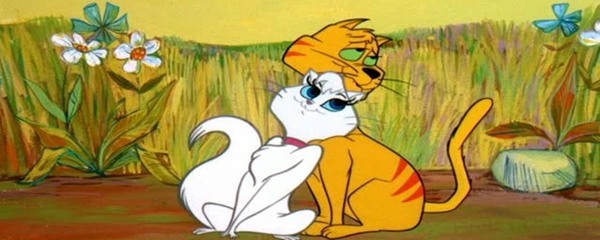
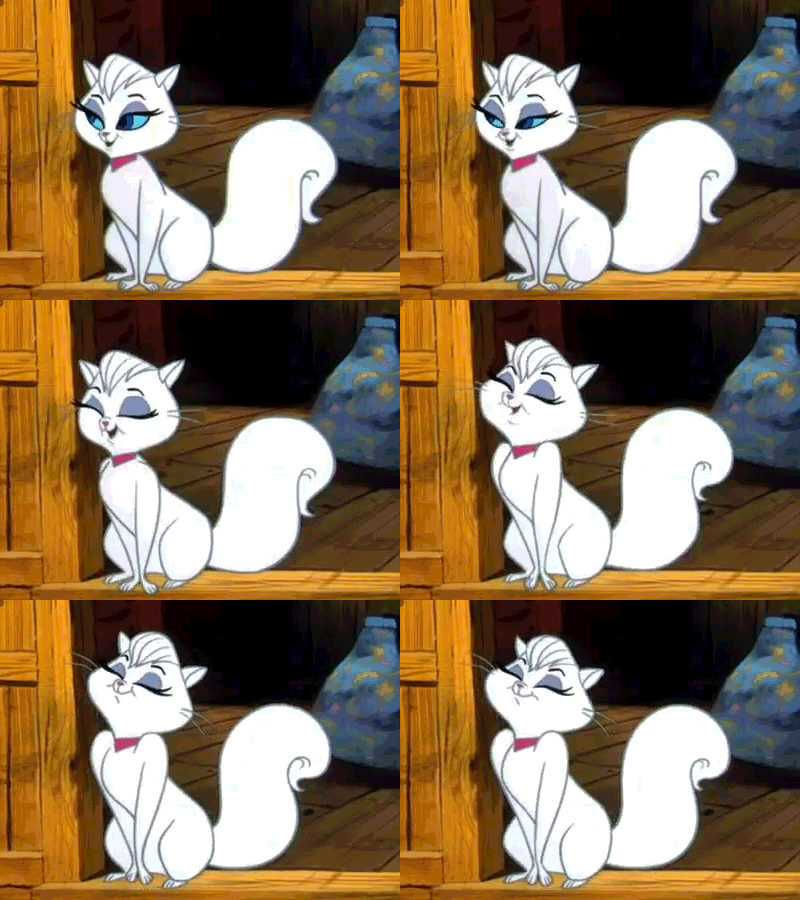
Milhares de histórias de amor ambientadas em Paris já foram contadas no cinema. E muitas outras histórias de amor, quando não completamente ambientadas em Paris, cedo ou tarde tiveram alguma cena na cidade. É isso que acontece em “A Gata dos meus Sonhos”. A linda gata Mewsette (dublada por Judy Garland) é cortejada por Jaune-Tom (dublado por Robert Goulet) em uma área rural da Provença. Um dia, ela ouve uma mulher falando sobre toda a classe e elegância de Paris, e de repente Jaune-Tom parece muito caipira comparado com todas as coisas que ela poderia obter em Paris. Ela então vai para a cidade grande em uma carruagem, seguindo o conselho raivoso dado por Robespierre (dublado por Red Buttons), o pequeno companheiro de Jaune-Tom que tem ciúmes de Mewsette.

Thousands of love stories set in Paris have already been told in the movies. And many more love stories, if not completely set in Paris, sooner or later have a few scenes there. This is what happens in “Gay Purr-ee”. The gorgeous female cat Mewsette (voiced by Judy Garland) is courted by Jaune-Tom (voiced by Robert Goulet) in a rural area of Provence. One day, she hears a woman talking about all the class that exists in Paris, and suddenly her Jaune-Tom seems too bland compared to all the fancy things she could get in Paris. She then leaves to the big city in a carriage, following the angry advice she receives from Robespierre (voiced by Red Buttons), Jaune-Tom's tiny companion who is very jealous of Mewsette.


Depois da carruagem, Mewsette toma um trem, e lá ela conhece Meowrice Percy Beaucoup (dubaldo por Paul Frees), que diz que sua irmã pode apresentá-la à high society. A irmã de Meowrice – que, você adivinhou, não é irmã dele de verdade – é a madame Rubens-Chatte (dublada por Hermione Gingold), uma gata professora de boas maneiras. Meowrice e madame Rubens-Chatte querem usar Mewsette em um de seus esquemas sujos. Enquanto isso, Jaune-Tom e Robespierre também vão para Paris procurar Mewsette.

After the carriage, Mewsette takes a train, and there she meets Meowrice Percy Beaucoup (voice by Paul Frees), who says his sister can introduce her to high society. Meowrice's sister – who, you got  it, isn't really his sister – is Mme. Rubens-Chatte (voiced by Hermione Gingold), a cat who teaches good manners. Meowrice and Mme. Rubens-Chatte want to use Mewsette in one of their dirty schemes. At the same time, Jaune-Tom and Robespierre also go to Paris, looking for Mewsette.


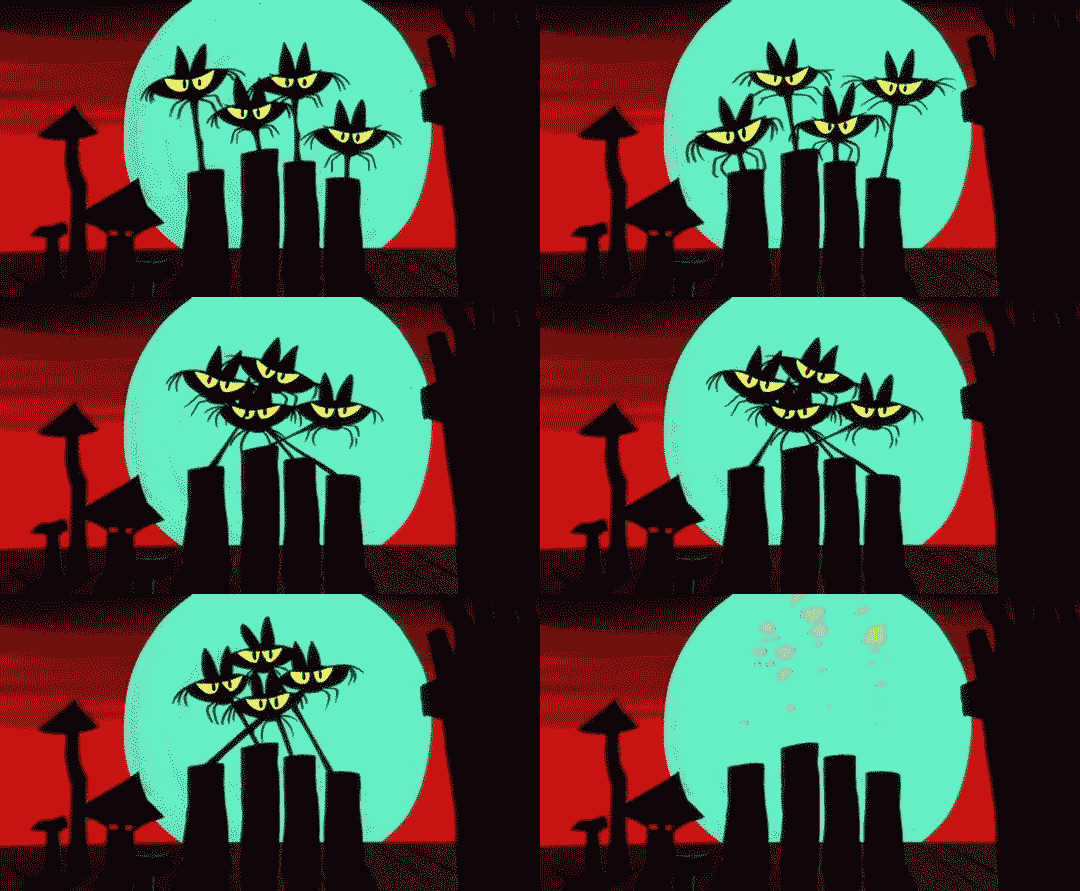
Eu amei o visual do filme. Muitos cenários – fundos estáticos, na frente dos quais os personagens se moviam – foram claramente inspirados em pinturas famosas. Outros cenários eram cópias da Paris “humana”: por exemplo, há o Follies Bergères, e Mewsette vai ao Felines Bergères,  e há o Moulin Rouge, e ao lado dele os gatos têm seu Mewlon Rouge. Mas nada se compara à sequência em que Mewsette tem seu retrato pintado por diversos artistas do final dos anos 1890 – época em que se passa a história.

I loved the visual of the movie. Many sets – static backgrounds, in front of which the characters moved – were clearly inspired by famous paintings. Others sets are counterparts of the “human” Paris: for instance, there is the Follies Bergères, and Mewsette goes to the Felines Bergères, and there is the Moulin Rouge, and next to it the cats have their Mewlon Rouge. But nothing compares to the sequence in which Mewsette's portrait is painted by several artists from the late 1890s – the time in which the story is set.


Hoje, é bem comum termos celebridades dublando personagens em animações. Quando se fala da origem desta prática, muitas pessoas citam erroneamente que Robin Williams dublando o Gênio de “Aladdin” (1992) foi a primeira vez em que isso aconteceu. Nós vemos, com “A Gata dos meus Sonhos”, que a prática é bem mais antiga. Neste filme, embora ela duble uma donzela ingênua em perigo, Judy Garland tem uma chance de brilhar, tanto falando mansinho como a gata romântica quanto cantando com sua voz poderosa. Aliás, fique atento e você poderá reconhecer uma voz bastante familiar: muitos personagens secundários foram dublados por Mel Blanc!

Today, it's fairly common to have  celebrities voicing characters in animated movies. When talking about the origin of this practice, many people erroneously cite Robin Williams's voicing the Genie in “Aladdin” (1992) as the first time this happen. We see, with “Gay Purr-ee”, that the practice is much older. In this film, although she voices the naïve damsel in distress, Judy Garland has a chance to shine, both speaking softly as the romantic cat and singing with her powerful voice. By the way, keep your ears open and you may recognize a very familiar voice: many secondary characters are voiced by Mel Blanc!
Muitas pessoas, em especial crianças, se recusam a ver filmes de animação se eles não forem em 3D, feitos por computador ou tiverem gráficos elaborados. Eu tenho pena dessas pessoas. Com este tipo de preconceito, eles perdem a oportunidade de ver obras como “A Gata dos meus Sonhos”, um pequeno filme realmente louvável e charmoso, cheio das cores psicodélicas que eram moda nos anos 60.

Many people, in special kids, are now discouraged to see animated features that are not in 3D, made by computer or highly stylized. I'm sorry for them. With this kind of prejudice, they miss works like “Gay Purr-ee”, a truly outstanding and charming little movie, full of psychedelic colors that were in vogue in the 1960s.


This is my contribution to the Second Annual Judy Garland blogathon, hosted by Crystal at In the Good Old Days of Classic Hollywood.

Related Posts Plugin for WordPress, Blogger...