} Crítica Retrô: Richard Barthelmess

Tradutor / Translator / Traductor / Übersetzer / Traduttore / Traducteur / 翻訳者 / переводчик

Showing posts with label Richard Barthelmess. Show all posts

Friday, February 27, 2026

David, o Caçula (1921) / Tol'able David (1921)


Anos atrás, escrevi um perfil de Richard Barthelmess para uma publicação conhecida como The Pre-Code Companion. Considerando o título, foquei mais nas performances de Richard em filmes pre-Code, e assim descobri um novo filme favorito, “Fome por Glória” de 1933. Mas ele fez 81 filmes, numa carreira que durou décadas. Alguns filmes me escaparam na época, e decidi assisti-los depois. Um deles é “David, o Caçula”, e o momento de assisti-lo é agora.  

Years ago, I wrote a profile of Richard Barthelmess for a publication known as The Pre-Code Companion. Given the title, I focused more on Richard’s performances in pre-Code films, and by doing this I discovered a new favorite, 1933’s “Heroes for Sale”. But he made 81 movies in a career that spanned decades. Some movies couldn’t fit my schedule, so I decided to watch them later. One of them was “Tol’able David”, and the moment to watch it is now.

A família Kinemon vive alegremente em Greenstream. Os pais têm dois filhos: Allan (Warner Richmond), o mais velho que já trabalha como carteiro, e David (Barthelmess), o filhinho da mamãe. Há também uma família de malfeitores, os Hatburns, formada por pai e dois filhos. Os Hatburns decidem visitar um primo, que é vizinho dos Kinemon e avô de Esther (Gladys Hulette), interesse amoroso de David. 

The Kinemon family lives happily in Greenstream. Ma and Pa have two sons: Allan (Warner Richmond), the oldest and already working as a mailman, and David (Barthelmess), mother’s boy. There is also a family of wrongdoers, the Hatburns, comprised of father and two sons. The Hatburns decide to visit a cousin, who is the Kinemon’s neighbor and the grandfather of Esther (Gladys Hulette), David’s love interest.

David não é adulto ainda, ele é apenas o caçula. Esther também não o vê como um adulto. Quando seu irmão é ferido pelos Hatburn e seu pai morre, David tem de crescer e se tornar o novo Homem da Casa. Isso inclui tomar para si a obrigação do irmão de entregar as cartas.

David isn’t an adult yet, he’s only “Tol’able” as an adult. Esther doesn’t see him as an adult either. When his brother is wounded by the Hatburns and his father dies, David has to grow up and become the new Man of the House. This includes taking as his the brother’s obligation to deliver the mail.

Um “ator” que merece destaque é o cachorro da família Kinemon, Rocket. Ele rouba as calças de David quando o garoto vai nadar, acompanha-o nas aventuras com ou sem Esther, David quase senta nele, mas o cachorro não se importa. O IMDb dá o crédito de Rocket para um cão chamado Lassie, que fez mais dois filmes. 

One “performer” to highlight is the Kinemon dog, Rocket. It steals David’s pants when the boy is swimming, accompanies David in his adventures with or without Esther, David almost sits on it, but the dog is fine with it. IMDb credits a dog named Lassie as Rocket, with two other film appearances.

No começo do filme David e Esther jogam um jogo chamado Mumblety-Peg, que eu desconhecia. Numa busca pela internet, o curioso site The Art of Manliness me informou que o jogo consiste em jogar uma faca para o ar e ver quem consegue fazê-la cair com a lâmina furando o chão. O vencedor afunda um graveto ou parafuso no chão, que o perdedor precisa tirar com os dentes. 

Early in the movie David and Esther play a game called Mumblety-Peg, which I didn’t know. In a web search, the website weirdly titled The Art of Manliness informed me that the game consists in throwing up a knife and seeing who can get it to stick to the ground. The winner plants a stick on the ground and the loser has to remove the stick with his teeth.
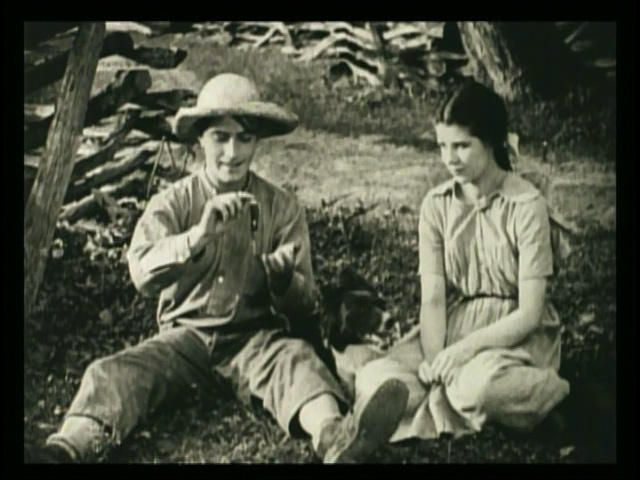
“David, o Caçula” foi feito pela Inspiration Pictures e é claramente um melodrama, mesmo com um momento engraçado não-intencional quando a mãe de David está esperando por ele toda arrumada e com um sorrisinho enquanto ele está envolvido numa briga com um Hatburn. Inspiration Pictures era a produtora de Richard Barthelmess e “David, o Caçula” foi seu primeiro crédito como produtor.

“Tol’able David” was made by Inspiration Pictures and it’s clearly a melodrama, even though there is an unintentional funny moment with David’s mom waiting for him all dolled up and with a silly smile while he is involved in a fistfight with a Hatburn. Inspiration Pictures was Richard Barthelmess’s own production company and “Tol’able David” was his first credit as a producer.  

O diretor e co-roteirista Henry King começou no cinema como ator em 1912 e três anos depois dirigiu seu primeiro filme. Ele dirigiu mais de 100 filmes tanto na era muda quanto após a chegada do cinema falado. Ele foi um dos fundadores da Academia, o órgão que organiza o Oscar. Ele próprio foi indicado a dois Oscars, mas não ganhou nenhum. Em “David, o Caçula”, King emula o estilo cinematográfico de Griffith, que foi o primeiro a receber a oferta para adaptar o livro para as telas mas recusou a oportunidade.

Director and co-screenwriter Henry King started as an actor in film in 1912 and three years later had his first directing credit. He directed over 100 movies both in the silent era and later with the talkies. He was one of the founders of the Academy, the organ that presents the Oscars. King himself was nominated for two Oscars, but failed to win both. In “Tol’able David” King emulates Griffith’s filmmaking style, as Griffith was first offered to adapt the novel to the screen but refused the opportunity.

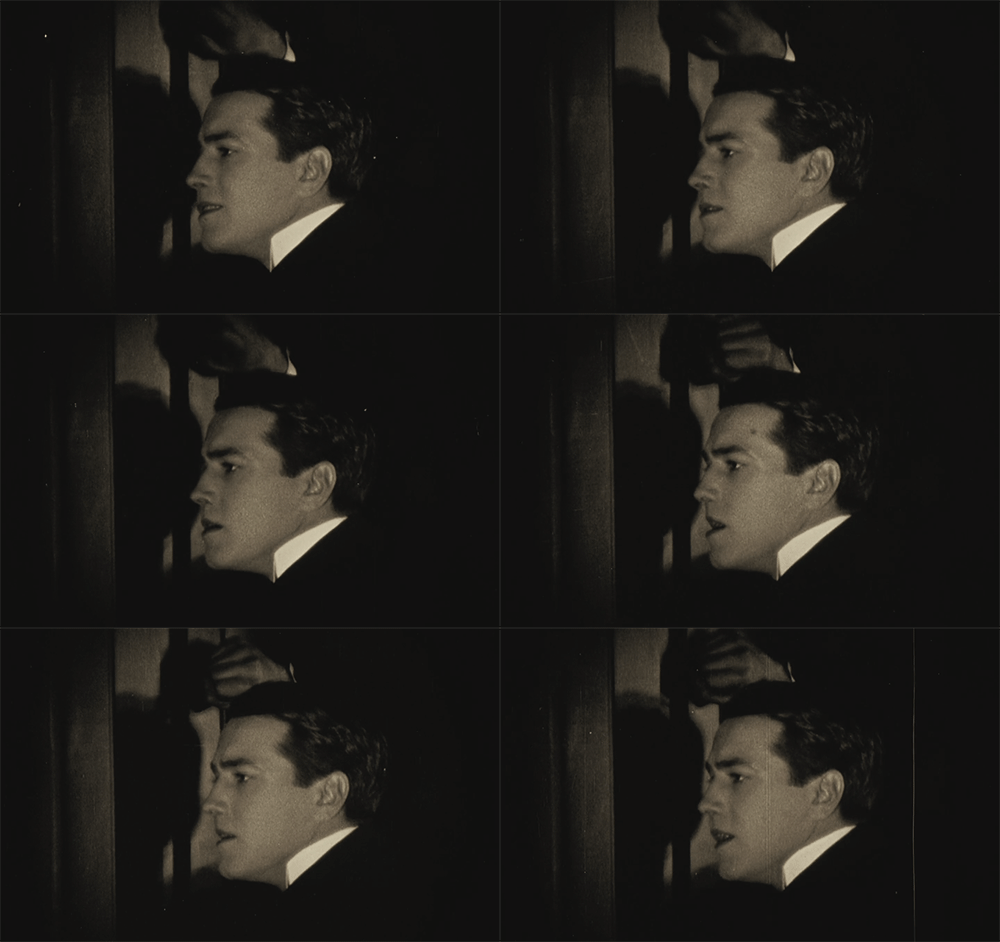
Barthelmess, que fez um par de filmes com Griffith, traz a quantia certa de charme jovial e ambição para o papel. Mesmo assim, David é tão delicado que chuta uma porta, abrindo-a, e não entra no recinto, só fica do lado de fora parado, sem saber o que fazer. Mas ele é nosso herói e sabemos que ele triunfará no final desta história sobre o que acontece quando meninos se tornam homens.

Barthelmess, who appeared in a couple of Griffith’s films, brings the right amount of young charm and ambition to the lead. Even so, David is so delicate that he kicks a door open and doesn’t enter the room, just stands outside without knowing what to do. But he is our hero and we know he’ll triumph in the end of this story of what happens when boys become men.

Thursday, October 13, 2011

Inocente Pecadora (1920) / Way Down East (1920)

Um melodrama singular dirigido por D. W. Griffith e estrelado por sua musa e constante colaboradora Lillian Gish, “Inocente Pecadora” ("As Duas Tormentas" em Portugal), com seus 145 minutos, embora com o subtítulo de "uma história simples de pessoas comuns", é prolixo e ao mesmo tempo fluente como a catarata para que Anna se dirige sobre uma pedra de gelo, no clímax da produção.

A singular melodrama drected by D.W. Griffith, starring his muse and Constant collaborator Lillian Gish, “Way Down East”, with its 145 minutes, although with the subtitle “a simple story of common people”, is exaggerate and at the same time fluent as the waterfall where Anna is going to, over a huge ice rock, in the film’s climax.


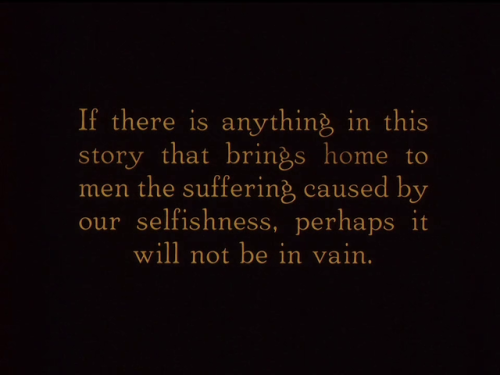
Assim como a maioria dos filmes mudos, esse tem também uma série de intertítulos que servem de prólogo da ação. Aqui vemos uma celebração do casamento monogâmico e o sofrimento que a infidelidade masculina pode causar para a mulher. As personagens têm nome, mas, como o próprio filme explicita, poderiam ser qualquer pessoa (ainda não houve a sacada de chamar as personagens apenas de "esposa" ou "marido", como faria Murnau em "Aurora", em 1927). Por si só, uma apresentação interessantíssima. E, quando a ação começa, nos vemos enfeitiçados pelo encanto virginal de Lillian e torcemos para sua personagem, embora, como em outros filmes, ela sofra, sofra, sofra e sofra mais um pouco durante toda a projeção.

Like many other silent films, here we also have some intertitles used to set the prologue. Here we see a celkebration of monogamy and the suffering that the male infidelity causes in a woman. The characters have a name, but the movie reinforces that they could be anyone (there hadn’t yet been the case of naming the characters just “the wife” and “the man” like it was done in “Sunrise”, from Murnau, in 1927). Standing alone, this is a very interesting prologue. And, when the action finally starts, we are bewitched by Lillian Gish’s virginal spell and we start rooting for her character, even though she suffers, suffers and suffers a little more, like other characters played by Lillian in other movies.


Anna, uma pobre jovem da Nova Inglaterra, vai a Boston pedir ajuda financeira para uma tia rica. Acolhida falsamente pela ricaça, ela acaba participando de uma festa na mansão, chamando a atenção do mulherengo Lennox Sanderson (Lowell Sherman). Depois de algumas investidas, ele a pede em casamento, mas implora que ela mantenha segredo sobre a cerimônia, pois ele não quer perder a “mesada” que ganha do tio. Mas ela não pode esconder a verdade por muito mais tempo, pois um herdeiro está a caminho. É aí que ele revela que eles não são realmente casados, deixando-a sozinha e desamparada após a morte da mãe. Anna passa a ser vista como “pecadora” por ter um filho sem ser casada, embora seja “inocente” por ter sido enganada por Lennox.


Anna, a poor Young woman from New England, goes to Boston to ask for financial help to a rich aunt. Taken without affection by the old woman, Anna takes part in a party at the mansion, and there she meets Lennox Sanderson (Lowell Sherman). After a few hits, he proposes to her, but begs her to not tell anyone about the marriage, so he won’t lose the ‘allowance’ his uncle gives him. But she can’t hide the truth for much longer, because she is with child. Then he reveals that their wedding was not valid, and he leaves her completely alone, because she had just lost her mother. Anna is now a ‘sinner’ because she had a child out of wedlock, but she is ‘innocent’ because her confidence was betrayed by Lennox.


Mais uma série de tragédias se segue. Numa sequência comovente, Anna batiza seu bebê sabendo que ele está muito doente e segura-o nos braços até ele morrer, quando ela tenta, sem sucesso, reaquecer seu corpinho. Lillian relembra que o pai do bebê estava no set de filmagem e, com a comoção causada pela cena, desmaiou. A sinistra mulher que alugava a casa para a jovem a obriga a sair, pois ela não tem boa reputação. Anna tenta recomeçar sua vida na fazenda Bartlett, escondendo seu passado. Mas um dos vizinhos próximos é o próprio Lennox, que a enganara e agora teme que sua presença estrague seus novos planos de romance com Kate (Mary Hay), até então comprometida com David (Barthelmess). Curiosamente, Barthelmess e Hay se casaram na vida real. Corine Seymour, presença constante nos filmes de Griffith, gravou várias cenas como Kate antes de adoecer gravemente e falecer aos 21 anos. Ela foi substituída por Mary e o que vemos na tela é uma mistura das atuações das duas atrizes.

Another series of tragedies strike. In a moving sequence, Anna baptizes her baby knowing he is very sick and holds him in her arms until he dies, and then she tries, without success, to keep his little body warm. Lillian remembers that the baby’s father was on the studio watching the scene and, moved by it, passed out. The sinister woman who rented Anna a room sends her away because of her bad reputation. Anna tries to start again at the Bartlett farm, hiding her past. But one of the neiughbors is Lennox himself – he now fears that Anna’s presence so near spoils his plans to romance Kate (Mary Hay) who was until then dating David (Richard Barthelmess). As ca curiosity, Barthelmess and Hay got married in real life. Corine Seymour, a constant presence in Griffith’s films, shot several scenes as Kate before she fell gravely ill and passed away at age 21. She was replaced by Mary Hay and what we see on screen is a mix of the two girls’ performances.


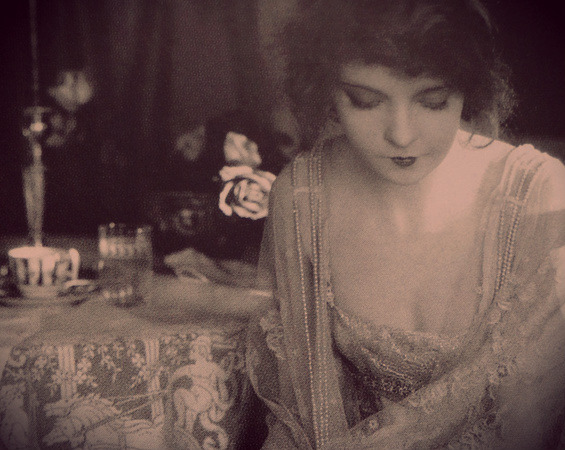
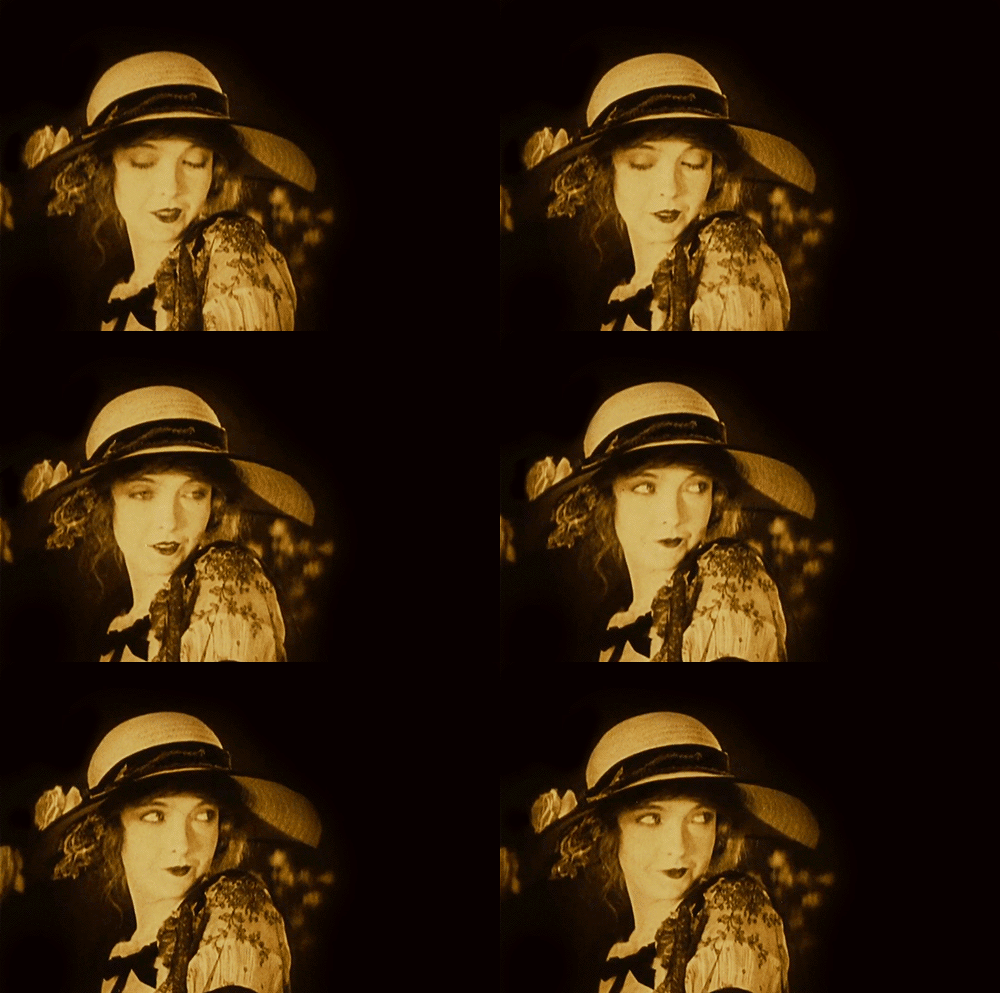
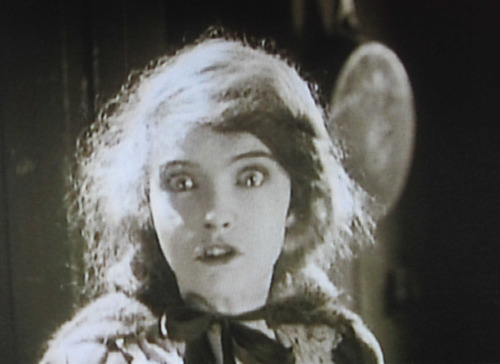
Lillian está especialmente bonita nesse filme, quase sempre com seus longos cachos presos em um coque. Os closes durante a festa chique são de uma beleza única, assim como a interação infantil com uma pombinha. É impossível não ser ofuscado por sua presença. Seu co-protagonista Richard Barthelmess (com quem também atuou em “Lírio Partido / Broken Blossoms”, no ano anterior), o sensível fazendeiro David Bartlett, não chega aos pés dela em tempo em cena. Seu grande momento é quando recita um poema para ela e diz que sempre a amou – além, é claro, dos momentos como herói perto do final.

Lillian is particularly pretty in this film, with her long curls almost always in a bun. Her close-ups in the fancy party are beautiful and unique, almost as beautiful as her childish interaction with a dove. It’s impossible not to be overshadowed by her. Her scene partner Richard Barthelmess (with whom she did “Broken Blossoms” the previous year), as the sensitive farmer David Bartlett, has much less screen time than her. His great moment arrives when he recites a poem to her and tells her he has always loved her – besides, obviously, his moments as a hero in the end.


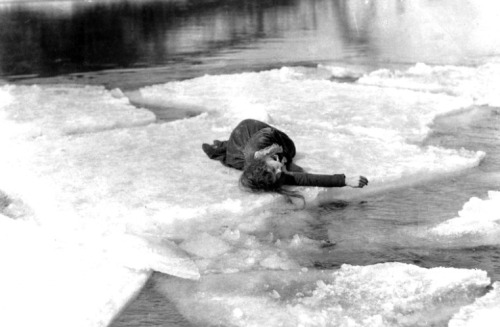
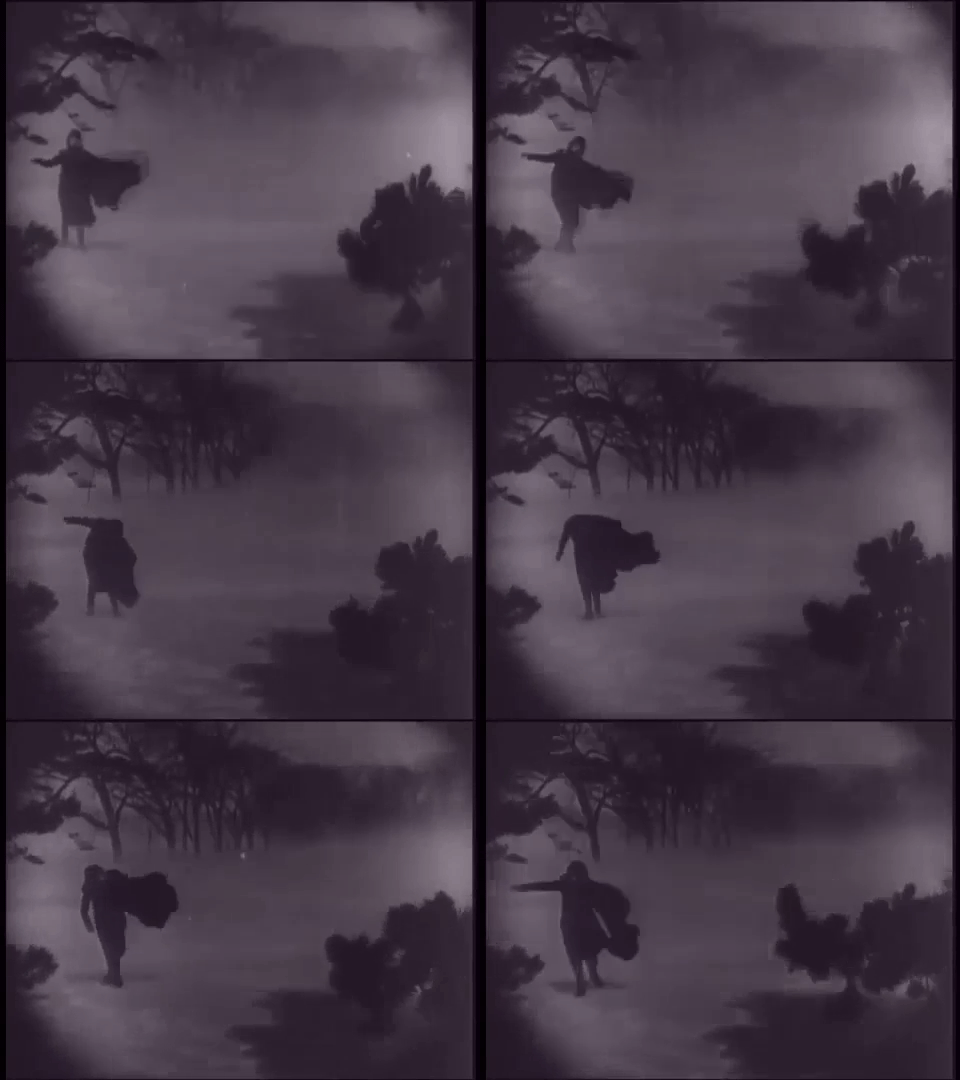
A versão a que eu assisti tem a maioria de suas cenas em tons de sépia, com algumas poucas – em especial a da catarata – em um tom de azul que me lembrou da própria Gish balançando o berço em “Intolerância” (1916). Em se tratando de visual, não podemos deixar de falar da sequência na nevasca, criada exclusivamente para o cinema, que culmina com Anna desmaiada em uma pedra de gelo (feita de madeira pela equipe cenográfica) e sendo levada para a morte. Lillian permaneceu horas com a mão mergulhada nas águas geladas de um rio para completar a cena, ficando com problemas motores na mão direita pelo resto da vida.

The version I watched has mosto f its scenes in sepiatone, with a few – in special the waterfall sequence – in a blue tone that reminded me of Gish herself rocking the cradle in “Intolerance” (1916). If we’re talking about visuals, we have to mention the snowfall sequence, created especially for the film, that culminates with Anna passed out on an ice rock (made of wood by the scenographic team) and being taken slowly to her death. Lillian spent several hours with her hand in the icy waters of a river, what led her to have motor problems in her right hand for the rest oif her life.


A música é simpática, combinando melodias agradáveis que se intercalam e algumas músicas conhecidas usadas em pequenos momentos, como a Marcha Nupcial, uma canção de ninar e a cantiga folclórica infantil "Three Blind Mice". Em uma cena de dança (dança no cinema mudo é algo bastante peculiar) a futura estrela Norma Shearer participa como extra. Para surpresa geral, Griffith, em meio ao drama de Anna, salpica momentos e personagens cômicos. Mais uma vez ele constrói histórias paralelas (um gosto pessoal) que nem sempre se mostram úteis (um defeito pessoal).

The soundtrack in this version is very nice, as it mixes pleasant tunes and some well-known songs used in particular moments, such as the Wedding March, a lullaby and the folkloric “Three Blind Mice”. In a dance scene (something that is quite peculiar in a silent movie) future film star Norma Shearer is an extra. As a surprise, Griffith adds, in the middle of Anna’s drama, many comic reliefs. Once more, he builds parallel stories (something he was fond of) that are not exactly useful (something he is guilt of). 


O tema excessivamente puritano soa datado. Anna não poderia mais se casar porque ela não é "a branca flor virginal" com que David sempre sonhou. Hoje isso não mais se aplica (e se aplicasse, meu Deus!).  No entanto, outros aspectos moderninhos prevalecem, como Anna acusando Lennox de tê-la enganado sem medo da reação alheia (OK, ela não tinha medo porque sua situação não podia ficar pior), David atacando o pai após este expulsar Anna e alguns detalhes finais: um beijo cômico entre dois homens e o beijo entre Anna e a sogra, selando a união e terminando a película.

The excessively puritane theme sounds dated. Anna couldn’t get married anymore because she is not the “white virginal flower” that David has always dreamed of. Today, the exigence of being a virgin is almost over in the world (thank God!). However, there are some modern aspects in this movie, for instance: Anna confronting Lennox and accusing him of betraying her, a confront in a fearless way (even though her sitation couldn’t get any worse), David attacking his father after he expels Anna and some final details: a comic kiss between two men and the kiss between Anna and her mother-in-law, a gesture that shows the union is sealed and the movie is over.


Como não gosto do melodrama exagerado de Griffith, não me empolguei com o clímax no gelo, mas confesso que é uma sequência tecnicamente impressionante e de beleza pungente. Este filme foi 175 mil dólares mais caro que o épico "O Nascimento de uma Nação / The Birth of a Nation" (1915). Nada controverso, ele acabou se tornando um sucesso absoluto de público. Surpreendente, incrivelmente moderno em alguns pontos e ultrapassado em outros, "Inocente Pecadora" ainda emociona, diverte, prende o espectador e, em especial, mostra o talento incontestável de Lillian Gish.


I’m not a fan of Griffith’s exaggerated melodrama, so I wasn’t that moved by the clímax in the ice, but I have to agree that the sequence is impressive and very beautiful. This film costed 175,000 dollars more than “The Birth of a Nation” (1915). As it was not controverse, it ended up being a box-office hit. It is surprising, incredibly modern in some points and dated in others, but “Way Down East” is still able to move, entertain, attract the viewer’s attention and, in special, show Lillian Gish’s indisputable talent. 


th,
Related Posts Plugin for WordPress, Blogger...