Primeiro, vemos nossos
protagonistas fugindo da polícia. Seria ele mais um dos “homens errados” de
Hitchcock, um cara sendo perseguido por causa de um crime que ele não cometeu? Talvez.
Talvez não. No
mundo de Hitchcock, nada é o que parece e, embora seja considerado um filme
menor na filmografia do diretor, “Pavor nos Bastidores” merece ser analisado.
We first see our leads as hey are running away from the police. Is he another of Hitchcock's “wrong men”, a guy being pursued because of a crime he didn't commit? Maybe. Maybe not. In Hitchcock’s world, nothing is what it seems, and although it’s considered a lesser entry in the director’s filmography, “Stage Fright” is a film worth analyzing.

Num flashback, vemos como a atriz Charlotte
(Marlene Dietrich) foi atrás do amante Jonathan (Richard Rodd) logo após matar
acidentalmente o marido durante uma discussão. Ele a aconselha a ir para o
teatro onde ela trabalha e agir como se nada tivesse acontecido até que alguém
encontre o corpo. Mas, para ela fazer isso, ela não pode estar usando um
vestido branco manchado de sangue.
In a flashback, we see
how the actress Charlotte (Marlene Dietric) went to see her lover Jonathan
(Richard Todd) after accidentaly killing her husband during a heated argument.
He advises her to go the theater where she works and act as nothing happened
until someone finds the body. But, for her to do that, she can't be wearing a
white dress stained with blood.

Jonathan vai ao apartamento dela para pegar um
vestido limpo. Lá, ele tenta fazer com que o lugar pareça ter sido invadido por
um ladrão que também matou o marido de Charlotte, mas o plano de Joanathan
falha quando a empregada Nelle (Kay Walsh) chega, encontra o corpo e vê
Jonathan saindo depressa. Depois que Charlotte deixa a casa de Jonathan, a
polícia chega – porque Nellie o reconheceu – e ele foge deles, levando consigo
o vestido manchado de sangue.
Jonathan goes to her
apartment to get a clean dress. There, he tries to make it appear like the
place was invaded by a thief who then killed Charlotte's husband, but
Jonathan's plan fails quickly as the maid Nellie (Kay Walsh) arrives, finds the
body and sees Jonathan leaving in a hurry. After Charlotte leaves Jonathan's
place, the police arrive – as Nellie has recognized him – and he runs away from
them, taking the blood stained dress with him.

Jonathan então vai até a Real Academia de Arte
Dramática para pedir ajuda à sua velha amiga Eve (Jane Wyman). Fica claro que
ela está apaixonada por ele, e naturalmente ela o ajuda a fugir. Estamos agora
de volta ao começo, com ambos no carro. Eve leva Jonathan para a casa do pai
dela. Ele, o Comandante Gill (Alastair Sim) rapidamente percebe que o vestido
foi manchado propositalmente de sangue – não foi apenas resultado de sangue
espirrando por todos os lados. Charlotte pode estar querendo incriminar Jonathan.
Jonathan then goes to the Royal Academy of Dramatic Art to ask his old friend Eve (Jane Wyman) for help. It's crystal clear that she is in love with him, so she naturally helps him escape. We're now back to the beginning, with the two in the car. Eve takes Jonathan to her father's house. He, Commodore Gill (Alastair Sim), quickly notices that the stain in the dress was deliberately put there – it was not just blood splashing all over. Charlotte might have wanted to incriminate Jonathan.

Enxerida e apaixonada,
Eve decide confrontar Charlotte. Para
isso, ela bola um plano ela dirá a Nellie, a empregada, que ela é uma repórter
escrevendo uma matéria sobre o caso e convencerá Nellie a deixá-la tomar seu
lugar como empregada de Charlotte. Nellie aceita a ideia – e um pouco de
dinheiro – mas as coisas se dificultarão porque Eve acabou de fazer amizade com
o detetive do caso, Wilfred Smith (Michael Wilding), e ele sabe tudo sobre ela,
como bom detetive que é.
Nosy and in love, Eve
decides to confront Charlotte. For this, she develops a plan: she'll tell
Nellie, the maid, that she is a reporter writing a story about the case and will
convince Nellie to let her take her place as Charlotte's maid. Nellie accepts
the idea – and some money – but things will be made difficult because Eve has
just made an acquaintance with the detective of the case, Wilfred Smith
(Michael Wilding), and he knows everything about her, as any good detective
would do.

O figurino de Marlene
Dietrich foi feito por Christian Dior, que não recebeu créditos no filme.
Quando ela chega ao apartamento de Jonathan, seu vestido é branco e tem uma chamativa
mancha de sangue, e Jonathan pega um vestido quase idêntico, porém preto, para
ela se trocar. É uma escolha óbvia que mostra o lado sombrio dos dois personagens.
Uma troca de roupa semelhante porém mais sutil aconteceria em “Psicose” (1960),
com Marion Crane mudando a cor de seus sutiãs, também de branco para preto,
para mostrar que ela mudou de ideia e decidiu ficar com os 40 mil dólares que
estava transportando.
Marlene Dietrich's
outfits were provided by Christian Dior, uncredited. When she arrives at Jonathan's
place, her dress is white and has a prominent blood stain, and Jonathan gets a
nearly identical black dress for her to change. It's an obivous choice to show
the real darkness of both characters. A similar but more subtle wardrobe change
would be found in Hitchcock's “Psycho” (1960), with Marion Crane changing the
color of her bras, also from white to black, to show the change of heart of the
character when she decides to keep the 40,000 dollars she was transporting.

A cena com Eve
tentando se disfarçar é muito engraçada. Em seu quarto, ela muda o penteado, as
roupas, coloca um chapei e óculos de lentes grossas. Mas ela não passa no teste
principal: a mãe de Eve ainda é capaz de reconhecê-la! Ao se dar conta de que
Charlotte nunca a viu, Eve não se disfarça, apenas se apresenta como Doris,
prima de Nellie. Se você assistiu a alguns filmes de Hitchcock, já deve ter percebido
que eles têm um lado cômico. Os personagens mais engraçados de “Pavor nos
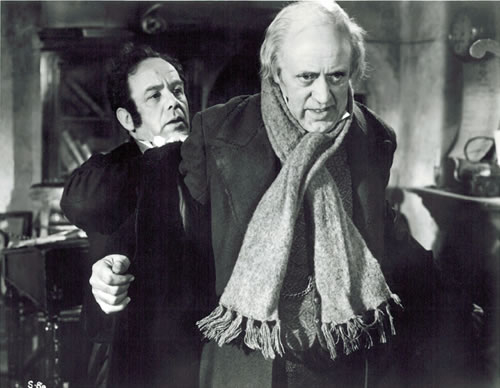
Bastidores” são os pais de Eve, interpretados por Alastair Sim, mais conhecido
por “Um Conto de Natal” (1951), e Sybil Thorndike, uma conhecida atriz de
cinema e teatro.
The scene with Eve trying
a disguise is very funny. In her bedroom, she changes her hair, her clothes,
puts on a hat and thick glasses. But she doesn't pass the main test: Eve's
mother still can recognize her! Realizing that Charlotte has never seen her,
Eve goes as she is, only presents herself as Doris, Nellie's cousin. If you
have watched a few of Hitchcock's movies, you might have seen that they had a
humorous side. The funniest characters in “Stage Fright” are Eve's parents,
played by Alastair Sim, from “A Christmas' Carol” (1951) fame, and Sybil
Thorndike, a celebrated stage and film actress.

Uma novata em um papel
pequeno chama nossa atenção: ela é Patricia Hitchcock, filha de Alfred
Hitchcock e Alma Reville. Patricia, em sua estreia no cinema, interpreta Chubby
Bannister, atriz e amiga de Eve. Ela já havia feito algumas peças em Nova York
e estava enão estudando na Real Academia de Arte Dramática. Patricia aparece
apenas na segunda metade do filme, mas foi dublê de Jane Wyman em algumas
sequências dirigindo. Algumas pessoas, como o crítico de cinema Stephen Whitty,
chegam mesmo a chamar Wyman de uma “Patricia glamourizada”.
A newcomer playing a
small part calls our attention: she’s Patricia Hitchcock, Alfred Hitchcock’s
and Alma Reville’s daughter. Patricia, in her film debut, plays Chubby
Bannister, an actress and Eve’s friend. She had already made a couple of plays
in New York and was by then actually studying at the Royal Academy of Dramatic
Art. Patricia only appears by the second half of the film, but served as a
stand-in for Jane Wyman in some driving sequences. Some people like film critic
Stephen Whitty even go as far as calling Wyman a glamourized Patricia.

O roteiro foi escrito
por Alma Reville e Whitfield Cook, autor de uma peça na qual Patricia atutou.
Segundo Patrick McGilligan, autor do livro “Alfred Hitchcock: A Life in
Darkness and Light”, Alma e Whitfield passaram alguns meses trabalhando juntos
em 1947 e tiveram um caso neste período, de acordo com os diários de Whitfield.
Nenhuma outra fonte sustenta esta ideia, e a dupla trabalhou em dois roteiros
adaptados para Hitchcock: “Pacto Sinistro”
(1951) e este “Pavor nos Bastidores”, baseado em um romance publicado de forma
seriada numa revista. “Pavor nos Bastidores” foi o último filme em que Alma foi
creditada.
The screenplay was
written by Alma Reville and Whitfield Cook, who was the author of a play in
which Patricia Hitchcock appeared on stage. According to Patrick McGilligan,
author of the book “Alfred Hitchcock: A Life in Darkness and Light”, Alma and
Whitfield spent some months working together in 1947 and had an affair in this
period, based on Whitfield’s diaries. No other sources support this claim, and
the duo worked in two adapted screenplays for Hitchcock: “Strangers on a Train”
(1951) and this “Stage Fright”, based on a novel originally published
serialized in a magazine. “Stage Fright” was the last time Alma Reville was
credited for her work in a film.
 |
| Hitch and Alma |
Hitchcock disse que “Pavor nos Bastidores” deu a
ele a chance de explorar criticamente o trabalho do ator. Por isso, é
interessante que, para Eve, atuar seja fingir ser outra pessoa – e ainda mais
interessante é o fato de encontrarmos essa análise num filme feito por um
diretor que dizia que “atores são como gado”. Há várias evidências de Hitchcock
usando essa frase desde 1940, e quando Patricia se tornou atriz ele até disse
que “Pat é o mais adorável gado que eu já vi”. Para François Truffaut,
Hitchcock deu mais de uma explicação sobre a frase, mas ela permanece uma controvérsia no mundo
hitchcockiano.
Hitchcock said that
“Stage Fright” gave him the chance to explore critically the acting craft. So,
it’s interesting that, for Eve, acting is pretending to be someone else – and
even more interesting that we can find this in a film made by a director who told
that “actors are cattle”. There is a lot of evidence from Hitchcock using this
quote as early as 1940, and when Patricia became an actress he even said that
“Pat is the nicest cattle I’ve ever seen”. For François Truffaut, Hitchcock
gave more than one explanation for the quote, but it still remains a
controversy in the Hitchcockian world.

O comandante Gill analisa
a situação objetivamente: Eve está tratando tudo como se fosse uma peça de
teatro. “Tudo parece uma peça de teatro quando você está apaixonada pelos
palcos”, ele diz. Na “Alfred Hitchcock Encycloped”, Stephen Whitty comenta que
“Pavor nos Bastidores” é um dos muitos filmes de Hitchcock com sequências
crucias em teatros, e chega à mórbida conclusão de que, para o diretor”, “a
vida é um espetáculo, mas a maioria de nós somos espectadores simples que
ficaram com os piores lugares”.
Commodore Gill analyzes
the situation objectively: Eve is treating it like a play. “Everything looks
like a play when you're stage struck”, he says. At the “Alfred Hitchcock
Encycloped”, Stephen Whitty notices that “Stage Fright” is one of many
Hitchcock films with crucial sequences happening in theaters, and reaches the
morbid conclusion that, for the director, “life is a show, but most of us are
simply ticketholders stuck in the cheap seats”.

Vindo depois de quarto
fracassos de bilheteria consecutivos – e a lista inclui o hoje cultuado “Festim
Diabólico” (1948) – “Pavor nos Bastidores” foi chamado por Stephen Whitty de
“um intervalo” na filmografia de Hitchcock. Em “Pavor nos Bastidores”, ele teve
grandes atores coadjuvantes, filmou uma bela cena perto do final com destaque
para os olhos de Jane Wyman e Richard Todd e também enganou o público ao
quebrar uma regra crucial e subentendida dos flashbacks. Felizmente, o público
perdoou Hitchcock por essa traição e, após “Pavor nos Bastidores”, ele faria
alguns de seus melhores filmes.
Coming after four
consecutive box-office disasters – and the list includes the now cult “Rope”
(1948) – “Stage Fright” was called by Stephen Whitty as an “intermission” in
Hitchcock’s body of work. In “Stage Fright”, he managed to have great
supporting actors, he shot a beautiful scene near the end with Wyman’s and
Todd’s eyes highlighted and he also deceived his audience by breaking a crucial
unwritten rule on flashbacks. Fortunately, the public forgave Hitchcock for
this deception, and, after “Stage Fright”, he’d make some of his best movies.
This is my contribution to the 4th Alfred Hitchcock blogathon, hosted by Maddy at Maddy Loves Her Classic Films.



.jpg)