} Crítica Retrô: cinema italiano

Tradutor / Translator / Traductor / Übersetzer / Traduttore / Traducteur / 翻訳者 / переводчик

Showing posts with label cinema italiano. Show all posts

Wednesday, July 15, 2026

A Odisseia (1911) / The Odyssey (1911) / L’Odissea (1911)


Quando eu tinha treze anos, a escola exigiu a leitura de uma versão resumida de duas obras-primas de Homero: a Ilíada e a Odisseia. Já naquela época, a leitura não era uma obrigação para mim, era um prazer. Eu fiquei surpresa com a presença e a intervenção dos deuses gregos nas histórias e suas tramas ficaram marcadas na minha mente.

When I was thirteen, school made us read an abridged version of Homer’s two masterpieces: the Iliad and the Odyssey. Already at the time, reading wasn’t an obligation for me, it was a pleasure. I was surprised by the presence and intervention of the Greek gods in the stories and their plots were glued to my mind. 


No meu primeiro ano de faculdade surgiram os MOOCs - sigla em inglês para Cursos Abertos Online em Massa. O primeiro que eu fiz era sobre a Ilíada e a Odisseia, com um professor especialista nestas duas obras da literatura. Dá para imaginar ser especialista numa obra de arte? Isso mexeu comigo e o curso foi exigente, mas foi um prazer fazê-lo.

In my first year of college MOOCs - Massive Open Online Courses - became a thing. The first I took part in was about the Iliad and the Odyssey, taught by a professor with a degree in these two works of literature. Can you imagine having a degree in a work of art? It puzzled my mind and the course was demanding, but also rewarding.


Semana passada vi um post no Instagram da Le Giornate del Cinema Muto sobre o filme de 1911 “A Odisseia / L’Odissea”. A publicação nos contava que essa adaptação do poema épico de Homero foi feita após o sucesso de “L’Inferno” (1911), um filme sobre o qual já escrevi AQUI. Por isso, em vez de marchar para os cinemas para assistir à nova adaptação de Christopher Nolan, eu decidi escrever sobre a adaptação vintage de uma das maiores histórias de todos os tempos.

Last week I saw a post on the Instagram account of the Pordenone Silent Film Festival about the 1911 film “The Odyssey / L’Odissea”. The publication told us that this adaptation of Homer’s epic tale was made after the success of “L’Inferno” (1911), a film I previously reviewed HERE. So, instead of marching to the cinemas to watch Christopher Nolan’s new adaptation, I decided to review the vintage retelling of one of the greatest stories ever told.


Ulisses ou Odisseu (Giuseppe de Liguoro) deixa sua família na ilha de Ítaca para lutar na guerra de Troia. Começam os rumores de que Odisseu morreu e pretendentes começam a fazer fila esperando que a viúva Penélope decida com quem se casará em seguida. Com o  intuito de adiar essa decisão, Penélope tece uma mortalha para o marido de dia e desfaz o trabalho de noite - essa noite sendo representada por um filtro azul na película.

Odysseus (Giuseppe de Liguoro) leaves his family on the island of Ithaca to fight the war in Troy. People start the rumor that Odysseus is dead and suitors start to line up waiting for widow Penelope to decide whom she will remarry. Wanting to postpone the decision, Penelope weaves a shroud for her husband by day and unweaves at night - night being represented by a blue tinting.


A guerra em Troia acaba - sem nenhum cavalo à vista - e Odisseu, vivíssimo, começa sua viagem de volta. É verdade que quando estamos voltando a viagem parece mais rápida, mas não para nosso herói: antes de chegar a Ítaca ele vai encontrar um ciclope, sereias, todo tipo de monstros e a fúria dos deuses.

The war in Troy ends - no horse in sight - and Odysseus, very much alive, starts his voyage home. It’s true that when you’re coming back the trip seems quicker, but not for our hero: before reaching Ithaca he’ll encounter a cyclop, sirens, all kinds of monsters and the rage of the gods.


Você deve achar que em 1911 o cinema era muito rudimentar, certo? ERRADO! Em “A Odisseia” há efeitos especiais como dupla exposição para revelar a deusa Atena e o gigante de um olho só Polifemo é convincentemente assustador. Agora é um bom momento para contar que o episódio do gigante já havia sido contado antes nas telas, por ninguém menos que nosso velho amigo Méliès em 1905.

You think that in 1911 cinema was very rudimentary, right? WRONG! In “The Odyssey” there are special effects such as double exposure to reveal the goddess Athena and the one-eyed giant Polyphemus is seen as convincingly menacing. Here it’s a good moment to tell that the episode of the giant had been told before on screen, by none other than our old friend Méliès in 1905.


“A Odisseia” foi feita pela Milano Filmes, então uma das mais importantes companhias produtoras italianas. Fundada em 1908, continuou firme até o final da década de 1920. Em 1919, ela surpreendentemente se recusou a se juntar ao conglomerado Unione Cinematografica Italiana.

“The Odyssey” was made by Milano films, then one of the most important Italian film production companies. Founded in 1908, it remained strong until the late 1920s. In 1919, it surprisingly refused to join the conglomerate Unione Cinematografica Italiana.


O filme foi feito para ser exibido na Feira Mundial de Turin, um evento que durou seis meses e recebeu quse 7,5 milhões de visitantes. O evento também celebrava os 50 anos da Unificação Italiana. Uma competição de filmes foi levada a cabo dentro da feira e “A Odisseia” ganhou um prêmio na categoria de filmes educativos.

The film was made to be exhibited in the Turin World Fair, an event that lasted six months and received almost 7,5 million visitors. The event was also celebrating 50 years of the Italian Unification. A film competition was held in the fair and “The Odyssey” won an award in the educational films category.   


Apesar de durar apenas 44 minutos, o filme cobre quase todas as histórias de dentro da Odisseia, com a ausência óbvia do encontro de Odisseu com a feiticeira Circe. A Odisseia é a história de um homem sábio, e sua primeira adaptação completa para a tela só podia ser assim: cheia de sabedoria.

Despite being only 44 minutes long, the movie covers almost all tales inside of the Odyssey, with the obvious absence being the encounter between Odysseus and the witch Circe. The Odyssey is all about a clever man, and its first full adaptation to the screen could only be that: clever.

Friday, May 2, 2025

Inferno (1911) / Dante’s Inferno (1911)


Quando falamos de autores de livros no gênero aventura, quem vem à sua mente? Pode ser Mark Twain com sua dupla Tom Sawyer e Huck Finn, ou talvez Júlio Verne. Dificilmente pensaríamos em alguém como Dante Alighieri como autor de aventura, mas o IMDb não pensa assim. O filme de 1911 “Inferno”, adaptado da “Divina Comédia” de Dante, é um dos primeiros filmes classificado como “aventura” no IMDb.

When we talk about book authors in the adventure genre, who comes to your mind first? It might be Mark Twain with his duo Tom Sawyer and Huck Finn, or maybe Jules Verne. We hardly think of someone like Dante Alighieri as an adventure author, but IMDb thinks differently. The 1911 movie “Dante’s Inferno”, adapted from his “Divine Comedy” is one of the earliest movies labeled “adventure” on IMDb.

Dante (Salvatore Papa) é uma alma vagando por uma floresta quando bestas ferozes (pessoas vestidas em roupas de animais, completas com rabos) impedem que ele deixe o lugar. Ele é resgatado por Virgílio (Arturo Pirovano), mas eles marcham direto para o inferno. Numa excursão guiada pelo poeta, Dante visita os círculos do inferno. Enquanto isso, sua amada Beatrice confiou em Virgílio para ajudá-la a se reunir com Dante.

Dante (Salvatore Papa) is a soul walking through a forest when ferocious beasts (people dressed in animals’ clothes complete with tails) stop him from leaving the place. He’s rescued by Virgilio (Arturo Pirovano), but they march straight to hell. In an excursion guided by the poet, Dante visits all the circles of hell. Meanwhile, his beloved Beatrice has trusted Virgilio to reunite her with Dante.

No último parágrafo me referi a Virgílio como “poeta”, mas ele foi mais que isso. Ele foi O poeta da Roma Antiga, da Idade Média e também do início da modernidade, apenas recentemente deixando os bancos escolares e caindo parcialmente no esquecimento. Ele ficou famoso com, acima de tudo e até hoje, com sua Eneida, um poema épico.

In the last paragraph I referred to Virgilio - or Virgil - as “poet”, but he was more than that. He was THE poet of Ancient Rome, the Middle Ages and even the early modern times, leaving the school benches and thus fading into partial obscurity only very recently. He became famous with, above all and until today, his Aeneid, an epic poem.

Dante ouve a história de vida, ou melhor, a história de morte, de muitas almas que estão no inferno. Não é possível aprofundar nas histórias num filme que dura 65 minutos, mas há pequenos vislumbres de pelo menos três histórias que acontecem em cenários variados. Aqui algum conhecimento da “Divina Comédia” pode ajudar, porque há figuras ilustres contando suas histórias e não é fácil reconhecê-las no filme.  

Dante hears the life story, or rather death story, of many souls who are in hell. Not much can be told deeply in a movie that lasts 65 minutes, but there are small snippets of at least three stories that happen in diverse settings. Here some knowledge of the “Divine Comedy” may help, because there are illustrious figures telling their stories and it’s not easy to recognize them in the film.

Enquanto há alguns efeitos especiais muito bons, como almas flutuando acima da cabeça de Dante, há também alguns primitivos, como as já mencionadas bestas e o cão de três cabeças, Cerberus. Multidões de figurantes, em sua maioria nus, foram necessários para fazer o filme. Você poderia pensar que muita tecnologia seria demandada para transportar para as telas as coisas imaginadas por Dante Alighieri, como uma chuva de fogo, mas mais uma vez o primeiro cinema mostra como era inventivo.

While there are some very good special effects, like souls floating over Dante’s head, there are also primitive ones, like the aforementioned beasts and the dog with three heads, Cerberus. Crowds of extras, most of them naked, were necessary to make this movie. You might think that a lot of technology would be necessary to portray on screen the things imagined by Dante Alighieri, such as a rain made of fire, but once again the early cinema shows its inventiveness.

O visual do filme foi inspirado pelo artista Gustave Doré. Suas xilogravuras feitas para ilustrar a “Divina Comédia” de Dante foram seu passaporte para a fama e também a inspiração para o filme. Embora não elogiado em vida como um grande artista, os talentos de Doré foram reconhecidos após sua morte com apenas 52 anos.

The overall look of the film was inspired by artist Gustave Doré. His wood-engravings made to illustrate Dante’s “Divine Comedy” were his passport to fame and also the inspiration for the movie. Although not praised in life as a great artist, Doré’s talents were recognized after his death at only 52.

O cinema era um negócio de família para Giuseppe de Liguoro, que atuou em “Inferno” e também foi um dos diretores. Vindo da aristocracia, ele dirigiu 91 filmes na era muda. Um de seus filhos, Eugenio, por vezes atuava nos filmes do pai, e seu outro filho, Wladimiro, se tornou ator / diretor / diretor de fotografia.

Cinema as a family affair can be found in Giuseppe de Liguoro, who acted in “Dante’s Inferno” and is also one of the directors. Coming from an aristocratic background, he directed 91 films in the silent era. One of his sons, Eugenio, sometimes acted in his films, and his other son, Wladimiro, became an actor / director / cinematographer.

Custando o dobro de outro épico do primeiro cinema, “Quo Vadis?”, feito no ano seguinte, “Inferno” é atualmente o mais antigo longa-metragem preservado e ajudou a trilhar o caminho para os longas por onde passou, fosse na Europa ou nos Estados Unidos, em sessões com custo diferenciado do ingresso, educando  o público para deixá-los acostumados a ficar sentados por períodos mais longos de tempo.

Costing twice as much as the early epic “Quo Vadis?”, made the following year, “Dante’s Inferno” is now the oldest surviving feature film and helped pave the way for features whenever it was exhibited, be it Europe or the United States, in sessions that had a different pricing and educated their public to make them used to sitting through longer periods of time.

Considerado perdido por muitos anos, uma cópia foi encontrada na Filmoteca Vaticana, um arquivo criado pelo Papa João XXIII em 1959. Tive sorte de encontrar uma cópia cristalina e restaurada no YouTube. “Inferno” demorou três anos para ficar pronto, e é ótimo que possamos nos deliciar com essa estranha aventura saída da mente de um dos maiores escritores da História.

Presumed lost for many years, a copy was found at the Filmoteca Vaticana, an archive established by the Pope John XXIII in 1959. I was lucky enough to find a pristine restored copy on YouTube. “Dante’s Inferno” took three years to make, and it’s great that we can still rejoice at this strange adventure taken from the mind of one of the greatest writers in History.

This is my contribution to the Adventurethon, hosted by Gill and Barry at Realweegiemidget Reviews and Cinematic Catharsis.

Thursday, January 30, 2025

A Quadrilha dos Honestos (1956) / The Band of Honest Men (1956) / La Banda degli Onesti (1956)


No mês de novembro passado, tive a chance de participar de um Festival de Cinema Italiano online. Havia uma seleção “moderna” e uma de “clássicos”, e obviamente eu foquei nesta última. Assim, pude conhecer o “Príncipe da Risada”, o comediante Totò. Este post é uma continuação do meu novembro bastante italiano: um delicioso reencontro com Totò em “A Quadrilha dos Honestos”.

Last November, I had the chance to attend an online Italian Film Festival. There was a “modern” selection and a “classics” one, and of course I focused on the latter. This way, I got to know the “Prince of Laughter”, the comedian Totò. This post is a follow-up to my very Italian November: a delightful re-encounter with Totò in “The Band of Honest Men” (1956).

Com seu inconfundível queixo quadrado, Totè aqui interpreta Antonio Bonocore, porteiro de um complexo de apartamentos. Logo antes de morrer, um vizinho revela a Antonio que ele possui os moldes e materiais para produzir notas de 10 mil liras, a moeda italiana na época. Quando Antonio descobre que está prestes a perder o emprego, graças ao novo administrador Casoria (Luigi Pavese), ele decide não mais jogar fora os materiais para fazer dinheiro, e sim guardá-los consigo.

With his unmistakable square chin, Totò here plays Antonio Bonocore, concierge in an apartment complex. Right before dying, a neighbor reveals to Antonio that he has the mold and the material to produce notes of 10,000 lire, the Italian currency of the time. When Antonio finds out that he’s about to lose his job, thanks to the new administrator Casoria (Luigi Pavese), he decides not to throw the money-making materials away, but keep them for himself.

Antonio se junta ao tipógrafo Lo Turco (Peppino De Filippo) e o pintor Cardone (Giacomo Furia) para imprimir dinheiro, mas não sem antes passar por uma crise de consciência. Porém há obstáculos: o filho mais velho de Antonio, Michele (Gabriele Tinti), está trabalhando no combate às falsificações!

Antonio teams up with typographer Lo Turco (Peppino De Filippo) and the painter Cardone (Giacomo Furia) to print money, not without a conscience crisis before. But there are obstacles: Antonio’s oldest son Michele (Gabriele Tinti) is working combating falsifications!

Há sequências sem diálogos, nas quais podemos adivinhar o contexto pela mímica. Isso ocorre quando Antonio conta seu segredo paraa Lo Turco e quando o trio passa de amigos para literais parceiros no crime, assim como na sequência que mostra como os três homens estão exibindo sua nova riqueza.

There are sequences without dialogue, when we can guess the context through mime. This includes when Antonio tells his secret to Lo Turco and when the trio agrees to become literal partners in crime, as well as when the three men show off their newfound richness.

Algumas cenas acontecem numa gráfica, semelhante à que meu bisavô tinha na época em que o filme foi feito. Eu só ouvi histórias da minha avó sobre o negócio, por isso a imagem que eu tinha dele era repleta de imaginação jovial. Por isso foi ótimo ver as máquinas trabalhando no filme, com o destaque para a “pedalina” que fazia 100 cópias por minuto.  

Some action happens in a printing house, similar to the one my great-grandfather had at the same time the movie was made. I only hear stories from my grandma about the business, so the image I had of it was pregnant with youthful imagination. That’s why it was a treat to see the machines working in the movie, with the highlight being the “pedalina” that makes 100 copies in one minute.

Totò nasceu como Antonio de Curtis em 1898 e faleceu em 1967. Filho de um nobre empobrecido, por usa nobreza lhe foi dado em 1946 o nome Antonio Grifo Focas Flavio Ducas Comneno Porfirogenito Gagliardi De Curtis di Bisanzio. Ele também foi um famoso poeta e compositor, além de ter feito mais de 100 filmes entre 1937 e 1968. A maior parte do humor de Totò que não se perde na tradução em “A Quadrilha dos Honestos” advém da incapacidade de seu personagem de se lembrar do nome de Lo Turco.

Totò was born Antonio de Curtis in 1898 and died in 1967. The son of an impoverished noble, for his nobility he was given in 1946 the name Antonio Grifo Focas Flavio Ducas Comneno Porfirogenito Gagliardi De Curtis di Bisanzio. He was also an accomplished poet and songwriter, besides appearing in over 100 films between 1937 and 1968. Most of Totò’s humor that is not lost in translation in “The Band of Honest Men” comes from his character’s inability to remember Lo Turco’s name.

Inteligente, com um plot twist e extremamente divertida, “A Quadrilha dos Honestos” pode não ser tão conhecida como merecia fora da Itália, mas é um exemplo perfeito do charme e humor do maior comediante italiano, o inesquecível Totò.

Clever, with a plot twist and extremely enjoyable, “The Band of Honest Men” might not be as known as it should outside of Italy, but is a perfect example of the charms and the humor of the greatest Italian comedian, the unforgettable Totò.


“A Quadrilha dos Honestos” está disponível com legendas no YouTube.

                                                
“The Band of Honest Men” is available with subtitles on YouTube.


This is my contribution to the Journey to Italy blogathon, hosted by Jill and Kristina at RealWeegieMidget Reviews and Speakeasy.


Saturday, December 14, 2024

Filibus (1915)


Atualmente tenho 190 títulos na minha lista de filmes para assistir no IMDb e 225 filmes na lista do Letterboxd. Nunca perco uma chance de adicionar novos títulos a estas listas – mas, como você deve imaginar, eu deveria estar trabalhando para deixar estas listas menores. Eu fui ver minhas listas para escolher um filme parar assistir e escrever sobre quando a Rebecca do blog Taking Up Room anunciou o evento chamado On the Spot blogathon. E ali, on the spot, escolhi o filme italiano de 1915 “Filibus: o misterioso pirata aéreo”.


I currently have 190 titles on my watchlist on IMDb and 255 films on my watchlist on Letterboxd. I never waste an opportunity to add new titles to these lists – but, as you might imagine, I should be working to make the lists smaller. I jumped to the watchlists to choose a movie to write and review when Rebecca from the blog Taking Up Room announced her On the Spot blogathon. And, on the spot, I chose the 1915 Italian film“Filibus: the mysterious sky pirate”.

A questão é que Filibus não é exatamente um misterioso pirata aéreo. Desde o início sabemos que Filibus é na verdade a Baronesa Troixmonde (Valeria Creti). Um novo roubo a banco levou o detetive Hardy (Giovanni Spano) a ser contratado para descobrir quem realmente é Filibus. Mais encantada que preocupada com isso a Baronesa promete a Hardy que vai provar que ELE é Filibus.


The issue is that Filibus isn’t a mysterious pirate of the sky at all. Since the beginning we know that Filibus is actually Baroness Troixmonde (Valeria Creti). A new bank robbery led detective Hardy (Giovanni Spano) to be hired to find out who Filibus really is. More amused than worried with it, the Baroness promises Hardy that she will prove that HE is Filibus.

Um plano é executado: a irmã do detetive Hardy, Leonora (Cristina Ruspoli), é raptada e resgatada pelo Conde De la Brive, que é na verdade a Baronesa travestida. Isso permite que a Baronesa fique próxima de sua vítima seguinte, Leo Sandy (Filippo Vallino, provavelmente – o ator não foi totalmente identificado), um colecionador de antiguidades. E então Hardy cai em uma de suas armadilhas: ao comparar impressões digitais, ele descobre que as dele são iguais às de Filibus e passa a acreditar que está enlouquecendo.


A plan is executed: detective Hardy’s sister, Leonora (Cristina Ruspoli), is kidnapped and rescued by Count De la Brive, who is actually the Baroness in drag. This allows the Baroness to become close to her next victim, Leo Sandy (Filippo Vallino, probably – the actor wasn’t identified for certain), an antiques collector. And then Hardy falls on one of her traps: while comparing handprints, he finds out his matches Filibus’s and starts thinking that he is becoming insane.

“Filibus” ilustra bem as muitas oportunidades que existiam para mulheres no Primeiro Cinema. Como o meio era considerado só mais uma curiosidade, as mulheres podiam dirigir, atuar, escrever e produzir seus próprios filmes. A imagem de uma donzela em perigo amarrada aos trilhos do trem é apenas um mito: as mulheres eram ousadas e corajosas nos filmes das décadas de 1900 e 1910, incluindo seriados nos quais as estrelas dispensavam dublês. Adicionado a isso temos em “Filibus” alguns temas que eram novidade para o cinema e a sociedade, como uma heroína travestida que flerta com uma mulher apesar de também ser mulher.   


“Filibus” illustrates well the many opportunities that existed for women in early cinema. As the medium was considered just another curiosity, women could direct, act, write and produce their own films. The image of a damsel in distress tied to train tracks is only a myth: women were bold and courageous in films from the 1900s and 1910s, including serials in which the stars did their own stunts. Adding to this were some themes in “Filibus” that were brand new to cinema and society, such as a cross-dressing heroine who flirts with females despite being female herself.

Uma aeronave é peça fundamental na narrativa, algo que não seria possível uma década antes – na verdade, o cinema feito uma década antes era muito diferente do cinema feito em 1915! Não importa se você acredita que os irmãos Wright ou Santos Dumont inventaram o avião, você sabe que ele foi inventado na primeira década do século XX. Aeronaves não eram de interesse somente dos departamentos de guerra dos países: o cinema desde o início incluiu a novidade nas narrativas – e o próprio Santos Dumont esteve envolvido com o mundo do cinema, conforme escrevi AQUI.


An airship is a fundamental piece in the narrative, something that wouldn’t have been possible a decade before – in reality, film from a decade before was very distinct from what was made in 1915! No matter if you believe that the Wright brothers or Santos Dumont invented the airplane, you know that it was invented in the first decade of the 20th century. Aircrafts weren’t only of interest of the war departments in several countries: film since the beginning included the novelty in narratives – and Santos Dumont himself was linked to the movie world, as I wrote HERE.

Você não precisa ser fluente na língua para saber que Troixmonde vem do francês. É uma variação de “trois mondes”, que significa três mundos, em alusão a Filibus, a Baronesa e o Conde. Não podemos evitar torcer para Filibus, que é interpretado por Valeria Cresti, uma atriz que por décadas não recebeu crédito pela performance, até que o pessoal do Eye Filmmuseum da Holanda a reconheceu.


You don’t need to be fluent in the language to know that Troixmonde comes from the French. It’s a variation of “trois mondes”, that means three worlds, in an allusion of Filibus, the Baroness and the Count. We can’t avoid to root for Filibus, who is played by Valeria Cresti, an actress who wasn’t for decades given credit for the performance, until folks at the Eye Filmmuseum in the Netherlands recognized her.

“Filibus” foi produzido pela companhia Corona, que durou somente de 1914 a 1918. Foi escrito por Giovanni Bertinetti, antecipando temas do movimento Futurista e também da ficção científica, gênero no qual o autor mais tarde se especializou. A escolha por uma anti-heroína pode ter vindo de seriados da época como “Fantômas” (1913) de Feuillade e também da popularidade de Arsène Lupin. O filme termina apontando para uma possível continuação que foi impedida pela Primeira Guerra Mundial, infelizmente.


“Filibus” was produced by the short lived – from 1914 to 1918 – production company called Corona. It was written by Giovanni Bertinetti, anticipating themes from the Futurist movement as well as science fiction tropes, a genre the author would specialize in later. The choice for a female anti-hero may have come from serials of the time such as Feuillade’s “Fantômas” (1913) and also from the popularity of Arsène Lupin. The film ends signaling for a possible sequence that World War I prevented from happening, unfortunately.

“Filibus” prova quão complexas as narrativas cinematográficas eram apenas 20 anos depois da invenção do cinema. Nos faz imaginar como o mundo será daqui a 20 anos, com novidades como a Internet das Coisas e a Inteligência Artificial. Dito isto – esta ponte entre passado e futuro – fico muito feliz por ter tirado “Filibus” da minha lista. Já vi mais de cinco mil filmes, mas ainda há TANTO para descobrir – e sou grata por isso.


“Filibus” proves how complex the film narratives were a mere 20 years after cinema was invented. It makes us wonder how the world will be in 20 years, with novelties such as the Internet of Things and Artificial Intelligence. This being said – this bridge between the past and the future – I’m very happy I crossed “Filibus” out of my watchlist. I’ve watched more than five thousand movies, but there is still SO MUCH MORE to discover… and for this I am grateful.


“Filibus” pode ser visto no YouTube e no Internet Archive.

“Filibus” can be watched on YouTube and Internet Archive.


This is my contribution to the On the Spot blogathon, hosted by Rebecca at Taking Up Room.

Saturday, November 21, 2020

Redescobrindo Marcel Perez / Rediscovering Marcel Perez


Marcel Perez. Robinet. Marcel Fabre. Michel Fabre. Fernandea Perez. Tweedledum. Twede Dan. Tweedy. Todos estes nomes se referem à mesma pessoa: o comediante Marcel Perez. Você pode não ter ouvido falar dele, mas Marcel já foi uma superestrela. Você já deve ter ouvido que Max Linder foi a primeira estrela de cinema internacional, e Chaplin foi a segunda. Entre eles, houve o quase esquecido Marcel Perez, um artista espanhol que foi bem-sucedido nos muitos países em que trabalhou.

Marcel Perez. Robinet. Marcel Fabre. Michel Fabre. Fernandea Perez. Tweedledum. Twede Dan. Tweedy. All those names refer to the same person: comedian Marcel Perez. You may not have heard about him, but once Marcel was a superstar. You may have heard that Max Linder was the first international film star, and Chaplin was the second. In the middle of them, there was the nearly forgotten Marcel Perez, a Spanish performer who found success in the many countries he worked in. 

Nascido na Espanha em 1884 como Marcel Fernández Perez, ele começou sua carreira no show business como palhaço de circo. Seu mais antigo – e muito ousado – filme de que se tem notícia é de 1907: o curta-metragem metragem francês The Short-Sighted Cyclist” (ou “The Near-Sighted Cyclist”), embora haja evidências de que ele já estivesse trabalhando no cinema desde 1900 para companhias como Pathé e Gaumont.

Born in Spain in 1884 as Marcel Fernández Perez, he started his show business career in as a circus clown. His earliest – and one his most daring – known screen appearance dates from 1907, in the French film “The Short-Sighted Cyclist” (or “The Near-Sighted Cyclist”), although there is evidence that he had been in films since 1900, working for companies such as Pathé and Gaumont. 

Em 1910, ele se mudou para a Itália e rapidamente fez enorme sucesso interpretando o personagem Robinet para os estúdios Ambrosio. Em mais de 100 filmes de meio rolo – de cerca de cinco minutos de duração – feitos em um período de cinco anos, Robinet, por vezes com sua esposa Robinette (Nilde Baracchi), vive pequenas aventuras que iam desde um ataque de ciúmes com consequências doloridas, passando pela tentativa de aprender a dirigir mesmo sendo extremamente míope, até várias tentativas de manter limpo seu novíssimo terno branco. Nos EUA, o personagem Robinet era conhecido como Tweedledum.

In 1910, he moved to Italy and quickly found enormous success playing the character Robinet at the Ambrosio studios. In over a hundred split-reel shorts - about five minutes long - made in a period of five years, Robinet, sometimes paired with his wife Robinette (Nilde Baracchi), lives little adventures that could consist in a bout of jealousy with painful consequences, learning how to drive a car despite being extremely nearsighted  or several attempts to keep his brand new white suit clean. In the USA, the character Robinet was known as Tweedledum.


Já que estamos falando de aventuras, o longa-metragem “Viagens Maravilhosas de Saturnino Fanrandola” (1913) traz Marcel Perez em oito aventuras diferentes contadas em menos de 60 minutos. Resgatado quando criança de um naufrágio, Saturnino foi criado por macacos, resgatado novamente por marinheiros e lutou contra piratas, cientistas, gorilas, leões e vilões ambiciosos. É um filme estranho, incrível e bastante surpreendente.

Since we’re talking about adventures, the feature “The Extraordinary Adventures of Saturnino Farandola” (1913) brings Marcel Perez in eight different adventures told in less than 60 minutes. Rescued from a sinking ship as a baby, Saturnino was raised by monkeys, rescued again by sailors and fought pirates, scientists, gorillas, lions and greedy villains. It’s a weird, amazing and extremely surprising film.

Em 1915, com a Primeira Guerra Mundial impactando a indústria do cinema na Itália, Perez mudou-se para os Estados Unidos. Em sua breve passagem por Jacksonville, Flórida, ele trabalhou nos estúdios Vim e fez quatro curtas-metragens como o personagem Bungles, contracenando com Oliver Hardy, então creditado como Babe Hardy. Perez dirigiu os quatro filmes e foi creditado, enquanto ator, como Fernandea Perez. Enquanto diretor, ele sempre foi creditado como Marcel Perez.

In 1915, with World War One impacting the film industry in Italy, Perez moved to the United States. In his brief passage to Jacksonville, Florida, he worked at the local Vim studios and made four short films as the character Bungles, with co-star Oliver Hardy, then billed Babe Hardy. Perez directed the four films and was billed, as an actor, Fernandea Perez. As a director, he was always billed Marcel Perez.

Nos EUA, ele trabalhou tanto como ator quanto como diretor para os estúdios e companhias Vim, Eagle, Jester, Reelcraft e Sanford. Um dos destaques de sua carreira norte-americana é “A Busy Night” (1916), em que ele interpreta todos os 16 personagens – e ainda dirige o filme! Esta é também a primeira vez que Perez dirige um curta de dois rolos – cerca de 25 minutos – como nota o historiador e pianista Ben Model.

While in the USA, he worked as both actor and director for studios and companies Vim, Eagle, Jester, Reelcraft and Sanford. One of the highlights of his American career is “A Busy Night” (1916), in which he plays all sixteen characters – and also directs! It’s also Perez’s first time directing a two-reel film – about 25 minutes long – as film historian and accompanist Ben Model notices.

"Some Hero" (1916)

Em 1920 Perez se casou com a atriz Dorothy Earle, com quem trabalhava frequentemente, e eles tiveram um filho, Marcel Perez Jr. Antes de conhecer Dorothy, a protagonista feminina dos filmes de Perez ainda era Nilde Baracchi, que também emigrou da Europa. Nos filmes feitos para a companhia Eagle, Nilde era creditada como Babette Perez, e nos filmes para a companhia Jester, como Nilde Babette. Dorothy Earle, cujo nome verdadeiro era Esther Lucille Elmendorf, após se casar com Perez ela chegou a assinar o nome como Esther Perez. Ufa! Viu como tudo pode ser bem confuso?

In 1920 Perez married his frequent co-star Dorothy Earle and they had a son, Marcel Perez Jr. Before meeting Dorothy, Perez’s female co-star was still Nilde Baracchi, who also emigrated from Europe. In films made for the Eagle company, Nilde was billed Babette Perez, and in films for the Jester company, she was billed Nilde Babette. Dorothy Earle, whose real name was Esther Lucille Elmendorf, after marrying Perez often used the name Esther Perez. Wow! See how confusing things can get?

Nilde Baracchi and Marcel Perez in "what a Day!" (1918)

Em meados dos anos 20, Perez foi diagnosticado com câncer e teve de amputar sua perna esquerda, fazendo sua última aparição no cinema em “Lash of the Law” de 1926, como um aleijado. Então ele passou a trabalhar apenas por trás das câmeras. Ele dirigiu curtas para o produtor e ator ocasional Joe Rock. Infelizmente, Marcel Perez faleceu em 1919, com apenas 44 anos.

In the mid-1920s, Perez was diagnosed with cancer and had to amputate his left leg, making his last film appearance in 1926's “Lash of the Law”, as an amputee. Then he switched entirely to behind-the-camera work. He directed short films for producer and occasional actor Joe Rock. Unfortunately, Marcel Perez passed away in 1929, at only 44. 

"The Tenderfoot" (1919)

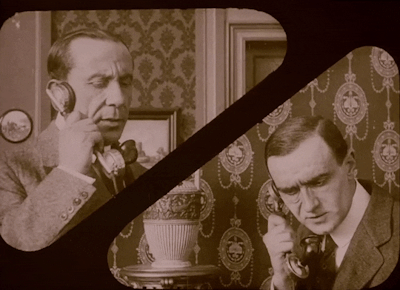
Sim, este homem morreu há mais de 90 anos e nós ainda estamos – ou talvez finalmente estamos – falando sobre ele hoje, porque ele definitivamente merece todos os elogios. Marcel Perez era incrivelmente talentoso, criativo e atlético. Algumas de suas gags desafiam qualquer tipo de lógica, enquanto outras demandam muito fisicamente. Suas expressões faciais e gestos são sempre uma alegria para nossos olhos. Como diretor, ele mostra ser inventivo e sofisticado no uso de técnicas cinematográficas como a split screen. Entre os filmes que estão disponíveis, o mais criativo é “Amor Pedestre” (1914), uma história de amor contada apenas com os pés dos personagens. Você jamais poderia imaginar que pés podem demonstrar tanta emoção, tensão e até erotismo!    

Yes, this man died over 90 years ago and we are still – or maybe finally – talking about him today, because he definitely deserves all the praise. Marcel Perez was incredibly talented, inventive and athletic. Some of his gags defy all kinds of logic, while others are very physically demanding. His facial expressions and gestures are always a delight to watch. As a director, he shows inventiveness and sophistication in his use of film techniques such as the split screen. His most creative film, out of the ones available now, is “Amor Pedestre” (1914), a love story told only with the characters’ feet. You could never imagine that feet can show so much emotion, tension and even eroticism!

O ano de 2020 foi difícil para mim e certamente também foi para muitos de vocês que estão lendo o blog. Mas foi o ano em que descobri Marcel Perez, e isso fez de 2020 um pouco melhor. Foi através da Silent Comedy Watch Party, um evento semanal de exibição ao vivo de comédias mudas, apresentado por Ben Model e pelo historiador de cinema Steve Massa. O evento exibiu, até agora, quatro filmes de Perez ─ na verdade, foi através deste evento que eu fui apresentada a Marcel Perez e não poderia estar mais grata. Antes de criar a Silent Comedy Watch Party, Ben & Steve trabalharam no lançamento de dois DVDs com filmes de Perez, e Steve escreveu um livro sobre o ator e diretor. Com este projeto de resgate, Ben & Steve inclusive conseguiram exibir os filmes para os netos de Marcel Perez e de Dorothy Earle, que até então nunca haviam visto seus avós na tela!   

This year of 2020 was difficult for me and certainly also for many of you reading this blog. But it was the year I discovered Marcel Perez, and that made 2020 a little better. It was through the Silent Comedy Watch Party, a weekly live-stream of silent shorts hosted by Ben Model and film historian Steve Massa. The Party has showed four of Perez’s films so far ─ actually, it was through the Party that I was introduced to Marcel Perez and I couldn’t be more grateful. Before creating the Party, Ben & Steve worked on the release of two DVDs of Perez’s films, and Steve wrote a book about the actor-director. With this rescue project, Ben & Steve even managed to show the films for Marcel Perez’s and Dorothy Earle’s grandchildren, who until then had never seen their grandparents on screen!

Assim como o terno branco de Robinet não conseguiu ficar limpo por muito tempo, eu sei que no final da pandemia não serei a mesma que era no começo. Mas terei certeza de que Marcel Perez foi uma das pessoas que me ajudaram a passar por este momento. Marcel ficou fora dos holofotes por muito tempo. Fico feliz por agora ele receber os elogios que merece, e estou grata porque mais e mais de seus filmes estão sendo (re)descobertos e exibidos. Rir é, de fato, o melhor remédio.    

Like Robinet’s white suit couldn’t be kept clean for long, I know I’ll not end the pandemic being the same I was before. But I’ll be sure that Marcel Perez was one of the people who helped me get through this moment. Marcel Perez was kept out of the limelight for too long. I’m happy he’s getting the praise he deserves now, and I’m grateful more and more of his films are being (re)discovered and made available. Laughter is, indeed, the best medicine.

This is my contribution to A Blogathon to Be Thankful for, hosted by Sally at 18 Cinema Lane.

Related Posts Plugin for WordPress, Blogger...