} Crítica Retrô: documentary

Tradutor / Translator / Traductor / Übersetzer / Traduttore / Traducteur / 翻訳者 / переводчик

Showing posts with label documentary. Show all posts

Wednesday, June 18, 2025

Silvino Santos: o cineasta da selva

 
Silvino Santos: a filmmaker from the jungle 

Dois anos atrás, eu não sabia quem foi Silvino Santos. Claro, eu sabia que seu documentário “No Paiz das Amazonas” de 1922 estava no 71º lugar na lista de 100 melhores documentários feitos no Brasil segundo ranking da Associação Brasileira de Críticos de Cinema, da qual faço parte - mesmo tendo entrado na associação depois desta votação. Minha história com Silvino Santos começa na Le Giornate del Cinema Muto, o Festival de Cinema Mudo de Pordenone em 2023. 

Two years ago, I didn’t know who Silvino Santos was. Sure, I knew that his documentary “No Paiz das Amazonas” from 1922 was ranked #71 at the 100 best documentaries made in Brazil listed by the Brazilian Association of Film Critics, which I’m a member of - even though I entered the association after this poll was released. My story with Silvino Santos begins at Le Giornate del Cinema Muto, the Pordenone Silent Film Festival in 2023.

A 42ª edição da Giornate exibiu, em sua versão presencial na Itália, uma cópia recém-restaurada de um filme considerado perdido: “Amazonas, o Maior Rio do Mundo”, dirigido por Silvino Santos em 1918 e o primeiro documentário em longa-metragem da História. Foi a estreia mundial da restauração e foi inclusive matéria de jornal na TV brasileira. Depois disso, a cópia restaurada foi exibida em diversas cidades do Brasil, até que foi disponibilizada no site da Cinemateca.

The 42nd edition of the Giornate exhibited, in its in-person event in Italy, a recently restored copy of a film considered lost: Silvino Santos’ “Amazonas, o Maior Rio do Mundo” (“Amazonas, the Biggest River in the World”) from 1918, the first documentary feature ever. It was the world premiere of the restoration and it was even covered in the TV news here. Afterwards, the restored copy toured several cities in Brazil, until it was uploaded to the Cinematheque website.

Eu assisti a “Amazonas…” no conforto do meu quarto, mas a emoção de vê-lo pela primeira vez num século com acompanhamento musical faria do momento bem mais memorável. Mas foi memorável o suficiente: eu fiquei maravilhada com o que eu vi. Foi o passado voltando à vida. Dali em diante, fiquei mais próxima de Silvino Santos: vi e escrevi sobre “No Paiz das Amazonas” em fevereiro e em março me surpreendi ao saber que um documentário / cinebiografia sobre ele seria exibida na TV. E então me surpreendi ainda mais com os paralelos entre a trajetória de Silvino e a vida do meu bisavô. 

I watched “Amazonas…” in the comfort of my bedroom, but the emotion of seeing it for the first time in a century with a live musical would make the moment more memorable. But it was memorable enough: I was amazed by what I saw. It was the past coming back to life. From then on, I kept Silvino Santos in my radar: I watched and reviewed “No Paiz das Amazonas” last February and in March was surprised by the fact that a biopic / documentary about him from 1997 would be shown on TV. And then I was much more surprised by the parallels between Silvino’s trajectory and my great-grandfather’s life.

Silvino Santos nasceu em Cernache do Bonjardim, Portugal, em 1886 e veio para o Brasil aos 14 anos, enfeitiçado pela descrição do Amazonas que encontrou num livro. Meu bisavô, José D’Oliveira Magalhães, nasceu em Caldas de Aregos, Portugal, em 1895 e veio para o Brasil aos 19, fugindo da guerra. Santos começou a trabalhar como fotógrafo aos 17 e nem tinha completado 30 anos quando ficou famoso e foi contratado para fazer um filme para o magnata da borracha Juan Araña. Logo depois de chegar, meu bisavô começou a trabalhar como caixeiro viajante e não tinha completado 30 anos quando conheceu o amor de sua vida - na verdade, seu primeiro encontro com minha bisavó foi assistindo a um filme de Mary Pickford! 

Silvino Santos was born in Cernache do Bonjardim, Portugal, in 1886 and came to Brazil aged 14, bewitched by the description of the Amazon he read in a book. My great-grandfather, José D’Oliveira Magalhães, was born in Caldas de Aregos, Portugal, in 1895 and came to Brazil aged 19, escaping the war. Santos started working as a photographer at 17 and he wasn’t 30 yet when he became famous and was commissioned to make a movie for latex mogul Juan Araña. My great-grandfather right after arriving started working as a traveling salesman and wasn’t 30 yet when he met the love of his life - in fact, his first date with my great-grandmother was watching a Mary Pickford movie!

My great-grandparents

O primeiro filme de Silvino literalmente afundou porque o navio que o levava da América do Sul para a Inglaterra foi vítima de um ataque alemão durante a Primeira Guerra Mundial. Mas naquele momento ele já estava apaixonado pelo fazer cinematográfico. Ele logo se tornou sócio, diretor e produtor na companhia Amazônia Cine Film. Ele começou a trabalhar em sua estreia nos longas com o já mencionado “Amazonas…”. Um distribuidor vendeu as cópias do filme na Europa como se fossem dele, e o filme permaneceu incógnito até que foi redescoberto dois anos atrás.

Silvino’s first movie literally sank as the ship that was taking it from South America to England was the victim of a German attack during World War I. But by then he was totally in love with filmmaking. He soon became a partner, director and producer in the company Amazonia Cine Film. He began working on his feature debut, the aforementioned “Amazonas…”. A distributor sold the copies of the film in Europe as his own, and it remained mislabeled until the movie was rediscovered a couple of years ago.

Também um projeto sob encomenda, “No Paiz das Amazonas” foi um imenso sucesso, sendo assistido por 15 mil pessoas em um único fim de semana e ficando em cartaz nos cinemas por cinco meses consecutivos. Estando no Rio para a estreia do filme, Silvino rodou outro filme, “Terra Encantada”. De volta a Manaus, outra encomenda faz de Silvino responsável pela primeira tomada aérea do Amazonas. Mais viagens resultaram em mais filmes, como “Terra Portuguesa”, exibida com som semi-sincronizado em 1927 - na verdade, uma trilha sonora com canções e vozes foi sobreposta às imagens.  

Also a commissioned project, “No Paiz das Amazonas” was a huge success, being watched by 15,000 people in only one weekend and staying in theaters for five consecutive months. Once in Rio for his film’s premiere, Silvino shot another movie there, “Terra Encantada”. Back to Manaus, another commissioned project makes Silvino responsible for the first aerial shot of the Amazonas. More trips resulted in more movies, such as “Terra Portuguesa”, exhibited with semi-synchronized sound in 1927 - in reality, a soundtrack was recorded with songs and voices.

“O cineasta da selva” é, como eu disse, uma mistura de cinebiografia e documentário. Como Silvino Santos, o ator José de Abreu divide a narração com uma voz feminina - de Rosi Campos, com a narração de Abreu sendo em primeira pessoa. A atriz Denise Fraga tem um pequeno papel como a esposa de Silvino, Anita. Os filhos deles, Guilherme e Lília, são entrevistados. Fragmentos de seus filmes são mostrados.   

“A filmmaker from the jungle” is, as I said, a mix of biopic and documentary. As Silvino Santos, actor José de Abreu shares the narration with a female voice - by Rosi Campos -, with Abreu’s narration being in the first person. Actress Denise Fraga has a bit part as Silvino’s wife Anita. Their children Guilherme and Lília are interviewed. Fragments of his films are shown.

Algo muito interessante retratado é o misticismo de Silvino. Ele teve uma experiência de quase morte aos cinco anos, considerava-se protegido por alguma força porque nunca foi atacado por indígenas ferozes nem adoeceu durante suas expedições, e já idoso comentava que conversava com espíritos, como o fantasma do também diretor de cinema F.W. Murnau.

One very interesting thing portrayed is Silvino’s mysticism. He had a near-death experience when he was five, considered to be blessed or protected in some way because he never got attacked by ferocious Indians nor got sick during his expeditions, and at an old age talked about communicating with spirits, such as the ghost of fellow filmmaker F.W. Murnau.

Silvino Santos fez mais de 50 curtas, as “Silvinadas”, e nove longas entre 1914 e 1957. Ele faleceu em 1970. Meu bisavô teve seis filhos entre 1920 e 1931. Ele faleceu em 1976. Silvino Santos escreveu seu nome na História do Cinema. Meu bisavô marcou as vidas de quem o conheceu e ainda é lembrado com carinho por eles. Dois imigrantes portugueses que venceram no Brasil, mesmo de maneiras bem diferentes.

Silvino Santos made more than 50 shorts, the “Silvinadas”, and nine features from 1914 to 1957. He died in 1970. My great-grandfather had six children between 1920 and 1931. He died in 1976. Silvino Santos wrote his name in Film History. My great-grandfather marked the lives of people who met him and is still fondly remembered by them. Two Portuguese emigrés who won in Brazil, albeit in very different manners.

This is my contribution to the Fifth Luso World Cinema blogathon, hosted by me here at Crítica Retrô and Beth at Spellbound with Beth Ann.

Monday, March 4, 2024

The Great Buster: A Celebration (2018)


Uma das razões para o sucesso da Nova Hollywood - nome utilizado para se referir aos cineastas que começaram suas carreiras no final da década de 1960 e início de 1970 - foi que eles não eram apenas cineastas: eram também cinéfilos. O exemplo máximo é Martin Scorsese, que tem até uma fundação para preservar e restaurar filmes antigos, e em documentários, assim como em seus filmes de ficção, já demonstrou sua paixão pela História do Cinema. Peter Bogdanovich é outro nome da Nova Hollywood que amava filmes clássicos - tanto que ele homenageou mais de uma vez as comédias malucas. O último filme de Bogdanovich foi um documentário sobre o grande Buster Keaton, um filme bastante informativo sobre este ícone inesquecível.


One of the reasons for the success of the New Hollywood – a name used to refer to filmmakers who started in the late 1960s and early 1970s – was that they weren’t only filmmakers: they were also cinephiles. The maximum example is Martin Scorsese, who even has a foundation to preserve and restore old films, and in documentaries, just like in his fiction films, has demonstrated his passion for the History of Cinema. Peter Bogdanovich is another name from New Hollywood who loved classic movies – so much that he paid tribute more than once to screwball comedies. Bogdanovich’s last film was a documentary about the great Buster Keaton, a very informative film about this unforgettable icon.

Nós, fãs de Buster Keaton, conhecemos a história. Buster nasceu em 1895 e, ainda bebê, se juntou aos pais no palco. Ele cresceu como uma popular estrela de vaudeville, se tornando, antes dos 10 anos de idade, o astro do número dos Keaton graças às suas quedas - quedas que podem ter inspirado Houdini a dar ao menino o apelido de Buster. Em 1917 ele adentra no mundo do cinema com Roscoe Arbuckle, que se tornaria seu mestre e amigo próximo, e em 1920 ele fez seu primeiro longa-metragem, “O Pesado”.


We, Buster Keaton fans, know all the basics. Buster was born in 1895 and, as a baby, joined his parents on stage. He grew up as a popular vaudevillian, becoming, before he turned 10, the star of the Keatons’ act with his falls – falls that might have inspired Houdini to give him the nickname Buster. In 1917 he enters the movie world with Roscoe Arbuckle, who would become his professor and close friend, and in 1920 he made his first feature, “The Saphead”.

Walter Kerr, famoso escritor, disse que assistir ao primeiro curta-metragem solo de Buster, “One Week”, é como ver um jardim no exato momento de florescer. Todos os curtas são mencionados e vemos clipes deles, provando que Buster, com vinte e poucos anos, já era um cineasta genial.


Walter Kerr, a famous writer, said that watching Buster’s first released solo short, “One Week”, is like seeing a garden in the exact moment of blooming. All his shorts are mentioned and we see clips of them, proving that Buster, in his mid-20s, was already a genius filmmaker.

Buster nunca trabalhou com um roteiro na década de 1920. Ele sabia o começo e o fim dos seus filmes, mas como ele disse, “o meio tomará conta de si mesmo”. Isto muda quando ele se associa à MGM, e sua carreira sofre. Ao mesmo tempo, Buster tem que encarar o fim da era muda no cinema, o fim de seu casamento, seu vício em álcool e uma nova maneira de fazer filmes na MGM.


Buster never worked with a script during the 1920s. He knew the beginning and the ending of his films, but, as he said, “the middle would take care of itself”. This changes when he joins MGM, and his career suffers. At the same time, Keaton has to face the end of the silent era, the end of his marriage, his drinking addiction and a new way of making pictures at MGM.

Há várias manchetes de jornal mostradas ao longo da vida e carreira de Buster, incluindo algumas da época em que ele foi demitido da MGM e sofreu um colapso nervoso, o que o levou a uma hospitalização. Os jornais disseram que ele se aposentaria e nunca mais trabalharia no cinema, o que provou ser uma mentira após ele voltar à sobriedade. Ele encontra trabalho novamente com a Educational Pictures e depois com a Columbia, mas os filmes que faz nessa época são tão ruins que o próprio Buster os chama de “traições”.


There are several newspaper headlines shown throughout Keaton’s life and career, including some from the time he was fired from MGM and had a nervous breakdown, which made him be hospitalized. Newspapers said that he would retire and never work again in film, which proved to be a lie after he became sober again. He finds work again with Educational Pictures and later Columbia, but the movies he makes at that time are so bad that Keaton himself calls them “cheaters”.

Felizmente, Buster é salvo por seu último casamento. Em 1940 ele se casa com Eleanor Norris, que se torna Eleanor Keaton, e é ela quem mais o apoia. Esse apoio vem nos maus momentos e também quando as coisas começam a melhorar, com Keaton se apresentando num circo internacional, na TV, fazendo comerciais e pontas em filmes.


Luckily, Buster is saved by his last marriage. In 1940 he weds Eleanor Norris, who becomes Eleanor Keaton, and she is his biggest cheerleader. She supports him through bad and also when things start to look good again, with Keaton appearing at an international circus, on TV, making commercials and cameos in film.

Há algo novo no documentário mesmo para os velhos fãs como eu. Eu nunca havia visto alguns dos comerciais que Buster fez, nem seu episódio do programa de TV “This is Your Life”, em que ele se emociona bastante. Isso prova que há sempre mais sobre Buster para ser redescoberto e virar assunto de artigos. O documentário também ousa ao escolher contar a vida toda de Buster e só depois analisar os dez filmes - dez obras-primas! - que ele fez nos anos 20.


There is something new in the documentary even for old fans like me. I had never seen some commercials Buster did, as well as his “This is Your Life” TV episode, in which he’s deeply moved. This is proof that there is always more about Buster to be rediscovered and written about. The documentary also takes a bold turn by choosing to tell Buster’s whole life and then analyze the ten films - ten masterpieces! - he made in the 1920s.

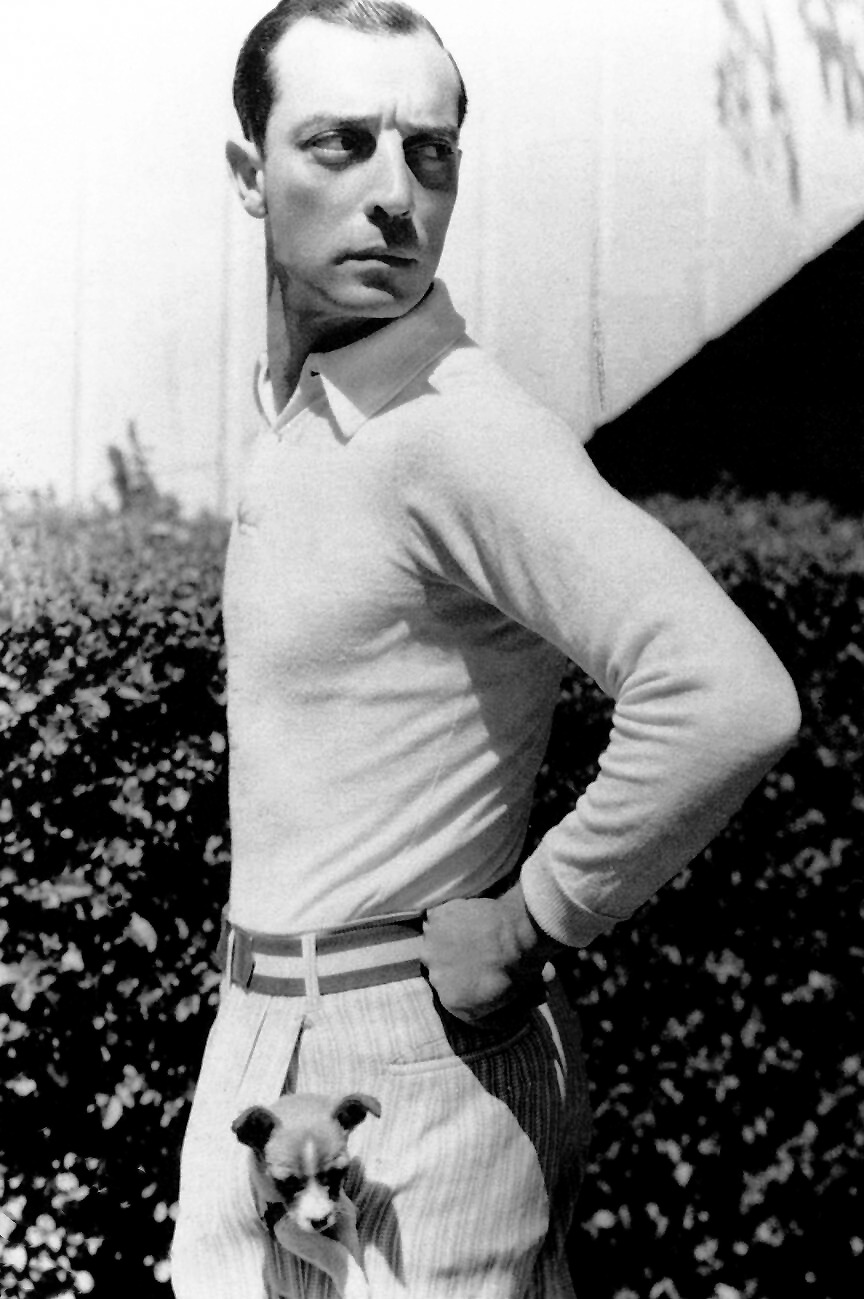
Buster foi apelidado de “great stone face” (“grande cara de pedra”), mas o documentário nos faz lembrar que ele tinha olhos muito expressivos, algo que valia ouro no cinema mudo. E não apenas nesta época: o diretor Jon Watts, de “Homem-Aranha: De Volta para Casa” (2017), nos conta que se inspirou em Buster para criar as emoções de um Homem-Aranha com rosto também inexpressivo, coberto por uma máscara.   


Buster was nicknamed “the great stone face”, but the documentary reminds us that he had very expressive eyes, a feature that was like gold for silent cinema. And not only for that: director Jon Watts, from “Spider-Man: Homecoming” (2017), tells us that he was inspired by Buster to create the emotions of an also stone-faced Spider-Man, whose face is covered by a mask.

São muitos os entrevistados no documentário: amigos de Keaton, como Dick Van Dyke, atores, como Bill Hader e Mel Brooks, diretores, tais quais Werner Herzog e Tarantino, dublês, historiadores, a exemplo de Leonard Maltin, e pesquisadores. Todos eles falam sobre como Buster influenciou seus trabalhos, em especial com seus feitos sobre-humanos sem o uso de dublês.


The “talking heads” in the documentary are many: friends of Keaton, such as Dick Van Dyke, actors, such as Bill Hader and Mel Brooks, directors, like Werner Herzog and Tarantino, stuntmen, historians, like Leonard Maltin, and researchers. They all talk about how Buster influenced their works, especially his super-human stunts.

O produtor do documentário é Charles S. Cohen. De acordo com Bogdanovich, Cohen adquiriu os direitos sobre a obra de Keaton e ofereceu ao cineasta a oportunidade de fazer o documentário com todo o material de arquivo de que ele dispunha - uma oferta que nem Peter, nem ninguém, poderia recusar. Bogdanovich escreveu, dirigiu e narrou o documentário.


The producer of the documentary is Charles S. Cohen. According to Bogdanovich, Cohen got the rights over Keaton’s oeuvre and offered the filmmaker the opportunity to make a documentary with all the archival footage he got – an offer Peter, or anyone, couldn’t refuse. Bogdanovich wrote, directed and narrated the documentary.

Numa entrevista para Ben Mankiewicz no TCM, Bogdanovich disse que fazer este documentário foi só alegria e - polêmico! - que Keaton é melhor que Chaplin porque o humor de Chaplin era demasiado Vitoriano, enquanto o humor de Keaton era moderno. Mesmo assim, não havia animosidade entre eles: Eleanor Keaton disse que Chaplin tratou Keaton como um rei quando eles filmaram a única cena em que contracenaram, em “Luzes da Ribalta” (1952).


In an interview to Ben Mankiewicz on TCM, Bogdanovich said that making this documentary was a joy and – polemic! – that Keaton is better than Chaplin because Chaplin’s humor was too Victorian, while Keaton’s humor was modern. Nevertheless, there was a lovely relationship between them: Eleanor Keaton claimed that Chaplin treated Keaton like a king when they shot their only appearance together, in “Limelight” (1952).

Leonard Maltin diz que Buster Keaton sempre se esforçou 100% para fazer todas as coisas que fez. É por isso que ele teve êxito em seu objetivo máximo: nos fazer rir - o que ele continua fazendo mesmo 100 anos após seu auge. É por isso que ele é o Grande Buster Keaton.


Leonard Maltin says that Buster Keaton always gave 100% of his efforts to all the things he did. That’s why he succeeded in his ultimate goal: to make us laugh – which he keeps doing despite it’s been 100 years since his heyday. This is why he is the Great Buster.


This is my contribution to the 10th Annual Buster Keaton blogathon, hosted by Lea at Silent-ology.

Wednesday, March 16, 2022

Documentário: Buster Keaton, um Gênio Desajustado em Hollywood (2016)


Documentary: Buster Keaton, the Genius Destroyed by Hollywood (2016)

Buster Keaton está na moda! Dois livros sobre o homem que nunca ri acabam de ser lançados, e uma cinebiografia está sendo preparada. Mas a renascença Keaton vem acontecendo já há alguns anos. Muitos livros, documentários e mesmo posts em blogs foram lançados / publicados nos últimos anos. E a fama de Keaton atravessa fronteiras! Mas é claro que atravessa, pois agora mesmo você está lendo um post escrito por uma brasileira. Na Europa Buster também é popular, e o objeto de discussão de hoje é um documentário francês sobre Buster Keaton.

Buster Keaton is on vogue! Two books about the Great Stone Face were just released, and a biopic is in the works. But the Keaton renaissance has existed for a bunch of years now. Many books, documentaries and blog posts about Keaton have been produced and published / issued in the last few years. And Keaton’s fame has crossed borders! Of course it has, as you are now reading a blog post written by a Brazilian woman. In Europe Buster is popular too, and today’s object of discussion is a French documentary about Buster Keaton.

Como o título revela, esta é uma história triste. É a história da queda de Buster Keaton. Nós, os fãs, a conhecemos de cor: em 1928, Buster assinou um contrato com a MGM e perdeu sua liberdade criativa. Antes de chegarmos a este ponto, entretanto, o documentário fala brevemente da infância de Keaton no vaudeville e seu sucesso na década de 1920.

As the title reveals, this is a sad story. It’s the story of the fall of Buster Keaton. We, the fans, know it by heart: in 1928, Buster signed a contract with MGM and lost his creative freedom. Before we reach this point, however, the documentary talks briefly about Keaton’s childhood in vaudeville and his success in the 1920s.

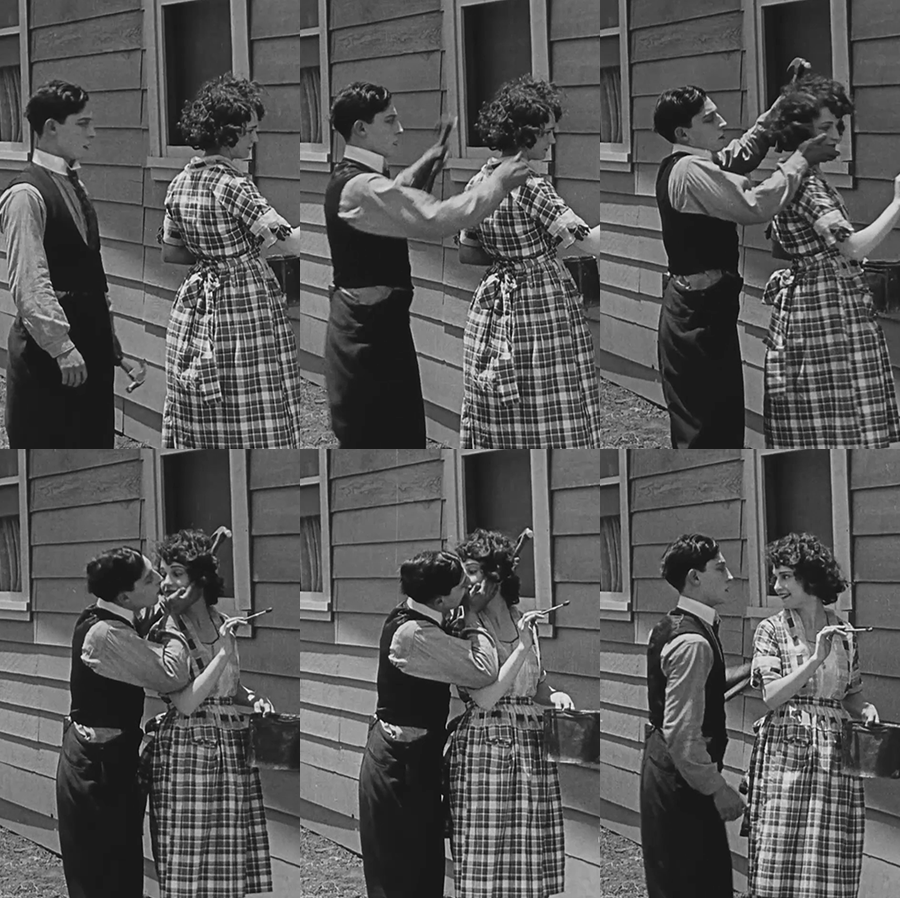
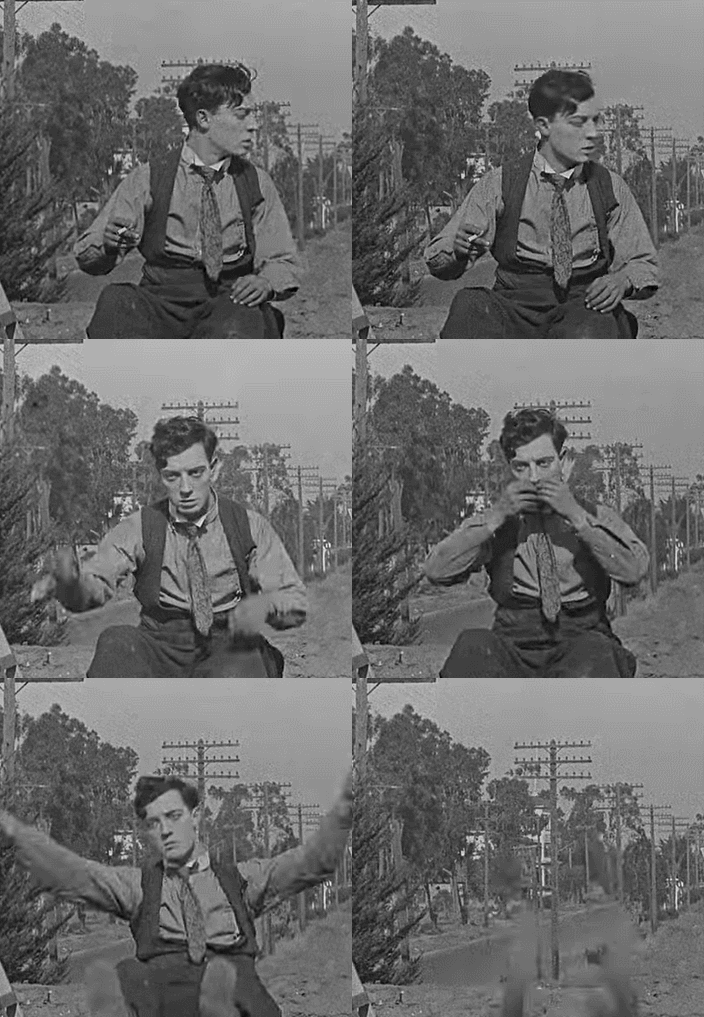
Parafraseando o documentário, Buster nunca riu porque não precisou. Sua linguagem corporal dizia tudo que ele queria dizer. Ele sabia cair – e como! - sem se machucar. Ele era mais que um dublê: ele era um acrobata. Ele fazia experimentos com o cinema, uma arte ainda jovem nos anos 1920, e foi mais que um grande comediante: ele foi um cineasta genial.

Paraphrasing the documentary, Buster never laughed because he didn’t need to. His body language said everything that he wanted to be said. He knew how to fall - and how! - without being hurt. He was more than a stuntman: he was an acrobat. He experimented with cinema, an art still young in the 1920s, and was more than a great comedian: he was a genius filmmaker.

O documentário destaca o amor de Keaton por trens, dizendo que era como se o cinema fosse, para ele, um pretexto para brincar com trens. Esta obsessão culmina com “A General” (1926), um filme com, de acordo com o documentário, duas partes simétricas, como uma viagem de ida e volta de trem. Os esforços e a genialidade em “A General” fazem com que, até hoje, muitas das outras obras-primas de Keaton sejam eclipsadas.

The documentary highlights Keaton’s love for trains, saying that it was as if cinema was, for him, a pretext for playing with trains. This obsession culminates in “The General” (1926), a film with, the documentary says, two symmetrical parts, like a full train trip. The efforts and the geniality in “The General” eclipse, even today, many of Keaton’s other masterpieces.

Keaton sabia como nos fazer rir, mas também sabia seduzir. Uma sequência é dedicada a Keaton conquistando garotas não com seus músculos, mas sim com “infinita ternura”. Neste momento, o documentário fala sobre a vida pessoal de Keaton, e até mostra vídeos dos exteriores de uma casa magnífica em Beverly Hills, que parece ser do astro. E também, pela primeiríssima vez, eu ouço falar que Buster tinha amantes.


Keaton knew how to make us laugh, but also knew how to seduce. A sequence is dedicated to Keaton winning the girls not by showing his muscles, but by showcasing infinite tenderness. At this moment, the documentary talks about Keaton’s personal life, even showing footage from a magnificent Beverly Hills house that is supposed to be his. Also, for the first time ever, I hear that Buster had lovers.

Estamos agora na marca de 30 minutos do documentário (de 52 minutos no total) quando a tragédia acontece. Joe Schenck, sócio e cunhado de Keaton, o aconselha a assinar um contrato com a MGM, algo que Buster, de início, não quer fazer. Mas Schenck insiste e Buster comete o maior erro de sua vida – indo inclusive contra o conselho de seu amigo Charles Chaplin, que disse (traduzido diretamente do documentário em francês): “Eles vão devorá-lo querendo ajudá-lo, vão atrapalhar seu julgamento, e você vai se esfalfar se defendendo e sabendo que tem razão. Não que eles tenham maus elementos, eles têm os melhores do país, mas são muitos e todos vão meter a colher nos seus filmes, como muitos chefes na mesma cozinha.”

We’re now 30 minutes into the documentary (that is 52 minutes long) when tragedy strikes. Joe Schenck, Keaton’s business partner and brother-in-law, advises him to sign with MGM, something Keaton doesn’t want to do at first. But Schenck insists and Buster makes the biggest mistake of his life – even going against the advice of his friend Charles Chaplin, who said (translated directly from the documentary in French): “They will devour you wanting to help you, they will twist your judgment, and you will die defending yourself and knowing you’re right. Not that they have bad elements, they have the best in the country, but they are too many and everyone will stick their fingers on your films, like many chefs in the same kitchen”.

A MGM foi estabelecida em 1924, com a fusão da Metro com a Goldwyn Pictures, e a presença do produtor Louis B. Mayer. Mayer acreditava que o destino de um filme dependia primeiro da estrela, depois do produtor, então do roteiro e por último do diretor. Pela primeira vez, na MGM Keaton teve de escrever um roteiro e submetê-lo a dezenas de cérebros que fariam muitas modificações. E agora suas acrobacias são consideradas perigosas demais para serem feitas sem um dublê.

MGM was established in 1924, with the fusion of Metro and Goldwyn Pictures, and the presence of producer Louis B. Mayer. Mayer believed that the fate of a film relied on the star first, the producer second, the script third and only then the director. For the first time ever, at MGM Keaton has to write down the script and submit it to dozens of brains who would heavily change it. And now his stunts are considered too dangerous to be made without a stunt double.

Mesmo assim, Keaton encontra um jeito de trabalhar do seu jeito e faz “O Homem das Novidades” (1928), uma obra-prima – algo que nunca voltaria a acontecer na MGM. O estúdio não permite que Keaton transforme “O Noivo Cara-Dura” (1929) em um filme falado, mas obriga o ator a aparecer como um cantor ridículo em “Jeca de Hollywood” (1930), um filme que o documentário chama de “aberração”. O som não mata a carreira de Buster Keaton: é o sistema de estúdio que o faz. Porque nós costumamos falar sobre os grandes filmes que foram feitos com o sistema de estúdio, quando na realidade deveríamos estar falando sobre os grandes filmes que foram feitos apesar do sistema de estúdio. Ou como o documentário diz: Hollywood é um ogro de devora suas crias.

Nevertheless, Keaton finds a way to work as he was used to and makes “The Cameraman” (1928), a masterpiece – and something that would never happen again in MGM. The studio doesn’t allow Keaton to transform “Spite Marriage” (1929) in a talkie, but makes the actor appear as a ridiculous singer in “Free and Easy” (1930), a movie the documentary calls “an aberration”. Sound doesn’t kill Keaton’s career: the studio system does. Because we often talk about the great movies that were made with the studio system, when in reality we should be talking about the great movies made in spite of the studio system. Or as the documentary puts it: Hollywood is an ogre that devours its children.


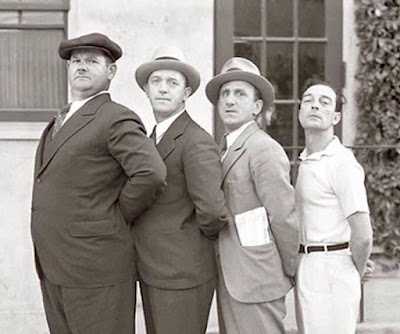
No começo dos anos 30, Keaton é colocado para contracenar com o comediante Jimmy Durante, formando uma dupla que o documentário descreve como “incompatível”. Forçado a fazer filmes menores que seu talento, Buster começa a beber. Quando ele desafia Mayer e se recusa a aparecer em filmes promocionais, Buster é demitido da MGM. Aos 40 anos, Buster está ridicularizado, viciado e desempregado.

In the early 1930s, Keaton is paired with comedian Jimmy Durante, forming a duo that the documentary describes as “incompatible”. Forced to appear in films that were not as big as his talent, Buster starts to drink. When he challenges Mayer and refuses to appear in promotional movies, Buster is fired from MGM. At forty, Buster is ridiculed, addicted and unemployed.

Oliver Hardy, Stan Laurel, Jimmy Durante, Buster

Mas as coisas melhoram de maneira irônica: de volta à MGM como consultor de gags, Buster se apaixona pela dançarina Eleanor Norris, que se torna sua esposa. Nos anos seguintes, ele aparece em filmes, programas de TV e comerciais e até mesmo ganha um Oscar honorário. A primeira renascença Keaton começa nos anos 60 – bem a tempo para Buster testemunhá-la!

But things get better in an ironic way: back to MGM as a gag man, Buster falls in love with the dancer Eleanor Norris, who becomes his wife. The following years, he appears in movies, TV and commercials and even wins an honorary Oscar. The first Buster Keaton renaissance begins in the 1960s – just in time for Buster to witness it!

Além das sequências dos filmes de Keaton, há também no documentário sua voz retirada de entrevistas. Nestes momentos aprendemos mais sobre a vida e o processo criativo de Keaton, e podemos vê-lo cantando, celebrando seu aniversário, jogando cartas, dando autógrafos. Estes momentos íntimos tornam o documentário melhor e mais agradável, e nós nos sentimos mais próximos de Keaton.

Besides the sequences from Keaton’s films, there is also in the documentary voiceover taken from his interviews. In these moments we learn more about Keaton’s life and creative process, and we can witness Keaton singing, celebrating his birthday, playing cards, signing autographs. These candid moments make the documentary better and more tender, and we feel closer to Buster. 

Buster Keaton, um Gênio Desajustado em Hollywood” foi escrito e dirigido por Jean-Baptiste Péretié, que também dirigiu documentários no mesmo formato sobre John Wayne, Jacques Tati e Al Pacino. O trabalho de edição maravilhoso foi feito por Véronique Lagoarde-Ségot, uma expert em documentários históricos. Esta é mais uma boa homenagem para o comediante que nós amamos, e só há uma coisa a dizer para quem cria conteúdo sobre Buster Keaton: continue com o bom trabalho! É um prazer estar viva durante a renascença Keaton.

Buster Keaton, the Genius Destroyed by Hollywood” was written and directed by Jean-Baptiste Péretié, who also directed documentaries in the same format about John Wayne, Jacques Tati and Al Pacino. The outstanding editing work was done by Véronique Lagoarde-Ségot, an expert in historical documentaries. This is another well-made tribute to the Great Stone Face we all love, and there is only one thing to say to those creating Buster Keaton content: keep them coming! It’s a pleasure to be alive during the Buster Keaton renaissance.


This is my contribution to the Eighth Annual Buster Keaton blogathon, hosted by Lea at Silent-ology.

Related Posts Plugin for WordPress, Blogger...