Há muitas atrizes do cinema clássico que poderiam ser chamadas de deusas
– atrizes demais para citar aqui. Mas foram poucas que de fato interpretaram
deusas nas telas. Uma delas foi Rita Hayworth em “Quando os Deuses Amam”
(1947). No ano seguinte, outro filme sobre uma deusa que vem à Terra e se
apaixona por uma mortal foi feito: “Vênus, a Deusa do Amor”. A atriz sabiamente
escolhida para interpretar a deusa foi Ava Gardner.
There were many classic film actresses that
could be called goddesses – like, too many to mention. But only a handful of
them went on to actually play goddesses on screen. One of them was Rita
Hayworth in “Down to Earth” (1947). The following year, another movie about a
goddess who comes to Earth and falls in love with a mortal was made: “One Touch
of Venus”. The actress wisely chosen to play the love goddess was Ava Gardner.
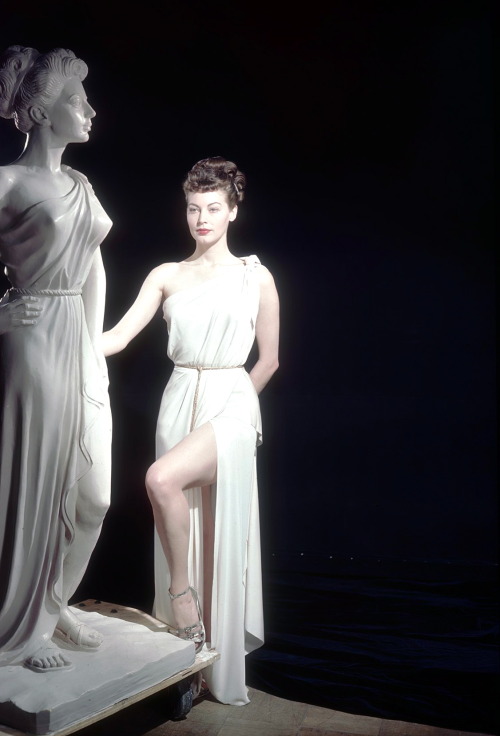
Os créditos passam por cima de um anfiteatro grego. Quando eles acabam,
Eddie Hatch (Robert Walker) aparece por trás do anfiteatro, revelando que este
era um modelo em uma vitrine. O atrapalhado Eddie é então chamado por seu
chefe Savory (Tom Conway) para consertar as pregas de uma cortina que cobre a
estátua da deusa do amor, Vênus. Eddie fica encantado com a estátua e, depois
de tomar uma taça de champanhe, a beija. Um trovão se escuta e a estátua se
torna viva. Agora, Eddie está com problemas e Vênus, a deusa do amor (Ava
Gardner) só vai criar mais confusão.
The credits roll over a Greek amphitheatre.
When we’re done with the credits, Eddie Hatch (Robert Walker) appears behind
the amphitheatre, revealing that it was a window shop model. Clumsy Eddie is
then called by his boss Savory (Tom Conway) to fix a curtain drape that covers
a statue of the love goddess Venus. Eddie becomes infatuated by the statue and,
after one glass of champagne, he kisses it. A thunder is heard and the statue
comes to life. Now Eddie is in trouble, and Venus, the love goddess (Ava
Gardner) will only bring him more problems.

Primeiro, Eddie é acusado por seu chefe de ter roubado a estátua. Ele diz
a verdade ao chefe e à polícia, mas ninguém acredita que uma estátua de mármore
simplesmente saiu andando. Eddie é mandado para casa, onde recebe cuidados do
amigo Joe (Dick Haymes) e da namorada Gloria (Olga San Juan). Logo Vênus
reaparece, e eles têm de fugir para escapar da fúria ciumenta de Gloria.
First, Eddie is accused by his boss of
stealing the statue. He tells him and the police the truth, but nobody believes
that a marble statue simply walked away. Eddie is sent home, where he is helped
by his friend Joe (Dick Haymes) and his girlfriend Gloria (Olga San Juan). Soon
Venus reappears there, and they have to run away to escape Gloria’s jealous
fury.

Na sua forma humana, Vênus não usa seus poderes com frequência – só em
momentos cruciais. Seu maior poder é a sedução, e quando ela descende do
Olimpo, o amor fica no ar. Além disso, ela só quer se divertir aqui na Terra
durante alguns dias. Considerando sua beleza, sex appeal e personalidade de
amante da diversão, podemos dizer que a escolha da jovem Ava Gardner, então com
23 anos, foi perfeita.
In her human form, Venus doesn’t use her
powers often – only in crucial moments. Her biggest power is seduction, and
when she descends from the Olympus, love gets in the air. Moreover, she just
wants to have fun while she is spending a few days on Earth. Considering her
beauty, sex appeal and fun-loving personality, we can say that choosing young
Ava Gardner, then 23, was a perfect move.

Se você só conhece Robert Walker como o sinistro Bruno de “Pacto
Sinistro” (1951), você terá uma grande surpresa. Ele é muito engraçado como
Eddie, fazendo caras e boas exageradas e parecendo tão desconcertado com o que
acontece quanto Cary Grant em “Este Mundo é um Hospício” (1944). Outra boa
performance é de Eve Arden, que interpreta a secretária de Savory, Molly, que é
apaixonada pelo patrão. Ela tem várias frases de efeito engraçadas e também
brilha com suas expressões faciais.
If you’re only familiar with Robert Walker as
the sinister Bruno in “Strangers on a Train” (1951), you’re in for a huge
surprise. He is very funny as Eddie, making exaggerated faces and appearing as
flabbergasted by all the action as Cary Grant is in “Arsenic and Old Lace”
(1944). Another great performance is Eve Arden’s, who play Savory’s secretary
Molly, who is in love with her boss. She has many hilarious one-liners and also
shines with her facial expressions.

“Vênus, a Deusa do Amor” é um filme de fantasia e comédia romântica e é
também um musical. Há três números musicais, e em todos eles a voz de Ava
Gardner é dublada por Eileen Wilson. Em sua curta carreira de apenas 12 filmes,
Eileen dublou atrizes como Jane Russell em “Os Homens Preferem as Loiras”
(1953) e Ava em três ocasiões: “Mercador de Ilusões” (1947), “Lábios que
Escravizam” (1949) e aqui em “Vênus, a Deusa do Amor”.
“One Touch of Venus” is a romantic comedy-fantasy and
also a musical. There are three musical numbers, and in all three Ava Gardner’s
singing voice is dubbed by Eileen Wilson. In her short career that lasted only
12 films, Eileen dubbed actresses like Jane Russell in “Gentlemen Prefer
Blondes” (1953) and Ava in three occasions: in “The Hucksters” (1947), “The
Bribe” (1949) and here in “One Touch of Venus”.

A trama tem origem em um fato histórico misturado a um mito grego. A
influência histórica é o templo de Vênus na cidade grega de Tessalônica,
construído no século VI a.C. - e ainda preservado. O mito em questão é o mito
de Pigmaleão, um escultor talentoso que se apaixonou por uma de suas criações.
Vênus, a deusa do amor, foi ao seu estúdio ver as estátuas e, comovida com a
estátua em questão, chamada Galateia, deu vida a ela.
The plot is originated in a historical fact
mixed with a Greek myth. The historical influence is the temple of Venus in the
Greek city of Thessaloniki, built in the 6th century B.C. - and preserved until today. The myth in question
is the myth of Pygmalion, a talented sculptor who fell in love with one of his
creations. Venus, the goddess of love, went to his studio to see his statues
and, moved by his devotion to the statue named Galatea, brought it to life.
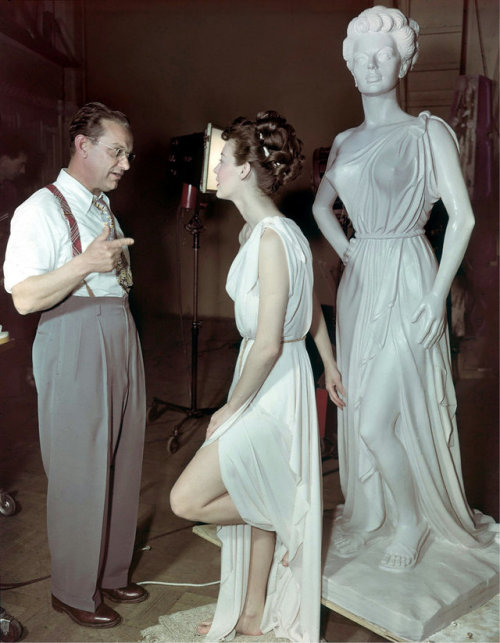 |
| With director William A. Seiter |
É inevitável a comparação entre “Vênus, a Deusa do Amor”, e “Quando os
Deuses Amam”. “Quando os Deuses Amam” foi feito em 1947 pela Columbia e trazia
Rita Hayworth como Terpsícore, a musa da música e da dança, que se apaixona por
um mortal que num primeiro momento ela queria punir. Em “Vênus, a Deusa do
Amor”, feito pela Universal em 1948, Vênus se apaixona pelas pequenas coisas
que um mortal – que já estava apaixonado por ela – dá a ela. Além disso,
“Quando os Deuses Amam” é em Technicolor, e “Vênus, a Deusa do Amor” é em preto
e branco – embora o plano inicial era que fosse em cores, quando Mary Pickford
comprou os direitos da peça de teatro original para produzir o filme.
We can't avoid comparing “One Touch of Venus”
with “Down to Earth”. “Down to Earth” was made in 1947 by Columbia and starred
Rita Hayworth as Terpsichore, the muse of music and dance, who falls in love
with a mortal who she was at first going to punish. In “One Touch of Venus”,
released by Universal in 1948, Venus falls in love with the little things a
mortal – who was already in love with her – provides her. Moreover, “Down to
Earth” is in Technicolor, and “One Touch of Venus” is in black and white –
although it was first supposed to be shot in color, when Mary Pickford bought
the rights of the original play to produce a movie in 1945.


“Vênus, a Deusa do Amor” é um filme subestimado que podia ser mais longo.
Mesmo assim, ele tem mais pontos positivos que negativos, e é um filme que te
fará sorrir e desejar a possibilidade de experimentar um amor inspirado por
ninguém mais ninguém menos que Vênus, a deusa do amor.
“One Touch of Venus” is an underrated movie
that could have been longer. However, it has more positive aspects than
negative ones, and it is a movie that will make you smile and wish you could
experience a love inspired by Venus herself.
This is my contribution to the Ava Gardner blogathon, hosted by Maddy at Maddy Loves Her Classic Films.