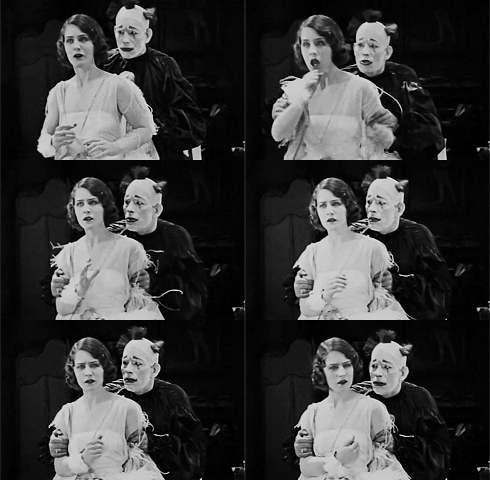
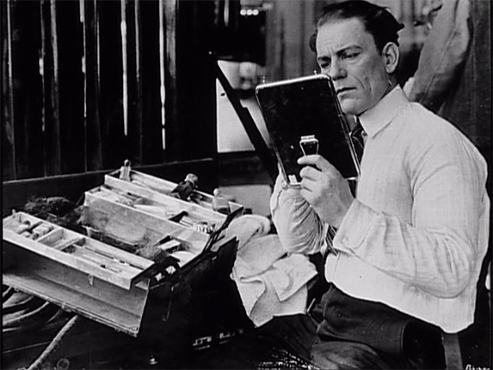
TRADUÇÃO
EM PORTUGUÊS EM BREVE!
“The Miracle
Man” is a lost film. No, no copies of it have been found so far. No, I haven’t
found some reels in my attic – the most exciting thing I’ve found recently in
my attic was a spider. And how come I am writing about it? One of the
Commandments of Film Criticism, a list created by me, is “you shall not analyze
a film you haven’t watched”. Am I disobeying my own rule?

No. Because I’m not writing an analysis or a critical review of “The
Miracle Man”. I’m actually making a reconstruction of this treasured lost film
– it’s a detective’s work or, more precisely, an archaeological work.
Considered that I flirted with being both a detective and an archaeologist when
I was younger, this is not only a huge responsibility but also a dream coming
true.
But WHY “The Miracle Man”, when all silent film fans know that the Holy
Grail of lost film is another Lon Chaney flick, “London After Midnight” (1927)?
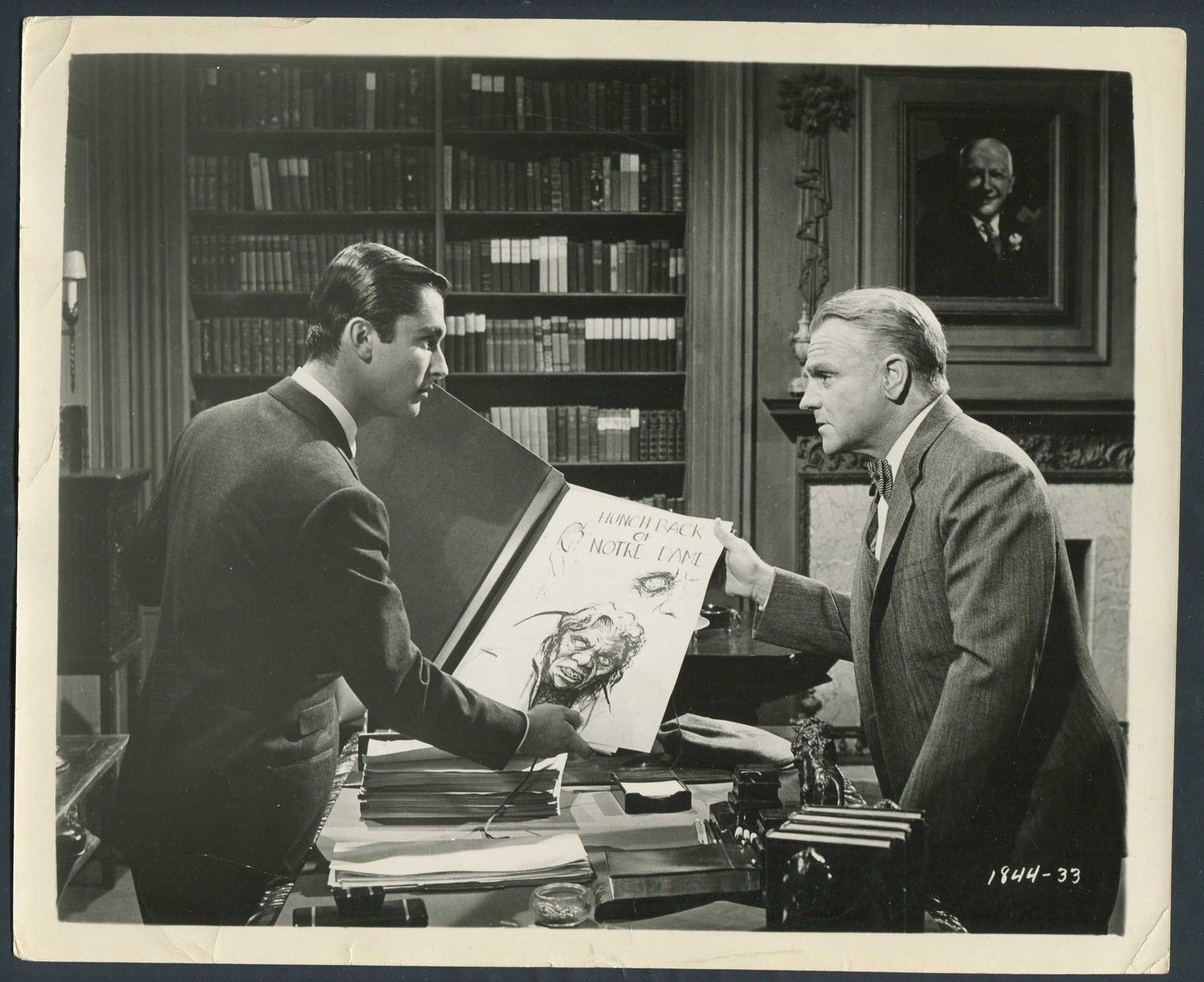
Well, I chose “The Miracle Man” for personal reasons. I first heard of it – and
of Lon Chaney – when I watched Chaney’s curious biopic “Man of a Thousand
Faces”, made in 1957 and starring my favorite actor, James Cagney. Cagney’s
recreation of a scene from “The Miracle Man” impressed me beyond words. And
then a love for Chaney was born.
The Historical Sources
You might be asking: “how the hell will she reconstruct a lost movie?”.
I’ll answer: through Brazilian film magazines. We, Brazilians, usually joke
that this country knows no limits. Well, Brazilian film magazines knew no limits
either: from the silent era onwards, until the 1950s, when most of them were
extinct, these magazines published the whole plot of a film, together with
stills. No criticism, no analysis: only spoilers. The magazines, however, were
written in an archaic Portuguese – because the Portuguese language went through
many changes in the past century.
 |
| The Magazine |
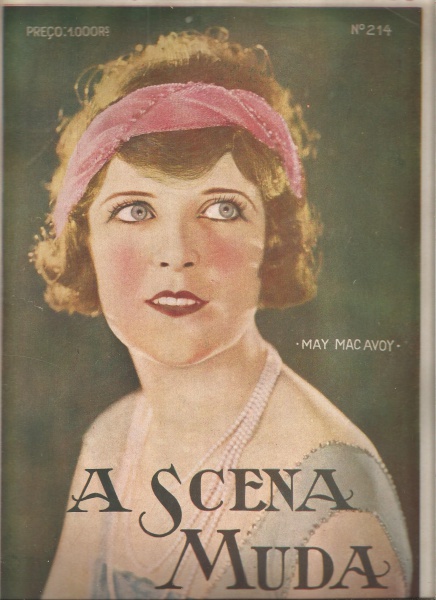
And thank God for those spoilers! I can only reconstruct the film
because of them! I used here, to reconstruct the movie, the magazine “A Scene
Muda”, that brought the story as adapted from the novel by Frank L. Packard to
the screen. The whole story was published in six numbers in 1921 (numbers 12 to
18), and most images in this article are from the magazine.
The Story – part 1 – The Swindlers
“The
Miracle Man” is set in a picturesque New York neighborhood – a place where
children are poor and malnourished, yet money flows in nearby cabarets where
the bourgeois has fun. At night, the darkness is almost total – only the
cabarets offer some light to the sad streets. Looks like “The Penalty” (1920),
another Chaney film.
One night, a policeman stops the traffic, and everybody looks at what
may be causing the trouble: a horrid shapeless creature, with angry eyes and a
face that shows, more than humanity, suffering. He walks with his elbows in the
ground, his back protected by a leather piece, and his face turned upwards. He
is The Frog and, yes, it is Lon Chaney at the screen.
 |
| Chaney |
Many people look at him, some curious, some disgusted, some full of
pity. A few of those people put coins in his deformed hand. He can’t say no. An
older couple gives The Frog some money and enters a cabaret, an ugly building
with a bar, a restaurant and some boarding rooms to rent. There they find all
kinds of people: Chinese immigrants, prostitutes with exaggerated make-up,
gamblers and drunkards. The woman is horrified with what she sees, while the
man seems to be used to that sighting.
A girl is harassed by a drunken man, and goes far from him. She sits
with a first-timer, a young man that was the first to give money to The Frog.
The young man doesn’t want anything with the girl, and when she goes back to
the place she was, the man attacks her – he wanted her to take money away from
the silly young man. The young man enters the fight and saves the woman. The
old woman, Mrs Higgins, is ecstatic with the action. The young man and the old
woman give money to the girl to go away from that life. The young man
introduces himself as Tom Burke (Thomas Meighan).

The girl, now with a good amount of money, gets out of the cabaret and
in again, after helping a drunken woman. The girl is Rose (Betty Compson), and
she goes to the second floor and enters a big room. A few moments later the
crippled man enters. With a few movements, he puts all his members back in
their place. The Frog is not really crippled: he is a swindler and his name is
Jimmy. Lon Chaney has just surprised us. Then, the man who was harassing Rose
enters the room and asks how much she had made that night. The man is Harry
(J.M. Dumont) and he pretends to have tuberculosis to earn money from
donations.
 |
| The gang |
A man enters pretending he is from the police. It’s Tom Burke, also part
of the scheme. After him enters the Japanese man (Kisaburô Kurihara) who guides
the bourgeois to the cabaret, wanting his share of the money. Rose only
presents a little of it, and the Japanese man gets angry, but Tom dissuades him
of fighting. He goes out. Tom announces that he’ll use all the money in a new
scheme, to what Jimmy protests, wanting his share. Tom orders all to give away
the money, and they do.
Tom’s scheme is based on a newspaper article he found, about a deaf and
blind man who can cure any illness. Tom tells that his plan is to go see the
man in the village he lives in and pretend he was cured. Then Rose and Harry
would go after him to help the story spread through newspaper, and at last
Jimmy would do his contortionist trick and they would start managing the blind
man’s cures – for a big price, obviously.

The Story – part 2 – The Miracle
Tom hit the road and, near the village of Needley, started pretending he
was suffering from vertigo. Tom got out of his car and was quickly surrounded
by peasants. He asked for a doctor. They said there was no doctor there, but he
could see the Patriarch (Joseph J. Dowling). Tom is taken to him by peasant
Hiram Higgins (F.A. Turner). The Patriarch, a strong old man in his seventies,
was already waiting for them in front of his house. Tom felt some strange
feeling when he got near the Patriarch.
 |
| Tom and Rose |
The Patriarch walked to Tom and put his hand over Tom’s head, what
impressed Tom very much. The Patriarch then left and Tom, saying he was cured,
started talking with Higgins again. After Higgins offered him a place to stay,
Tom saw Higgins’ daughter, Ruth (Lucille Hutton), with a little boy who walked
with crutches (Frankie Lee). Tom learned that the little boy was the local
teacher’s son, and his father didn’t want the boy to see the Patriarch because
he didn’t believe in his curative powers.
Rose arrives at Needley two days later, wearing simple clothes and not
using any make-up. With a few fake documents, she was going to impersonate the
Patriarch’s niece, who left Needley as a child and never returned.
 |
| Tom and Rose in Needley |
Jimmy and Harry followed, and traveled calling all the attention they
could. In the train, Jimmy kept saying that he was going to see a miracle man
who would cure him of his deformities, which called the attention of the other
passengers, including siblings Richard (Lawson Butt) and Claire King (Elinor
Fair). They were rich, and Claire suffered with a paralysis and needed a
wheelchair to go anywhere. Listening to Jimmy, they decided to see the
miraculous man, too.

At the same time, Tom tried to send the boy with crutches away to not
spoil the whole miracle show, however the boy’s father once again refused,
saying his son had an incurable disease and wasn’t going anywhere.
On the big day, a crowd followed Jimmy and Claire to the Patriarch’s
house. Jimmy had convinced many of the train passengers to follow him and watch
the miracle – including two journalists. Jimmy was covered in sweat and was
making an extra hard effort to walk, with his elbows, on the irregular soil. He
moved like a reptile on the ground.
When they arrived, the Patriarch started walking towards them. Everybody
seemed skeptical – everybody but Claire, who started smiling with hope when she
saw the Patriarch. In the front line, the boy with crutches observed.
 |
| Jimmy nears the Patriarch |
Jimmy started shaking when he got near the Patriarch. It was show time.
With his face pale, Jimmy seemed to suffer while doing his gymnastics, and put
his members on the right place, one by one. He stood up and touched the
Patriarch.
Silence. Everybody was impressed. An old woman passed out. The happiest
of all people was the little boy with crutches, who then realized he could be
cured, too. The little boy ran to the Patriarch, excited, and as he ran his
legs got stronger, he left the crutches, and suddenly he was walking freely.
The little boy hugged the Patriarch, moved. This is the scene we have extant,and it’s beautiful!
Everybody is speechless, but Tom, Rose, Harry and Jimmy are speechless.
Tom feels he just committed sacrilege with his trick. Soon Claire King got up
from her chair, in a suave and delicate way, and started walking, too.
 |
| Claire and the boy hug the Patriarch |
The Story – Part 3 – The Business
Tom believes that both the “miracles” were a matter of suggestion –
maybe a disease of the mind prevented Claire and the boy from walking? Anyway,
Tom talks to the journalists, saying that he, too, was cured by the miracle
man. Tom shows them the Patriarch’s house, and there he informs that he wants
to create an economical fund to help poor sick people travel to Needley to see
the Patriarch.
Everybody likes the idea and contributes. Tom writes a big check and
Richard writes one twice as big. Rich men from Needley give money, and even the
little boy gives a few coins to the fund. Rose is there, helping the Patriarch
to sit in his usual chair to rest.
 |
| The three crooks |
When everybody left, Rose hugged and kissed Tom. He told her to get out.
Then she lit a cigarette, something Tom also criticized. Rose sat in corner,
feeling upset.
The newspapers talked about Jimmy’s cure, the most impressive of the
three that happened that day, and people started peregrinating towards Needley.
All those people were rich, and after their cure – or the cure of their
relatives – they gave a lot of money and expensive jewels for Tom’s fund. Tom,
of course, kept everything and didn’t help any poor sick person.
Tom took care of the business while the others had fun. Jimmy started
helping an old lonely woman who lived next door to the Patriarch. She said her
only son would be Jimmy’s age if he hadn’t died. As Jimmy helped her with daily
activities, she offered to pay him. He refused and said that, because she lost
her son and Jimmy didn’t have a mother, he’d consider her as his mother. The
old lady cried of happiness.
 |
| Jimmy and his new mother |
Harry was at first upset with the lack of action in Needley, but he fell
in love with Ruth Higgins and accepted a job at her father’s farm, to Tom’s
surprise. Harry worked hard and, one day, decided to be totally honest with
Hiram Higgins and tell him what he felt about Ruth. Mr. Higgins agreed with the
relationship, and Harry and Ruth got engaged.
 |
| Harry and the Patriarch |
The day before Harry got engaged Rose refused a pearl necklace from Tom,
preferring to sew the Patriarch’s coat. Rose was also being courted by Richard
King, but Tom didn’t pay attention to that, because he was worried only with
his profit. That’s why Tom didn’t accept Richard’s invitation for a boat ride,
but Rose did. When Jimmy said that Richard liked Rose, Tom punched him, and
Jimmy fell. Jimmy, however, decided not to fight further, and left. When he
passed near the Patriarch, Jimmy prayed for him to convert Tom and turn him
into a good man.
Richard’s boat got stuck in sand, and couldn’t leave the place until the
following morning. To save Rose’s reputation, Richard was willing to swim to
the shore, but Rose stopped him, because he wasn’t a good swimmer and could
die. They hugged, but Richard resisted the urge to kiss her. In his house, Tom
was crazy with jealousy, and willing to kill Rose and Richard when they came
back.
 |
| Rose and Richard |
The Story – Part 4 – Conclusion
When they saw Rose arriving the next morning, Jimmy and Harry told her
to be careful. With her conscience clean, Rose entered the house. Tom had given
up his violent plan. Tom started being sarcastic, and Rose started defending
Richard. Tom got more and more nervous, and when he put his hands up to hurt
Rose, the Patriarch entered the room and put both his hands over Tom’s
shoulders.

Tom put his hands down and, putting his head over one of the Patriarch’s
hands, started crying. Harry and Jimmy entered the house, speechless. Tom was
sorry, and decided to end the fund and leave Needley. Tom said he would keep
the jewels, and the other three could share the money. Jimmy was the first one
to refuse, saying he preferred to remain poor with his beloved new mother.
Harry refused, too, saying his fiancée wouldn’t accept the money,
because they lived a simple life. Jimmy and Harry left. Tom stayed with Rose,
and asked her what she would say if Richard asked her to marry him. Tom wanted
to kill Richard and go away with Rose. Rose answered Tom: “you’ll know”.
 |
| Harry's change |
Richard arrived as Tom left. Tom shook his rival’s hand, in a fake act
of politeness. Richard and Rose started walking through the fields, and he
proposed. She said she couldn’t marry him, and told him the truth about her
life. Richard asked if Rose still loved Tom. She said yes.
Richard left, met Tom, said goodbye and told him to go on with the fund for
poor sick people. Tom felt extremely ashamed and went back to the Patriarch’s
house. He opened a case full of jewels and started crying. He was alone and
ashamed of his villainy. He wanted to be like his friends, who changed and
became simple, good people in that village.
 |
| Tom and Rose |
Rose touched his shoulders. She had a pious look, and remembered him he
still had a salvation. She said he isn’t an evil man, and she trusted him to
run the fund, just like Richard said. A few minutes later, they went downstairs
holding hands. The Patriarch, Jimmy and Harry were there. The Patriarch touched
Tom’s and Rose’s hands and died.
The Patriarch’s dog licked its owner’s hand. All the people cried in the
room. Very moved, Jimmy said they owned everything to the old man, and they could
go on with his work if they were good people, because the Patriarch’s key for
being a miracle man was having good thoughts.

Influences
“The Miracle
Man” premiered in Brazil in 1921. In the beginning of the following year, it
was voted as the second best film shown in the country in 1921 by the readers
of the magazine “Para Todos”, after only “Male and Female”, a DeMille-Swanson
picture.“The Miracle Man” had such an impact that, in some 1924 numbers of the
same magazine, it is still cited as an example of a great film yet to be
matched.

The film was remade in 1932, with Sylvia Sidney, Chester Morris and
Hobart Bosworth as the Patriarch. In the 1957 biopic “Man of a Thousand Faces”,
the scene in which Jimmy is cured by the Patriarch is seen been shot, and it
curiously is more moving in the 1957 recreation, probably because it shows
Cagney in close-up, while the original scene was in a long shot – and the
highlight in the 1919 movie was the little boy being cured, not Chaney.
Director George Loane Tucker made only one more film after “The Miracle
Man”, and passed away in 1921. When this happened, the magazine Cinearte called
him “the greatest director after Griffith”. “The Miracle Man” was a turning
point in the careers of both Betty Compson and Lon Chaney, who then became big
stars. Thomas Meighan was already popular – and, according to one publication,
wasn’t able to cry on camera, so the director let him starve and not sleep
until for two days he managed to do the scene and cry out of exhaustion.

We can know the exact plot of “The Miracle Man”, but a lot is still
lost: the expressions, the energy put in the performances, the special effects
and camera angles. All of those could only be analyzed and enjoyed if the film
is found. They say an image is worth a thousand words. This is, by far, my
biggest post here, but still not enough to fully recreate the experience of
watching “The Miracle Man”. Let’s hope for a copy to appear – after all,
miracles do happen in the silent film world.