Um dos filmes mais românticos de todos os tempos e o filme favorito do grande Gene Wilder, “Na Noite do Passado” é um filme cuja existência eu conhecia já há algum tempo. Com minhas Resoluções de Ano Novo de 2024, finalmente assisti a ele pela primeira vez - e foi ótimo! Trata-se realmente de um filme tocante, que brinca com nossas emoções sem nos incomodar e nos faz suspirar em muitas ocasiões.
One of the most romantic movies of all times and the favorite movie of the great Gene Wilder, “Random Harvest” has been on my radar for quite some time. With my 2024 New Year Resolutions, I finally watched it for the first time - and had a blast! It’s really a touching movie, one that plays with our emotions without us getting upset and makes us swoon in many occasions.

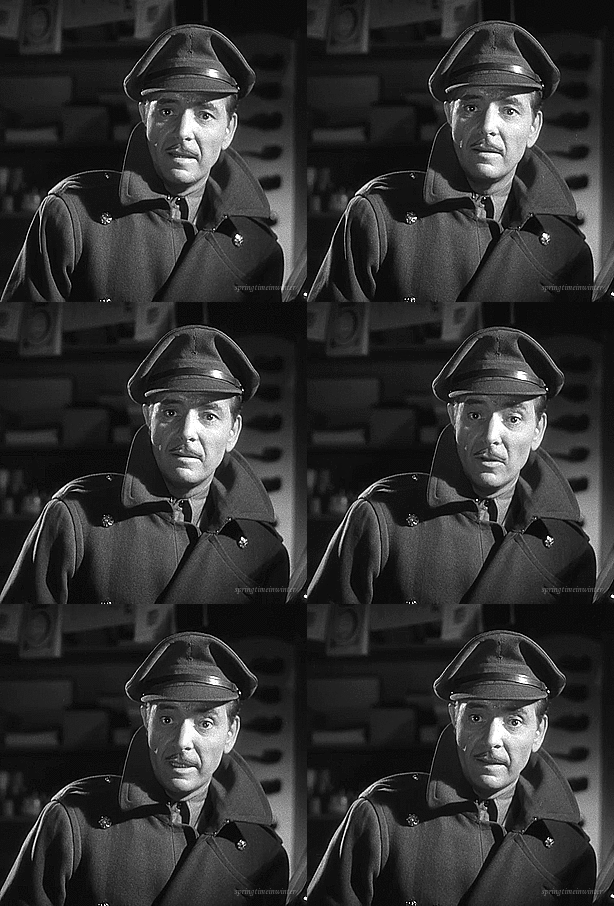
Outono de 1918. Smith (Ronald Colman) está internado num hospício na Inglaterra, porque ele perdeu a memória durante a guerra e desenvolveu também um problema de fala. No Dia do Armistício, ele sai para a rua e conhece a artista Paula (Greer Garson). O dono do grupo de teatro do qual Paula faz parte não aceita Smith, temendo que ele seja um lunático perigoso. Paula e Smith seguem então para o campo.
Autumn, 1918. Smith (Ronald Colman) is staying in an asylum in England, because he lost his memory during the war and developed a speech issue. On Armistice Day, he goes to the streets and meets the artist Paula (Greer Garson). The owner of the theater group Paula works with doesn’t accept Smith, afraid that he is a dangerous lunatic. Paula and Smith leave for the countryside.

O namoro é breve e eles se casam. Smith consegue um emprego escrevendo para um jornal e o casal tem um filho, batizado de “John” como o pai. Tudo vai bem, até que Smith é atropelado por um carro... e recobra a memória. Ele se esquece de Paula e do pequeno Johnny e volta para sua velha mansão, onde descobre que seu pai havia falecido e que ele, Charles Rainier, herdou o local. Rainier se transforma no “Príncipe da Indústria” e, depois de ver a foto dele no jornal, Paula se torna sua secretária, sob o nome de senhorita Hanson. Ela espera que ele se lembre dos anos que passaram juntos, mas a única coisa que acontece é que ele vai se casar com outra mulher, Kitty (Susan Peters). Será que ele vai se lembrar da noite do passado antes que seja tarde?
The courtship is brief and they are married. Smith gets a job writing for a newspaper and the couple has a son, named “John” after the father. Everything is fine, until Smith is hit by a car… and recovers his memory. He forgets all about Paula and Little Johnny and goes back to his old mansion, where he finds out his father has died and he, Charles Rainier, inherited the place. Rainier becomes “The Industrial Prince” and, after seeing his picture in the newspaper, Paula becomes his secretary, under the name Miss Hanson. She’s waiting for him to remember their years together, but the only thing that is happening is that he’s getting married to another woman, Kitty (Susan Peters). Will he remember it all before it’s too late?

Em 1942 Greer Garson fez dois filmes, este e “Rosa de Esperança”, pelo qual ela ganhou o Oscar de Melhor Atriz. Nascida em Londres, Garson começou sua carreira como atriz nos palcos em 1932 e fez seu primeiro filme em Hollywood em 1939. “Rosa de Esperança” não deu a ela apenas um Oscar, mas também um marido: em 1943 ela se casou com Richard Ney, que era 12 anos mais novo que ela e havia interpretado seu filho no filme. O casamento durou quatro anos e Ney abandonou o cinema nos anos 60. Garson trabalhou até o fim dos anos 70 tanto no cinema quanto na televisão.
In 1942 Greer Garson appeared in two films, this one and “Mrs. Miniver”, for which she won a Best Actress Oscar. Born in London, Garson had started her career on stage in 1932 and made her first Hollywood movie in 1939. “Mrs. Miniver” didn’t give her only an Oscar, but also a husband: in 1943 she married Richard Ney, who was 12 years her junior and had played her son in the movie. The marriage lasted four years and Ney abandoned cinema in the 1960s. Garson worked until the late 1970s on both film and TV.

Ronald Colman ganharia seu Oscar cinco anos depois, mesmo tendo sido indicado a um por “Na Noite do Passado”. Nascido na Inglaterra como Garson, ele fez sua primeira peça de teatro em 1914, aos 23 anos. Assim como seu personagem Smithy, ele lutou na Primeira Guerra Mundial e foi ferido em batalha. Ele voltou para os palcos e fez seu primeiro curta na Inglaterra em 1917. Sua estreia em Hollywood em 1923, “Irmã Branca”, fez dele uma estrela do dia para a noite e daí em diante ele fez 61 filmes e programas de TV, até sua performance final em “A História da Humanidade” (1957).
Ronald Colman would win his Oscar five years later, even though he was nominated for one for “Random Harvest”. Born in England like Garson, he appeared in his first play in 1914, aged 23. Like his character Smithy, he fought in World War I and was wounded in battle. He returned to the stage and made his first short film in England in 1917. His Hollywood debut in 1923, “The White Sister”, made him a star overnight and from then on he appeared in 61 films and TV shows, until his last performance in “The Story of Mankind” (1957).
Uma atriz que merece ser destacada é Susan Peters. Sua carreira havia começado em 1940 e por “Na Noite do Passado” ela recebeu sua única indicação ao Oscar na categoria Atriz Coadjuvante. Seu mentor, George Cukor, disse que ela o lembrava de uma jovem Katharine Hepburn. Infelizmente, sua vida foi interrompida por uma tragédia: no Ano Novo de 1945, ela sofreu um acidente enquanto caçava e ficou paraplégica. Ela recebeu e recusou várias propostas da MGM por não querer interpretar heroínas paralisadas. Ela teve uma volta aos filmes em 1948 no papel de uma vilã, mas sua saúde estava frágil e ela ficava sem comer com frequência. Peters faleceu em 1952, aos 31 anos de idade. Greer Garson e Ronald Colman estavam entre as estrelas que compareceram ao seu funeral.
One performer to highlight is Susan Peters. Her career in film had started in 1940 and for “Random Harvest” she received her only Oscar nomination in the Best Supporting Actress category. Her mentor, George Cukor, said she reminded him of a young Katharine Hepburn. Unfortunately, her life was cut short by a tragedy: on New Year’s Day of 1945, she suffered an accident while hunting and was left paraplegic. She received and refused several scripts from MGM, not wanting to play paralyzed heroines. She made a comeback in 1948 in the role of a villain, but her health declined as she started starving herself. Peters died in 1952, aged 31. Greer Garson and Ronald Colman were among those who attended her funeral.

O diretor Mervin LeRoy nasceu em San Francisco em 1900, sobreviveu junto com seu pai ao terremoto de 1906 na cidade, e despontou no vaudeville como imitador de Chaplin. Aos 19 anos, ele pela primeira vez trabalhou em um filme, e ficou intrigado por todas as técnicas cinematográficas. Ele faria 11 filmes como ator entre 1922 e 1946. Ele trabalhou dobrando figurinos, como técnico de laboratório, assistente de câmera e escritor de gags antes de dirigir seu primeiro filme em 1927. Seu período de maior sucesso foram os anos 1930, mas ele seguiu dirigindo até 1968.
Director Mervin LeRoy was born in San Francisco in 1900, survived with his father the 1906 earthquake in the city, and appeared on vaudeville as a Chaplin impersonator. At 19, he experienced working on cinema for the first time, and became intrigued by the whole modus operandi. He would appear in 11 films as an actor between 1922 and 1946. He worked folding costumes, as a lab technician, assistant cameraman and gag man before directing his first film in 1927. His most successful period was the 1930s, when he worked for Warner Bros, but he directed until 1968.

Um filme cheio de surpresas, do começo ao fim, “Na Noite do Passado” é um verdadeiro tesouro. Sua cena final nos lembra de outro lacrimoso fim: o de “Luzes da Cidade” (1931) de Chaplin. Na trigésima sexta posição na lista de filmes mais românticos do Instituto de Cinema Americano, “Na Noite do Passado” é mais que um filme: é uma experiência que brinca com tudo o que pensamos que sabemos sobre amor.
A film full of surprises, from start to finish, “Random Harvest” is truly a gem. Its end scene reminds us of another teary famous ending: Chaplin’s “City Lights” (1931). Appearing as the 36th film in the AFI list of Most Romantic films of all time, “Random Harvest” is more than a film: is an experience that plays with all we think we know about love.