} Crítica Retrô: Nada de Novo no Front

Tradutor / Translator / Traductor / Übersetzer / Traduttore / Traducteur / 翻訳者 / переводчик

Showing posts with label Nada de Novo no Front. Show all posts

Wednesday, May 20, 2026

Guerra! Flagelo de Deus (1930) / Westfront 1918 (1930)


Sou completamente obcecada pela Primeira Guerra Mundial. Já escrevi sobre alguns clássicos sobre o conflito, como “Eu Acuso!” (1919) e as duas versões para o cinema de Adeus às Armas. Escrevi todo um artigo científico sobre filmes da Primeira Guerra. E se puder adicionar mais uma obsessão, melhor ainda. É o caso aqui: filmes alemães, em especial filmes dirigidos pelo grande G.W. Pabst. “Guerra! Flagelo de Deus” foi meu primeiro filme falado de Pabst, e também o primeiro que ele fez com som sincronizado! Levando em conta essas coincidências, essas são minhas opiniões sobre o filme.   

I’m totally obsessed with the subject of World War I. I reviewed a few classics about the conflict, such as “J’Accuse!” (1919) and the two screen versions of A Farewell to Arms. I wrote a full paper about WWI movies. And if I can add another obsession to it, better yet. This is the case: German movies and especially movies directed by the great G.W. Pabst. “Westfront 1918” was my first Pabst talkie, which was in fact Pabst’s first talkie! With my pocket full of coincidences, here are my thoughts about the movie.

É tudo muito divertido num albergue francês até que as bombas começam a cair. É hora de voltar para as trincheiras, que não estão tão longe assim. Aprendi no Ensino Fundamental II que foi na Primeira Guerra Mundial que a guerra invadiu as cidades, e antes disso os combates eram assunto exclusivo dos campos de batalha.

It’s all fun and games at a French inn when the bombs start falling. It’s time to get back to the trenches, which weren’t far away. I learned in middle school that it was during WWI that the war invaded the cities, before that the combats were a thing for the battlefields only.

O posto de comando pode ser no subsolo como as trincheiras comuns, mas os comandantes de alta patente têm telefone e um soldado que lhes serve comida fresca. Enquanto isso, há soldados empregados somente para fazer as cruzes usadas para marcar os túmulos - talvez seus próprios túmulos. Mas todos são iguais quando o assunto é diversão e artistas voluntários se apresentam para as tropas.

The commanders’ headquarters may be also underground like the common trenches, but the higher offices have a telephone and a soldier to serve their fresh food. Meanwhile, there are soldiers employed only to make crosses used to mark graves - maybe their own graves. But they are all equal when it’s about fun and voluntary artists put on a show for the troops.

A guerra também afeta as mulheres, mas elas não são muito vistas em filmes de guerra. Das apenas três personagens femininas, duas não têm nome e são só ligadas ao soldado Karl (Gustav Diessl): são sua mãe, interpretada por Else Heller, e sua esposa, interpretada por Hanna Hoesrich. A terceira personagem feminina é a garota francesa Yvette, interpretada por Jackie Monnier. As sequências com Karl chegando em seu apartamento é o puro suspense criado no cinema mudo, provando que Pabst ainda conservava suas raízes com firmeza no cinema silencioso.

War affects women as well, but they are not often seen in war movies. Of the only three credited female characters, two have no name and are only linked to the soldier Karl (Gustav Diessl): they are his mother, played by Else Heller, and his wife, played by Hanna Hoesrich. The third female character is Yvette, the French girl, played by Jackie Monnier. The sequence of Karl arriving in his flat is pure silent cinema build-up of suspense, proving that Pabst still had roots firmly in silent movies.

É covardia comparar Hollywood com o cinema de Weimar, quando a Alemanha estava passando por uma enorme crise. Do mesmo ano de “Guerra! Flagelo de Deus” - na verdade, os dois filmes estrearam com um intervalo de apenas 32 dias! - temos a obra-prima absoluta e ganhador do Oscar de Melhor Filme “Nada de Novo no Front”. Uma das melhores sequências neste filme envolve o protagonista de licença, voltando para casa para ser surpreendido - mas não positivamente. Em “Guerra! Flagelo de Deus”, Karl diz que não gosta quando os soldados saem de licença, porque eles voltam com más notícias para os colegas, dizendo que em casa as pessoas estão passando fome. Mais tarde, Karl tem sua própria experiência desagradável enquanto está de licença. Isso me lembrou de outro filme, a produção soviética “Balada de um Soldado” (1959), sobre um soldado de licença que ajuda as pessoas pelo caminho sempre com a esperança de ir para casa ver sua mãe.

It’s unfair to compare Hollywood with Weimar-Era cinema, when Germany was going through a huge crisis. From the same year of “Westfront 1918” - actually, the two movies premiered 32 days apart! - we have the absolute masterpiece and Best Picture Oscar winner “All Quiet on the Western Front”. One of the best sequences in the latter sees its protagonist on leave, returning home to be surprised - but not in the good sense. In “Westfront 1918”, Karl says he doesn’t like when soldiers go on leave, because they return to disappoint their colleagues, saying that at home people are starving. Later, Karl has his own unpleasant experience while on leave. This reminded me of yet another film, the Soviet production “Ballad of a Soldier” (1959), about a soldier on leave who helps people along the way while hoping to go home to see his mother.

O roteiro foi escrito por Ladislaus Vajda. Este roteirista nascido na Hungria foi colaborador constante de Pabst e não deve ser confundido com seu filho, também húngaro, o diretor Ladislao Vajda, que fez mais de 40 filmes em diversos países da Europa, sendo o mais famoso “Marcelino, Pão e Vinho” (1955).  

The screenplay was written by Ladislaus Vajda. This screenwriter born in Hungary was a constant collaborator of Pabst’s and must not be confused with his son, also Hungarian, the director Ladislao Vajda, who made over 40 movies in several countries of Europe, being the most famous “The Miracle of Marcelino” (1955).

Vajda Sr.

Meu querido François Truffaut disse que é impossível fazer um filme antiguerra porque todos os filmes sobre a guerra a mostram de maneira emocionante. Eu discordo completamente. Você precisa estar muito carregado de testosterona para achar legal ter balas e bombas caindo sobre sua cabeça, e a companhia constante do medo. A única coisa a temer é o próprio medo? Bobagem. A guerra é verdadeiramente um flagelo, como diz o título brasileiro, e “Guerra! Flagelo de Deus” é de fato um filme antiguerra, tanto é que foi banido pelos nazistas, que fizeram o mesmo com “Nada de Novo no Front”. Um grande elogio, eu diria.

My darling François Truffaut said that you can’t make an anti-war movie because all movies about war show it in an exciting way. I wholeheartedly disagree. You need to be too soaked in testosterone to think it’s cool having bullets and bombs near your head, and lots of fear. The only thing to fear is fear itself? Bullshit. War is truly a scourge, as the Brazilian title describes it, and “Westfront 1918” is truly an anti-war film, so much that it was banned by the Nazis, who did the same thing to “All Quiet on the Western Front”. A true compliment, may I say.

Sunday, December 22, 2019

François Truffaut, filmes de guerra e eu

François Truffaut, war movies and me

François Truffaut é um dos deuses do cinema. Além de ser um grande diretor, roteirista e por vezes ator, ele amava o cinema acima de todas as coisas. Ele era um de nós, cinéfilos. Mas isso não significa que ele estava sempre correto em suas opiniões sobre o cinema. Há algum tempo eu li algo que Truffaut disse e discordei dele. Truffaut disse que não existe um filme completamente antiguerra porque mesmo os filmes antiguerra acabam glorificando a guerra.

François Truffaut is one of the cinema gods. Besides being a great director, screenwriter and sometimes actor, he loved cinema above all else. He was one of us, film people. But it doesn’t mean he was always right in his opinions about film. A while ago I read something Truffaut said and I strongly disagreed. Truffaut said that there can’t be a completely anti-war movie because even anti-war movies end up glorifying war.

Chicago Tribune - November 11th, 1973 

Eu encontrei esta declaração enquanto pesquisava para uma apresentação. Eu passei 2019 e boa parte de 2018 fazendo esta pesquisa. No final, escolhi 34 filmes, feitos entre 1917 e 2017 – este intervalo de 100 anos foi coincidência – sobre a Primeira e a Segunda Guerras Mundiais.

I came across this declaration when I was doing research for a presentation. I spent 2019 and a good chunk of 2018 doing this research. In the end, I chose 34 films, made between 1917 and 2017 – this 100-year period was a coincidence – about World War I and World War II.


Minha intenção era analisar o discurso nestes filmes, e como ele mudou com o passar do tempo. No final, eu descobri que, durante as guerras, os filmes tinham um tom bem patriótico, mas depois ele mudava. Com “Eu Acuso!” (1919) de Abel Gance, os filmes e a sociedade em geral começaram a ver a Primeira Guerra Mundial como uma guerra na qual não valeu a pena lutar – e que moldou a Geração Perdida. Entretanto, por causa dos horrores dos campos de concentração, a Segunda Guerra Mundial sempre foi retratada no cinema como uma guerra do bem contra o mal, com os bons sendo parte da Geração Grandiosa.

My intention was to analyze the discourse in those films, and how it changed over time. In the end, I found out that, during the wars, the films had a very patriotic tone, but afterwards it changed. With Abel Gance’s “J’Accuse!” (1919), films and society in general started seeing World War I as a war that was not worth fighting – and one that shaped the Lost Generation. However, due to the horrors of concentration camps, World War II was always portrayed in film as a war of good versus evil, with the good ones being part of the Greatest Generation.

Me at the presentation

Isso significa que a maioria dos filmes sobre a Primeira Guerra Mundial é de filmes antiguerra, enquanto filmes sobre a Segunda Guerra Mundial são a favor da guerra. No artigo, Truffaut menciona “Glória Feita de Sangue” (1957), de Kubrick, como um filme antiguerra que na verdade glorifica a guerra. Eu não concordo muito com isso, mas há um filme que é completamente antiguerra e contesta a teoria de Truffaut: “Nada de Novo no Front” (1930).

This means that most films about WWI are anti-war films, while WWII films are pro-war. In the article, Truffaut mentions Kubrick’s “Paths of Glory” (1957) as an anti-war film that actually glorifies war. I don’t really agree with that, but there is one film that is completely anti-war and disproves Truffaut’s theory: “All Quiet on the Western Front” (1930).


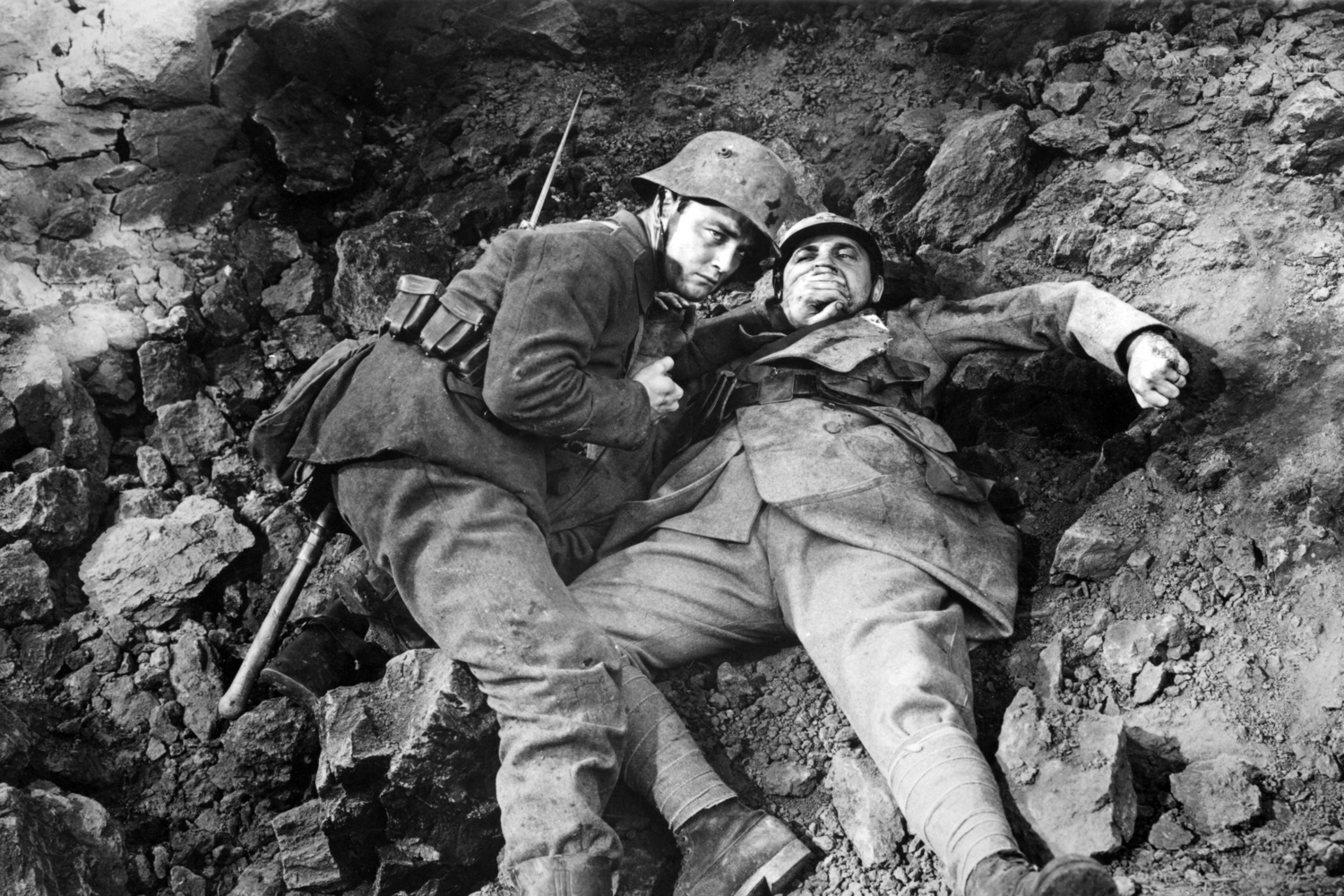
“Nada de Novo no Front” é um filme de 1930 da Universal Pictures dirigido por Lewis Milestone. Ele é baseado no romance homônimo de Erich Maria Remarque, publicado em 1928. Ele conta a história do jovem alemão Paul Bäumer (interpretado por Lew Ayres) e seus colegas de classe que se alistam no exército após um inflamado discurso patriótico feito por um professor. Eles aprenderão que a guerra é bem diferente da descrição do professor: menos emocionante e glamourosa.

“All Quiet on the Western Front” is a 1930 Universal Pictures movie directed by Lewis Milestone. It is based on the novel of the same name by Erich Maria Remarque, published in 1928. It follows the young German Paul Bäumer (played by Lew Ayres) and his fellow classmates who enlist in the German Army after their teacher makes an intense patriotic speech. They all will learn that war isn’t that exciting or glamorous as the teacher had painted it.


Para mim, há duas sequências fundamentais que mostram a desilusão destes jovens e também que a guerra não merecia o esforço. A primeira é quando o Cabo Himmelstoss (John Wray) – o homem abusivo que treinou os jovens antes de eles partirem para o campo de batalha – chega ao front e, vendo a guerra pela primeira vez, se mostra um covarde. Himmelstoss só era valente perto de jovens imaturos. Fato curioso: Himmelstoss significa "céu em queda" em alemão.

For me, there are two key sequences that show the disillusionment of those youngsters, also showing that the war was not worth fighting. The first is when Corporal Himmelstoss (John Wray) – the abusive man who trained the boys before they went to the front – arrives in the front and, seeing war for the first time, acts with cowardice. Himmelstoss was, after all, only a big bully. Curious fact: Himmelstoss means "falling sky" in German.


A segunda sequência envolve Paul voltando para casa, de folga. Quando ele chega à sua cidade natal, ele percebe que ninguém lá é capaz de imaginar os horrores da guerra, e eles inclusive acham que a Alemanha está a um passo da vitória. Pior ainda: quando ele visita sua velha escola, ele vê o professor Kantorek (Arnold Lucy) repetindo o mesmo discurso patriótico glorioso para alunos muito mais jovens que Paul. Revoltado, Paul conta a eles a verdade sobre a guerra, e como o professor não sabe do que está falando porque nunca esteve no front. Paul é então chamado de covarde pelos jovens estudantes, em transe com o discurso patriótico.

The second sequence involves Paul coming back home for a while. When he reaches his hometown, he realizes that nobody there imagines the horrors of war, and they all actually think that Germany is almost winning the war. Even worse: when he visits his old school, he finds Professor Kantorek (Arnold Lucy) repeating the same glorious patriotic speech to students much younger than Paul. Revolted, Paul tells them the truth about war, and how the professor can’t know them because he had never been to the front. Paul is then called a coward by the young students entranced by the patriotic speech.


“Nada de Novo no Front” era tão pacifista em sua mensagem que foi banido na Alemanha Nazista, na Itália fascista, na Áustria e até mesmo na França. Estes países só puderam ver a obra-prima de 1930 após a Segunda Guerra Mundial.

“All Quiet on the Western Front” had such a strong pacifist message that it was banned from Nazi Germany, fascist Italy, Austria and even France. Those countries could only see the 1930 masterpiece after World War II.


Além disso, a história foi tão profunda que fez o ator Lew Ayres se tornar pacifista. Isso lhe custou muito: ele se opunha à Segunda Guerra Mundial e se alistou no exército apenas para servir como ajudante médico. Depois de alguma confusão, ele finalmente seguiu no exército no posto desejado.

Moreover, the story was so appealing that it turned actor Lew Ayres into a lifelong pacifist. This cost a lot to him: he was a conscientious objector to the Second World War and enlisted in the army only to serve as medical aid. A little kerfuffle followed, until he was granted his wish.


Eu não consegui encontrar nada sobre o que Truffaut achou de “Nada de Novo no Front” – e sua opinião seria bem-vinda, porque o filme só estreou na França em 1963, quando Truffaut já era crítico de cinema. De qualquer forma, eu posso dizer uma coisa: por ter os vencedores da guerra contando uma história empática sobre os perdedores, “Nada de Novo no Front” humaniza ambos os lados do conflito e mostra que a guerra é inútil porque somos todos iguais. E eu sinto muito, monsieur Truffaut, mas este filme cria este discurso antiguerra da mais perfeita e inquestionável maneira que eu já vi no cinema.

I couldn’t find anything about what Truffaut thought of “All Quiet on the Western Front” – and his thoughts would be welcome, because the film was only allowed to be shown in France in 1963, when Truffaut was already a film critic. Anyway, I can say one thing: by letting the winners of the war tell an empathetic story about the losers, “All Quiet on the Western Front” humanizes both sides of the conflict and shows that war is useless because we’re all equal. And I’m sorry, monsieur Truffaut, but this film does this anti-war speech in the most perfect, unquestionable way I’ve ever seen on a screen.

Related Posts Plugin for WordPress, Blogger...