} Crítica Retrô: Segunda Guerra Mundial

Tradutor / Translator / Traductor / Übersetzer / Traduttore / Traducteur / 翻訳者 / переводчик

Showing posts with label Segunda Guerra Mundial. Show all posts

Friday, September 11, 2026

Ser ou Não Ser (1942) / To Be or Not to Be (1942)

 Ser ou não ser: eis a questão. A frase de Shakespeare conhecida até mesmo por quem não sabe quem foi Shakespeare. Naquele que seria o último filme de Carole Lombard, a frase é um código para um encontro furtivo entre amantes. Nas habilidosas mãos de Ernst Lubitsch, aqui como diretor e produtor, a frase também funciona como o título de uma comédia de humor negro essencial dentro da História do cinema.

To be or not to be: that’s the question. The Shakespearean line known even by those who don’t know who Shakespeare was. In what was Carole Lombard’s last film, the line is a code for a furtive encounter between lovers. In the skillful hands of Ernst Lubitsch, here as both director and producer, the line also works as the title of a quintessential black comedy.

Damos a primeira risada quando Bronski (Tom Dugan), vestido como Hitler, faz a saudação nazista e diz “Heil, eu”. Tudo o que havíamos presenciado até então não é nada além de uma peça encenada pela companhia do Sr Dobosh (Charles Halton). É agosto de 1939 na Polônia e a peça “Gestapo” não pode estrear porque pode desagradar a Hitler. Eles então reencenam Hamlet.

The first laugh is upon us when Bronski (Tom Dugan), dressed as Hitler, does the Nazi salute and says “Heil, me”. All we had been witnessing is nothing but a play staged by the company that belongs to Mr Dobosh (Charles Halton). It’s August 1939 in Poland and their play “Gestapo” can’t open because it may upset Hitler. They go on to stage Hamlet once again.

As principais estrelas da companhia são Joseph Tura (Jack Benny) e sua esposa Maria (Carole Lombard). Maria recebe a visita de um piloto, Stanislav Sobinski (Robert Stack), sempre que seu marido está no meio do famoso solilóquio “ser ou não ser”. E então a guerra é declarada. 

The company’s main stars are Joseph Tura (Jack Benny) and his wife Maria (Carole Lombard). Maria receives the visit of a pilot, Stanislav Sobinski (Robert Stack), always when her husband is in the middle of the “to be or not to be” soliloquy. War is then declared.

Stanislav vai para a Inglaterra para se juntar à Real Força Aérea britânica. Lá ele se aproxima de um professor chamado Siletsky (Stanley Ridges), que diz ser polonês. Mas ele nunca ouviu falar de Maria Tura, o que acende um sinal de alerta na mente de Stanislav. Siletsky vai para Varsóvia e Stanislav o segue, temendo que ele possa ser um agente alemão levando informações secretas para a Gestapo. Stanislav envolve Joseph e Maria no jogo de espionagem.

Stanislav goes to England to join the Royal Air Force, the RAF. There he befriends a professor named Siletsky (Stanley Ridges) who claims to be Polish. But he had never heard of Maria Tura, which is a red flag according to Stanislav. Siletsky goes to Warsaw and Stanislav follows him, fearing he could be a German agent bringing top secret information to the Gestapo. Stanislav then involves Maria and Joseph in the espionage game.

Durante a guerra, entregar uma mensagem podia ser uma missão complexa. Você tinha que falar através de códigos que só as pessoas certas sabiam. Você tinha que carregar fotos em lugares incomuns. Você tinha que esconder as evidências. Você não podia se comunicar rapidamente pelo telefone ou por mensagens de texto. Mas você também não conhecia o rosto das pessoas, o que permite, por exemplo, que Joseph finja ser o coronel Ehrhardt para econtrar Siletsky.  

During the war, delivering a message could be a tricky task. You had to speak using codes that only the right people knew. You had to take photos in the most unusual places. You had to hide evidence. You couldn’t communicate quickly through the phone or text message. But you also didn’t know the face of the person you had to meet, which allows, for instance, Joseph to pose as colonel Ehrhardt for Siletsky.

Jack Benny é mais conhecido por seu trabalho no rádio e na televisão. Ele foi a primeira e única opção para interpretar Joseph Tura, pois Lubitsch escreveu o personagem com o ator em mente. Isso levou Benny a aceitar o papel de imediato. Entretanto, para a protagonista feminina a primeira opção foi Miriam Hopkins, mas ela e Jack Benny não se deram bem e Carole Lombard foi escalada. 

Jack Benny is better known for his radio and television work. He was the first and only option to play Joseph Tura, as Lubitsch wrote the character with the actor in mind. This led to Benny accepting the role immediately. However, for the female lead the first option was Miriam Hopkins, but she and Jack Benny didn’t get along, so Carole Lombard was cast instead.

A única indicação para o Oscar que este filme teve foi na categoria Melhor Música. A trilha sonora deveria ter sido composta por Miklós Rózsa, mas ele não concordou com uma sátira ao regime Nazista e recusou o trabalho. Rózsa era húngaro, assim como o produtor Alexander Korda, e foi substituído pelo judeu alemão Werner Heymann, que já havia trabalhado com Lubitsch anteriormente. Curiosidade: naquele ano, 18 filmes foram indicados ao Oscar de Melhor Música! 

The only nomination for the Oscar for this film came for Best Music. The soundtrack was supposed to have been composed by Miklós Rózsa, but he didn’t agree with a satirization of the Nazi regime and refused the job. Rózsa was Hungarian, as was the producer Alexander Korda, and was replaced by Jewish and German Werner Heymann, who had worked with Lubitsch previously. Curious tidbit: that year, 18 films were nominated for the Best Music Oscar! 

O filme estreou logo depois de os EUA entrarem na guerra. Carole Lombard, podemos dizer, foi vítima da guerra, pois faleceu num acidente de avião numa campanha de bônus de guerra dias depois de terminar de rodar “Ser ou Não Ser”.  

The movie premiered right after the USA entered the war. Carole Lombard, we could say, was a victim of the war, as she died in a plane crash while promoting war bonds days after she finished shooting “To Be or Not to Be”.

Anos antes de assistir a este filme, assisti ao remake de 1983 com Mel Brooks. Lembro que era um filme divertido, mas nem tanto quanto o original, e também tinha menos senso de urgência que o filme de Lubitsch. Fazer piada com os nazistas em 1983 era anacrônico, fazer piada com os nazistas em 1942 e hoje é catártico. Se toda catarse fosse como este filme hilário, o mundo seria um fardo bem mais leve de carregar.  

Years before I watched this film, I watched the 1983 remake with Mel Brooks. I remember it being funny, but not as much as the original, and also lacking the sense of urgency the Lubitsch film has. Making fun of Nazis in the 1980s was anachronistic, making fun of Nazis in the 1940s and nowadays is a catharsis. If all catharsis could play like this hilarious film, the world would be a lighter burden for us to carry.

Monday, May 17, 2021

Cinco Dedos (1952) / 5 Fingers (1952)


“Esta é uma história verídica”: sempre que essas palavras aparecem na tela antes do começo do filme, meu coração acelera. Às vezes a realidade é mais louca e mais inacreditável que a ficção, e este é o caso de “Cinco Dedos” (também conhecido pelo título “Operação Cícero”), um filme de suspense extremamente subestimado protagonizado por James Mason. Desde que eu o vi pela primeira vez em 31 de dezembro de 2012 – foi tão memorável que eu me lembro do dia – eu considero “Cinco Dedos” como um exemplo perfeito de um tesouro escondido do cinema.

This is a true story”: anytime those words pop up on screen before a film starts, my heart skips a bit. Sometimes reality is wilder and more unbelievable than fiction, and this is the case of “5 Fingers”, an extremely underrated thriller starring James Mason. Since I saw it for the first time on December 31st, 2012 – it was so memorable that I remember the day – I consider “5 Fingers” to be a palpable example of a “hidden gem”.

É março de 1944, e o cenário é a Turquia, um país neutro durante a Segunda Guerra Mundial. A condessa Anna Staviska (Danielle Darrieux) é uma francesa que vivia em Varsóvia com o falecido marido, um conde polonês. Ela deixou a Polônia quando os bombardeios começaram. Agora ela só consegue comer quando é convidada para algum jantar por um amigo. São tempos difíceis para ela, como nota o conde Franz Von Papen (John Wengraf), embaixador alemão. Em tempos difíceis são tomadas decisões difíceis: a condessa está disposta a trabalhar como espiã, e Von Papen  a aconselha a desistir da ideia.

It’s March 1944, and the scenery is Turkey, a neutral country during World War II. Countess Anna Staviska (Danielle Darrieux) is a French woman who lived in Warsaw with her late husband, a Polish count. She left Poland when the bombings started. She now can only eat when she’s invited for any friend's reception. These are difficult times for her, as Count Franz Von Papen (John Wengraf), the German Ambassador, notices. In desperate times, desperate measures: the countess is willing to work as a spy, and Von Papen advises her to forget this idea.

L.C. Moyzisch (Oskar Karlweis), que trabalha para Von Papen, é visitado numa noite por um espião de verdade, Ulysses Diello (James Mason), que oferece para os alemães várias informações armazenadas em microfilme. Diello é na verdade o camareiro do embaixador britânico, por isso ele tem acesso a documentos ultrassecretos.

L.C. Moyzisch (Oskar Karlweis), who works for Von Papen,  is visited one night by a real spy, Ulysses Diello (James Mason), who offers a bunch of information in microfilm for the Germans. Diello is actually the valet of the British Ambassador, that’s why he has access to top secret documents.

Moyzisch fica nervoso facilmente e é um pouco tonto. Diello é esperto, muito esperto – ou foi o patriotismo dos alemães que os deixou burros e sem imaginação? Diello consegue abrir o cofre da casa de Moyzisch usando como combinação a data em que Hitler chegou ao poder. Moyzisch fica abestalhado mas, seguindo as ordens que havia recebido, ele diz que a embaixada alemã irá trabalhar com Diello, que dali em diante receberá o codinome Cícero. Diello fica satisfeito porque Cícero, o chefe de Estado romano foi, nas palavras de Diello, “um homem de nobreza, eloquência e insatisfação”. Como podemos ver, Diello é esperto mas também vaidoso.

Moyzisch is nervous and a bit silly. Diello is smart, very smart – or did German’s patriotism made them dumb and unimaginative? Diello is able to open the safe at Moyzisch’s place using the date when Hitler rose to power as the combination. Moyzisch is stunned but, as he was advised to do, he says the German Embassy will now work with Diello, who will from now on be referred to with the codename Cicero. Diello is pleased, as Cicero the Roman statesman was, as he says “a man of nobility, eloquence and dissatisfaction”. As we can see, Diello is clever but also vain.

Agora todas as pontas soltas se unem: Diello dá parte do dinheiro para a condessa Staviska – porque ele era camareiro do conde e, após a morte do patrão, a condessa o demitiu. Ela diz que o demitiu porque ele era “esperto demais para um criado”. Ele sabe que ela o demitiu porque ele gostava dela. Agora ele oferece parte do dinheiro que ganhou para que a condessa alugue uma casa onde Diello possa, de vez em quando, fazer negócios. Em três meses, ele terá dinheiro suficiente para conseguir uma nova identidade e começar uma vida nova com ela na América do Sul.

Now everything comes full circle: Diello gives part of the money to Countess Staviska – because he was the count’ valet and, after his boss died, the countess fired him. She says she fired him because he was “too clever for a servant”, he knows she fired him because he liked her. Now he offers part of the money he made for the countess to get a house where Diello can, sometimes, do his business. In three months, he will have enough to adopt a new identity and start a new life with her in South America.

Obviamente, não demora para que a embaixada britânica desconfie de que há um espião entre eles. O agente especial Colin Travers (Michael Rennie) é enviado da Inglaterra para investigar o caso. Agora todos são suspeitos, incluindo Diello e a condessa Anna Staviska. 

Of course, soon the British Embassy suspects that there is a spy among them. Special agent Colin Travers (Michael Rennie) is sent from England to investigate the case. Now everybody is a suspect, including Diello and the Countess Anna Staviska.

Cinco Dedos” foi filmado em locação na Turquia, com o objetivo de parecer mais real. Entretanto, a produção se recusou a deixar tudo ainda mais real quando dispensaram serviços de consultoria do verdadeiro Cícero, o espião Elyesa Bazna, e de Moyzisch, que escreveu o livro que deu origem ao filme. O Moyzisch verdadeiro não gostou da maneira como foi retratado nas telas. A história foi recontada em 1956 em um episódio da série de TV antológica “The 20th Century-Fox Hour”, com Ricardo Montalban como Diello/Cicero e com Peter Lorre como Moyzisch.

5 Fingers” was shot in location in Turkey, aiming for reality. However, the production refused to make things even more real when they refused technical advice from both the real Cicero, the spy Elyesa Bazna, and from Moyzisch, who wrote the book who originated the film. The real Moyzisch was displeased with the manner he was portrayed on screen. The story was told again in 1956 in an episode of the TV anthology series “The 20th Century-Fox Hour”, with Ricardo Montalban as Diello/Cicero and Peter Lorre as Moyzisch.

Cinco Dedos” foi dirigido por Joseph L. Mankiewicz, que também dirigiu “Quem é o Infiel?” (1949) e “A Malvada” (1950). Mas a direção e as mudanças no roteiro feitas pelo outro Mank não são a parte mais importante do filme: na minha opinião, a música de Bernard Herrmann é o elemento que se destaca. Herrmann havia estreado no cinema com “Cidadão Kane” (1941) e suas colaborações com Hitchcock ainda aconteceriam dali a alguns anos, mas em “Cinco Dedos” sua trilha sonora cria suspense da maneira que só um mestre da música conseguiria.

5 Fingers” was directed by Joseph L. Mankiewicz, who also directed “A Letter to Three Wives” (1949) and “All About Eve” (1950). But the other Mank's direction and changes in the script aren't the most important part of the film: I think the music by Bernard Herrmann is the real outstanding element. Herrmann had debuted in films with “Citizen Kane” (1941) and his collaborations with Hithcock were still a few years in the future, but in “5 Fingers” his soundtrack creates suspense like only a master musician could do. 

É interessante perceber como é a relação entre Diello e a condessa Anna Staviska. Em alguns momentos ela fala para ele preparar um drink para ela, como se ele fosse empregado dela. Quando eles finalmente se beijam, isto mudo e ele que fala para ela preparar-lhe um drink, o que ela faz com um sorriso tímido nos lábios. Entretanto, existe sempre a sensação de que eles vão entregar um ao outro, em especial quando Diello fala para Colin Travers sobre seus anos trabalhando para o conde.

It’s interesting to notice the relationship between Diello and Countess Anna Staviska. In some moments she tells him to fix him a drink, as if he was her servant. When they finally kiss, this changes and he tells her to fix him a drink, which she does with a shy smile in her lips. However, there is always the feeling that they are going to betray each other, in special when Diello talks to Colin Travers about the years he worked for the count.

Von Papen é um personagem extremamente interessante. Ele é um embaixador alemão, mas diz que “representamos um governo de delinquentes juvenis” - que é um jeito bem leve de se referir a nazistas. Começamos a ver que ele é diferente dos outros alemães na primeira cena, quando ele confessa que não suporta as composições de Wagner. Mais humano e preocupado com os outros, ele acredita que os alemães precisavam contar aos outros povos – os romenos, no caso – que seu país estava prestes a ser bombardeado pela Inglaterra, de acordo com os documentos vendidos por Diello, em vez que ficar esperando para confirmar se esta informação era correta. Na vida real, Franz Von Papen não era tão legal: enquanto chanceler, ajudou Hitler a chegar ao poder e serviu por dois anos como vice-chanceler de Hitler. Não faço ideia do motivo que levou Hollywood a retratá-lo como um cara legal.

Von Papen is an extremely interesting character. He is a German ambassador, but says that “we represent a government of juvenile delinquents” - which is a rather light term to refer to Nazis. We start to see that he’s different from other Germans in his very first scene, when he confesses that he can’t stand Wagner’s compositions. More human and concerned with others, he believes the Germans needed to tell other people – the Romanians, in this case – that their country was about to be bombarded by England, according to the documents Diello sold, rather than wait and watch to confirm the information is correct. In real life, Franz Von Papen was nowhere as nice: as a Chancellor, he helped Hitler rise to power and served as Hitler's Vice-Chancellor for two years. I have no idea why Hollywood portrayed him as a nice guy.

Ulysses Diello é esperto, sedutor e por vezes esnobe. Ele está trabalhando para os nazistas – somente por dinheiro, porque ele não é simpatizante nazista – e mesmo assim torcemos por ele. Talvez a razão para esta torcida seja porque ele é interpretado pelo sempre fabuloso James Mason. Outro dia eu me surpreendi novamente com o fato de que Mason nunca ganhou o Oscar. Talvez seja porque a Academia não foi capaz de reconhecer a facilidade e a classe com que ele atuava – e essas são as características de um ótimo espião, não?

Ulysses Diello is clever, seductive and sometimes a snob. He’s working for the Nazis – only for money, because he isn't a sympathizer – and yet we root for him. Maybe the reason why we root for him is because he’s played by the always fabulous James Mason. The other day I was once again surprised with the fact that Mason won no Oscars. Maybe it's because the Academy couldn't recognize the effortlessness and class with which he acted – and an effortless and classy spy sounds like a great spy, doesn't it?

Cheio de reviravoltas até o final, “Cinco Dedos” é um ótimo suspense que deveria ser mais conhecido. Joseph L. Mankiewicz disse que Darryl F. Zanuck, o produtor, supervisionou o processo de edição e eliminou algumas das melhores cenas. O que vemos na tela já é incrível – e eu posso apenas imaginar como este filme poderia ter sido ainda melhor se acreditarmos na palavra de Mankiewicz.

Full of plot twists until the very end, “5 Fingers” is a thrilling movie that should be better known. Joseph L. Mankiewicz said that Darryl F. Zanuck, the producer, supervised the editing process and ended up cutting some of the best scenes. What we see on screen is already amazing – and I can only wonder how much better the film could have been if we believe Mankiewicz's claim.

This is my contribution to the CMBA Hidden Classics blogathon, hosted by the Classic Movie Blog Association.

Sunday, December 22, 2019

François Truffaut, filmes de guerra e eu

François Truffaut, war movies and me

François Truffaut é um dos deuses do cinema. Além de ser um grande diretor, roteirista e por vezes ator, ele amava o cinema acima de todas as coisas. Ele era um de nós, cinéfilos. Mas isso não significa que ele estava sempre correto em suas opiniões sobre o cinema. Há algum tempo eu li algo que Truffaut disse e discordei dele. Truffaut disse que não existe um filme completamente antiguerra porque mesmo os filmes antiguerra acabam glorificando a guerra.

François Truffaut is one of the cinema gods. Besides being a great director, screenwriter and sometimes actor, he loved cinema above all else. He was one of us, film people. But it doesn’t mean he was always right in his opinions about film. A while ago I read something Truffaut said and I strongly disagreed. Truffaut said that there can’t be a completely anti-war movie because even anti-war movies end up glorifying war.

Chicago Tribune - November 11th, 1973 

Eu encontrei esta declaração enquanto pesquisava para uma apresentação. Eu passei 2019 e boa parte de 2018 fazendo esta pesquisa. No final, escolhi 34 filmes, feitos entre 1917 e 2017 – este intervalo de 100 anos foi coincidência – sobre a Primeira e a Segunda Guerras Mundiais.

I came across this declaration when I was doing research for a presentation. I spent 2019 and a good chunk of 2018 doing this research. In the end, I chose 34 films, made between 1917 and 2017 – this 100-year period was a coincidence – about World War I and World War II.


Minha intenção era analisar o discurso nestes filmes, e como ele mudou com o passar do tempo. No final, eu descobri que, durante as guerras, os filmes tinham um tom bem patriótico, mas depois ele mudava. Com “Eu Acuso!” (1919) de Abel Gance, os filmes e a sociedade em geral começaram a ver a Primeira Guerra Mundial como uma guerra na qual não valeu a pena lutar – e que moldou a Geração Perdida. Entretanto, por causa dos horrores dos campos de concentração, a Segunda Guerra Mundial sempre foi retratada no cinema como uma guerra do bem contra o mal, com os bons sendo parte da Geração Grandiosa.

My intention was to analyze the discourse in those films, and how it changed over time. In the end, I found out that, during the wars, the films had a very patriotic tone, but afterwards it changed. With Abel Gance’s “J’Accuse!” (1919), films and society in general started seeing World War I as a war that was not worth fighting – and one that shaped the Lost Generation. However, due to the horrors of concentration camps, World War II was always portrayed in film as a war of good versus evil, with the good ones being part of the Greatest Generation.

Me at the presentation

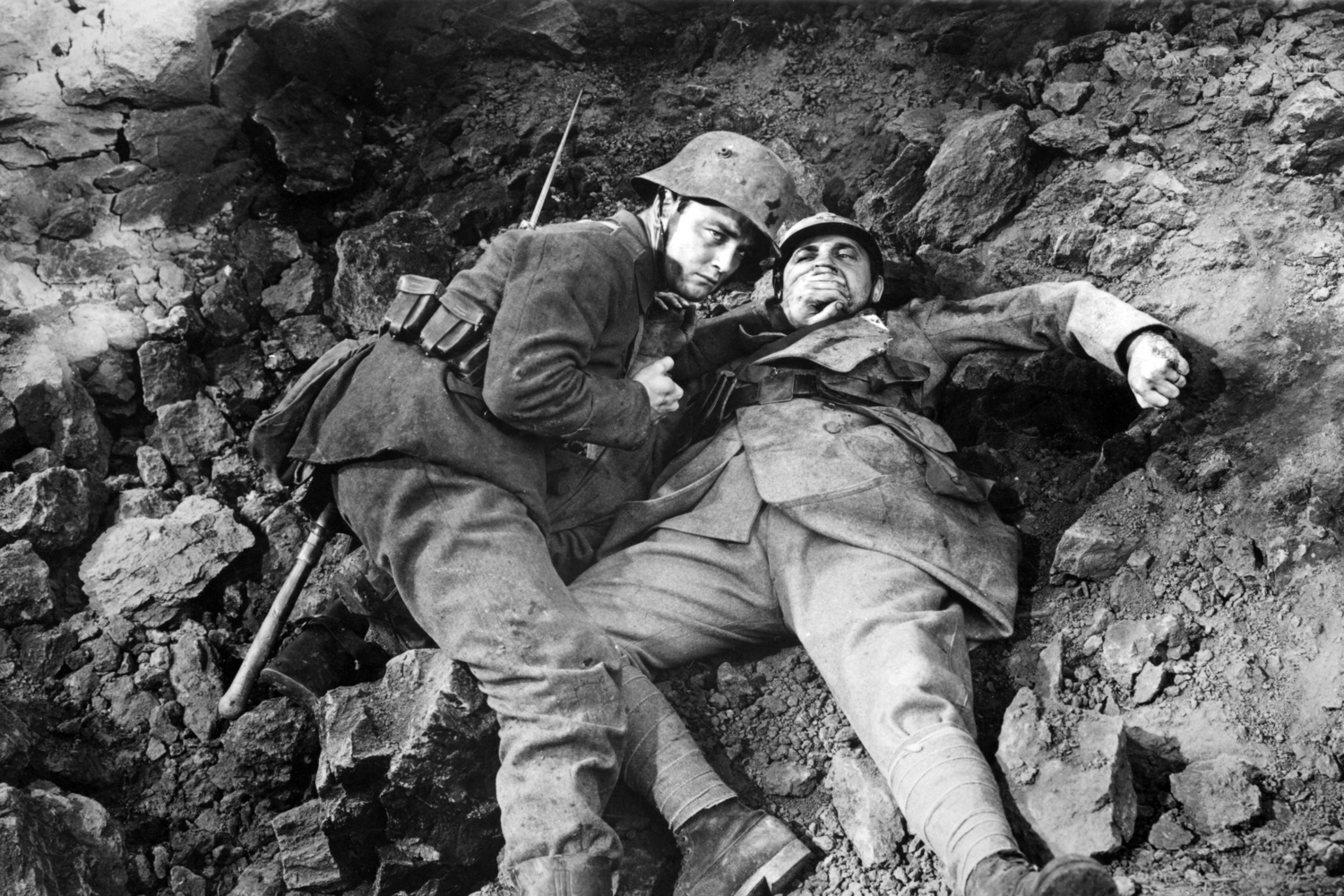
Isso significa que a maioria dos filmes sobre a Primeira Guerra Mundial é de filmes antiguerra, enquanto filmes sobre a Segunda Guerra Mundial são a favor da guerra. No artigo, Truffaut menciona “Glória Feita de Sangue” (1957), de Kubrick, como um filme antiguerra que na verdade glorifica a guerra. Eu não concordo muito com isso, mas há um filme que é completamente antiguerra e contesta a teoria de Truffaut: “Nada de Novo no Front” (1930).

This means that most films about WWI are anti-war films, while WWII films are pro-war. In the article, Truffaut mentions Kubrick’s “Paths of Glory” (1957) as an anti-war film that actually glorifies war. I don’t really agree with that, but there is one film that is completely anti-war and disproves Truffaut’s theory: “All Quiet on the Western Front” (1930).


“Nada de Novo no Front” é um filme de 1930 da Universal Pictures dirigido por Lewis Milestone. Ele é baseado no romance homônimo de Erich Maria Remarque, publicado em 1928. Ele conta a história do jovem alemão Paul Bäumer (interpretado por Lew Ayres) e seus colegas de classe que se alistam no exército após um inflamado discurso patriótico feito por um professor. Eles aprenderão que a guerra é bem diferente da descrição do professor: menos emocionante e glamourosa.

“All Quiet on the Western Front” is a 1930 Universal Pictures movie directed by Lewis Milestone. It is based on the novel of the same name by Erich Maria Remarque, published in 1928. It follows the young German Paul Bäumer (played by Lew Ayres) and his fellow classmates who enlist in the German Army after their teacher makes an intense patriotic speech. They all will learn that war isn’t that exciting or glamorous as the teacher had painted it.


Para mim, há duas sequências fundamentais que mostram a desilusão destes jovens e também que a guerra não merecia o esforço. A primeira é quando o Cabo Himmelstoss (John Wray) – o homem abusivo que treinou os jovens antes de eles partirem para o campo de batalha – chega ao front e, vendo a guerra pela primeira vez, se mostra um covarde. Himmelstoss só era valente perto de jovens imaturos. Fato curioso: Himmelstoss significa "céu em queda" em alemão.

For me, there are two key sequences that show the disillusionment of those youngsters, also showing that the war was not worth fighting. The first is when Corporal Himmelstoss (John Wray) – the abusive man who trained the boys before they went to the front – arrives in the front and, seeing war for the first time, acts with cowardice. Himmelstoss was, after all, only a big bully. Curious fact: Himmelstoss means "falling sky" in German.


A segunda sequência envolve Paul voltando para casa, de folga. Quando ele chega à sua cidade natal, ele percebe que ninguém lá é capaz de imaginar os horrores da guerra, e eles inclusive acham que a Alemanha está a um passo da vitória. Pior ainda: quando ele visita sua velha escola, ele vê o professor Kantorek (Arnold Lucy) repetindo o mesmo discurso patriótico glorioso para alunos muito mais jovens que Paul. Revoltado, Paul conta a eles a verdade sobre a guerra, e como o professor não sabe do que está falando porque nunca esteve no front. Paul é então chamado de covarde pelos jovens estudantes, em transe com o discurso patriótico.

The second sequence involves Paul coming back home for a while. When he reaches his hometown, he realizes that nobody there imagines the horrors of war, and they all actually think that Germany is almost winning the war. Even worse: when he visits his old school, he finds Professor Kantorek (Arnold Lucy) repeating the same glorious patriotic speech to students much younger than Paul. Revolted, Paul tells them the truth about war, and how the professor can’t know them because he had never been to the front. Paul is then called a coward by the young students entranced by the patriotic speech.


“Nada de Novo no Front” era tão pacifista em sua mensagem que foi banido na Alemanha Nazista, na Itália fascista, na Áustria e até mesmo na França. Estes países só puderam ver a obra-prima de 1930 após a Segunda Guerra Mundial.

“All Quiet on the Western Front” had such a strong pacifist message that it was banned from Nazi Germany, fascist Italy, Austria and even France. Those countries could only see the 1930 masterpiece after World War II.


Além disso, a história foi tão profunda que fez o ator Lew Ayres se tornar pacifista. Isso lhe custou muito: ele se opunha à Segunda Guerra Mundial e se alistou no exército apenas para servir como ajudante médico. Depois de alguma confusão, ele finalmente seguiu no exército no posto desejado.

Moreover, the story was so appealing that it turned actor Lew Ayres into a lifelong pacifist. This cost a lot to him: he was a conscientious objector to the Second World War and enlisted in the army only to serve as medical aid. A little kerfuffle followed, until he was granted his wish.


Eu não consegui encontrar nada sobre o que Truffaut achou de “Nada de Novo no Front” – e sua opinião seria bem-vinda, porque o filme só estreou na França em 1963, quando Truffaut já era crítico de cinema. De qualquer forma, eu posso dizer uma coisa: por ter os vencedores da guerra contando uma história empática sobre os perdedores, “Nada de Novo no Front” humaniza ambos os lados do conflito e mostra que a guerra é inútil porque somos todos iguais. E eu sinto muito, monsieur Truffaut, mas este filme cria este discurso antiguerra da mais perfeita e inquestionável maneira que eu já vi no cinema.

I couldn’t find anything about what Truffaut thought of “All Quiet on the Western Front” – and his thoughts would be welcome, because the film was only allowed to be shown in France in 1963, when Truffaut was already a film critic. Anyway, I can say one thing: by letting the winners of the war tell an empathetic story about the losers, “All Quiet on the Western Front” humanizes both sides of the conflict and shows that war is useless because we’re all equal. And I’m sorry, monsieur Truffaut, but this film does this anti-war speech in the most perfect, unquestionable way I’ve ever seen on a screen.

Related Posts Plugin for WordPress, Blogger...