} Crítica Retrô: racismo

Tradutor / Translator / Traductor / Übersetzer / Traduttore / Traducteur / 翻訳者 / переводчик

Showing posts with label racismo. Show all posts

Friday, October 31, 2025

Adivinhe Quem vem para Jantar (1967) / Guess Who’s Coming to Dinner (1967)


Eu fui apresentada a Sidney Poitier pela minha professora de português do Ensino Fundamental II, que passou “Ao Mestre, com Carinho” (1968) para nós na sexta série. Quando eu comentei sobre ter visto o filme, uma das amigas da minha mãe confessou que era apaixonada por Poitier por causa de dois filmes: aquele que eu recém havia visto e “Adivinhe Quem vem para Jantar”. Uns quatro anos mais tarde eu fui apresentada à dupla dinâmica e romântica de Katharine Hepburn e Spencer Tracy. Assisti a alguns dos nove filmes que eles fizeram juntos, mas ainda não era a hora de assistir à colaboração final deles. A hora finalmente chegou.

I was introduced to Sidney Poitier by my middle school grammar teacher, who showed “To Sir, With Love” (1968) for us in sixth grade. When I talked about seeing the movie, one of my mom’s friends confessed she was in love with Poitier because of two films: that one I’d just watched and “Guess Who’s Coming to Dinner”. Some four years later I was introduced to the dynamic and romantic duo of Katharine Hepburn and Spencer Tracy. I watched some of the nine films they made together, but it wasn’t time to watch their final collaboration. The time finally arrived.

Um homem e uma mulher descem de um avião, conversando animadamente e com intimidade. Ele é negro, ela é branca. Um motorista de táxi se surpreende, assim como a plateia, quando eles se beijam no banco de trás do táxi, uma cena vista pelo retrovisor. Ele é o doutor John Prentice (Sidney Poitier), e ela é Joanna Drayton (Katharine Houghton, sobrinha na vida real de Hepburn). Eles se conheceram há somente dez dias, mas já têm certeza de que querem se casar e viver felizes para sempre. O obstáculo? Preconceito.

A man and a woman come off a plane, chatting with excitement and closeness. He’s black, she’s white. A taxi driver is surprised, as we in the audience also are, when they kiss in the back of the taxi, a scene seen by the rear mirror. He is doctor John Prentice (Sidney Poitier) and she is Joanna Drayton (Katharine Houghton, Hepburn’s real-life niece). They have known each other for only 10 days, but they are sure that they want to get married and live happily ever after. The obstacle? Prejudice.

Não é um problema o fato de John ter sido casado e tido um filho, afinal, sua esposa e a criança morreram num acidente de trem oito anos antes. John brinca que Joanna “não tem como saber quando estou com as bochechas vermelhas” e esta é sua maneira de fazer piada sobre um assunto sério. A mãe de Joanna, Christina (Katharine Hepburn), já mostrou surpresa e desapontamento em seu olhar quando ela pôs os olhos em John. O pai dela, Matt (Spencer Tracy), também está embasbacado e decide investigar o doutor Prentice. E eles têm que ser rápidos: John pega um voo naquela noite, e na semana seguinte ele e Joanna se casam em Genebra. Os Draytons darão ao casal sua bênção? 

There is no problem that John had been married and had a son, after all, wife and kid died in a train accident eight years before. John jokes that Joanna “can’t know when I’m blushing” and this is his way to joke about a serious issue. Joanna’s mother Christina (Katharine Hepburn) already showed surprise and disappointment in her look when she laid eyes on John. Her father Matt (Spencer Tracy) is also flabbergasted and decides to investigate Doctor Prentice. And they must be quick: John grabs a plane that night, and the following week he and Joanna will get married in Geneva. Will the Draytons give the couple their blessing?

O preconceito vem também da empregada dos Draytons, Tillie (Isabel Sanford). Ela é direta quando diz para Joanna que não pode se casar com John porque ele é negro. Joanna aponta que Tillie é da mesma cor que John, e por isso por que ela pode amar Tillie e não John? Às vezes o racismo está tão internalizado que negros falam e fazem coisas racistas. 

The prejudice also comes from the Draytons’ maid, Tillie (Isabel Sanford). She is blunt and candid as she says that Joanna can’t marry John because he’s black. Joanna points out that Tillie is the same color as John, so why can she love Tillie and can’t love John? Sometimes racism is so internalized that black people talk and do racist things.

Por outro lado, há aqueles que parecem ser daltônicos com o assunto, como a própria Joanna e um amigo dos Draytons, Monsenhor Ryan (Cecil Kellaway). Ele diz que já viu um bom número de casais interraciais e eles provavelmente vivem melhor porque há mais esforço, consideração e compreensão entre eles para fazer o casamento funcionar. A última lei Jim Crow de segregação havia sido revogada em 1965, e o curioso caso do casal Loving acontecido em 1958 e, como o pai de John o lembra, o casamento interracial era então ainda ilegal em 16 estados.  

On the other hand, there are those who seem to be colorblind about the issue, like Joanna herself and a friend of the Draytons, Monsignor Ryan (Cecil Kellaway). He says he’s seen a good amount of interracial couples and they probably live better together because there is more effort, consideration and comprehension between them to make the marriage work out. The last Jim Crow segregation law had been overruled in 1965, and the curious case of the Loving couple had happened in 1958 and, as John’s father reminds him, interracial marriage by then was still illegal in 16 states.

Em “Old Films, Young Eyes” (resenha em inglês AQUI), a autora Simone Elias transcreve uma fala da avó, que assistiu ao filme perto da estreia: “Na época, foi visto como um filme realmente revolucionário, por causa de uma mulher branca e um homem negro se apaixonando, formando uma relação saudável, e se casando”. Eram tempos revolucionários: pouco antes da estreia, o casamento interracial foi permitido em todos os estados. Era um passo em direção ao progresso.  

In “Old Films, Young Eyes”, author Simone Elias transcribes a quote by her grandmother, who watched the film near its premiere: “At the time, it was thought to be a breakthrough, a real revolutionary movie, because of a white woman and a black man falling in love, forming a healthy relationship, and getting married.” These were revolutionary times: months before the premiere, interracial marriage was allowed in all states. It was a step towards progress.

Spencer Tracy - ganhador de dois Oscars de Melhor Ator - e Sidney Poitier - um Oscar de Melhor Ator - são o primeiro e o segundo nomes nos créditos, e em terceiro lugar vem Katharine Hepburn, que ganharia seu segundo Oscar por esse filme, mais de 40 anos após a primeira vitória. Poitier, Tracy e Hepburn foram todos indicados ao Oscar pelo filme, mas só ela ganhou - uma vitória merecida, pois seus olhos expressivos podiam dizer mais que um monólogo. Mas são os olhos de Tracy que se enchem d’água quando ela fala sobre a melhor época do relacionamento deles - como você deve saber, Tracy e Hepburn estiveram romanticamente envolvidos por 25 anos.

Spencer Tracy - two Best Actor Oscars - and Sidney Poitier - one Best Actor Oscar - are billed first and second, and third comes Katharine Hepburn, who would win her second Oscar for this film, more than forty years after her first win. Poitier, Tracy and Hepburn were all nominated for Oscars for the film, but only she won - a win she deserved, as her expressive eyes could tell more than a long monologue. But it’s Tracy’s eyes that fill with water when she talks about the best time of their relationship - as you may know, Tracy and Hepburn were romantically involved for 25 years.

O diretor e produtor Stanley Kramer nasceu em Nova York em 1913 e era judeu - ele sabia por experiência própria o que era preconceito e discriminação. De acordo com o IMDb, ele produziu 35 títulos entre 1942 e 1979 e dirigiu 19 filmes, sendo indicado ao Oscar nove vezes, mas ganhou apenas o prêmio honorário Irving Thalberg Memorial Award em 1962. Para “Adivinhe Quem vem para Jantar”, tanto Kramer quanto Hepburn usaram seus salários como garantia porque Tracy estava muito doente durante as gravações e a garantia monetária era necessária se ele falecesse antes do fim das gravações. Tracy faleceu 17 dias após o fim das gravações. 

Director and producer Stanley Kramer was born in New York in 1913 and was Jewish - he knew a lot from his own experience about bigotry and discrimination. According to IMDb, he produced 35 titles from 1942 to 1979 and directed 19 films, being nominated for nine Oscars, but won only the Irving Thalberg Memorial Award in 1962. For “Guess Who’s Coming to Dinner”, both Kramer and Hepburn used their salaries as backing because Tracy was too sick while filming and the backing was necessary if he died before the filming was done. Tracy died 17 days after the shooting ended.

Sem dúvida inspirado pelo filme de 1967, no Brasil em 1973 estreou “Compasso de Espera”, no qual Jorge, um escritor e publicitário, se apaixona por Cristina, uma modelo. Ele é negro, ela é branca. No Brasil existe o mito da “democracia racial”, que diz que não existe racismo no país, mas está longe da verdade. O casal interpretado por Zózimo Bulbul e Renée de Vielmond sofre preconceito sobretudo de estranhos. 

Without a doubt inspired by the 1967 film, in Brazil in 1973 premiered the film “Compasso de Espera”, in which Jorge, a writer and publicist, falls in love with Cristina, a model. He’s black, she’s white. In Brazil there is the myth of “racial democracy”, according to which there isn’t racism in the country, but the contrary is true. The couple, played by Zózimo Bulbul and Renée de Vielmond, faces backlash especially from strangers.

A relação entre pais e filhos é desafiadora, e nela ambos os lados podem enfrentar situações que jamais imaginaram - como os Draytons vendo sua filha apaixonada por um homem negro. Mas os obstáculos que enfrentamos podem nos ensinar que somos mais fortes do que pensamos. Como alguém que descobre um novo sabor de sorvete favorito, nos acostumamos com coisas novas. 

The parents-children relationship is a challenging one, in which both sides might face situations they never dreamed about - like the Draytons seeing their daughter falling in love with a black man. But the obstacles we face can teach us that we’re stronger than we thought. Like someone who discovers a new favorite ice cream flavor, we get used to new things.

Tuesday, July 29, 2025

Magnólia: O Barco das Ilusões (1936) / Show Boat (1936)


Um dos meus atores / cantores favoritos é Paul Robeson. Eu sempre fiquei intrigada com a letra de uma música comumente associada à Robeson: Ol’ Man River. A letra é assim: “Estou cansado de viver mas com medo de morrer”. Já ouvi alguns idosos dizendo que estavam cansados de viver, mas ouvir um adulto saudável dizendo isso me chocou. Isso aconteceu porque eu não conhecia o contexto, algo que corrigi quando finalmente assisti ao filme “Magnólia: O Barco das Ilusões” (1936).

One of my favorite singers / actors is Paul Robeson. I’ve always been intrigued with the lyrics of one tune commonly associated with Robeson: Ol’ Man River. The lyrics are those: “I’m tired of living but scared of dying”. I’ve heard quite a few old people saying they were tired of living, but a healthy adult saying this shocked me. It was because I didn’t get the context, something I fixed by finally watching “Show Boat” (1936).

Você sabe que a sessão vai ser boa quando um verdadeiro desfile traz os créditos.

You know you’re in for a treat when a whole parade brings the credits.

A família Hawks administra um barco de espetáculos cuja aparição no horizonte é suficiente para deixar todas as pessoas - e os animais! - de uma cidade alvoroçados. Os Hawks só têm um desejo: que sua filha Magnólia (Irene Dunne) se torne uma pessoa respeitável, isso é, que ela nunca se apresente no barco de espetáculos. Mas Magnólia, ou Nola, sonha em cantar, dançar e se apresentar para o público.

The Hawks are the managers of a show boat whose sighting is enough to make all the people - and the animals! - of a town excited. They only have one wish: that their daughter Magnolia (Irene Dunne) becomes a respectable person, that is, that she never becomes a show boat attraction. But Magnolia, or Nola, dreams about singing, dancing and acting for the public.

Ela tem sua grande chance após um episódio triste: descobre-se que Steve (Donald Cook) e Julie (Helen Morgan), as estrelas do show, são um casal interracial, algo proibido no Mississipi. Num país em que “uma gota de sangue negro faz de você um negro”, ter pele clara não faz uma pessoa ser considerada branca. O episódio pode soar como um problema de um passado distante, mas não se engane: a última lei de segregação foi abolida apenas em 1965 e a genética ainda dita quem é branco e quem não é. Em “Magnólia: O Barco das Ilusões”, Julie e Steve têm que abandonar o espetáculo.

She gets her big chance after a shameful episode: it’s discovered that Steve (Donald Cook) and Julie (Helen Morgan), the stars of the show, are a mixed-race couple, a thing forbidden in Mississippi. In a country where “one drop of negro blood makes you a negro”, having fair skin doesn’t make a person be seen as white. The whole episode might sound as a problem from a distant past, but don’t be fooled: the last segregation law only fell in 1965 and genetics still dictate who is white and who isn’t. In “Show Boat”, Julie and Steve have to leave the show.

Como ela era próxima de Julie, Magnólia conhecia o papel principal e podia substituí-la, o que faz sua mãe se desesperar. Para o papel masculino principal, os Hawks contratam um viajante, Gaylord Ravenal (Allan Jones) do Tennessee. Ele e Magnólia têm uma química incrível, afinal, estão apaixonados! Mas este é um melodrama musical, então você pode esperar que muitos obstáculos aparecerão em seus caminhos.

Since she was close to Julie, Magnolia knew the lead part and could replace her, to her mother’s desperation. As the leading man, the Hawks hire a passerby, Gaylord Ravenal (Allan Jones) from Tennessee. He and Magnolia have a magnificent chemistry, after all, they’re in love! But this is a musical melodrama, so you can expect that many hardships will come their way.

A escolha do diretor pode parecer estranha: James Whale, o mesmo cara que dirigiu “Frankenstein” (1931), entre outros filmes de monstro. Na sequência de Ol’ Man River, há alguns ângulos de câmera inspirados e sombras que contam uma história. “Magnólia: O Barco das Ilusões” acabou sendo o filme favorito de Whale entre suas próprias obras.

The director choice may look odd: James Whale, the same guy who directed “Frankenstein” (1931), among other monster movies. In the Ol’ Man River sequence, there are some inspired camera angles and shadows telling the story. “Show Boat” ended up being the favorite among Whale’s own films.

A música é de Jerome Kern e as letras de Oscar Hammerstein II. As canções são mais o estilo de uma ópera, como aquelas nos filmes de Nelson Eddy e Jeanette MacDonald. Elas são perfeitas para o estilo de Allan Jones, que também foi estrela do filme dos Irmãos Marx “Uma Noite na Ópera” (1935).

The music is by Jerome Kern and the lyrics by Oscar Hammerstein II. The songs are more operatic, such as the ones in the Nelson Eddy and Jeanette MacDonald movies. They suit perfectly the style of Allan Jones, who also starred in the Marx Brothers vehicle “A Night at the Opera” (1935).

Falamos dos pontos positivos, agora vem a parte negativa: o racismo. Quando Irene Dunne começa a fazer uma dança chamada cakewalk, é simplesmente ofensivo. E aí fica pior: ela canta com blackface. Mais do que isso, Hattie McDaniel faz um papel de empregada (“Mamie”). O Joe de Paul Robeson é retratado como preguiçoso - mesmo com suas canções sendo as melhores do filme.

We talked about the good, now comes the bad and the ugly: racism. When Irene Dunne starts doing the cakewalk it’s simply offensive. And then it gets worse: she sings while doing blackface. Moreover, Hattie McDaniel is stuck in a Mamie kind of role. Paul Robeson’s Joe is portrayed as lazy - even though his songs are the best in the movie.

Agora que eu assisti a “Magnólia: O Barco das Ilusões”, eu sei que a letra de Ol’ Man River vai além: Paul Robeson canta expressando seu desejo de cruzar o Rio Jordão, o que significa que ele está em busca de liberdade e redenção. Morrer numa vida para começar de novo. No final das contas, o filme pode ser uma saga focada numa família do ramo do entretenimento, mas o que se perpetua e sobrevive através do tempo é o grande número de Paul Robeson.

Now that I have watched “Show Boat”, I know there is more to the Ol’ Man River lyrics: Paul Robeson sings about his wish to cross the Jordan River, meaning he’s looking for freedom and redemption. Dying in one life to start anew. In the end, the film might be a saga focusing on a white family in the entertainment business, but what remains and shall survive through the ages is Paul Robeson’s big number.

Sunday, March 31, 2024

No Calor da Noite (1967) / In the Heat of the Night (1967)


O que seria do cinema sem as duplas dissonantes? Pessoas que são como yin e yang, mas estão juntas por alguma razão, em uma missão ou para resolver um problema. Pessoas que são unidas pelo destino, pela providência ou qualquer outra crença. A primeira dupla dissonante que me vem à mente são o Gordo e o Magro – Laurel & Hardy – mas assim como eles há dúzias de duplas juntas para resolverem algumas belas bagunças. Isso acontece num dos mais icônicos filmes da década de 1960, “No Calor da Noite”.


What would be of cinema if there weren’t mismatched duos? People who are like yin and yang, but are together for some reason, on a mission or solving a problem. People who are reunited by fate, providence or whatever else you believe in. The first mismatched duo that comes to my mind are Stan Laurel and Oliver Hardy, but like them there are dozens of duos together to solve a nice mess. This happens in one of the most iconic films of the 1960s, “In the Heat of the Night”.

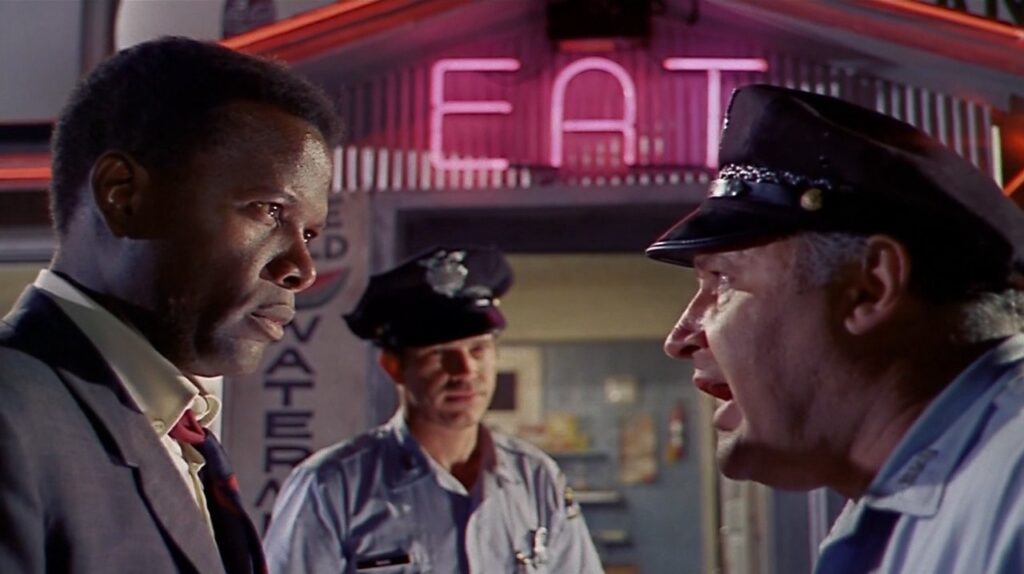
Virgil Tibbs (Sidney Poitier) chega de trem uma noite em Sparta, Mississippi. Ele mal havia descido do trem quando é conduzido à delegacia de polícia local como suspeito de assassinato. Mas é claro, pensa o policial Sam Wood (Warren Oates), pois trata-se de um homem negro estranho com dinheiro demais na carteira. Tibbs, ele próprio um policial na Pensilvânia, estava apenas esperando o próximo trem para Memphis, para ir visitar a mãe.


Virgil Tibbs (Sidney Poitier) arrives by train one night in Sparta, Mississippi. He barely got down the train when he’s taken to the local police station as suspect for a homicide. Of course, thinks police officer Sam Wood (Warren Oates), because he’s a foreign black man with too much money on his wallet. Mr Tibbs, himself a police officer in Pennsylvania, was just waiting for the next train to Memphis, to visit his mother.

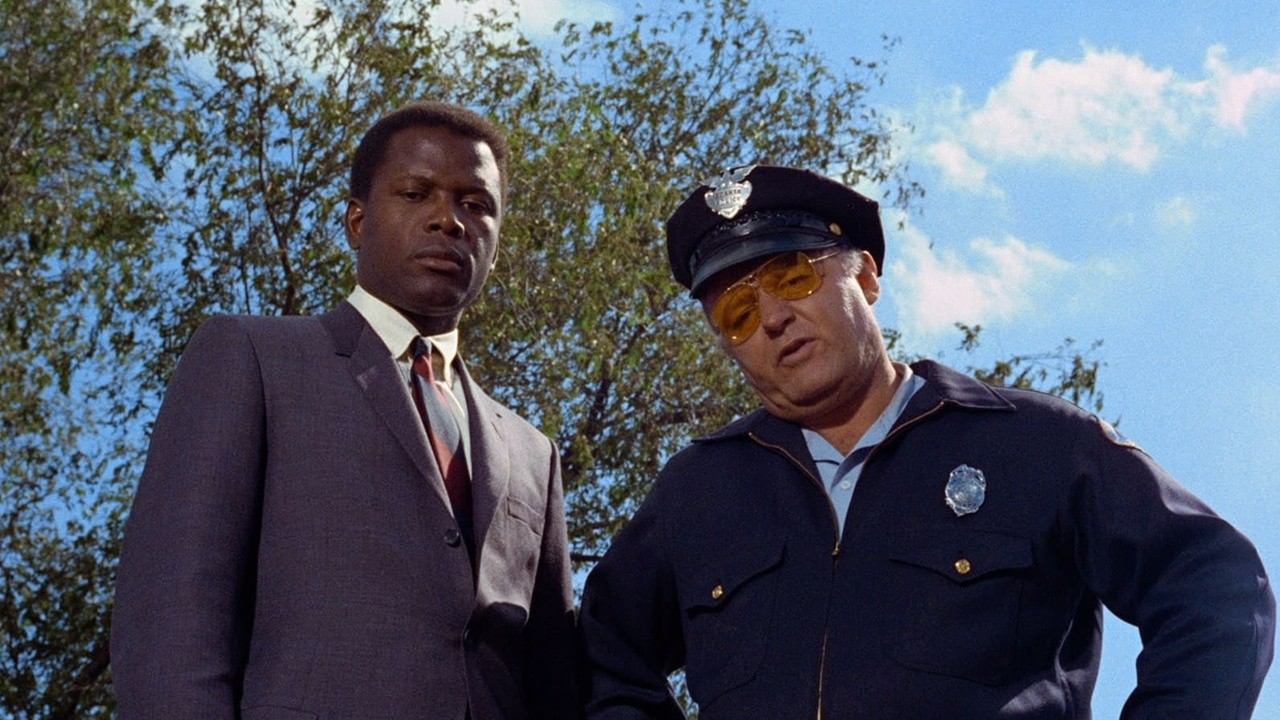
Acontece que Virgil Tibbs é um perito em homicídios, como seu chefe conta aos policiais que o prenderam. De repente, Tibbs, de suspeito torna-se investigador do assassinato do Sr Colbert, um homem rico. Ele trabalhará ao lado do chefe de polícia Bill Gillespie (Rod Steiger), que é o yin do yang representado por Tibbs.


Virgil Tibbs happens to be an expert in homicides, as his boss tells the police officers who arrested him. Suddenly, Tibbs goes from suspect to investigator in the murder of Mr Colbert, a rich man from the town. He’ll work alongside chief of police Bill Gillespie (Rod Steiger), the yin to Tibbs’s yang.   

Na manhã seguinte, Bill e seus homens encontram a carteira do Sr Colbert com um homem, Harvey (Scott Wilson), que tentava escapar para o Arkansas. O suspeito é detido e o caso considerado solucionado por Bill. Mas não está certo, insiste Tibbs, pois Harvey é canhoto e o Sr Colbert foi morto por uma pessoa destra. Vendo Tibbs em ação, a Senhora Colbert (Lee Grant) insiste que ele continue na investigação. Bill não quer trabalhar com Tibbs, mas este é um “mal” necessário.


The following morning, Bill and his men recover Mr Colbert’s wallet with a man, Harvey (Scott Wilson), who intended to escape to Arkansas. The suspect is arrested and the case is considered solved by Bill. But it isn’t, Tibbs insists, as Harvey is left-handed and Mr Colbert was killed by a right-handed person. Seeing Tibbs in action, Mrs Colbert (Lee Grant) insists that he keeps investigating the case. Bill doesn’t want Tibbs working with him, but the needs Tibbs nevertheless.

Harvey é mais hostil com Tibbs do que com Bill. Quando os dois ficam presos na mesma cela – porque Tibbs estava “escondendo evidências” – Harvey pergunta a ele “o que você está fazendo nestas roupas de homem branco?”. É claro que ninguém seria super simpático estando preso acusado de um crime, mas é em momentos como este que as pessoas mostram como são de verdade – e quais os seus preconceitos.


Harvey is more hostile towards Tibbs than Bill. When the two men share a cell – because Tibbs was “hiding evidence” – Harvey asks him “what are you doing wearing white men’s clothes?”. Of course nobody would be fully sympathetic while in a cell accused of a crime, but it’s in moments like those that the people show their true colors – and prejudices.

O próprio crime pode ter a ver com racismo. O Sr Colbert foi para Sparta para construir uma fábrica, onde ele empregaria mil pessoas, metade delas negras. Por enquanto, as únicas pessoas negras na cidade são o mecânico e sua família e os trabalhadores que colhem algodão na propriedade do Sr Endicott – ao passar por eles, Bill até mesmo provoca Virgil dizendo “nada disso foi feito para você, né?”.


The crime itself may be linked to racism. Mr Colbert went to Sparta to build a factory, where he would hire a thousand men, half of them black. For now, the only other black people in town are the mechanic and his family and those picking cotton at Mr Endicott’s property – passing them, Bill even teases Virgil by saying “nothing of this is for you, uh?”.

Apesar de sua resistência contra Tibbs, Bill acaba o salvando quando um grupo de jovens delinquentes, dirigindo um carro com a bandeira confederada na placa, começa a atacar Tibbs num barracão aparentemente abandonado. Tibbs sofre preconceito em muitos outros momentos, como quando o atendente do restaurante se recusa a servi-lo, mas estas coisas são consideradas “normais” por Bill e os demais.


Despite his resistance against Tibbs, Bill ends up saving him when a group of young troublemakers, driving a car with the Confederate flag in the plaque, starts attacking Tibbs in a seemingly abandoned hangar. Tibbs suffers prejudice in many more moments, like when the restaurant clerk refuses to serve him, but these things are deemed “normal” by Bill and the others.

A música é do incomparável Quincy Jones, com a canção de abertura cantada por outra lenda, Ray Charles – esta canção alcançou o TOP 40 da Billboard quando o filme foi lançado. AS letras das canções são de Alan e Marilyn Bergman, que se casaram em 1958 e ficaram juntos por 64 anos. “No Calor da Noite” foi o pontapé inicial para o sucesso do casal no mundo do cinema, e eles mais tarde ganhariam três Oscars.


The music is by the incomparable Quincy Jones, with the title song sung by another music legend, Ray Charles – this song made it to Billboard’s TOP 40 when the movie was released. The lyricists are Alan and Marilyn Bergman, a couple who married in 1958 and were together for 64 years. “In the Heat of the Night” was the couple’s breakthrough in the movie industry and they would go on to win three Oscars.

O editor do filme é Hal Ashby, também assistente do produtor, e que iria se tornar um diretor de sucesso. Ashby ganhou o Oscar de Melhor Edição por “No Calor da Noite”, sendo este o acontecimento que coroou sua parceria com o diretor Norman Jewison, que convenceu Ashby a se aventurar também na direção. Um dos filmes de maior sucesso de Ashby na direção foi “Amargo Regresso” (1978).


The editor of the film is Hal Ashby, also assistant to the producer, who would go on to become a successful director. Ashby won the Best Editing Oscar for “In the Heat of the Night”, being this the crowning achievement of his partnership with director Norman Jewison, who convinced Ashby to try directing as well. One of Ashby’s greatest hits as director was “Coming Home” (1978).

A escolha do elenco foi feita por Lynn Stallmaster. De acordo com o IMDb, George C. Scott era a primeira escolha para interpretar Bill Gillespie, mas estava gravando outro filme. A Robert Mitchum foi oferecido o papel, mas ele o recusou. Rod Steiger, escalado em seu lugar, ganhou o Oscar de Melhor Ator naquele ano. Por outro lado, a Wikipedia, citando o AFI – Instituto de Cinema Americano – diz que Poitier e Steiger foram as primeiras escolhas para os papéis e, sendo velhos amigos, queriam muito trabalhar juntos.


The casting was done by Lynn Stallmaster. According to IMDb, George C. Scott was the first choice to play Bill Gillespie, but was working in another movie at the same time. Robert Mitchum was offered the role, but refused it. Rod Steiger, cast instead, went on to win the Best Actor Oscar that year. On the other hand, Wikipedia, quoting the American Film Institute, says that Poitier and Steiger were the first choices for the roles, and, as old friends, were looking forward to working together.

Eu ouvi numa aula recentemente que os filmes de Sidney Poitier trazem uma “narrativa de assimilação”, o que quer dizer que seus personagens são construídos de tal maneira, com tantas qualidades e nenhum defeito, que as pessoas brancas não têm outra opção a não ser aceitar aquele homem negro perfeito entre elas. Isso acontece novamente em “No Calor da Noite” e inclusive foi apontado por catedráticos que Tibbs é uma figura messiânica trazendo uma comunidade inteira de volta à vida.


I heard in a class recently that Sidney Poitier’s movies bring an “assimilation narrative”, that is to say that they paint his characters with so many qualities and no bad characteristic that white people have no other option than to accept that perfect black man among them. This happens again in “In the Heat of the Night” and it has even been pointed out by scholars that Tibbs is a messianic figure bringing a whole community back to life.

“No Calor da Noite” ganhou cinco Oscars e está presente em diversas listas da AFI de melhores filmes e personagens – Tibbs é o número 19 na lista da AFI de 50 heróis mais inspiradores do cinema. O filme é famoso por uma fala dita de maneira raivosa mas demonstrando muita personalidade: “They call me MISTER Tibbs!” Mas, como o Oscar provou, este é um filme tanto sobre Bill Gillespie quanto sobre Virgil Tibbs, pois eles formaram uma verdadeira dupla dinâmica.


“In the Heat of the Night” won five Oscars and is cited in several AFI lists of best movies and best characters – Tibbs is the number 19 in the AFI list of 50 most inspiring screen heroes. The film is famous for the line with an angry delivery and a lot of personality: “They call me MISTER Tibbs!”. But, as the Oscar proved, this is as much a film about Bill Gillespie as it is about Virgil Tibbs, because they were truly a powerful duo.


This is my contribution to The Mismatched Couples blogathon, hosted by Gill and Barry from Realweegiemidget Reviews and Cinemathic Catharsis.

Wednesday, March 10, 2021

Ilha nos Trópicos (1957) / Island in the Sun (1957)


O começo de “Ilha nos Trópicos” parece um anúncio sedutor que convida o público para visitar a ilha de Santa Marta e aproveitar o verão. De fato, parece ser o paraíso, um lugar como muitos outros no Caribe. Santa Marta é um lugar fictício, mas muitas das características dadas à ilha são encontradas por todo o Caribe há os descendentes dos colonizadores britânicos, há os nativos, há uma economia baseada no turismo e nas plantações e há uma boa dose de tensão racial.

The beginning of “Island in the Sun” looks like a seductive ad calling the audience to visit the island of Santa Marta and enjoy the summer. Indeed, it looks like a paradise, a place like many others in the Caribbean. Santa Marta happens to be a fictional place, but many of the characteristics given to it could be found everywhere in the Caribbean: there are descendants of the English colonizers, there are natives, there is an economy based on tourism and plantations and there is a good deal of racial tension.

Uma das famílias mais ilustres de Santa Marta é a família Fleury. Maxwell Fleury (James Mason) pode ser parte da família bem-sucedida, mas é muito infeliz. Com medo de não corresponder à expectativa das pessoas em relação a ele e à família, Maxwell se torna muito inseguro e começa a acreditar que sua esposa Sylvia (Patricia Owens) está traindo-o com um homem que fuma cigarros egípcios – a única prova que ele tem para alimentar sua paranoia.

One of the most notorious families in Santa Marta is the Fleurys. Maxwell Fleury (James Mason) may be part of the successful family, but he is very unhappy. Fearing that he does not live to people's expectation of him and his family, he becomes very insecure and starts believing his wife Sylvia (Patricia Owens) is cheating on him with a man who smokes Egyptian cigarettes – the only evidence to support his paranoia.

Enquanto isso, a irmã mais nova de Maxwell, Jocelyn (Joan Collins), está aproveitando a vida quando conhece e se apaixona por Euan Templeton (Stephen Boyd), filho do governador da ilha. Joan Collins e Stephen Boyd estavam na época entre os candidatos para os papéis de Cleópatra e Marco Antônio no épico que acabou sendo feito em 1963 com Elizabeth Taylor e Richard Burton.

Meanwhile, Maxwell's young sister Jocelyn (Joan Collins) is living life to the fullest when she meets and falls in love with Euan Templeton (Stephen Boyd), son of the governor of the island. Joan Collins and Stephen Boyd were at the time being considered for the roles of Cleopatra and Marc Anthony in the epic film that was eventually made in 1963 with Elizabeth Taylor and Richard Burton.

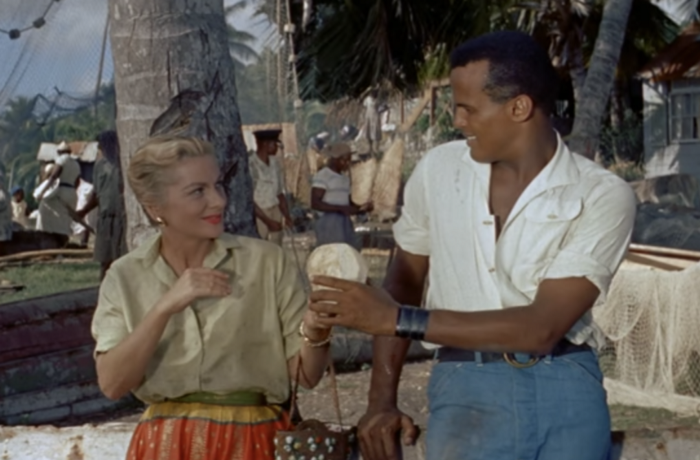
Surpreendentemente, há dois casais inter-raciais: David Boyeur (Harry Belafonte) é um líder comunitário em ascensão que está saindo com Mavis Norman (Joan Fontaine), uma mulher muito rica. E Denis (John Justin), que trabalha para o governador, começa a namorar Margot (Dorothy Dandridge), que trabalha numa farmácia.

Surprisingly, there are two interracial couples: David Boyeur (Harry Belafonte) is a rising community leader going out with Mavis Norman (Joan Fontaine), a very rich woman. And Denis (John Justin), who works for the governor, starts dating Margot (Dorothy Dandridge), a drugstore cashier. 

Maxwell e Jocelyn ficam chocados quando um artigo de jornal revela que a avó deles era jamaicana – portanto, negra. Julian, o pai deles (interpretado por Basil Sydney), tenta amenizar a situação com cálculos extremos: a mãe dele era ¾ branca! Ele é apenas 1/16 “de cor”! Já vi este tipo de matemática frequentemente no cinema e na TV norte-americanos – nunca me esquecerei quando alguém numa série de TV disse que era “1/64 Cherokee”. De fato, cor e raça são assuntos de peso nos EUA, e não de maneira velada. Veja isto: recentemente: um site se referiu à atriz Anya Taylor-Joy como “uma mulher de cor” apenas porque ela foi criada na Argentina – ela não nasceu lá, nasceu em Miami, apenas foi criada na América Latina!

Maxwell and Jocelyn are shocked when a newspaper article reveals that their grandmother was Jamaican – that means: black. Julian, their father (played by Basil Sydney), tries to compensate the situation by doing extreme math: his mother was ¾ white! He’s only 1/16 “colored”! I've seen this kind of math frequently on US film and TV – Il'll never forget when someone on a TV show claimed to be “1/64 Cherokee”. Indeed, color and race are huge issues in the US, and not in a veiled way. Take a look at this: recently, a website referred to actress Anya Taylor-Joy as “a woman of color” only because she was raised in Argentina – she wasn't born there, she was born in Miami, she was only raised in Latin America!

From dvdbeaver.com

De volta ao filme: quando o pai o obriga a agir como se nada tivesse acontecido, um contrariado Maxwell diz que é maravilhoso que o artigo tenha sido publicado porque ele pode fazer campanha para um cargo político chegando nos eleitores e dizendo “Sou um de vocês agora”, porque ele combina o negro e o branco. Maxwell acaba de dobrar suas chances de ser eleito – e de atrapalhar a carreira política de David Boyeur.

Back to the film: when his father makes him act as if nothing happened, an upset Maxwell says that it’s wonderful that the article was published because he can campaign for a political position by approaching all people and saying “I’m one of you now”, because he combines black and white.Maxwell just doubled his chances of being elected – and he can even stand in the way of David Boyeur's political career.

Além dos romances e da eleição, há mais uma coisa acontecendo na ilha: assassinato! Hilary Carson (Michael Rennie) é assassinado em sua casa, e um chefe de polícia muito sagaz, o coronal Wittingham (John Williams), investiga o caso.

Besides the romances and the election, there is something else happening in the island: murder! Hilary Carson (Michael Rennie) is murdered in his house, and a very clever chief of police, Colonel Wittingham (John Willams), investigates the case.

Quando perguntado sobre o principal problema na ilha, David Boyeur responde rapidamente: cor. Boyeur acredita que também há problemas com a manutenção das tradições. Maxwell, por outro lado, não perde a oportunidade para lembrar Boyeur de que o pai dele trabalhou na plantação do pai de Maxwell, e não foi deixado sem assistência quando adoeceu – ou seja, quando deixou de ser útil para o patrão. “Isto é caridade. O que nós queremos é igualdade”, Boyeur resume.

When asked what is the biggest problem in the island, David Boyeur answers in a heartbeat: color. Boyeur believes there are problems with keeping traditions as well. Maxwell, on the other hand, doesn't waste the opportunity to remind Boyeur that his father had worked in Maxwell's father's plantation and wasn't left unassisted when he got sick – that is, when he was no longer useful for his master. “That's charity. What we want is equality”, Boyeur summarizes.

E David está certo: há um problema envolvendo cor na ilha. Quando David e Mavis compram refrigerantes para um grupo de crianças, uma mulher mulata tira o refrigerante da mão do filho e devolve a bebida, mostrando que o menino de pele clara não deveria ser tratado da mesma forma que as outras crianças, que tinham a pele mais escura. Outro momento tenso, e muito surpreendente para um filme de 1957, ocorre quando Mavis segura uma máscara na frente do rosto e David violentamente tira a máscara, porque ela simula blackface - algo subentendido e, aparentemente, considerado normal na ilha.

And David is right: there is a problem about color in the island. When David and Mavis buy sodas for a group of kids, a mixed-race woman takes the soda away from her son’s hand and gives it back, showing that the boy with light-colored skin shouldn’t be treated like the other children, who had darker skin. Another tense moment, and a surprising one for a 1957 movie, is when Mavis puts a mask in front of her face and David violently takes it from her, as it simulates blackface - something implied and, apparently, considered normal in the island.

Maxwell é o personagem principal e a maior parte do filme é sobre ele, o que é um pouco desanimador, pois eu preferiria ter visto mais sobre os problemas enfrentados pelos casais inter-raciais. Mesmo assim, podemos dizer que é um milagre que este filme tenha sido feito, considerando os vários assuntos polêmicos que foram minimamente abordados - e isso inclui retratar David como um líder popular carismático e justo em tempos de histeria McCarthista.

Maxwell is the main character and most of the film revolves around him, which is a little upsetting, as I'd rather have seen more of the troubles faced by the interracial couples. Nevertheless, we can say that it's a miracle that this film was made at all, considering the many risky subjects that were barely addressed – and this includes the portrayal of David as a charismatic and just popular leader in a time of McCarthism hysteria.

Mas, na Hollywood dos anos 50, Darry F. Zanuck não tinha (muito) medo de arriscar - lembre-se de que ele foi produtor de outro filme sobre o controverso tema da miscigenação, “O que a Carne Herda” (1949). Zanuck comprou os direitos de adaptação do romance “Island in the Sun” quando ele foi publicado em 1955. Mesmo com sua experiência em polêmicas, Zanuck ficou apreensivo com possíveis reclamações e exigiu algumas mudanças no roteiro - por exemplo, Dorothy Dandridge e John Justin tiveram de enfrentar o produtor para que seus personagens pudessem dizer que se amavam.

But, in Hollywood in the 1950s, Darryl F. Zanuck was not (very) afraid of risking – remember that he was the producer of another movie about the controversial theme of miscegenation, “Pinky” (1949). Zanuck bought the rights to adapt the novel “Island in the Sun” when it was published in 1955. Even though he was experienced in polemics, Zanuck was apprehensive about possible complaints and demanded some changes in the script – for instance, Dorothy Dandrige and John Justin had to battle the producer so their characters were able to say that they loved each other.

O último filme de Dorothy Dandridge tinha sido “Carmen Jones”, em 1954, com Harry Belafonte. Depois do sucesso do filme e uma indicação ao Oscar, Dorothy assinou um contrato com a 20th Century Fox, que planejava um remake de “O anjo Azul” (1930) com um elenco todo negro, um projeto que infelizmente não se concretizou. Dorothy então recusou o papel coadjuvante de Tuptim em “O Rei e Eu” (1956), papel que foi para Rita Moreno. Em 1957, ela processou a revista Confidential após a publicação de uma notícia falsa que a acusava de “ter fornicado com um músico branco” em Nevada em 1950.

Dorothy Dandridge's last film had been “Carmen Jones”, in 1954, with Harry Belafonte. After the success of the film and an Oscar nomination, Dorothy signed with 20th Century Fox, that was planning to film a remake of “The Blue Angel” (1930) with an all-black cast, a project that unfortunately wasn’t further developed. Dorothy then refused the supporting role of Tuptim in “The King and I” (1956), a role that went to Rita Moreno. In 1957 she sued Confidential magazine when it published a false story accusing Dorothy of having “fornicated with a white band leader” in Nevada in 1950.

Logo antes de o filme estrear, Belafonte se casou com Julie Robinson, uma mulher branca. Mesmo assim, Joan Collins diz em sua autobiografia que ela e Belafonte tiveram um caso durante as filmagens de “Ilha nos Trópicos”. Poucos anos após o filme ser feito, nos anos 60, Belafonte se envolveu com o movimento dos Direitos Civis, tornando-se próximo de Martin Luther King Jr. Em sua carreira, Belafonte recusou diversas ofertas quando o papel retratava negros de maneira negativa ou quando o elenco era segregado racialmente.

Right before the film opened, Belafonte married Julie Robinson, a white woman. Nevertheless, Joan Collins claimed in her autobiography that she and Belafonte had an affair while filming “Island in the Sun”. A few years after the film was made, in the early 1960s, Belafonte got involved in the Civil Rights Movement, becoming close to Martin Luther King Jr. Throughout his career, Belafonte refused several offers if the role portrayed black people in a derogatory way or if the cast was segregated.

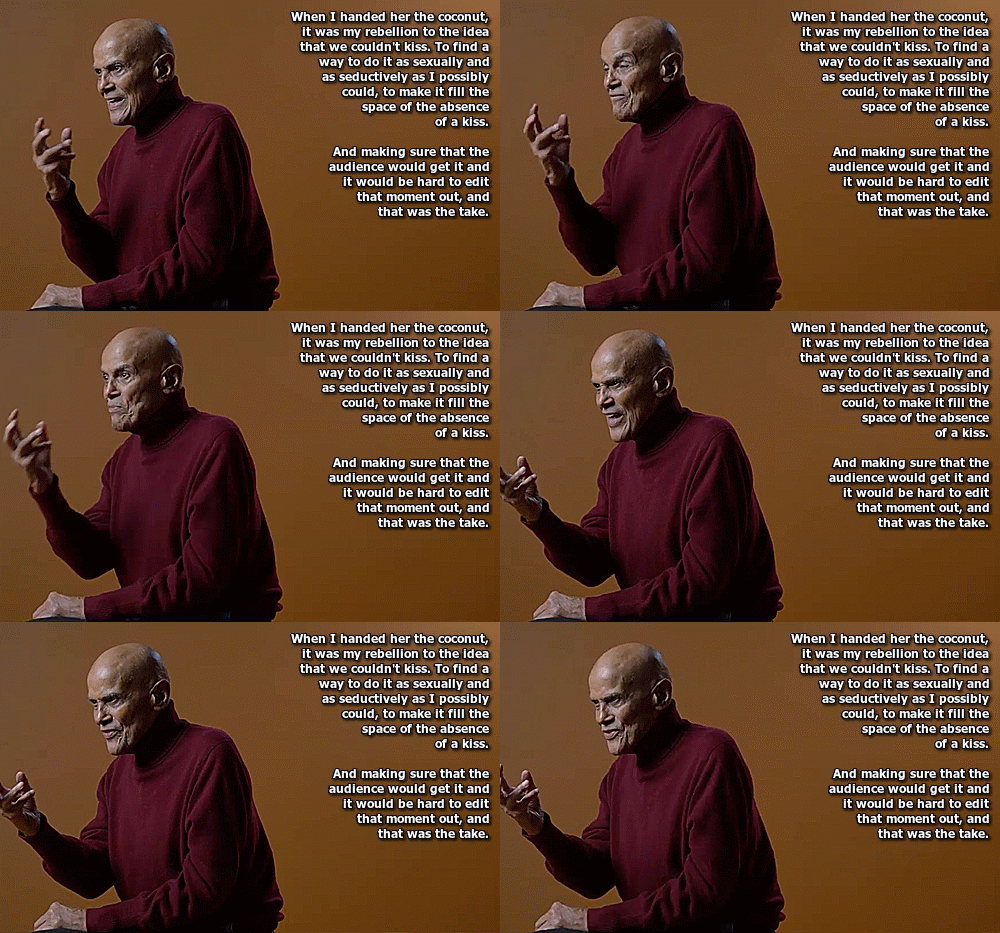
Como era de se esperar, o filme não foi bem recebido por racistas. A Ku Klux Klan e outros fanáticos mandaram cartas odiosas para Joan Fontaine - e ela nem beija Harry Belafonte no filme, mas o fato de eles beberem do mesmo coco foi considerado chocante demais! Joan precisou de escolta policial para ir à estreia do filme em Hollywood - o mesmo tipo de coisa que sua personagem jamais poderia imaginar, mas que é algo que afeta o personagem de Belafonte todos os dias. Houve protestos contra o filme em Minneapolis, um político tentou bani-lo na Carolina do Sul e o filme foi de fato banido em Memphis. Em todos estes casos, assim como acontece hoje, os racistas estavam protestando contra o filme sem tê-lo visto: para eles, a simples existência de tal filme era inaceitável.

As you may expect, the film was not received well by racists. The Ku Klux Klan and other fanatics sent Joan Fontaine hate letters – and she doesn't even kiss Harry Belafonte in the movie, but they simply sharing a coconut was considered too shocking! Fontaine needed police escort to attend the premiere of the film in Hollywood – just the kind of thing her character could never imagine, but it's something that affects Belafonte's character daily. There were protests against the film in Minneapolis, a politician tried to ban it in South Carolina and it was indeed banned in Memphis. In all these cases, just as it happens nowadays, the racists were protesting against a movie without having seen it: for them, the simple existence of such a movie was unacceptable.

Há um momento em que David diz “minha pele é meu país”. De fato, muitas pessoas sofrem por causa da cor da pele, não importa aonde elas vão - há preconceito, e especialmente preconceito racial, em toda parte do mundo. “Ilha nos Trópicos” tem boas performances e poderia ter sido muito mais revolucionário. Também poderia ter sido censurado. Por isso, vamos nos alegrar porque o filme foi feito e exibiu os talentos de artistas como Dorothy Dandridge e Harry Belafonte.

There is one moment when David says “My skin is my country”. Indeed, many people suffer because of their skin color anywhere they go - there is prejudice, and especially racial prejudice, anywhere in the world. “Island in the Sun” has nice performances and it could have been much more groundbreaking. It could also have been censored. So, let’s get happy because it was made at all, with talents such as Dorothy Dandridge’s and Harry Belafonte’s.

This is my contribution to the Joan Collins blogathon, hosted by Gill at Realweegiemidget Reviews.

Related Posts Plugin for WordPress, Blogger...