} Crítica Retrô

Tradutor / Translator / Traductor / Übersetzer / Traduttore / Traducteur / 翻訳者 / переводчик

Wednesday, June 28, 2023

Como Gosteis (1936) / As You Like It (1936)


Desde os primórdios do cinema, Shakespeare parece ser uma fonte inesgotável de histórias para serem filmadas. E não houve melhor ator para interpretar Shakespeare que Laurence Olivier. Ver a primeira vez em que ele interpretou Shakespeare num filme é como embarcar em uma máquina do tempo e poder ter um vislumbre de todo o talento e potencial – e beleza! - que ele tinha aos 29 anos. Este primeiro filme Shakespeareano é “Como Gosteis” (1936).


Since the dawn of cinema, Shakespeare seems to be a never-ending source for stories to be filmed. And there was no better actor to play Shakespeare than Laurence Olivier. Seeing the first time he played Shakespeare in a film is like embarking on a time machine and taking a glimpse of all the talent and potential - and handsomeness! - he had at age 29. This first Shakespearean flick is “As You Like It” (1936).


Nosso herói Orlando (Olivier) é um órfão que foi posto sob a tutela do irmão mais velho e precisa lutar por sua liberdade. Lutar literalmente: ele desafia Charles, o homem forte do povoado, numa luta e vence. É nesta luta que ele conhece as primas Celia (Sophie Stewart) e Rosalind (Elisabeth Bergner), e se apaixona por esta última.


Our hero Orlando (Olivier) is an orphan who was put under the wings of his older brother and needs to wrestle for his freedom. Literally wrestle: he challenges Charles, the local strongman, in a wrestling match and wins. It’s in that match that he meets the cousins Celia (Sophie Stewart) and Rosalind (Elisabeth Bergner), and falls in love with the latter.


As coisas não saem como planejado e, fugindo da ira do irmão, Orlando vai viver na floresta junto a um grupo de homens que foram banidos do reino, entre eles o pai de Rosalind. Mais apaixonado a cada dia, Orlando escreve poemas e os pendura em árvores, além de escrever o nome “Rosalind” no tronco das árvores. Um dia, sem seu vestido elegante, Rosalind se apresenta para Orlando como um homem, o único que pode fazê-lo se esquecer de seu amor impossível, e os dois iniciam um flerte esquisito e constante.


Things don’t go as expected and, running away from his brother’s rage, Orlando goes live in the forest with a group of men who have been banished from the kingdom, among them Rosalind’s father. More in love each day, Orlando writes poems and hangs them on trees, and carves the name “Rosalind” in the trees. One day, without her fancy dress, Rosalind presents herself to Orlando as a man, the only one who can make him forget this impossible love, and the two start a weird and constant flirt.


O nome de Laurence Olivier não é o primeiro nos créditos, esta honra pertence a Elisabeth Bergner. Nascida no Império Austro-Húngaro, num território que hoje faz parte da Ucrância, Bergner tinha como língua materna o alemão e de fato interpretou Rosalind nos palcos alemães. Fugindo da Alemanha quando Hitler chegou ao poder, ela jurou que só voltaria a interpretar Shakespeare na Inglaterra quando tivesse dominado a nova língua. Alguns críticos disseram que seu sotaque alemão ainda é forte no filme, mas eu discordo. Bergner fez seu primeiro filme em 1924 e já era uma atriz indicada ao Oscar quando fez “Como Gosteis”. Neste filme, ela é dirigida por seu marido Paul Czinner. Curiosidade: foi um episódio da vida de Bergner que inspirou a história de “A Malvada” (1950).


Laurence Olivier isn’t first billed in the film, this honor belongs to Elisabeth Bergner. Born in Austria-Hungary, in a territory that now is part of Ukraine, Bergner’s mother tongue was German and she did portray Rosalind on the German stage. Fleeing Germany when Hitler rose to power, she vowed to play Shakespeare again in England only when she had mastered the new language. Some critics say that her German accent was still strong in the film, but I disagree. Bergner had made her film debut in 1924 and by the time she made “As You Like It” she was already an Oscar-nominated performance and was, in this film, directed by her husband Paul Czinner. Curious tidbit: It was an episode of her life that inspired the short story that was the basis for the film “All About Eve” (1950).


David Lean trabalhou como editor neste filme. Nascido em 1908 – o que faz dele um ano mais novo que Olivier – David Lean já trabalhava como editor desde 1930, quando começou em cinejornais. No final dos anos 30 ele já era um conhecido e reconhecido editor. Ele co-dirigiu seu primeiro filme em 1942, e o resto é História.


David Lean worked as editor in this film. Born in 1908 - making him one year younger than Olivier - David Lean had been working as an editor since 1930, starting with newsreels. By the late 1930s Lean was already a well-known and praised editor. He co-directed his first film in 1942, and the rest is history.


O IMDb diz que um terço da peça original foi removido na adaptação para as telas, mas o epílogo permaneceu. O texto original foi mantido, cheio de formalidades. Acredita-se que a peça foi escrita em 1599 e é descrita como uma comédia pastoral. Foi adaptada para o cinema por J.M. Barrie, que escreveu “Peter Pan”. Considerando que cross-dressing – ou melhor, uma mulher se apresentando como um homem – é um ponto principal da trama, podemos afirmar que este filme não seria feito em Hollywood sob o Código Hays, e ainda bem que este é um filme britânico. Às vezes só os britânicos – como Olivier – conseguem fazer justiça a Shakespeare, e mesmo uma de suas peças menores pode se tornar um filme agradável se feito pelas mãos certas.


IMDb says that one-third of the play was removed when adapted to the screen, but they chose to retain the theatrical epilogue. The text was kept as it was, full of “thy’s” and “thee’s”. The play is believed to have been written in 1599 and is described as a pastoral comedy. It was adapted to the screen by J.M. Barrie, who wrote “Peter Pan”. Considering that cross-dressing - or rather, a woman presenting as a man - is a main part of the plot, this film wouldn’t be made in the US under the Hays Code, and we’re glad this is a British film. Sometimes only the British - like Olivier - can do their homeboy Shakespeare justice, and even one of his lesser plays can become an enjoyable movie if made by the right hands.

Saturday, June 17, 2023

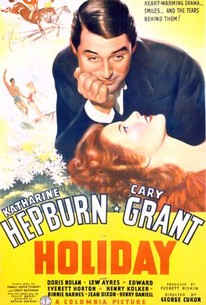
Boêmio Encantador (1938) / Holiday (1938)

 “Boêmio Encantador” é o terceiro de quatro filmes que Katharine Hepburn e Cary Grant fizeram juntos. Os outros três são “Vivendo em Dúvida” (1935), “Levada da Breca” (1938) e “Núpcias de Escândalo” (1940). “Boêmio Encantador” é o pior do quarteto, e isso pode ser porque ele é teatral demais – mas ainda é um filme bacana.


“Holiday” is the third of four movies Katharine Hepburn and Cary Grant made together. The other three are “Sylvia Scarlett” (1935), “Bringing Up Baby” (1938) and “The Philadelphia Story” (1940). “Holiday” is the worst of the bunch, and this may be because it’s too theatrical – but still a nice movie.

A trama é bem simples. Johnny Case (Grant) conhece Julia Seton (Doris Nolan) há apenas dez dias, mas acredita que está pronto para se casar com ela. O que ele não esperava descobrir é que Julia vem de uma família extremamente rica – sua casa é tão grande que tem um elevador – e que o pai dela tem tudo preparado para o casal: ele planejou a futura casa deles e quer que seu futuro genro aceite um emprego no banco dele... mas o pobre Johnny só quer sair de férias para clarear as ideias.


The plot is pretty simple. Johnny Case (Grant) has known Julia Seton (Doris Nolan) for ten days, but believes he’s ready to marry her. What he didn’t expect to discover is that Julia comes from an extremely rich family – her house is so big that it has an elevator – and her father has everything prepared for the soon-to-be newlyweds: he’s planned their future house and wants his future son-in-law to take a job at his bank… but poor Johnny only wants a holiday to clear his mind.

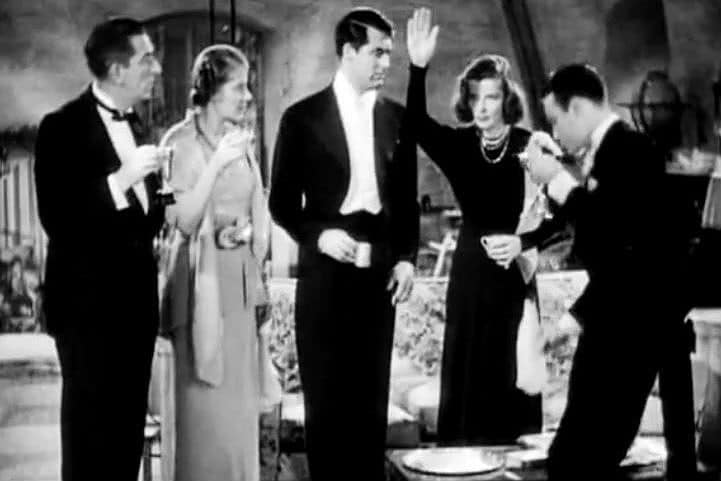
A família da noiva é fora de série: temos o irmão mais novo de Julia, o alcoólatra Ned (Lew Ayres) e a vivaz irmã mais nova Linda (Hepburn). Linda queria dar uma festa de noivado simples e íntima para Julia e Johnny, mas o pai dela decide dar uma imensa festa de véspera de Ano Novo para anunciar o noivado para toda a alta sociedade. Esta festa é o assunto da maior parte do filme.


The future in-laws Johnny meets are out of this world: there is Julia’s alcoholic younger brother Ned (Lew Ayres) and vivacious younger sister Linda (Hepburn). Linda wanted to throw a simple and intimate engagement party to Julia and Johnny, but her father decides to throw a huge New Year’s Eve party to announce their engagement to all of high society. This party takes the biggest bulk of the film.

Linda decide não se juntar à festa e fica na sala de jogos da casa, onde podemos encontrar vários brinquedos da infância dos irmãos – um tempo mais simples e mais feliz para eles. No meio da festa se juntam a ela os amigos de Johnny, Nick e Susan Potter, interpretados por Edward Everett Horton e Jean Dixon. Logo Johnny e Ned também se juntam a eles na sala de jogos, onde a verdadeira diversão está – e talvez também o amor verdadeiro.


Linda decides to not join the party and stays in the house’s playroom, where we can find several toys from the siblings’ childhood – a simpler, happier time for them. In the middle of the party she’s joined by Johnny’s close friends Nick and Susan Potter, played by Edward Everett Horton and Jean Dixon. Soon Johnny and Ned also join them in the playroom, where the true fun is – and maybe also true love.

“Boêmio Encantador” foi uma peça de teatro que estreou em 1928 e teve 229 performances. Donald Ogden Stewart, que escreveu o roteiro do filme, havia interpretado Nick Potter no teatro, e Katharine Hepburn foi substituta na peça. A peça de Philip Barry – que também escreveu “Núpcias de Escândalo” – já havia sido adaptada para as telas em 1930, e Edward Everett Horton também interpretou Nick Potter neste filme.


“Holiday” was a theater play that opened in 1928 and ran for 229 performances. Donald Ogden Stewart, who wrote the screenplay for the movie, had played Nick Potter in the theater, and Katharine Hepburn was an understudy in the play as well. The play by Philip Barry – who also wrote “The Philadelphia Story” – had already been adapted to the screen in 1930, and Edward Everett Horton was in this film as Nick Potter.

Katharine Hepburn não foi a primeira escolha para o papel de Linda. O papel era supostamente de Irene Dunne, e Ginger Rogers e Joan Bennett também foram nomes cotados antes de Hepburn ser emprestada da RKO para a Columbia - o que foi ótimo, uma vez que ela está perfeita no papel. O diretor George Cukor queria que Rita Hayworth interpretasse Julia, mas a novata foi considerada sem experiência suficiente para o papel, que ficou com Doris Nolan.


Katharine Hepburn wasn’t the first choice to play Linda. The role was supposed to go to Irene Dunne, and Ginger Rogers and Joan Bennett were also considered before Hepburn was loaned from RKO to Columbia - a great deal, as she is perfect in the role. Director George Cukor wanted Rita Hayworth to play Julia, but the newcomer wasn’t considered to be too inexperienced for the role, that went to Doris Nolan.

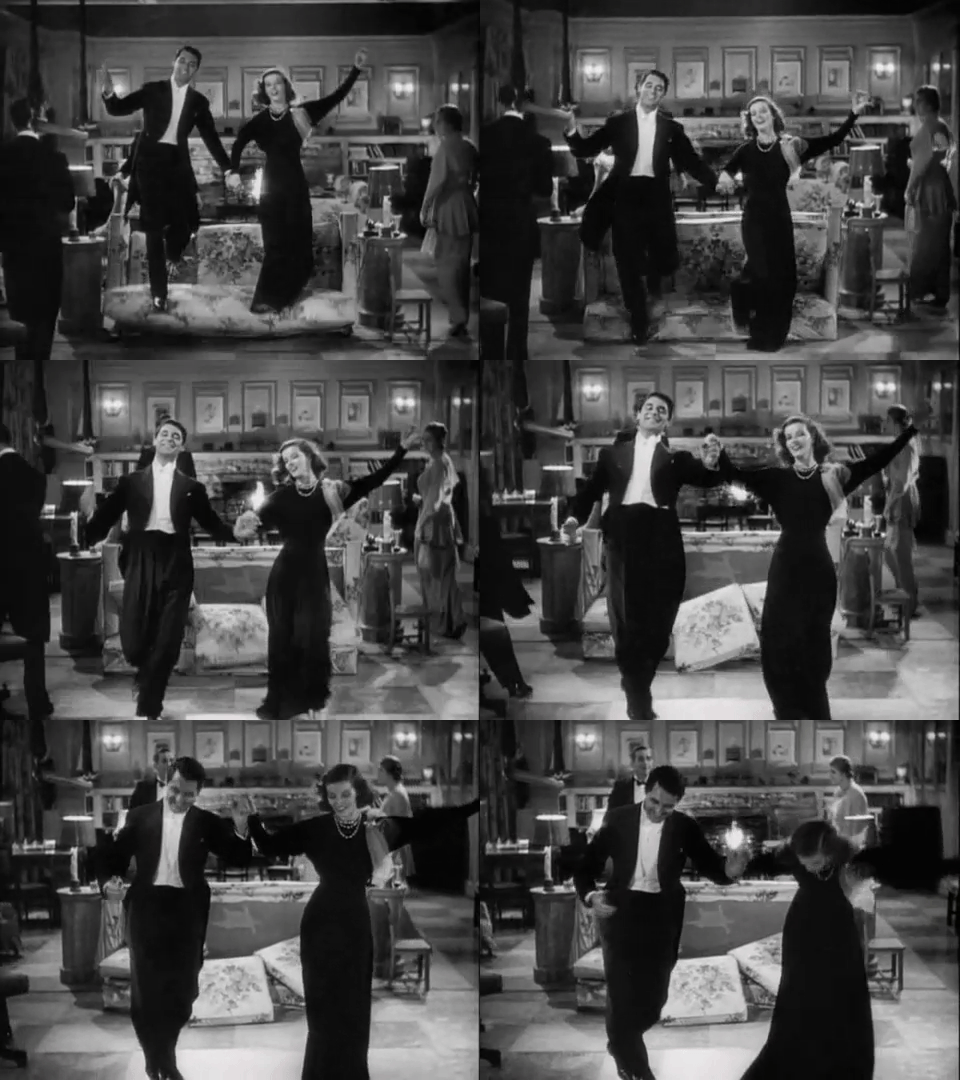
“Boêmio Encantador” é certamente um filme sofisticado, mas também verborrágico. Há muita falação – especialmente quando estão solucionando a situação toda – e só um pouco de ação. O momento com mais ação é a acrobacia de Grant e Hepburn, um momento que você pode já ter visto em forma de GIF. Menos famoso que os outros três filmes feitos pela dupla dinâmica Grant e Hepburn, “Boêmio Encantador” pode ser charmoso, mas também é um pouco chato e previsível. Uma pena, mas nem todos os filmes podem ser obras-primas.


“Holiday” is certainly a sophisticated film, but also a “talky” one. There is too much talking – especially when they are solving the whole situation – and just a little action. The moment with the most action is Grant’s and Hepburn’s tumbling trick, a moment you might have already seen as a GIF. Less famous than the other three films made by the dynamic duo Grant and Hepburn, “Holiday” may be charming, but it’s also a bit boring and predictable. Too bad, but we can’t have only masterpieces.


 This is my contribution to The Intruder blogathon, hosted by Silver Scenes. 

Saturday, June 10, 2023

Glorificação da Beleza (1929) / Glorifying the American Girl (1929)


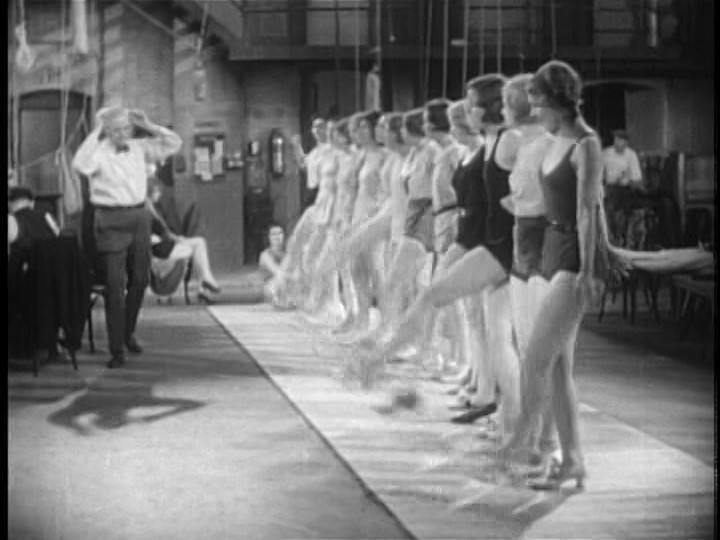
Se existisse uma máquina do tempo que funcionasse, que experiência do passado você gostaria de ter? Você escolheria ir a uma festa luxuosa em Versalhes? Ou talvez participar de um banquete romano regado a muito vinho? Você estaria na plateia da primeira apresentação de uma nova peça de Shakespeare ou preferiria assistir a uma tragédia grega? Eu escolheria a experiência de assistir a uma revista dos Ziegfeld Follies na Broadway do começo do século XX. Para minha alegria, nós temos algo semelhante a uma máquina do tempo para realizar meu desejo: o cinema. “Glorificação da Beleza”, uma famosa revista dos Ziegfeld Follies, foi adaptada para o cinema com os primeiros filmes falados e sobreviveu para ser um vislumbre do que Ziegfeld costumava fazer no teatro.


If there was a functional time machine, which experience from the past would you like to have? Would you choose attending a lavish party at Versailles? Or maybe experience a Roman banquet with lots of wine? Would you attend the first presentation of a new Shakespeare play or prefer to see a Greek tragedy live? For me, the chosen experience would be watching one of the Ziegfeld Follies revues on early 20th century Broadway. Lucky for me that we do have something similar to a time machine to fulfill my desire: the movies. “Glorifying the American Girl”, a famous Ziegfeld revue, was made into a film in the early talkie era and survived to serve as a glimpse to what Ziegfeld used to do in the theater.


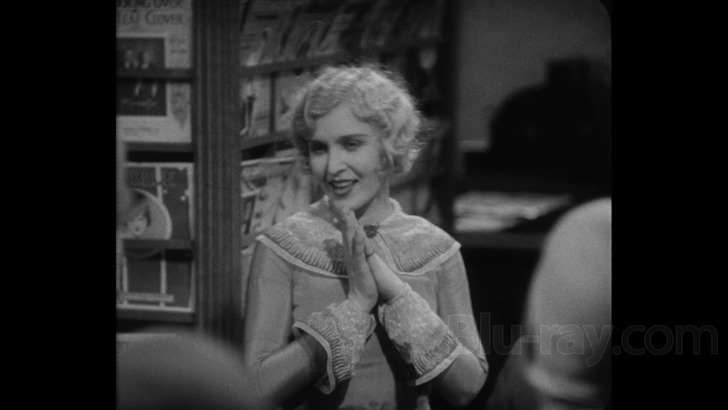
Gloria Hughes (Mary Eaton) trabalha na parte de música de uma loja de departamentos, cantando as canções junto a um pianista para vender partituras. Ela é explorada pela mãe e quer viajar e ver coisas diferentes antes de se casar com seu namorado Buddy (Edward Crandall). Gloria é a garota 100% americana: uma sonhadora e batalhadora.


Gloria Hughes (Mary Eaton) works in the music shop inside a department store, singing the songs with a piano player to sell the music sheets. She’s exploited by her mother and wants to go places and see things before finally settling down with her boyfriend Buddy (Edward Crandall). Gloria is the all-American girl: a hardworking dreamer.


Um dia, num piquenique organizado pela loja de departamentos, Gloria é descoberta, enquanto está dançando, por um artista de teatro, Miller (Dan Healy), e na mesma hora ela se junta a uma revista itinerante como parceira de dança de Miller. Acontece que Miller tinha segundas intenções com Gloria, e por isso ela o coloca no lugar dele, o que desagrada à mãe de Gloria (Sarah Edwards), uma verdadeira “overbearing stage mother”. O filme então acompanha Gloria até que ela se junta aos Ziegfeld Follies. O clímax é uma versão filmada em Technicolor da revista dos Ziegfeld Follies, completa com a presença de artistas como Eddie Cantor e Rudy Vallee.


One day, at a picnic organized by the department store, Gloria is discovered by a theater artist, Miller (Dan Healy), while she’s dancing and at the spot she joins a touring revue as Miller’s dancing partner. Turns out Miller has second intentions with Gloria, so she puts him on his place, which displeases her mother (Sarah Edwards), a real overbearing stage mother. The film then accompanies Gloria until she joins the Ziegfeld Follies. The climax is a filmed version of a Ziegfeld Follies revue in Technicolor, with special appearances of names such as Eddie Cantor and Rudy Vallee.


A maioria dos números musicais é filmada parada, como se a câmera fosse um de nós na plateia. Isto muda no grande número final, no qual a câmera é colocada em outras posições e passeia por todo o cenário. Mesmo com esses posicionamentos de câmera tradicionais, o diretor Millard Webb e o diretor de fotografia George Folsey compreenderam as possibilidades fílmicas que não eram possíveis no teatro e fizeram algumas belas cenas: uma no lago, uma com uma multidão no piquenique e uma com a câmera emulando a visão de um motorista de ambulância numa rua movimentada.


Most of the musical numbers are shot stationary, as if the camera was one of us in the audience. This changes in the big final number, in which the camera is put in other positions and strolls down the whole scenery. Even with these traditional camera placements, director Millard Webb and cinematographer George Folsey understood the filmic possibilities that couldn’t be met in theater and made beautifully shot scenes: one in the lake, one with a crowd at the picnic, and one where the camera matched the vision an ambulance driver had in a busy street.

Não há músicas muito memoráveis em “Glorificação da Beleza”. Um dos quatro nomes creditados pela “música e letra” é Irving Berlin, naquele que é apenas seu segundo crédito num filme – sendo o primeiro por música e letra de “No Hotel da Fuzarca”, do mesmo ano. Berlin alcançou a fama quando compôs “Alexander’s Ragtime Band” em 1911, e os filmes, agora falados e cantados, eram um passo natural para ele.


There are no catchy songs in “Glorifying the American Girl”. One of the four credited for “music and lyrics” is Irving Berlin, in only his second credit in a movie – the first being for music and lyrics in “The Cocoanuts”, from the same year. Berlin had rose to fame when he composed “Alexander’s Ragtime Band” in 1911, so the movies, now talking and singing, were a natural step for him.

Mary Eaton é mais conhecida hoje como irmã de Doris Eaton Travis, a Ziegfeld Girl que viveu até os 106 anos. A carreira de Mary começou com a irmã numa produção de “O Pássaro Azul” em 1911, quando Mary tinha 10 anos de idade. Mary juntou-se aos Ziegfeld Follies em 192, participando das revistas por três anos consecutivos. Tal estrela era a escolha natural para ser a protagonista da versão para os cinemas de “Glorificação da Beleza”. Naquele mesmo ano de 1929, Mary se casou com Millard Webb, diretor e roteirista do filme. Alcóolatra, Mary deixou de aparecer em filmes depois de “Glorificação da Beleza” e abandonou os palcos em 1932. Ela morreu aos 47 anos, vítima de ataque cardíaco.


Mary Eaton is best known today as the sister of Doris Eaton Travis, the Ziegfeld Girl who lived to be 106. Mary’s career began with her sister in a production of “The Blue Bird” in 1911, when Mary was only 10. Mary became part of the Ziegfeld Follies in 1920, appearing in their revues for three consecutive years. It was a no-brainer that such a star would be chosen to be the lead in the film version of “Glorifying the American Girl”. That same year of 1929, Mary got married to Millard Webb, the director and writer of the film. An alcoholic, Mary ended her film career after “Glorifying the American Girl” and her stage career in 1932. She died at 47 from a heart attack.

A Wikipedia diz que “Glorificação da Beleza” foi um fracasso quando estreou, e ainda hoje não arranca elogios de críticos que o veem em retrospectiva. Eu me atrevo a discordar. Como um dos primeiros filmes falados e um filme feito antes do Código Hays, é uma curiosidade bacana, um musical com uma trama sólida e um raro vislumbre do que era a apoteose de uma revista dos Ziegfeld Follies. A máquina do tempo existe, e foi inventada pelos irmãos Lumière: a maior máquina do tempo do mundo é o cinema.


Wikipedia says that “Glorifying the American Girl” was a flop when released, and still hasn’t met success with retrospective critics. I dare to disagree. As an early talkie and a pre-Code film, it’s a nice curiosity, a musical with a solid plot and a rare glimpse of what was the apotheosis of a Ziegfeld Follies revue. The time machine exists, and it was invented by the Lumière brothers: the world’s biggest time machine is cinema.


This is my contribution to the Sixth Annual Broadway Bound blogathon, hosted by Rebecca at Taking Up Room.

Friday, May 26, 2023

Vozes do coração (1933) / Torch Singer (1933)


Se há uma coisa boa – entre as MUITAS coisas boas – no cinema pre-Code é que vários bons filmes têm menos de 90 minutos. Tome como exemplo “Três... Ainda é Bom” (1932) que tem apenas 63 minutos ou “Serpentes de Luxo” (1933), com 71 minutos de duração. Também de 1933 e também durando 71 minutos temos “Vozes do Coração” outro pequeno grande filme.


If there is one good thing - among the MANY good things - in pre-Code cinema is that several very good movies are under 90 minutes. Take for instance “Three on a Match” (1932), that is only 63 minutes long, or “Baby Face” (1933), clocking in at 71 minutes. Also from 1933 and also lasting only 71 minutes is “Torch Singer”, another excellent little movie.

A primeira coisa que vemos na tela são chamas. Este será um filme flamejante, sem dúvidas! E ele já começa com algo que seria proibido pelo Código Hays: moças solteiras grávidas indo para um hospital comandado por freiras. Uma destas mulheres em busca de ajuda é Sally Trent (Claudette Colbert), que na cena seguinte é vista em um delírio febril chamando pelo nome de Mike.


The first thing we see on screen are flames. This will be a burning movie, no doubt about that! And it already begins with something that would be forbidden by the Hays Code: unmarried pregnant ladies going to a hospital run by nuns. One of these women seeking help is Sally Trent (Claudette Colbert), who in the next scene is seen feverishly calling someone named Mike.

No hospital Sally se torna amiga de Dora (Lyda Roberti) e quando elas recebem alta depois de darem à luz as duas vão dividir um apartamento e seguir com suas vidas agora acompanhadas de seus filhos. Sem conseguir um trabalho como corista e sem ter como pagar as contas, Sally não tem outra opção a não ser dar sua filha para as freiras criarem.


At the hospital Sally befriends Dora (Lyda Roberti) and, when they are discharged after giving birth, the two go share an apartment and move on with their lives, now with their children. Unable to find a job as a chorus girl and pay the bills, Sally has no other option but give her daughter for the nuns to raise.

Agora usando o nome artístico Mimi Benton, nossa heroína galga o caminho do sucesso: primeiro ela canta numa cantina, depois num restaurante e de repente ela está cantando acompanhada por uma orquestra. Por acaso ela acaba num programa de rádio interpretando Tia Jenny, que conta histórias para crianças. Com o sucesso do programa de rádio Mimi vê uma oportunidade para encontrar a filha – até Mike (David Manners) reaparecer em sua vida... logo quando ela está ensaiando um romance com o dono de uma casa noturna, Tony (Ricardo Cortez).


Now under the name Mimi Benton, our hero takes all the steps to success: first she sings in a canteen, then at a restaurant, and suddenly she’s singing with a full orchestra. By chance, she ends up in a radio show as Aunt Jenny, telling stories for children. With the success of the radio show, Mimi sees an opportunity to find her daughter - until Mike (David Manners) reappears in her life… right when she’s rehearsing a romance with nightclub owner Tony (Ricardo Cortez).

Alguns detalhes nos dão uma nova perspectiva sobre ver filmes antigos. O bebê que Claudette Colbert beija no começo do filme tem hoje 90 anos de idade se ainda estiver viva. Imortalizada em nitrato, esta criança e as outras crianças do filme, assim como os atores conhecidos podem ser vistos hoje pelas massas do jeito que eram há tanto tempo atrás. Esta é a mágica dos filmes: manter as pessoas vivas para novas gerações verem!


Some details give us a new perspective about watching old movies. The baby Claudette Colbert kisses in the beginning of the movie is now 90 years old, if she’s alive at all. Immortalized on nitrate, this kid and the other kids in the movie, together with the well-known actors, can now be seen by the masses as they were in times so long gone. This is the magic of movies: keeping people alive for new generations to come and see!

Só mulheres foram responsáveis pela história que vemos na tela: o roteiro foi escrito por Lenore Coffee e Lynn Starling, baseadas na história “Mike” de Grace Perkins. Há uma sequência de Dora contando para Sally sobre ser assediada no trabalho algo que só roteiristas mulheres poderiam por no papel, e algo que infelizmente desapareceria com o Código Hays. Há ainda outras coisas em “Vozes do Coração” que seriam proibidas no ano seguinte como frases de duplo sentido, chantagem e muita bebedeira.


Only women were responsible for the story we see on screen: the screenplay was written by Lenore Coffee and Lynn Starling, based on the story “Mike” by Grace Perkins. There is a sequence of Dora telling Sally about her being harassed at work, something only female screenwriters could think of, and something that would unfortunately disappear with the Hays Code. There is even more things in “Torch Singer” that would be prohibited the following year, such as double entendres, bribery and lots of drinking.

Claudette Colbert está muito bem em “Vozes do Coração”. Ela tem uma cena bêbada e também cenas emotivas que demandaram choro. Tudo o que Mimi faz, ela faz por causa de sua filha, e este filme é sobre isso: a história de uma mãe sofredora que por acaso é uma cantora.


Claudette Colbert is very good in “Torch Singer”. She gets to play a drunk scene, and also has emotional scenes that required crying. Everything Mimi does, she does because of her daughter, and this film is ultimately that: the story of a suffering mother who happens to be a torch singer.

O final pode ser meio amargo para muitos – para mim foi – embora tente ser fofo e romântico. Não é um final satisfatório para audiências modernas – pois não podemos ver como os personagens seriam felizes para sempre depois dos créditos. Mas isso não estraga a diversão, mesmo que o elenco não tenha gostado muito do resultado. É um tour-de-force para Claudette Colbert, e um muito bom, compactado em apenas 71 minutos. As pessoas sabiam como fazer filmes no passado!


The ending might be a little sour for many - for me it was - despite trying to be cute and romantic. It’s not a satisfactory ending for modern audiences - as we can’t see how things will be happily ever after when the credits roll. But this doesn’t spoil the fun, even though the cast didn’t regard the film highly after making it. It’s a tour-de-force for Claudette Colbert, and a very good one compacted in only 71 minutes. People really knew how to make movies back then!

Thursday, May 18, 2023

Raymond Burr como Perry Mason / Raymond Burr as Perry Mason


Perry Mason é um personagem criado por Erle Stanley Gardner em 1933. Gardner escreveu 82 romances e quatro contos estrelando o advogado fictício. A última vez que vimos Perry Mason, ele era interpretado por Matthew Rhys na série da HBO que investiga a história de origem do personagem numa Los Angeles proto-noir no começo da década de 1930. Mas Perry Mason foi imortalizado na telinha da televisão por Raymond Burr, que interpretou o personagem numa série que durou nove temporadas - 271 episódios! - e depois em 26 filmes feitos para a TV. Embora o personagem tenha sido interpretado por outros atores no cinema, rádio e TV, ele sempre será associado a Burr, e é sobre um destes filmes feitos para a TV que falaremos hoje.


Perry Mason is a character created by Erle Stanley Gardner in 1933. Gardner wrote 82 novels and four short stories starring the fictional lawyer. We last saw Perry Mason played by Matthew Rhys in the HBO series that investigates the character’s origin story in a proto-noir Los Angeles in the early 1930s. But Perry Mason was immortalized on the small screen by Raymond Burr, who played the character in a TV show that lasted nine seasons - 271 episodes! - and subsequently in 26 films made for TV. Although the character was portrayed by other actors on film, radio and TV, he’ll be forever associated with Burr, and it’s about one of these made-for-TV movies that we talk about today.


Seis filmes de Perry Mason foram feitos pela Warner Brothers em 1930, três deles com Warren William, um com Ricardo Cortez e um com Donald Woods como o justo advogado. Nascido em 1917, Raymond Burr já estava atuando no começo dos anos 30, em tour com um grupo de teatro canadense. Em 1940 Burr fez sua estreia na Broadway, e em 1946 fez seu primeiro filme. Burr esteve em 50 filmes entre 1946 e 1957, o mais conhecido deles sendo “Janela Indiscreta” (1954), de Alfred Hitchcock. Seu papel em “Um Lugar ao Sol” (1951), numa cena de julgamento, chamou a atenção da atriz Gail Patrick, que estava trabalhando atrás das câmeras como produtora de uma nova versão das histórias de Gardner - desta vez, para a TV.


Six Perry Mason movies were made by Warner Brothers in 1930, three of them with Warren William, one with Ricardo Cortez and another with Donald Woods as the rightful lawyer. Born in 1917, Raymond Burr was already acting in the early 1930s, touring with a Canadian theater group. In 1940 Burr made his Broadway debut, and in 1946 he made his first movie. Burr appeared in 50 films from 1946 to 1957, the most famous of them being Alfred Hitchcock’s “Rear Window” (1954). His role in “A Place in the Sun” (1951), in a courtroom scene, called the attention of fellow thespian Gail Patrick, who was working behind the cameras as a producer for a new iteration of Gardner’s work - this time, on TV.


A série de TV, começando em 1957, ficou muito popular e rendeu a Raymond Burr dois prêmios Emmy de Melhor Ator em Série Dramática. Barbara Hale, como Della Street, também ganhou um Emmy de Melhor Atriz Coadjuvante em Série Dramática. O trio não estaria completo sem Paul Drake, interpretado por William Hopper. Hopper fez um teste para o papel de Perry Mason, mas os produtores consideraram que ele era perfeito para o papel de Paul Drake. Por falar em escolha de elenco, o IMDb nos conta que outros atores considerados para o papel de Perry Mason foram William Holden, Richard Carlson, Mike Connors, Efrem Zimbalist Jr e Fred MacMurray.


The TV show, starting in 1957, became widely popular and earned Raymond Burr two Primetime Emmy Awards for Outstanding Leading Actor in a Drama Series. Barbara Hale, playing Della Street, also won an Emmy as Outstanding Supporting Actress in a Drama Series. The trio wouldn’t be complete without Paul Drake, played by William Hopper. Hopper first auditioned for the role of Perry Mason, but the producers thought he was perfect for the Paul Drake character. Talking about casting, IMDb tells us that other actors considered for the role of Perry Mason were William Holden, Richard Carlson, Mike Connors, Efrem Zimbalist Jr and Fred MacMurray.


Entre os filmes feitos para a TV de Perry Mason disponíveis no YouTube, eu escolhi ver “The Case of the Sinister Spirit” (1987) para poder conferir como era Raymond Burr como o personagem. Também de volta da série original temos Barbara Hale como Della Street.


Among the made-for-TV Perry Mason movies available on YouTube, I chose to watch “The Case of the Sinister Spirit” (1987) to see what’s the deal with this fellow Raymond Burr. Also returning from the original TV show is Barbara Hale as Della Street.


Em “The Case of the Sinister Spirit”, nós primeiro vemos Perry Mason em um tipo de mansão, andando cuidadosamente num ambiente pouco iluminado. Ele para debaixo de um lustre chique e a peça pesada cai sobre sua cabeça. Um telefone toca. Era tudo apenas um sonho para o advogado, que estava dormindo em cima de uma pilha de livros. Do outro lado da linha está Jordan White (Robert Stack), editor do livro que Mason estava lendo, “The Resort”. Jordan está indo encontrar o autor do livro, David Hall (Matthew Faison).


In “The Case of the Sinister Spirit”, we first see Perry Mason in some kind of mansion, walking around carefully in the dimly lit scenario. He stops under a fancy chandelier and the heavy piece falls on his head. A phone rings. It was all just a dream for the lawyer who was sleeping laying his head on a pile of books. On the line with Mason is Jordan White (Robert Stack), the editor of the book “The Resort” that Mason was reading. Jordan is on his way to meet the author of the book, David Hall (Mathew Faison).


O local de encontro é um resort exatamente como aquele do livro. Além de Jordan, outras pessoas foram convidadas: pessoas que inspiraram personagens do livro. Depois de um jantar frustrado e piadas sádicas, David liga para o quarto de Jordan e pede que ele vá para o bar, e daí para a torre do resort. Antes que Jordan chega, há uma briga entre David e outra pessoa, e David cai do alto da torre. Jordan se torna, como esperado, o principal suspeito do assassinato.


The meeting place is a resort just like the one in the book. Besides Jordan, other people were invited: people who inspired characters in the book. After a failed dinner and sadistic practical jokes, David calls Jordan’s bedroom and asks him to go to the bat, then to the resort tower. Before Jordan arrives, there is a fight between David and someone else, and David falls from the tower. Jordan becomes, as expected, the main suspect on the murder.


Tudo fica mais complicado para Jordan quando a polícia encontra uma foto partida em dois pedaços: um pedaço com o corpo de David e o outro no terno de Jordan. A foto é de Janet, amante de Jordan. Jordan liga para seu advogado - nosso Perry Mason - e lá vai ele para o resort, onde os quatro suspeitos estão à espera de uma solução para o crime. Enquanto isso, a única testemunha do crime, a herdeira do local, Susan Warrenfield (Kim Delaney), está sendo perseguida pelo real assassino, que quer levá-la à loucura.


Things get more complicated for Jordan when the police finds a picture in two pieces: one piece with David’s body and the other in Jordan’s suit. The picture is of Janet, Jordan’s mistress. Jordan calls his lawyer - our Perry Mason - and there he goes to the resort, where the four suspects are also waiting for the solution of the crime. Meanwhile, the only witness to the crime, the heiress of the place, Susan Warrenfield (Kim Delaney), is being persecuted, as the real murderer tries to drive her crazy.


Com 70 anos em 1987, quando “The Case of the Sinister Spirit” foi ao ar pela primeira vez, Raymond Burr está excelente, em especial nas cenas de tribunal. Barbara Hale como Della Street também merece elogios, pois ela é bem mais que “o amuleto da sorte” de Mason, como ele a chama. Della também faz parte da investigação, e se juntando à dupla temos Paul Drake Jr (William Katt), que também se garante como ótimo investigador.


Aged 70 in 1987, when “The Case of the Sinister Spirit” first aired, Raymond Burr is excellent, in special in courtroom scenes. Barbara Hale as Della Street must be highlighted, as she is much more than Mason’s “good luck charm”, as he calls her. Della investigates together, and joining the duo is Paul Drake Jr (William Katt), another great investigator on his own.


Eu nunca consegui ver a série original de Perry Mason, mas assisti ao reboot da HBO - e adorei - e, claro, assisti a “The Case of the Sinister Spirit”. O filme para a TV é muito bem feito, com ótimas performances do elenco e uma trama intrigante. Eu gostei muito da experiência e espero um dia poder encontrar episódios da série original de Perry Mason para conferir.


I wasn’t able to watch the Perry Mason original series, but I watched the HBO reboot - loved it - and of course “The Case of the Sinister Spirit”. The TV movie is very well-done, with great performances by the cast and an intriguing plot. I was mostly pleased with the experience and hope to catch episodes of the original Perry Mason somewhere one day.


Numa entrevista, Sam White, produtor associado da série Perry Mason, disse que Raymond Burr confessou a ele: “Se você não gostar de mim como Perry Mason, eu mudo e interpreto o papel do promotor de justiça, Hamilton Burger.” Nós com certeza nos alegramos por Burr ter sido um ótimo e icônico Perry Mason.


In an interview, Sam White, associate producer of the Perry Mason series, said that Burr told him: “If you don't like me as Perry Mason, then I'll go along and play the part of the district attorney, Hamilton Burger." We certainly are glad he made a wonderful iconic Perry Mason.


This is my contribution to the Big Stars on the Small Screen blogathon, hosted by the Classic Movie Blog Association in support of the National Classic Movie Day.


Related Posts Plugin for WordPress, Blogger...