} Crítica Retrô: James Mason

Tradutor / Translator / Traductor / Übersetzer / Traduttore / Traducteur / 翻訳者 / переводчик

Showing posts with label James Mason. Show all posts

Monday, May 17, 2021

Cinco Dedos (1952) / 5 Fingers (1952)


“Esta é uma história verídica”: sempre que essas palavras aparecem na tela antes do começo do filme, meu coração acelera. Às vezes a realidade é mais louca e mais inacreditável que a ficção, e este é o caso de “Cinco Dedos” (também conhecido pelo título “Operação Cícero”), um filme de suspense extremamente subestimado protagonizado por James Mason. Desde que eu o vi pela primeira vez em 31 de dezembro de 2012 – foi tão memorável que eu me lembro do dia – eu considero “Cinco Dedos” como um exemplo perfeito de um tesouro escondido do cinema.

“This is a true story”: anytime those words pop up on screen before a film starts, my heart skips a bit. Sometimes reality is wilder and more unbelievable than fiction, and this is the case of “5 Fingers”, an extremely underrated thriller starring James Mason. Since I saw it for the first time on December 31st, 2012 – it was so memorable that I remember the day – I consider “5 Fingers” to be a palpable example of a “hidden gem”.

É março de 1944, e o cenário é a Turquia, um país neutro durante a Segunda Guerra Mundial. A condessa Anna Staviska (Danielle Darrieux) é uma francesa que vivia em Varsóvia com o falecido marido, um conde polonês. Ela deixou a Polônia quando os bombardeios começaram. Agora ela só consegue comer quando é convidada para algum jantar por um amigo. São tempos difíceis para ela, como nota o conde Franz Von Papen (John Wengraf), embaixador alemão. Em tempos difíceis são tomadas decisões difíceis: a condessa está disposta a trabalhar como espiã, e Von Papen  a aconselha a desistir da ideia.

It’s March 1944, and the scenery is Turkey, a neutral country during World War II. Countess Anna Staviska (Danielle Darrieux) is a French woman who lived in Warsaw with her late husband, a Polish count. She left Poland when the bombings started. She now can only eat when she’s invited for any friend's reception. These are difficult times for her, as Count Franz Von Papen (John Wengraf), the German Ambassador, notices. In desperate times, desperate measures: the countess is willing to work as a spy, and Von Papen advises her to forget this idea.

L.C. Moyzisch (Oskar Karlweis), que trabalha para Von Papen, é visitado numa noite por um espião de verdade, Ulysses Diello (James Mason), que oferece para os alemães várias informações armazenadas em microfilme. Diello é na verdade o camareiro do embaixador britânico, por isso ele tem acesso a documentos ultrassecretos.

L.C. Moyzisch (Oskar Karlweis), who works for Von Papen,  is visited one night by a real spy, Ulysses Diello (James Mason), who offers a bunch of information in microfilm for the Germans. Diello is actually the valet of the British Ambassador, that’s why he has access to top secret documents.

Moyzisch fica nervoso facilmente e é um pouco tonto. Diello é esperto, muito esperto – ou foi o patriotismo dos alemães que os deixou burros e sem imaginação? Diello consegue abrir o cofre da casa de Moyzisch usando como combinação a data em que Hitler chegou ao poder. Moyzisch fica abestalhado mas, seguindo as ordens que havia recebido, ele diz que a embaixada alemã irá trabalhar com Diello, que dali em diante receberá o codinome Cícero. Diello fica satisfeito porque Cícero, o chefe de Estado romano foi, nas palavras de Diello, “um homem de nobreza, eloquência e insatisfação”. Como podemos ver, Diello é esperto mas também vaidoso.

Moyzisch is nervous and a bit silly. Diello is smart, very smart – or did German’s patriotism made them dumb and unimaginative? Diello is able to open the safe at Moyzisch’s place using the date when Hitler rose to power as the combination. Moyzisch is stunned but, as he was advised to do, he says the German Embassy will now work with Diello, who will from now on be referred to with the codename Cicero. Diello is pleased, as Cicero the Roman statesman was, as he says “a man of nobility, eloquence and dissatisfaction”. As we can see, Diello is clever but also vain.

Agora todas as pontas soltas se unem: Diello dá parte do dinheiro para a condessa Staviska – porque ele era camareiro do conde e, após a morte do patrão, a condessa o demitiu. Ela diz que o demitiu porque ele era “esperto demais para um criado”. Ele sabe que ela o demitiu porque ele gostava dela. Agora ele oferece parte do dinheiro que ganhou para que a condessa alugue uma casa onde Diello possa, de vez em quando, fazer negócios. Em três meses, ele terá dinheiro suficiente para conseguir uma nova identidade e começar uma vida nova com ela na América do Sul.

Now everything comes full circle: Diello gives part of the money to Countess Staviska – because he was the count’ valet and, after his boss died, the countess fired him. She says she fired him because he was “too clever for a servant”, he knows she fired him because he liked her. Now he offers part of the money he made for the countess to get a house where Diello can, sometimes, do his business. In three months, he will have enough to adopt a new identity and start a new life with her in South America.

Obviamente, não demora para que a embaixada britânica desconfie de que há um espião entre eles. O agente especial Colin Travers (Michael Rennie) é enviado da Inglaterra para investigar o caso. Agora todos são suspeitos, incluindo Diello e a condessa Anna Staviska. 

Of course, soon the British Embassy suspects that there is a spy among them. Special agent Colin Travers (Michael Rennie) is sent from England to investigate the case. Now everybody is a suspect, including Diello and the Countess Anna Staviska.

“Cinco Dedos” foi filmado em locação na Turquia, com o objetivo de parecer mais real. Entretanto, a produção se recusou a deixar tudo ainda mais real quando dispensaram serviços de consultoria do verdadeiro Cícero, o espião Elyesa Bazna, e de Moyzisch, que escreveu o livro que deu origem ao filme. O Moyzisch verdadeiro não gostou da maneira como foi retratado nas telas. A história foi recontada em 1956 em um episódio da série de TV antológica “The 20th Century-Fox Hour”, com Ricardo Montalban como Diello/Cicero e com Peter Lorre como Moyzisch.

“5 Fingers” was shot in location in Turkey, aiming for reality. However, the production refused to make things even more real when they refused technical advice from both the real Cicero, the spy Elyesa Bazna, and from Moyzisch, who wrote the book who originated the film. The real Moyzisch was displeased with the manner he was portrayed on screen. The story was told again in 1956 in an episode of the TV anthology series “The 20th Century-Fox Hour”, with Ricardo Montalban as Diello/Cicero and Peter Lorre as Moyzisch.

“Cinco Dedos” foi dirigido por Joseph L. Mankiewicz, que também dirigiu “Quem é o Infiel?” (1949) e “A Malvada” (1950). Mas a direção e as mudanças no roteiro feitas pelo outro Mank não são a parte mais importante do filme: na minha opinião, a música de Bernard Herrmann é o elemento que se destaca. Herrmann havia estreado no cinema com “Cidadão Kane” (1941) e suas colaborações com Hitchcock ainda aconteceriam dali a alguns anos, mas em “Cinco Dedos” sua trilha sonora cria suspense da maneira que só um mestre da música conseguiria.

“5 Fingers” was directed by Joseph L. Mankiewicz, who also directed “A Letter to Three Wives” (1949) and “All About Eve” (1950). But the other Mank's direction and changes in the script aren't the most important part of the film: I think the music by Bernard Herrmann is the real outstanding element. Herrmann had debuted in films with “Citizen Kane” (1941) and his collaborations with Hithcock were still a few years in the future, but in “5 Fingers” his soundtrack creates suspense like only a master musician could do. 

É interessante perceber como é a relação entre Diello e a condessa Anna Staviska. Em alguns momentos ela fala para ele preparar um drink para ela, como se ele fosse empregado dela. Quando eles finalmente se beijam, isto mudo e ele que fala para ela preparar-lhe um drink, o que ela faz com um sorriso tímido nos lábios. Entretanto, existe sempre a sensação de que eles vão entregar um ao outro, em especial quando Diello fala para Colin Travers sobre seus anos trabalhando para o conde.

It’s interesting to notice the relationship between Diello and Countess Anna Staviska. In some moments she tells him to fix him a drink, as if he was her servant. When they finally kiss, this changes and he tells her to fix him a drink, which she does with a shy smile in her lips. However, there is always the feeling that they are going to betray each other, in special when Diello talks to Colin Travers about the years he worked for the count.

Von Papen é um personagem extremamente interessante. Ele é um embaixador alemão, mas diz que “representamos um governo de delinquentes juvenis” - que é um jeito bem leve de se referir a nazistas. Começamos a ver que ele é diferente dos outros alemães na primeira cena, quando ele confessa que não suporta as composições de Wagner. Mais humano e preocupado com os outros, ele acredita que os alemães precisavam contar aos outros povos – os romenos, no caso – que seu país estava prestes a ser bombardeado pela Inglaterra, de acordo com os documentos vendidos por Diello, em vez que ficar esperando para confirmar se esta informação era correta. Na vida real, Franz Von Papen não era tão legal: enquanto chanceler, ajudou Hitler a chegar ao poder e serviu por dois anos como vice-chanceler de Hitler. Não faço ideia do motivo que levou Hollywood a retratá-lo como um cara legal.

Von Papen is an extremely interesting character. He is a German ambassador, but says that “we represent a government of juvenile delinquents” - which is a rather light term to refer to Nazis. We start to see that he’s different from other Germans in his very first scene, when he confesses that he can’t stand Wagner’s compositions. More human and concerned with others, he believes the Germans needed to tell other people – the Romanians, in this case – that their country was about to be bombarded by England, according to the documents Diello sold, rather than wait and watch to confirm the information is correct. In real life, Franz Von Papen was nowhere as nice: as a Chancellor, he helped Hitler rise to power and served as Hitler's Vice-Chancellor for two years. I have no idea why Hollywood portrayed him as a nice guy.

Ulysses Diello é esperto, sedutor e por vezes esnobe. Ele está trabalhando para os nazistas – somente por dinheiro, porque ele não é simpatizante nazista – e mesmo assim torcemos por ele. Talvez a razão para esta torcida seja porque ele é interpretado pelo sempre fabuloso James Mason. Outro dia eu me surpreendi novamente com o fato de que Mason nunca ganhou o Oscar. Talvez seja porque a Academia não foi capaz de reconhecer a facilidade e a classe com que ele atuava – e essas são as características de um ótimo espião, não?

Ulysses Diello is clever, seductive and sometimes a snob. He’s working for the Nazis – only for money, because he isn't a sympathizer – and yet we root for him. Maybe the reason why we root for him is because he’s played by the always fabulous James Mason. The other day I was once again surprised with the fact that Mason won no Oscars. Maybe it's because the Academy couldn't recognize the effortlessness and class with which he acted – and an effortless and classy spy sounds like a great spy, doesn't it?

Cheio de reviravoltas até o final, “Cinco Dedos” é um ótimo suspense que deveria ser mais conhecido. Joseph L. Mankiewicz disse que Darryl F. Zanuck, o produtor, supervisionou o processo de edição e eliminou algumas das melhores cenas. O que vemos na tela já é incrível – e eu posso apenas imaginar como este filme poderia ter sido ainda melhor se acreditarmos na palavra de Mankiewicz.

Full of plot twists until the very end, “5 Fingers” is a thrilling movie that should be better known. Joseph L. Mankiewicz said that Darryl F. Zanuck, the producer, supervised the editing process and ended up cutting some of the best scenes. What we see on screen is already amazing – and I can only wonder how much better the film could have been if we believe Mankiewicz's claim.

This is my contribution to the CMBA Hidden Classics blogathon, hosted by the Classic Movie Blog Association.

Wednesday, March 10, 2021

Ilha nos Trópicos (1957) / Island in the Sun (1957)


O começo de “Ilha nos Trópicos” parece um anúncio sedutor que convida o público para visitar a ilha de Santa Marta e aproveitar o verão. De fato, parece ser o paraíso, um lugar como muitos outros no Caribe. Santa Marta é um lugar fictício, mas muitas das características dadas à ilha são encontradas por todo o Caribe há os descendentes dos colonizadores britânicos, há os nativos, há uma economia baseada no turismo e nas plantações e há uma boa dose de tensão racial.

The beginning of “Island in the Sun” looks like a seductive ad calling the audience to visit the island of Santa Marta and enjoy the summer. Indeed, it looks like a paradise, a place like many others in the Caribbean. Santa Marta happens to be a fictional place, but many of the characteristics given to it could be found everywhere in the Caribbean: there are descendants of the English colonizers, there are natives, there is an economy based on tourism and plantations and there is a good deal of racial tension.

Uma das famílias mais ilustres de Santa Marta é a família Fleury. Maxwell Fleury (James Mason) pode ser parte da família bem-sucedida, mas é muito infeliz. Com medo de não corresponder à expectativa das pessoas em relação a ele e à família, Maxwell se torna muito inseguro e começa a acreditar que sua esposa Sylvia (Patricia Owens) está traindo-o com um homem que fuma cigarros egípcios – a única prova que ele tem para alimentar sua paranoia.

One of the most notorious families in Santa Marta is the Fleurys. Maxwell Fleury (James Mason) may be part of the successful family, but he is very unhappy. Fearing that he does not live to people's expectation of him and his family, he becomes very insecure and starts believing his wife Sylvia (Patricia Owens) is cheating on him with a man who smokes Egyptian cigarettes – the only evidence to support his paranoia.

Enquanto isso, a irmã mais nova de Maxwell, Jocelyn (Joan Collins), está aproveitando a vida quando conhece e se apaixona por Euan Templeton (Stephen Boyd), filho do governador da ilha. Joan Collins e Stephen Boyd estavam na época entre os candidatos para os papéis de Cleópatra e Marco Antônio no épico que acabou sendo feito em 1963 com Elizabeth Taylor e Richard Burton.

Meanwhile, Maxwell's young sister Jocelyn (Joan Collins) is living life to the fullest when she meets and falls in love with Euan Templeton (Stephen Boyd), son of the governor of the island. Joan Collins and Stephen Boyd were at the time being considered for the roles of Cleopatra and Marc Anthony in the epic film that was eventually made in 1963 with Elizabeth Taylor and Richard Burton.

Surpreendentemente, há dois casais inter-raciais: David Boyeur (Harry Belafonte) é um líder comunitário em ascensão que está saindo com Mavis Norman (Joan Fontaine), uma mulher muito rica. E Denis (John Justin), que trabalha para o governador, começa a namorar Margot (Dorothy Dandridge), que trabalha numa farmácia.

Surprisingly, there are two interracial couples: David Boyeur (Harry Belafonte) is a rising community leader going out with Mavis Norman (Joan Fontaine), a very rich woman. And Denis (John Justin), who works for the governor, starts dating Margot (Dorothy Dandridge), a drugstore cashier. 

Maxwell e Jocelyn ficam chocados quando um artigo de jornal revela que a avó deles era jamaicana – portanto, negra. Julian, o pai deles (interpretado por Basil Sydney), tenta amenizar a situação com cálculos extremos: a mãe dele era ¾ branca! Ele é apenas 1/16 “de cor”! Já vi este tipo de matemática frequentemente no cinema e na TV norte-americanos – nunca me esquecerei quando alguém numa série de TV disse que era “1/64 Cherokee”. De fato, cor e raça são assuntos de peso nos EUA, e não de maneira velada. Veja isto: recentemente: um site se referiu à atriz Anya Taylor-Joy como “uma mulher de cor” apenas porque ela foi criada na Argentina – ela não nasceu lá, nasceu em Miami, apenas foi criada na América Latina!

Maxwell and Jocelyn are shocked when a newspaper article reveals that their grandmother was Jamaican – that means: black. Julian, their father (played by Basil Sydney), tries to compensate the situation by doing extreme math: his mother was ¾ white! He’s only 1/16 “colored”! I've seen this kind of math frequently on US film and TV – Il'll never forget when someone on a TV show claimed to be “1/64 Cherokee”. Indeed, color and race are huge issues in the US, and not in a veiled way. Take a look at this: recently, a website referred to actress Anya Taylor-Joy as “a woman of color” only because she was raised in Argentina – she wasn't born there, she was born in Miami, she was only raised in Latin America!

From dvdbeaver.com

De volta ao filme: quando o pai o obriga a agir como se nada tivesse acontecido, um contrariado Maxwell diz que é maravilhoso que o artigo tenha sido publicado porque ele pode fazer campanha para um cargo político chegando nos eleitores e dizendo “Sou um de vocês agora”, porque ele combina o negro e o branco. Maxwell acaba de dobrar suas chances de ser eleito – e de atrapalhar a carreira política de David Boyeur.

Back to the film: when his father makes him act as if nothing happened, an upset Maxwell says that it’s wonderful that the article was published because he can campaign for a political position by approaching all people and saying “I’m one of you now”, because he combines black and white.Maxwell just doubled his chances of being elected – and he can even stand in the way of David Boyeur's political career.

Além dos romances e da eleição, há mais uma coisa acontecendo na ilha: assassinato! Hilary Carson (Michael Rennie) é assassinado em sua casa, e um chefe de polícia muito sagaz, o coronal Wittingham (John Williams), investiga o caso.

Besides the romances and the election, there is something else happening in the island: murder! Hilary Carson (Michael Rennie) is murdered in his house, and a very clever chief of police, Colonel Wittingham (John Willams), investigates the case.

Quando perguntado sobre o principal problema na ilha, David Boyeur responde rapidamente: cor. Boyeur acredita que também há problemas com a manutenção das tradições. Maxwell, por outro lado, não perde a oportunidade para lembrar Boyeur de que o pai dele trabalhou na plantação do pai de Maxwell, e não foi deixado sem assistência quando adoeceu – ou seja, quando deixou de ser útil para o patrão. “Isto é caridade. O que nós queremos é igualdade”, Boyeur resume.

When asked what is the biggest problem in the island, David Boyeur answers in a heartbeat: color. Boyeur believes there are problems with keeping traditions as well. Maxwell, on the other hand, doesn't waste the opportunity to remind Boyeur that his father had worked in Maxwell's father's plantation and wasn't left unassisted when he got sick – that is, when he was no longer useful for his master. “That's charity. What we want is equality”, Boyeur summarizes.

E David está certo: há um problema envolvendo cor na ilha. Quando David e Mavis compram refrigerantes para um grupo de crianças, uma mulher mulata tira o refrigerante da mão do filho e devolve a bebida, mostrando que o menino de pele clara não deveria ser tratado da mesma forma que as outras crianças, que tinham a pele mais escura. Outro momento tenso, e muito surpreendente para um filme de 1957, ocorre quando Mavis segura uma máscara na frente do rosto e David violentamente tira a máscara, porque ela simula blackface - algo subentendido e, aparentemente, considerado normal na ilha.

And David is right: there is a problem about color in the island. When David and Mavis buy sodas for a group of kids, a mixed-race woman takes the soda away from her son’s hand and gives it back, showing that the boy with light-colored skin shouldn’t be treated like the other children, who had darker skin. Another tense moment, and a surprising one for a 1957 movie, is when Mavis puts a mask in front of her face and David violently takes it from her, as it simulates blackface - something implied and, apparently, considered normal in the island.

Maxwell é o personagem principal e a maior parte do filme é sobre ele, o que é um pouco desanimador, pois eu preferiria ter visto mais sobre os problemas enfrentados pelos casais inter-raciais. Mesmo assim, podemos dizer que é um milagre que este filme tenha sido feito, considerando os vários assuntos polêmicos que foram minimamente abordados - e isso inclui retratar David como um líder popular carismático e justo em tempos de histeria McCarthista.

Maxwell is the main character and most of the film revolves around him, which is a little upsetting, as I'd rather have seen more of the troubles faced by the interracial couples. Nevertheless, we can say that it's a miracle that this film was made at all, considering the many risky subjects that were barely addressed – and this includes the portrayal of David as a charismatic and just popular leader in a time of McCarthism hysteria.

Mas, na Hollywood dos anos 50, Darry F. Zanuck não tinha (muito) medo de arriscar - lembre-se de que ele foi produtor de outro filme sobre o controverso tema da miscigenação, “O que a Carne Herda” (1949). Zanuck comprou os direitos de adaptação do romance “Island in the Sun” quando ele foi publicado em 1955. Mesmo com sua experiência em polêmicas, Zanuck ficou apreensivo com possíveis reclamações e exigiu algumas mudanças no roteiro - por exemplo, Dorothy Dandridge e John Justin tiveram de enfrentar o produtor para que seus personagens pudessem dizer que se amavam.

But, in Hollywood in the 1950s, Darryl F. Zanuck was not (very) afraid of risking – remember that he was the producer of another movie about the controversial theme of miscegenation, “Pinky” (1949). Zanuck bought the rights to adapt the novel “Island in the Sun” when it was published in 1955. Even though he was experienced in polemics, Zanuck was apprehensive about possible complaints and demanded some changes in the script – for instance, Dorothy Dandrige and John Justin had to battle the producer so their characters were able to say that they loved each other.

O último filme de Dorothy Dandridge tinha sido “Carmen Jones”, em 1954, com Harry Belafonte. Depois do sucesso do filme e uma indicação ao Oscar, Dorothy assinou um contrato com a 20th Century Fox, que planejava um remake de “O anjo Azul” (1930) com um elenco todo negro, um projeto que infelizmente não se concretizou. Dorothy então recusou o papel coadjuvante de Tuptim em “O Rei e Eu” (1956), papel que foi para Rita Moreno. Em 1957, ela processou a revista Confidential após a publicação de uma notícia falsa que a acusava de “ter fornicado com um músico branco” em Nevada em 1950.

Dorothy Dandridge's last film had been “Carmen Jones”, in 1954, with Harry Belafonte. After the success of the film and an Oscar nomination, Dorothy signed with 20th Century Fox, that was planning to film a remake of “The Blue Angel” (1930) with an all-black cast, a project that unfortunately wasn’t further developed. Dorothy then refused the supporting role of Tuptim in “The King and I” (1956), a role that went to Rita Moreno. In 1957 she sued Confidential magazine when it published a false story accusing Dorothy of having “fornicated with a white band leader” in Nevada in 1950.

Logo antes de o filme estrear, Belafonte se casou com Julie Robinson, uma mulher branca. Mesmo assim, Joan Collins diz em sua autobiografia que ela e Belafonte tiveram um caso durante as filmagens de “Ilha nos Trópicos”. Poucos anos após o filme ser feito, nos anos 60, Belafonte se envolveu com o movimento dos Direitos Civis, tornando-se próximo de Martin Luther King Jr. Em sua carreira, Belafonte recusou diversas ofertas quando o papel retratava negros de maneira negativa ou quando o elenco era segregado racialmente.

Right before the film opened, Belafonte married Julie Robinson, a white woman. Nevertheless, Joan Collins claimed in her autobiography that she and Belafonte had an affair while filming “Island in the Sun”. A few years after the film was made, in the early 1960s, Belafonte got involved in the Civil Rights Movement, becoming close to Martin Luther King Jr. Throughout his career, Belafonte refused several offers if the role portrayed black people in a derogatory way or if the cast was segregated.

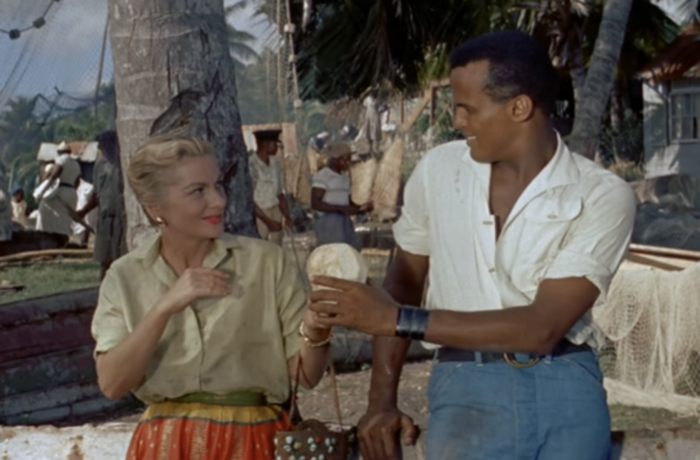
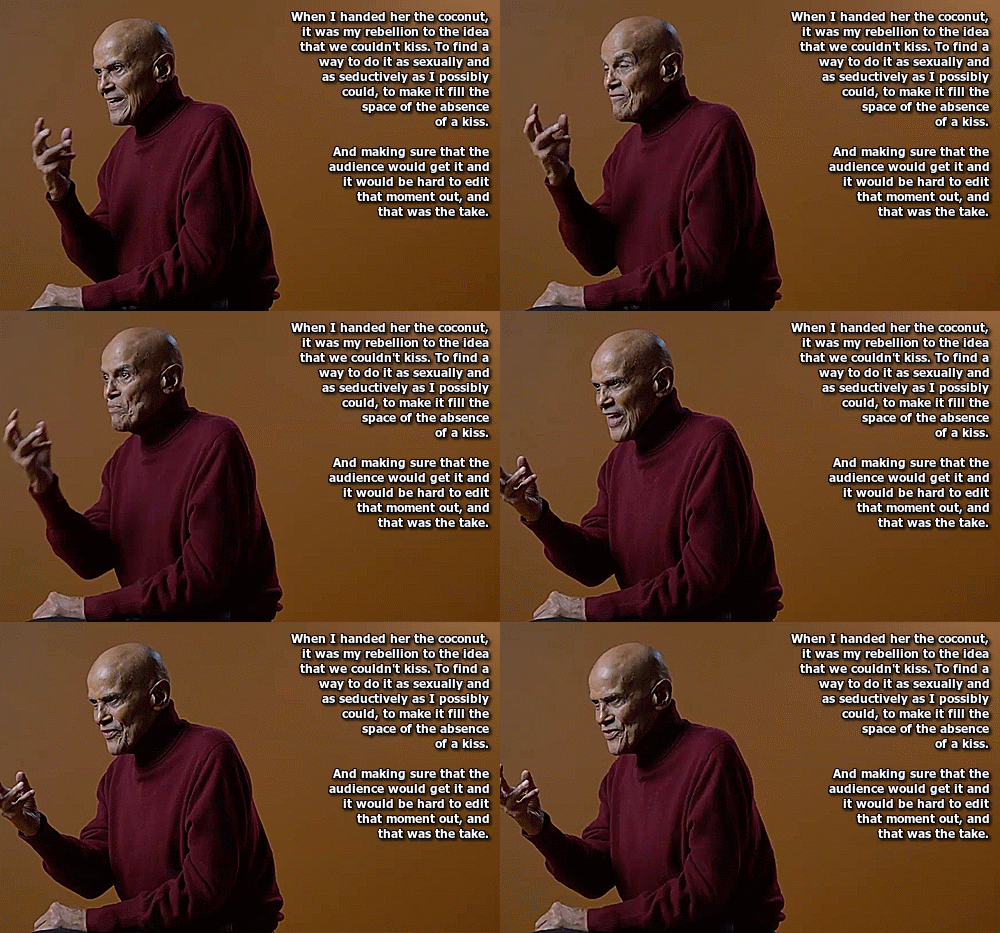
Como era de se esperar, o filme não foi bem recebido por racistas. A Ku Klux Klan e outros fanáticos mandaram cartas odiosas para Joan Fontaine - e ela nem beija Harry Belafonte no filme, mas o fato de eles beberem do mesmo coco foi considerado chocante demais! Joan precisou de escolta policial para ir à estreia do filme em Hollywood - o mesmo tipo de coisa que sua personagem jamais poderia imaginar, mas que é algo que afeta o personagem de Belafonte todos os dias. Houve protestos contra o filme em Minneapolis, um político tentou bani-lo na Carolina do Sul e o filme foi de fato banido em Memphis. Em todos estes casos, assim como acontece hoje, os racistas estavam protestando contra o filme sem tê-lo visto: para eles, a simples existência de tal filme era inaceitável.

As you may expect, the film was not received well by racists. The Ku Klux Klan and other fanatics sent Joan Fontaine hate letters – and she doesn't even kiss Harry Belafonte in the movie, but they simply sharing a coconut was considered too shocking! Fontaine needed police escort to attend the premiere of the film in Hollywood – just the kind of thing her character could never imagine, but it's something that affects Belafonte's character daily. There were protests against the film in Minneapolis, a politician tried to ban it in South Carolina and it was indeed banned in Memphis. In all these cases, just as it happens nowadays, the racists were protesting against a movie without having seen it: for them, the simple existence of such a movie was unacceptable.

Há um momento em que David diz “minha pele é meu país”. De fato, muitas pessoas sofrem por causa da cor da pele, não importa aonde elas vão - há preconceito, e especialmente preconceito racial, em toda parte do mundo. “Ilha nos Trópicos” tem boas performances e poderia ter sido muito mais revolucionário. Também poderia ter sido censurado. Por isso, vamos nos alegrar porque o filme foi feito e exibiu os talentos de artistas como Dorothy Dandridge e Harry Belafonte.

There is one moment when David says “My skin is my country”. Indeed, many people suffer because of their skin color anywhere they go - there is prejudice, and especially racial prejudice, anywhere in the world. “Island in the Sun” has nice performances and it could have been much more groundbreaking. It could also have been censored. So, let’s get happy because it was made at all, with talents such as Dorothy Dandridge’s and Harry Belafonte’s.

This is my contribution to the Joan Collins blogathon, hosted by Gill at Realweegiemidget Reviews.

Related Posts Plugin for WordPress, Blogger...