É Ano Novo e hora de escolher 12 clássicos - ou nem tão clássicos assim - que me escaparam para finalmente assistir e escrever sobre, um por mês, sem estresse. São estes os títulos que escolhi para 2026:
It’s a New Year and time to choose 12 classic - or not so classic - movies that have escaped me to finally watch and review, one per month, no stress. These are the titles I came up with for 2026:
It’s
just the most wonderful time of the year again! No, not Christmas - although I love
Christmas - it’s time to announce this year’s Luso World Cinema blogathon! The
event enters its fourth year with the usual and dedicated hostesses, Letícia
(or Le - that’s me) from Crítica Retrô and Beth from Spellbound with Beth Ann.
Just
like last year, we scheduled the blogathon around May 5th, that is
World Portuguese Language Day, a date established by UNESCO to celebrate the
first meeting of the Ministers of Culture of the Community of Portuguese
Language Countries that happened on May 5th, 2005.
Aniki Bóbó (1942)
Now,
let’s talk more about the blogathon rules:
The Luso World Cinema Blogathon once again accepts
posts about films made in Lusophone countries, that is, countries that speak
Portuguese – see the list below –, and film stars with Luso heritage, that
means, film stars of Portuguese descent. This list includes natives like Carmen
Miranda, Rodrigo Santoro, Sônia Braga, Raul Roulien, Maria de Medeiros and also
Keanu Reeves, Mary Astor, Louise Fazenda, Tom Hanks, Joe DeRita, James Franco,
Daniel Brühl, Auli'i Cravalho (the voice of Disney's Moana!), Nestor Paiva, Amy
Poehler,Dorothy DeBorba and many more
you can find listed HERE. You can write an overview of those people's lives or
careers or focus on a specific film or TV show they made. We also accept the quite
rare portraits of Portuguese, Brazilian or other Luso people in film, like in
1937’s “Captain Courageous”, in which Spencer Tracy plays a Portuguese sailor,
for instance.
Here are a few lists of movies from Lusophone
countries:
Spellbound with Beth Ann: interview with filmmaker
Alyssa Botelho
Crítica Retrô:
A Canção de Lisboa / Song of Lisbon (1933)
Musings of a Classic Film Addict: Carmen Miranda’s recipe for feijoada
Realweegiemidget Reviews: That Thing You Do (1996)
Taking Up Room: The Disaster Artist (2017)
Silver Screenings: Copacabana (1947)
The Wonderful World of Cinema: Lisbon (1956)
Moon in Gemini: Xica da Silva (1997 telenovela)
Whimsically Classic: favorite Mary Astor performances
Classic Film and TV Corner: Went the Day Well? (1942)
In the Good Old Days of Classic Hollywood: The Great Lie (1941)
Louise Brooks Society blog: Louise Brooks & Her Films as Seen in the Portuguese-American Press, Louise Brooks & Her Films as Seen in the Brazilian Magazines & Newspapers, Louise Brooks and Brazil – when Pandora’s Box was featured in a 1930 Chaplin Club newsletter
We have banners for you to spread the news about the
blogathon:
Noirvember has arrived and with it the
urge to watch foggy detective stories or films with iconic femme fatales. That’s
why we bring for you today another post in the “Lost in Translation” series.
This time, with good news: “Lost in Translation” was nominated for Best Classic
Movie Series in the latest Classic Movie Blog Association Awards. We didn’t
win, but it’s truly an honor to be nominated. Now, let’s go on with the list –
remembering that titles that do not appear here were translated verbatim:
“Double Indemnity” (1944) became “Blood
Pact” (“Pacto de Sangue”)
“Murder, my Sweet” (1944) is here “See
You, Darling” (“Até a Vista, Querida”)
“Detour” (1945) is known as “Destiny’s
Curve” (“Curva do Destino”)
Enquanto houver cinema, haverá
esperança. Este
é o mantra que eu adotei nos últimos anos, quando a realidade começou a parecer
um filme de terror e os tempos ficaram difíceis demais para nós, sonhadores. Em
certo sentido, o cinema sempre me salvou de me afogar em minhas próprias
emoções e desgostos. É isso: o cinema salva. Ele pode distrair, emocionar,
confortar, maravilhar, inspirar. Quando eu era uma adolescente que sofria
bullying, mais de 10 anos atrás, foi o cinema que me deu força para prosseguir,
então por que o cinema não poderia fazer o mesmo pelo mundo todo durante uma
pandemia? Para este momento, e para qualquer outro momento difícil, eu ofereço
minha lista de cinco clássicos para dias difíceis:
As long as there is cinema, there is hope. This is
the mantra I have adopted in the last few years, when reality started looking
like a horror movie and times became too hard for us, dreamers. In a sense,
cinema has always saved me from drowning in my own emotions and sorrows. That's
it: cinema saves. It can distract, move, comfort, amuse, inspire. When I was a
bullied teenager, over ten years ago, it was cinema that gave me strength to
carry on, so why can't cinema do the same for the whole world during a
pandemic? For this time, and for any other difficult time, I offer my top five
comfort films:
Uma Semana (1920): Sinceramente, eu poderia ter
escolhido qualquer filme de Buster Keaton. O homem que nunca ri, ironicamente,
nunca falha em colocar um sorriso no meu rosto. “Uma Semana” foi o primeiro
curta-metragem solo de Keaton – sem seu mentor no cinema, Roscoe Arbuckle – e é
o meu favorito de seus curtas. Os recém-casados Buster e Sybil Seely recebem
como presente de casamento uma casa montável que acaba ficando... peculiar.
Hilário, adorável e surpreendente, “Uma Semana” é uma pequena dose de felicidade.
One Week (1920): Sincerely,
I could have chosen any Buster Keaton film. The man who never laughs,
ironically, never fails to put a smile on my face. “One Week” was Keaton's
first solo short – without his movie mentor Roscoe Arbuckle – and it's my
favorite. Newlyweds Buster and Sybil Seely receive as a wedding gift a DIY
house that ends up being very... unique. Hilarious, lovely and surprising, “One
Week” is a small doses of happiness.
“Uma Semana” foi recentemente exibido no Silent Comedy Watch Party, que foi a única coisa boa que este caos trouxe. Esta iniciativa traz curtas-metragens mudos exibidos com acompanhamento ao vivo do pianista Ben Model e comentários do historiador Steve Massa. A exibição semanal tem mantido a minha sanidade – e também a de muitos cinéfilos.
“One Week” was recently featured at the Silent Comedy Watch Party aka
the only good thing that this chaos brought. This initiative brings silent
shorts played with live music accompaniment by pianist Ben Model and commentary
by historian Steve Massa. The weekly party has kept me – and many more film
fans – sane.
Cantando na Chuva (1952): Há algum filme mais feliz do que
“Cantando na Chuva”? Eu acho que não. Eu imagino que as pessoas que trabalhavam
no cinema se desesperaram quando os filmes falados surgiram. É assustador
seguir em frente quando você não sabe o que o futuro lhe reserva, certo? Você
pode estar vivendo isso agora, ou já viveu, ou ainda vai viver, por isso tenha
certeza: o show precisa continuar. “Cantando na Chuva” nos ensina que devemos
nos adaptar como Don Lockwood, ter um amigo leal e esforçado como Cosmo Brown e
seguir nossos sonhos como Kathy Selden – e de preferência, mantendo um senso de
humor que nos permita zombar de um técnico de voz de vez em quando.
Singin' in the Rain (1952): Is there a
happier movie than “Singin' in the Rain”? I don't think so. I imagine people
working in movies got desperate when talkies became a thing. It's scary to go
on when you don't know what the future has in store to you, right? You may be
living this right now, or have lived this, or will live, so be sure: the show
must go on. “Singin' in the Rain” teaches us that we must adapt like Don
Lockwood, have a loyal and hardworking friend like Cosmo Brown and follow our
dreams like Kathy Selden – and hopefully, keeping a sense of humor that allows
us to mock a voice coach sometimes.
Meu Tio (1958): Esta belezinha francesa funciona
basicamente como um filme mudo. Monsieur Hulot, o tio, interpretado pelo
próprio diretor Jacques Tati, vive uma vida simples em um bairro pobre.
Enquanto isso, sua irmã, cunhado e sobrinho vivem em uma casa tecnológica e os
dois adultos pensam que podem ajudar Hulot a ter uma vida melhor. Isso leva ao
conflito entre o velho e o novo, e a várias gags visuais deliciosas. Além
disso, por causa deste filme eu sempre serei louca por uma fonte em forma de
peixe.
Mon Oncle (1958): This
French beauty basically works as a silent film. Monsieur Hulot, the uncle,
played by director Jacques Tati himself, lives a simple life in a poor neighborhood.
Meanwhile, his sister, brother-in-law and nephew live in a high-tech house and the
two adults think they can help Hulot have a better life. This leads to the
conflict between old and new, and a lot of delightful visual gags. Also,
because of this film I'll be forever obsessed with a fish-shaped fountain.
Descalços no Parque (1967): Assim como “Cantando na Chuva”,
este filme mostra que, depois que as dificuldades são superadas, vem a alegria.
Corie (Jane Fonda) e Paul (Robert Redford) são recém-casados e muito
diferentes: Corie é extravagante e espontânea, enquanto Paul é quieto e sério.
A tentativa deles de encontrar um equilíbrio conforme começam uma nova vida
juntos é uma graça, e a noite de aventuras com a mãe de Corie e com um vizinho
é brilhante. Você pode ler mais sobre “Descalços no Parque” AQUI.
Barefoot in the Park (1967): Just like
“Singin' in the Rain”, this film shows that, after hardships are overcome,
there comes bliss. Corie (Jane Fonda) and Paul (Robert Redford) are newlyweds
and very different: Corie is extravagant and spontaneous, while Paul is quiet
and serious. Their attempt to find balance as they begin a new life together is
heartwarming, and their night out with Corie’s mother and a neighbor is
priceless. You can read all my thoughts about “Barefoot in the Park” HERE.
Era uma Vez em Hollywood, a
trilogia: Sinto que estou
trapaceando duas vezes aqui porque estou escolhendo uma trilogia e esta
trilogia tem pedaços de muitos filmes. De qualquer forma, os musicais sempre,
sempre me deixam feliz. Eles foram minha fonte de esperança nos dias tristes da
minha adolescência, e eu tinha 17 anos quando vi pela primeira vez “Era uma Vez
em Hollywood” (1974). Este filme, assim como “Isso Também Era Hollywood” (1976)
e “Era uma Vez em Hollywood – Parte III” (1994), traz uma compilação de clipes
de musicais da era de ouro e também algumas cenas descartadas e material dos
bastidores. Ah, e eu mencionei que o segundo filme traz Fred Astaire e Gene
Kelly dançando juntos, 30 anos depois da primeira vez que eles fizeram ISSO?
Porque isso acontece e é incrível. Essa trilogia prova que o cinema é,
realmente, uma fábrica de sonhos e de esperança.
That's Entertainment! Trilogy: I feel like
I'm cheating twice here because I'm choosing a trilogy and this trilogy has
bits of many films. Anyway, musicals always, always make me happy. They were my
main source of hope in my sad teen years, and I was 17 when I first saw “That's
Entertainment! - Part 1” (1974). This film, and also Part II (released in 1976)
and Part 3 (released in 1994), brings a compilation of clips from Golden Age
musicals and also some unused footage and behind-the-scenes material. Oh, have
I said that Part II brings Fred Astaire and Gene Kelly singing and dancing
together, 30 years after the first time they did THIS? Because it does and it's
awesome. This trilogy show that cinema really is a dream – and hope – factory.
Ah, os psicodélicos anos 60! O mundo estava
mudando e o cinema também se modificava. O Sistema de Estúdio estava vivendo
seus últimos anos. A categoria de Melhor Filme em Língua Estrangeira havia sido
introduzida no Oscar na década anterior, e os filmes de língua não-inglesa
ficavam cada vez melhores e mais acessíveis. Novas estrelas surgiam e algumas
estrelas antigas se reinventavam. Muitos filmes divertidos, inspiradores,
ousados e mesmo malucos foram feitos nesta década. Por isso foi uma tarefa
difícil escolher meus seis filmes favoritos dos anos 60. Curiosamente, acabei
com uma lista com dois dramas e quatro comédias!
Oh, the swinging 60s! The
world was changing, and the movie world was changing as well. The Studio System
was living its last years. The Best Foreign Language Movie category had been
created the decade before at the Oscar, and films not English were getting
better and more widespread. New stars were blossoming and some old ones were
reinventing themselves. Many funny, thoughtful, daring and even psychdelic
movies were made during this decade. That's why it was a hard mission to choose
my six favorite movies of the 1960s. Curiously, I ended up with two dramas and
four comedies!
Nunca aos Domingos (1960): Este filme é absolutamente delicioso. O diretor
Jules Dassin interpreta um intelectual que quer compreender a decadência da
civilização grega. Ele acredita que a Grécia não é mais o berço de artistas e filósofos
como no passado porque os gregos modernos se divertem demais. Ele inicia uma
cruzada para fazer a Grécia séria novamente, focando na prostituta Ilya (Melina
Mercouri, esposa de Dassin), uma amante da diversão. O filme ganhou o Oscar de
Melhor Canção Original, sendo a primeira vez que uma música cantada em línguadiferente do inglês levou o prêmio.
Never on Sunday (1960): This film is an absolute delight. Director Jules
Dassin also stars as a scholar who wants to comprehend the downfall of Greek civilization.
He thinks that Greece is no longer producing artists and philosophers like it
once did because the modern Greeks have too much fun. He starts a crusade to
make Greece serious again, focusing his case in the prostitute Ilya (Melina
Mercouri, Dassin’s wife), a fun-loving woman. The film won the Best Original
Song Oscar, and it was the first time a song not in English received the award.
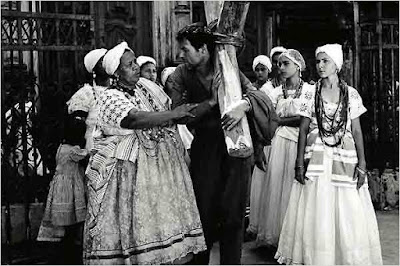
O Pagador de Promessas (1962): Zé do Burro (Leonardo Villar) prometeu doar sua
terra e carregar uma enorme cruz – como a cruz de Cristo – de sua casa até uma
igreja caso seu melhor amigo fosse curado de uma doença grave. O amigo é
curado, e Zé está a caminho da igreja... O problema é que seu melhor amigo é um
burro, e isso causa frisson, especialmente, no clero: qual será o impacto para
a igreja se deixarmos este homem fazer tamanho sacrifício por causa de um
insignificante burro? Outras questões como intolerância a religiões de origem
africana, sensacionalismo da imprensa e reforma agrária são discutidos no
filme. Se este filme tivesse sido feito na Itália, seria matéria obrigatória em
todos os cursos de cinema do mundo. “O Pagador de Promessas” não é uma
curiosidade do cinema latino-americano. É uma obra-prima.
The Given Word aka O Pagador de Promessas (1962): Zé do Burro (Leonardo Villar) promised to give away
his land and carry a huge cross – like Jesus’ cross – from his house to a
church if his best friend was cured from a serious disease. His friend is
cured, and Zé is en route to the church… The problem is that his best friend is
a donkey, and this fact causes uproar, mainly, in the clergy: what will the
impact on the church be if we let a man make such a sacrifice for an
insignificant donkey? Other issues like intolerance against African religions, sensationalist
press and land reform are tackled in this movie. If this film was made in
Italy, it’d be mandatory viewing in all film courses in the world. “The Given
Word” is not a curiosity from Latin-American cinema. It’s a masterpiece.
A Pantera Cor de Rosa (1963): Sim, o original. Com Peter Sellers e seu
Stradivarius, Claudia Cardinale, Capucine, Herbert Lom, David Niven e Robert
Wagner. Ah, e também uma certa pantera nos créditos iniciais. Há uma coleção de
ótimas gags clássicas nesta comédia deliciosa, e o clímax da ação acontece numa
festa à fantasia com uma perseguição. O que mais eu – ou qualquer pessoa –
poderia desejar?
The Pink
Panther (1963): Yes, the original. With Peter Sellers and his Stradivarius, Claudia
Cardinale, Capucine, Herbert Lom, David Niven and Robert Wagner. And, oh, also
a certain panther in the opening credits. There is a collection of great
classic gags in this delightful comedy, and all the action climaxes in a
costume party with a chase. What else could I – or anyone – ask for?
A Senhora e seus Maridos (1964): Louisa (Shirley MacLaine) se casou quatro vezes
com caras simples que de repente se tornaram muito ricos. A riqueza trouxe
infelicidade e a morte prematura para os quatro homens. Os maridos da senhora
foram Dick van Dyke, Paul Newman, Dean Martin e Gene Kelly, e a vida de casada
com cada um deles é mostrada como um tipo diferente de minifilme – filme mudo,
filme francês sensual, musical extravagante... Um filme hilário, inventivo e
visualmente incrível, “A Senhora e seus Maridos” é uma fábrica de sorrisos.
What a Way to Go! (1964): Louisa (Shirley MacLaine) got married four times to simple
fellows who suddenly became very rich. Their wealth brought sadness and their
premature deaths. Her husbands were Dick van Dyke, Paul Newman, Dean Martin and
Gene Kelly, and each married life is seen as a different kind of mini-movie –
silent movie, French sexy movie, lavish musical... A hilarious, inventive and
visually stunning film, “What a Way to Go!” is a smile factory.
Robin Hood de Chicago (1964): Este filme mistura dois dos meus gêneros
favoritos: musicais e filmes de gângster. Ele também traz os talentos vocais e
cômicos de Frank Sinatra, Bing Crosby, Sammy Davis Jr e Dean Martin. Com uma
trama um bocado complicada, envolve oficiais corruptos, guerra de gangues,
casas de jogo ilegais e, no meio disso tudo, Robbo (Sinatra), um gângster que
rouba dos ricos para dar aos pobres – nesse caso, ele dá dinheiro a um
orfanato. Há muitas canções memoráveis neste filme pouco conhecido, e “Style” é
a minha favorita entre elas.
Robin and the 7 Hoods (1964): This film mixes two of my favorite genres: musicals
and gangster movies. It also brings the vocal and comic talents of Frank
Sinatra, Bing Crosby, Sammy Davis Jr and Dean Martin. With a rather complicated
plot, it involves corrupt officers, gang wars, illegal gambling joints and, in
the middle of all this, Robbo (Sinatra), a gangster who robs from the rich and
gives to the poor – in this case, he gives money to a boys' orphanage. There
are many memorable songs in this little known film, and “Style” is probably my
favorite among them.
Doutor Jivago (1965): A Revolução Russa sempre foi um tema de me
fascinou. “Doutor Jivago” me permitiu a oportunidade de ver como as pessoas
viveram e reagiram à revolução – sim, claro que eu entende que a experiência de
Yuri (Omar Sharif) e de sua família foram apenas um lado da história. Como
historiadora, acho interessante comparar “Doutor Jivago” com os filmes feitos
na União Soviética sobre o período e a vida durante e após a revolução. A
verdade sobre a vida na Revolução Russa está em algum lugar entre essas duas
narrativas – ou talvez ambas sejam verdadeiras. De qualquer forma, “Doutor
Jivago” é um épico com uma fotografia maravilhosa, uma história de amor
inesquecível e o incomparável Omar Sharif.
Doctor Zhivago (1965):The Russian Revolution was always a theme that fascinated me. “Doctor
Zhivago” provided me with the opportunity to see how people lived and reacted
to the revolution – yes, of course I understand Yuri's (Omar Sharif) and his
family's experiences were only one side of the story. As a historian, I find it
interesting to compare “Doctor Zhivago” to the films made in the Soviet Union
about the period and the life during and after the revolution. The truth about living
through the Russian Revolution is somewhere between these two narratives – or
maybe both are true. Anyway, “Doctor Zhivago” is a beautifully shot epic with
an unforgettable love story and the incomparable Omar Sharif.
This is my contribution to the 6 from the ‘60s blogathon, hosted by Rick
at Classic Film & TV Cafe for National Classic Movie Day.