Este filme não tem Charles Chaplin, Buster Keaton, Harold Lloyd,
Clara Bow ou Gloria Swanson. As estrelas dele estão praticamente esquecidas
hoje. Qual o apelo deste filme, você pode perguntar? Para mim, foi vê-lo citado
por Alfred Hitchcock numa entrevista como um de seus 10 filmes favoritos quando
ele chegou em Hollywood em 1939. Além disso, é uma adição à minha nova
apreciação dos maravilhosos filmes mudos de Cecil B. DeMille. Vejamos o que “O
Fruto Proibido” tem a nos oferecer.
This movie has no Charles Chaplin, Buster Keaton, Harold Lloyd, Clara Bow or Gloria Swanson. Their stars are all basically forgotten today. What’s the appeal of this movie, you may ask? For me, it was seeing it being cited by Alfred Hitchcock in an interview as part of his 10 favorite movies when he arrived in Hollywood in 1939. Besides that, it speaks to my newfound appreciation of Cecil B. DeMille’s wonderful silents. Let’s see what “Forbidden Fruit” has in store for us.

Grace Harrington Mallory (Kathlyn Williams) é infeliz no casamento, mas quer ajudar o marido, Jim (Theodore Roberts). Ele está interessado em fechar negócio com um herdeiro, Sr Rogers (Forrest Stanley), que Grace convida para jantar. O plano dela é apresentar o Sr Rogers a uma bela mulher, mas quem ela tem em mente não pode comparecer ao jantar. Grace então faz uma oferta à sua costureira Mary Maddock (Agnes Ayres), também infeliz no casamento com o vagabundo Steve (Clarence Burton), para que ela seja a convidada especial para o jantar.
Grace Harrington Mallory (Kathlyn Williams) is unhappily married, but wants to help her husband, Jim (Theodore Roberts). He is interested in settling a deal with an heir, Mr Rogers (Forrest Stanley), who Grace invites for dinner. Her plan is to pair Mr Rogers with a beautiful young woman, but the one she had in mind can’t come to dinner. Grace then makes an offer to her poor seamstress, Mary Maddock (Agnes Ayres), also unhappily married to bum Steve (Clarence Burton), to be at the party as a special guest.

Para Mary, é a chance de viver uma história de Cinderela. Participando da festa como Miss Natalie Webb de Washington, ela seduz o Sr Rogers, que se apaixona. Quando é hora de acabar com o faz-de-conta, Grace convida o Sr Rogers para passar o fim de semana com ela e Miss Webb. Naquele momento, Mary percebe que a vida pode ser mais que sua existência miserável com Steve.
For Mary, it’s her chance to live a Cinderella story. Attending the party as Miss Natalie Webb from Washington, she charms Mr Rogers, who becomes infatuated. When it’s time to end the make-believe, Grace invites Mr Rogers to spend the weekend with her and Miss Webb. At that moment, Mary realized that there can be more to life besides her miserable existence with Steve.

Vamos dar uma olhada mais de perto na estrela de “O Fruto Proibido”, Agnes Ayres. Nascida em Illinois em 1892, ela teve sua primeira experiência no cinema como extra em 1914. Daria o grande passo e começaria a ser creditada, ainda como Agnes Eyre, apenas em 1917. Em 1920 ela começou um relacionamento com o produtor Jesse Lasky, que fez lobby para que ganhasse papéis em diversos filmes de prestígio, incluindo alguns com DeMille. Quando o romance arrefeceu, sua carreira sofreu. Quando o som chegou, ela foi para o vaudeville mas tentou voltar às telas em 1936, entretanto, ela só conseguiu pequenos papéis sem crédito e se aposentou de vez. Ela faleceu três anos depois. Seu trabalho mais lembrado é como a protagonista de “O Sheik” (1921), ao lado de Valentino.
Let’s take a closer look at the star of “Forbidden Fruit”, Agnes Ayres. Born in 1892 in Illinois, she had her first film experience in a bit part in 1914. She would make the leap to being credited, still as Agnes Eyre, only in 1917. In 1920 she started a relationship with film producer Jesse Lasky, who lobbied for parts in several prestige pictures, including a few with DeMille. When the romance waned, so did her career. As sound arrived, she turned to vaudeville but tried a comeback in 1936, however, she only got uncredited parts and retired for good in 1937. She died three years later. Her best remembered role was as the female lead in Valentino’s “The Sheik” (1921).

Embora também produzido por DeMille, “O Fruto Proibido” é nos créditos apresentado como “Uma SuperProdução Famous Players-Lasky”. Em 1913, DeMille, que ainda não havia dirigido um filme sequer, fundou com Jesse Lasky e Samuel Goldfish uma companhia produtora para fazer longas-metragens. Em 1916 veio a fusão com uma companhia fundada por Adolph Zukor chamada Famous Players e a empresa resultante cresceu exponencialmente nos anos seguintes. Samuel Goldfish foi embora, adotou o sobrenome Goldwyn e em 1924 seria um dos fundadores da Metro-Goldwyn-Mayer.
Although also produced by DeMille, “Forbidden Fruit” is in the credits presented as “A Famous Players-Lasky SuperProduction”. In 1913, DeMille, still without directing a single film, founded with Jesse Lasky and Samuel Goldfish a production company to make feature films. In 1916, it merged with a company founded by Adolph Zukor named Famous Players and it grew exponentially in the following years. Samuel Goldfish left, took the last name Goldwyn and in 1924 would be one of the founders of Metro-Goldwyn-Mayer.
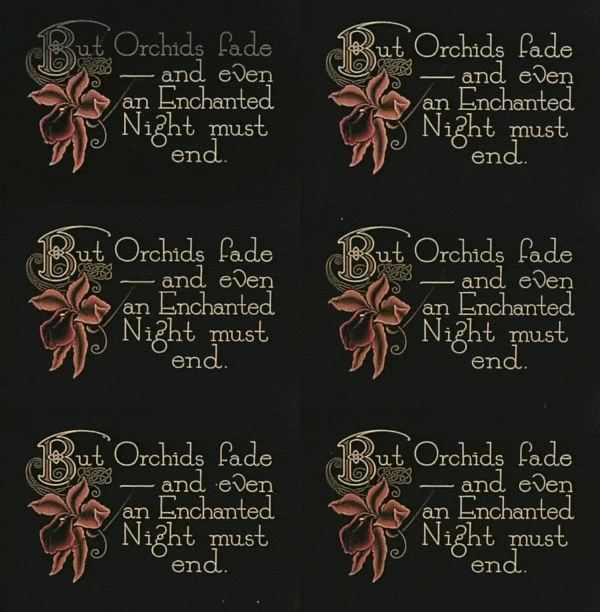
Steve é rude e violento, mas Mary não pode deixá-lo porque no casamento prometeu companheirismo “na alegria e na tristeza”. Steve representa a Tristeza, mas ela ficaria com ele se fosse na Alegria, não é? Um raciocínio como este manteve mulheres em casamentos sem amor e abusivos por tempo demais. Esta é outra razão pela qual eu amo o cinema mudo, mas não gostaria de ter vivido na época em que estes filmes eram feitos!
Steve is rude and violent, yet Mary can’t leave him because in their wedding vows they said they’d stay together “for better or for worse”. Steve represents the Worse part, but she would stay with him if he was in the Better part of life, wouldn’t she? Reasonings like those kept women trapped in loveless, abusive marriages for too long. This is another reason why I like silent movies, but would never want to have lived when these movies were being made!

Falando de muito tempo atrás, nos anos 1920 você podia ver um filme nos cinemas muitas vezes, mas uma vez que as sessões acabassem você talvez não veria o filme novamente por décadas - ou talvez nunca mais. Filmes favoritos eram diferentes na época: não eram os filmes que você revisitar várias vezes, mas aqueles que ficavam em você mesmo anos após tê-los visto. O que ficou de “O Fruto Proibido” em Hitchcock? O jogo de dados perto do final tem muito suspense, mas é a ideia do duplo que pode ter ficado com o Mestre do Suspense. Mary ser também Miss Webb pode não ser a mesma coisa que ter uma irmã gêmea, mas Hitchcock usaria gêmeas em “The White Shadow” (1924), no qual trabalhou sem receber crédito como roteirista e diretor.
Speaking of a time long gone, in the 1920s you could catch a movie at the theater several times, but once its showing was over you might not watch it again for decades - or maybe forever. Favorite movies were something else back then: not the movies you revisit time and time again, but those that stuck with you even years after you saw them. What stuck from “Forbidden Fruit” in Hitchcock’s work? The dice game near the end has a lot of suspense, but it’s the idea of the double that might have stuck with the Master of Suspense. Mary being also Miss Webb may not be the same of having a twin sister, but Hitchcock would use twins in “The White Shadow” (1924), where he worked uncredited as screenwriter and director.
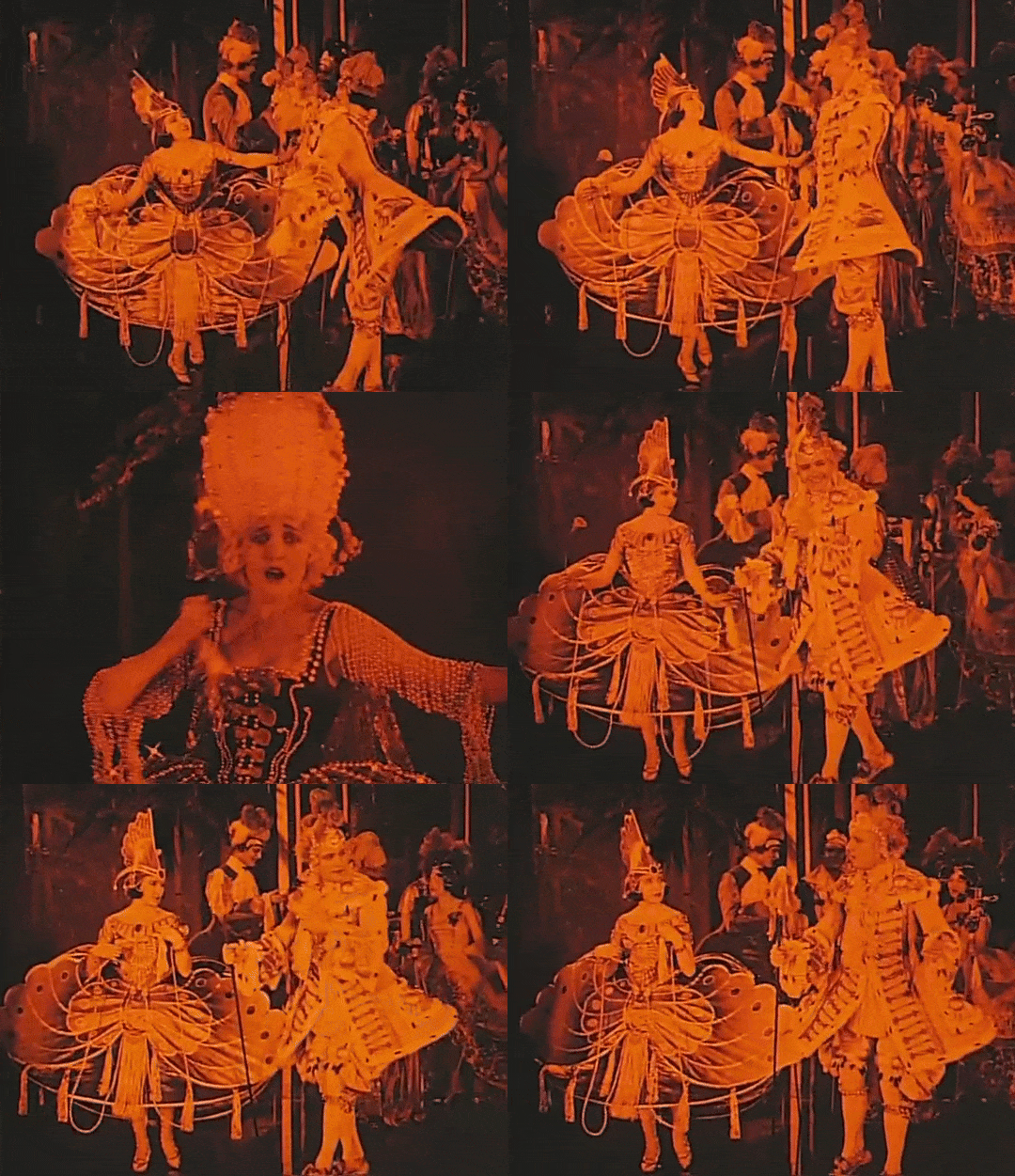
As sequências de Cinderela - com figurinos de Natacha Rambova, a senhora Rudolph Valentino - são as mais visualmente impressionantes no filme e o exemplo perfeito do que se esperava de uma produção de DeMille. Mais uma vez, meu amigo Cecil não me desapontou e, mesmo sem ser recheado de estrelas, “O Fruto Proibido” é um filme muito bom.
The Cinderella sequences - with costumes by Natacha Rambova a.k.a. Mrs Rudolph Valentino - are the most visually impressive in the movie, and the best that could come from a DeMille production - we could even say that it was by the time even expected from a DeMille production! Once again, my homeboy Cecil didn’t disappoint me and, although not full of stars, “Forbidden Fruit” is an immensely enjoyable silent film.
This is my contribution to The Return of the Silent Movie Day blogathon, hosted by Lea at Silent-ology and Shawn at The Everyday Cinephile.


