} Crítica Retrô: MGM

Tradutor / Translator / Traductor / Übersetzer / Traduttore / Traducteur / 翻訳者 / переводчик

Showing posts with label MGM. Show all posts

Thursday, August 21, 2025

Kismet (1944)


“Ainda haverá muitas oportunidades para ver este filme”. Conforme eu me tornava uma grande fã de cinema clássico na adolescência, eu também tinha que equilibrar meus estudos e o tempo com minha família. Eu disse essa frase com frequência, para muitos filmes. Agora sou uma adulta, formada e trabalhando, e a frase voltou, com uma nova perspectiva: sou eu a única que pode criar as oportunidades para ver os filmes que eu recusei anteriormente. Eu me lembro de dizer que haveria outras oportunidades para assistir a “Kismet”, uma produção cheia de ostentação estrelada por Marlene Dietrich. E agora chegou a hora de finalmente assistir e escrever sobre este filme.

“There will be plenty of opportunities to watch this movie”. As I was becoming a huge classic film fan in my teen years, I was also balancing my studies and time with my family. I said this quote often, for many movies. Now I’m an adult, graduated and working, and this came back to me, with a new perspective: I’m the only one who can make the opportunities to watch the movies I’ve let go before. I remember saying this to “Kismet”, a lavish production starring Marlene Dietrich. And now time has come for me to finally watch and review the movie.

No “coração exótico da romântica e fantástica Bagdá”, nossa história é contada. Somos apresentados a Hafiz (Ronald Colman), que durante o dia é o Rei dos Pedintes e durante a noite circula disfarçado como o Príncipe de Hassir e tem encontros furtivos com a Rainha Jamilla (Marlene Dietrich). Ele também socializa com o Califa (James Craig), que durante a noite se disfarça de Filho do Jardineiro Real e corteja a filha de Hafiz, Marsinah (Joy Page).

In “the exotic heart of romantic, fantastic Baghdad”, our story unfolds. We’re introduced to Hafiz (Ronald Colman), who by day is the King of Beggars and by night goes around disguised as the Prince of Hassir and has furtive encounters with Queen Jamilla (Marlene Dietrich). He also socializes with the Caliph (James Craig), who is by night disguised as the Gardener’s Son and courts Hafiz’s daughter, Marsinah (Joy Page).

O Califa quer fazer algumas reformas, o que desagrada ao Grão-Vizir (Edward Arnold), que quer assassinar o Califa. Enquanto isso, Hafiz se disfarça mais uma vez para dar à sua filha exatamente o que ele prometeu quando ela era uma menina: um Príncipe com quem se casar.

The Caliph wants to make some reforms, something that displeases the Grand Vizier (Edward Arnold), who wants the Caliph murdered. Meanwhile, Hafiz disguises once again to give his daughter exactly what he promised her when she was growing up: a Prince as a husband.

Podemos aprender muito com o cinema. Com “Kismet” aprendi sobre o governo na antiga Bagdá. O Califa era o governante de toda a Arábia, um sucessor político e religioso direto de Maomé, enquanto o Vizir era um alto funcionário administrativo nos impérios muçulmanos. 

With film we can learn a lot. With “Kismet” I learned about the government in ancient Baghdad. The Caliph was the ruler of all of Arabia, as a direct political and religious successor of Mohammad, while the Vizier was a high administrative officer in Muslim empires. 

“Kismet” tem tudo que você poderia esperar de um épico da MGM: cenários grandiosos, multidões, figurino colorido, danças exóticas, sapatos de ponta fina, camelos e elefantes. Tem Marlene Dietrich dançando com as pernas pintadas de dourado. Não é de surpreender que o filme tenha sido indicado ao Oscar nas categorias Melhor Fotografia para Filme em Cores e Melhor Direção de Arte - Decoração de Interiores para Filme em Cores. 

“Kismet” has everything you can expect from a MGM epic: grand sets, crowds, colorful costumes, exotic dances, pointy shoes, camels and elephants. There is Marlene Dietrich dancing with her legs painted golden. It’s no surprise that the movie was nominated for Oscars in the categories Best Cinematography, Color and Best Art Direction - Interior Decoration, Color.

Ronald Colman fez seu primeiro filme em 1917 e ganharia o Oscar de Melhor Ator em 1947 pelo pouco celebrado “Fatalidade”. Seu amigo Jack Benny pegou a estatueta emprestada e ela foi roubada, fato que foi explorado no programa de rádio de Benny. Marlene Dietrich estreou no cinema na Alemanha em 1923 e seu segundo filme, “May by the Wayside”, foi coincidentemente dirigido por William Dieterle. Dietrich já tinha mais de quarenta anos quando “Kismet” foi feito, e durante as filmagens ela encontrou um recurso para parecer jovem: um body cor da pele que ia do pescoço à virilha. 

Ronald Colman made his first movie in 1917 and would win the Best Actor Oscar in 1947 for the underseen “A Double Life”. His friend Jack Benny borrowed the statue and it was robbed, something that was explored in Benny’s radio show. Marlene Dietrich debuted in cinema in Germany in 1923 and her second film ever, “Man by the Wayside”, was coincidentally directed by William Dieterle. Dietrich was already past forty when “Kismet” was made, and during filming she came up with a resource to look young: wearing a flesh-colored body stocking from neck to crotch.

Como o conselheiro do Califa, Agha, temos Harry Davenport. Nascido em 1866 e parte da famosa família de atores - sua irmã era Fanny e sua filha a atriz que virou diretora Dorothy Davenport - , Harry começou a atuar no teatro aos seis anos e fez mais de 160 filmes, incluindo “E o Vento Levou…” (1939). Ele foi chamado por Bette Davis de “o maior ator coadjuvante de todos os tempos”.

As the Caliph’s adviser Agha we have Harry Davenport. Born in 1866 and part of the famous acting family - his sister was Fanny and his daughter the actress-turned-director Dorothy Davenport -, Harry started at the theater aged six and made more than 160 films, including “Gone with the Wind” (1939). He was called by Bette Davis “the greatest character actor of all time”.

As origens do filme datam de 1911, quando o espetáculo Kismet de Edward Knoblock estreou na Broadway. A primeira adaptação para o cinema foi curiosamente um curta-metragem feito na Inglaterra em 1914. Ele foi levado para as telas de Hollywood como um filme mudo em 1920 e novamente em 1931, ambos estrelando Otis Skinner e a versão de 1930 com Loretta Young como Marsinah - esta versão está perdida, com apenas a trilha sonora tendo sobrevivido. 

The origins of the movie date back to 1911, when the show Kismet by Edward Knoblock opened on Broadway. The first adaptation to film was curiously a short made in England in 1914. It was translated to the Hollywood screen as a silent film in 1920 and again in 1931, both starring Otis Skinner and the 1930 version with Loretta Young as Marsinah - this version is lost, only the soundtrack survives.

“Kismet” foi dirigido por William Dieterle, e foi seu primeiro filme em Technicolor. Nascido em 1893 - mais novo que Ronald Colman - ele fez mais de 60 filmes como ator na sua Alemanha natal, entre eles a versão de 1926 de “Fausto”. Ele estreou como diretor em 1923, no já mencionado filme com Dietrich, e também dirigiu o “Kismet” mudo de 1931.

“Kismet” was directed by William Dieterle, and it was his first Technicolor movie. Born in 1893 - younger than Ronald Colman - he appeared in over 60 films in his native German, among them the 1926 version of “Faust”. He debuted as a director in 1923, in the aforementioned film with Dietrich, and also directed the lost 1931 “Kismet”.

Eu associava “Kismet” com a música “Stranger in Paradise”, que não está em lugar nenhum neste filme. Mas há uma explicação para minha associação: é a música mais famosa no remake musical de 1955. Mas este filme é assunto para outra vez, afinal, há muitas oportunidades.

I associated “Kismet” with the song “Stranger in Paradise”, which is nowhere in this movie. But there is an explanation for my association: it’s the most famous song in the musical remake from 1955. But this film is a subject for another time, after all, there are plenty of opportunities.

Wednesday, March 16, 2022

Documentário: Buster Keaton, um Gênio Desajustado em Hollywood (2016)


Documentary: Buster Keaton, the Genius Destroyed by Hollywood (2016)

Buster Keaton está na moda! Dois livros sobre o homem que nunca ri acabam de ser lançados, e uma cinebiografia está sendo preparada. Mas a renascença Keaton vem acontecendo já há alguns anos. Muitos livros, documentários e mesmo posts em blogs foram lançados / publicados nos últimos anos. E a fama de Keaton atravessa fronteiras! Mas é claro que atravessa, pois agora mesmo você está lendo um post escrito por uma brasileira. Na Europa Buster também é popular, e o objeto de discussão de hoje é um documentário francês sobre Buster Keaton.

Buster Keaton is on vogue! Two books about the Great Stone Face were just released, and a biopic is in the works. But the Keaton renaissance has existed for a bunch of years now. Many books, documentaries and blog posts about Keaton have been produced and published / issued in the last few years. And Keaton’s fame has crossed borders! Of course it has, as you are now reading a blog post written by a Brazilian woman. In Europe Buster is popular too, and today’s object of discussion is a French documentary about Buster Keaton.

Como o título revela, esta é uma história triste. É a história da queda de Buster Keaton. Nós, os fãs, a conhecemos de cor: em 1928, Buster assinou um contrato com a MGM e perdeu sua liberdade criativa. Antes de chegarmos a este ponto, entretanto, o documentário fala brevemente da infância de Keaton no vaudeville e seu sucesso na década de 1920.

As the title reveals, this is a sad story. It’s the story of the fall of Buster Keaton. We, the fans, know it by heart: in 1928, Buster signed a contract with MGM and lost his creative freedom. Before we reach this point, however, the documentary talks briefly about Keaton’s childhood in vaudeville and his success in the 1920s.

Parafraseando o documentário, Buster nunca riu porque não precisou. Sua linguagem corporal dizia tudo que ele queria dizer. Ele sabia cair – e como! - sem se machucar. Ele era mais que um dublê: ele era um acrobata. Ele fazia experimentos com o cinema, uma arte ainda jovem nos anos 1920, e foi mais que um grande comediante: ele foi um cineasta genial.

Paraphrasing the documentary, Buster never laughed because he didn’t need to. His body language said everything that he wanted to be said. He knew how to fall - and how! - without being hurt. He was more than a stuntman: he was an acrobat. He experimented with cinema, an art still young in the 1920s, and was more than a great comedian: he was a genius filmmaker.

O documentário destaca o amor de Keaton por trens, dizendo que era como se o cinema fosse, para ele, um pretexto para brincar com trens. Esta obsessão culmina com “A General” (1926), um filme com, de acordo com o documentário, duas partes simétricas, como uma viagem de ida e volta de trem. Os esforços e a genialidade em “A General” fazem com que, até hoje, muitas das outras obras-primas de Keaton sejam eclipsadas.

The documentary highlights Keaton’s love for trains, saying that it was as if cinema was, for him, a pretext for playing with trains. This obsession culminates in “The General” (1926), a film with, the documentary says, two symmetrical parts, like a full train trip. The efforts and the geniality in “The General” eclipse, even today, many of Keaton’s other masterpieces.

Keaton sabia como nos fazer rir, mas também sabia seduzir. Uma sequência é dedicada a Keaton conquistando garotas não com seus músculos, mas sim com “infinita ternura”. Neste momento, o documentário fala sobre a vida pessoal de Keaton, e até mostra vídeos dos exteriores de uma casa magnífica em Beverly Hills, que parece ser do astro. E também, pela primeiríssima vez, eu ouço falar que Buster tinha amantes.


Keaton knew how to make us laugh, but also knew how to seduce. A sequence is dedicated to Keaton winning the girls not by showing his muscles, but by showcasing infinite tenderness. At this moment, the documentary talks about Keaton’s personal life, even showing footage from a magnificent Beverly Hills house that is supposed to be his. Also, for the first time ever, I hear that Buster had lovers.

Estamos agora na marca de 30 minutos do documentário (de 52 minutos no total) quando a tragédia acontece. Joe Schenck, sócio e cunhado de Keaton, o aconselha a assinar um contrato com a MGM, algo que Buster, de início, não quer fazer. Mas Schenck insiste e Buster comete o maior erro de sua vida – indo inclusive contra o conselho de seu amigo Charles Chaplin, que disse (traduzido diretamente do documentário em francês): “Eles vão devorá-lo querendo ajudá-lo, vão atrapalhar seu julgamento, e você vai se esfalfar se defendendo e sabendo que tem razão. Não que eles tenham maus elementos, eles têm os melhores do país, mas são muitos e todos vão meter a colher nos seus filmes, como muitos chefes na mesma cozinha.”

We’re now 30 minutes into the documentary (that is 52 minutes long) when tragedy strikes. Joe Schenck, Keaton’s business partner and brother-in-law, advises him to sign with MGM, something Keaton doesn’t want to do at first. But Schenck insists and Buster makes the biggest mistake of his life – even going against the advice of his friend Charles Chaplin, who said (translated directly from the documentary in French): “They will devour you wanting to help you, they will twist your judgment, and you will die defending yourself and knowing you’re right. Not that they have bad elements, they have the best in the country, but they are too many and everyone will stick their fingers on your films, like many chefs in the same kitchen”.

A MGM foi estabelecida em 1924, com a fusão da Metro com a Goldwyn Pictures, e a presença do produtor Louis B. Mayer. Mayer acreditava que o destino de um filme dependia primeiro da estrela, depois do produtor, então do roteiro e por último do diretor. Pela primeira vez, na MGM Keaton teve de escrever um roteiro e submetê-lo a dezenas de cérebros que fariam muitas modificações. E agora suas acrobacias são consideradas perigosas demais para serem feitas sem um dublê.

MGM was established in 1924, with the fusion of Metro and Goldwyn Pictures, and the presence of producer Louis B. Mayer. Mayer believed that the fate of a film relied on the star first, the producer second, the script third and only then the director. For the first time ever, at MGM Keaton has to write down the script and submit it to dozens of brains who would heavily change it. And now his stunts are considered too dangerous to be made without a stunt double.

Mesmo assim, Keaton encontra um jeito de trabalhar do seu jeito e faz “O Homem das Novidades” (1928), uma obra-prima – algo que nunca voltaria a acontecer na MGM. O estúdio não permite que Keaton transforme “O Noivo Cara-Dura” (1929) em um filme falado, mas obriga o ator a aparecer como um cantor ridículo em “Jeca de Hollywood” (1930), um filme que o documentário chama de “aberração”. O som não mata a carreira de Buster Keaton: é o sistema de estúdio que o faz. Porque nós costumamos falar sobre os grandes filmes que foram feitos com o sistema de estúdio, quando na realidade deveríamos estar falando sobre os grandes filmes que foram feitos apesar do sistema de estúdio. Ou como o documentário diz: Hollywood é um ogro de devora suas crias.

Nevertheless, Keaton finds a way to work as he was used to and makes “The Cameraman” (1928), a masterpiece – and something that would never happen again in MGM. The studio doesn’t allow Keaton to transform “Spite Marriage” (1929) in a talkie, but makes the actor appear as a ridiculous singer in “Free and Easy” (1930), a movie the documentary calls “an aberration”. Sound doesn’t kill Keaton’s career: the studio system does. Because we often talk about the great movies that were made with the studio system, when in reality we should be talking about the great movies made in spite of the studio system. Or as the documentary puts it: Hollywood is an ogre that devours its children.


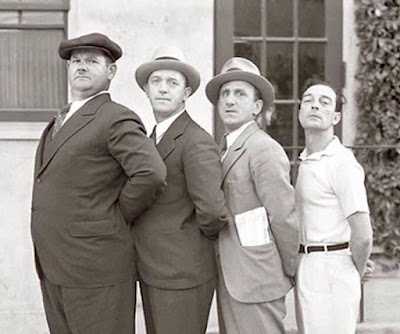
No começo dos anos 30, Keaton é colocado para contracenar com o comediante Jimmy Durante, formando uma dupla que o documentário descreve como “incompatível”. Forçado a fazer filmes menores que seu talento, Buster começa a beber. Quando ele desafia Mayer e se recusa a aparecer em filmes promocionais, Buster é demitido da MGM. Aos 40 anos, Buster está ridicularizado, viciado e desempregado.

In the early 1930s, Keaton is paired with comedian Jimmy Durante, forming a duo that the documentary describes as “incompatible”. Forced to appear in films that were not as big as his talent, Buster starts to drink. When he challenges Mayer and refuses to appear in promotional movies, Buster is fired from MGM. At forty, Buster is ridiculed, addicted and unemployed.

Oliver Hardy, Stan Laurel, Jimmy Durante, Buster

Mas as coisas melhoram de maneira irônica: de volta à MGM como consultor de gags, Buster se apaixona pela dançarina Eleanor Norris, que se torna sua esposa. Nos anos seguintes, ele aparece em filmes, programas de TV e comerciais e até mesmo ganha um Oscar honorário. A primeira renascença Keaton começa nos anos 60 – bem a tempo para Buster testemunhá-la!

But things get better in an ironic way: back to MGM as a gag man, Buster falls in love with the dancer Eleanor Norris, who becomes his wife. The following years, he appears in movies, TV and commercials and even wins an honorary Oscar. The first Buster Keaton renaissance begins in the 1960s – just in time for Buster to witness it!

Além das sequências dos filmes de Keaton, há também no documentário sua voz retirada de entrevistas. Nestes momentos aprendemos mais sobre a vida e o processo criativo de Keaton, e podemos vê-lo cantando, celebrando seu aniversário, jogando cartas, dando autógrafos. Estes momentos íntimos tornam o documentário melhor e mais agradável, e nós nos sentimos mais próximos de Keaton.

Besides the sequences from Keaton’s films, there is also in the documentary voiceover taken from his interviews. In these moments we learn more about Keaton’s life and creative process, and we can witness Keaton singing, celebrating his birthday, playing cards, signing autographs. These candid moments make the documentary better and more tender, and we feel closer to Buster. 

Buster Keaton, um Gênio Desajustado em Hollywood” foi escrito e dirigido por Jean-Baptiste Péretié, que também dirigiu documentários no mesmo formato sobre John Wayne, Jacques Tati e Al Pacino. O trabalho de edição maravilhoso foi feito por Véronique Lagoarde-Ségot, uma expert em documentários históricos. Esta é mais uma boa homenagem para o comediante que nós amamos, e só há uma coisa a dizer para quem cria conteúdo sobre Buster Keaton: continue com o bom trabalho! É um prazer estar viva durante a renascença Keaton.

Buster Keaton, the Genius Destroyed by Hollywood” was written and directed by Jean-Baptiste Péretié, who also directed documentaries in the same format about John Wayne, Jacques Tati and Al Pacino. The outstanding editing work was done by Véronique Lagoarde-Ségot, an expert in historical documentaries. This is another well-made tribute to the Great Stone Face we all love, and there is only one thing to say to those creating Buster Keaton content: keep them coming! It’s a pleasure to be alive during the Buster Keaton renaissance.


This is my contribution to the Eighth Annual Buster Keaton blogathon, hosted by Lea at Silent-ology.

Saturday, August 7, 2021

A Filha de Netuno (1949) / Neptune’s Daughter (1949)


Em 1940, uma nadadora de 18 anos chamada Esther Williams não pôde competir nos Jogos Olímpicos porque o evento foi cancelado por causa da Segunda Guerra Mundial. Os Jogos Olímpicos de 1944 também foram cancelados pelo mesmo motivo. Esther perdeu a oportunidade de uma vida, mas algo maior que a glória olímpica a esperava: a glória cinematográfica. Ela se juntou ao show Billy Rose’s Aquacade e foi vista por olheiros da MGM que lhe ofereceram a chance de fazer filmes. Menos de uma década depois de não ir para as Olimpíadas, Esther Williams era uma das mais populares estrelas de cinema de Hollywood e fez um filme cujo título descreve perfeitamente sua persona cinematográfica: “A Filha de Netuno”.

In 1940, an 18-year-old swimmer named Esther Williams was unable to compete in the Olympic Games as the tournament was cancelled because of World War II. The 1944 Olympics were also cancelled by the same reason. Esther lost this chance of a lifetime, but something bigger than the Olympic glory was waiting for her: cinematic glory. She joined Billy Rose’s Aquacade and was seen by MGM scouts who offered her the chance to be in movies. Less than a decade after missing the Olympics, Esther Williams was one of the most popular Hollywood movie stars and made a film whose title perfectly described her movie persona: “Neptune’s Daughter”.

Eve Barrett (Esther Williams) é uma nadadora que se tornou mulher de negócios na indústria de trajes de banho. Novas oportunidades surgirão com a chegada na cidade de um time de polo da América do Sul, diz o sócio dela. A pessoa que mais fica animada com o time de polo é a irmã de Eve, a namoradeira Betty (Betty Garrett). Betty vai ao local de treinamento do time e confunde o massagista, Jack (Red Skelton), com o capitão do time, José O’Rourke (Ricardo Montalban). Preocupada com a possibilidade da irmã ter seu coração partido por um conquistador, Eve diz ao José O’Rourke de verdade para ele ficar longe de Betty, e ele diz que a única maneira de fazer isso é se Eve aceitar ir a um encontro com ele.

Eve Barrett (Esther Williams) is a swimmer who became a businesswoman in the swimwear industry. New opportunities will appear with the arrival in town of a polo team from South America, her business partner says. The person who gets the most excited about the polo team is Eve’s man-hungry sister, Betty (Betty Garrett). Betty goes to the place where the team is training and mistakens the masseur, Jack (Red Skelton), for the team captain, José O’Rourke (Ricardo Montalban). Worried that her sister could have her heart broken by a womanizer, Eve tells the real José O’Rourke to keep away from Betty, and he says the only way he can do this is if Eve goes on a date with him.

“A Filha de Netuno” é o segundo de três filmes que Esther Williams fez com Ricardo Montalban - em 1947 eles interpretaram irmãos gêmeos no surpreendentemente bom “Festa Brava” e também fizeram “Numa Ilha com Você” em 1948. É interessante notar como Hollywood lidou com a origem latina de Montalban: aqui em “A Filha de Netuno” José O’Rourke é considerado o “Latin lover”, um sedutor barato. Outros elementos latinos usados no filme para provocar riso são as roupa de gaúcho que Red Skelton usa no seu primeiro encontro com a personagem de Betty Garrett, e também a incompreensão do idioma espanhol da parte destes dois personagens. No final das contas, com este humor simples, o filme não é ofensivo para com os latinos.

“Neptune’s Daughter” is the second of three movies that Esther Williams made with Ricardo Montalban - in 1947 they played twins in the surprisingly good “Fiesta” and appeared together again in “On an Island with You” in 1948. It’s interesting to notice how Hollywood dealt with Montalban’s Latino origin: here in “Neptune’s Daughter” José O’Rourke is considered the “Latin lover”, a cheap seducer. Other Latino elements used in the film for laughs are the gaucho clothes that Red Skelton wears in his first date with Betty Garrett’s character, and also the misunderstandings the Spanis language by these two characters. In the end, with this simple humor, this film is not very offensive towards Latinos.

“A Filha de Netuno” também é o segundo de três filmes que Williams fez com Red Skelton. Antes eles haviam contracenado em “Escola de Sereias” (1944), fazendo um par romântico. Aqui seus personagens apenas se encontram brevemente no final, o que é uma boa escolha do roteiro. Como dupla de alívio cômico, Red Skelton e Betty Garrett estão fantásticos e suas cenas são hilárias, em especial a sequência em que eles tentam fazer Skelton montar num cavalo. A personagem de Betty Garrett me lembrou da motorista de táxi que ela interpretou em outro musical de 1949, “Um Dia em Nova York”.

“Neptune’s Daughter” is also the second of three movies that Williams made with Red Skelton. Previously they worked together in “Bathing Beauty” (1944), where they were a romantic duo. Here their characters only meet briefly in the end, which is actually for good. As a comic relief duo, Red Skelton and Betty Garrett are outstanding and their scenes are hilarious, in special the one in which they are trying to put him up on a horse. Betty Garrett’s character reminded me of the taxi driver she played in another 1949 movie musical, “On the Town”.

“A Filha de Netuno” apresenta pela primeira vez a música “Baby It’s Cold Outside”, uma canção que recentemente foi retomada e criticada por causa de possivelmente retratar um assédio sexual ao mostrar uma pessoa que não aceita não como resposta. Curiosamente, a música que deveria ter sido usada no filme, “On a Slow Boat to China”, foi banida por censores do estúdio que acharam que a letra da música era sugestiva demais.

“Neptune’s Daughter” presents the debut of the song “Baby It’s Cold Outside”, a song that recently was reassessed and criticized because of its possible portrayal of sexual harassment as it portrays a person who can’t accept no for an answer. Curiously, the song that was supposed to be used in the film, “On a Slow Boat to China”, was banned by studio censors who thought the lyrics were too suggestive.

Uma cartela no começo do filme nos lembra de que “A Filha de Netuno” estreou quando os estúdios MGM completaram 25 anos. Nas décadas de 1940 e 1950, MGM era o estúdio número um para extravagâncias musicais como as que foram feitas com Esther Williams. Ela era uma estrela como nenhuma outra: ela não era capaz de cantar, dançar e atuar, ela era um talento único que podia cantar e nadar! Num primeiro momento considerada a resposta da MGM para Sonja Henie, estrela patinadora da Fox, Williams se tornou uma estrela maior que Henie ao fazer seus filmes de natação com muito improviso - ela chegou a declarar que só passou a ter um coreógrafo para os números subaquáticos depois de seu quinto filme. Seus filmes eram em geral grandes sucessos, com “A Filha de Netuno” terminando 1949 como décima maior bilheteria do ano.

A card at the beginning reminds us that “Neptune’s Daughter” was released in Metro-Goldwyn-Mayer’s Silver Anniversary, that is, when MGM studios turned 25. In the 1940s and 1950s, MGM was the number one studio for musical extravaganzas like the ones made with Esther Williams. Williams was a star like no other: she wasn’t the triple threat who sang, danced and could act, she was a unique talent who could sing and swim! At first considered the MGM answer to Fox’s ice-skating star Sonja Henie, Williams became a bigger star than Henie by doing the swim films with a lot of improvisation - Williams famously said that she only got a choreographer for the underwater ballets in her fifth film. Her films were often huge successes, with “Neptune’s Daughter” being the 10th highest-grossing film of 1949.

“A Filha de Netuno” apresenta uma história previsível com um elemento clássico de identidades trocadas. É um filme simples, divertido, charmoso. O balé aquático é muito curto no final do filme, mas ele vale a pena ser visto graças a Red Skelton, Betty Garrett e a estrela Esther Williams.

“Neptune’s Daughter” presents a predictable plot with a classic mistaken identity element. It’s a simple, fun, charming and enjoyable movie. The water ballet in it is very brief in the end, but it is worth a watch thanks to Red Skelton, Betty Garrett and Esther Williams’s star power.

This is my contribution to the 100 Years of Esther Williams blogathon, hosted by Michaela at Love Letters to Old Hollywood.

Tuesday, December 29, 2020

Três Palavrinhas (1950) / Three Little Words (1950)


Você deve conhecer Cole Porter, Ira e George Gershiwn, George M. Cohan, Irving Berlin e Jerome Kern. Talvez você não conheça Bert Kalmar e Harry Ruby, mas com certeza já ouviu as canções deles, como por exemplo “I Wanna Be Loved by You”. Kalmar e Ruby não foram os artistas mais famosos oriundos da Tin Pan Alley, região de Manhattan que concentrava os principais selos de música no começo do século XX, mas a dupla provou que merecia uma cinebiografia, que veio em 1950 com “Três Palavrinhas”.

You might be familiar with Cole Porter, Ira and George Gershwin, George M. Cohan, Irving Berlin and Jerome Kern. You might not know Bert Kalmar and Harry Ruby, but you certainly have heard their songs, such as “I Wanna Be Loved By You”. Kalmar and Ruby were not the most famous artists to emerge from the Tin Pan Alley, a region of Manhattan that concentrated the main music publishers of the early 20th century, but the duo proved to be worthy of a biopic, that came as 1950's “Three Little Words”.

Os dois se esbarram pela primeira vez em um incidente. Bert Kalmar (Fred Astaire) é um bem-sucedido dançarino no vaudeville, fazendo par com Jessie Brown (Vera-Ellen). Jessie quer se casar com Bert, mas ele está mais interessado em se tornar um mágico. Quando ele tenta fazer alguns truques de mágica no palco, o pianista Harry Ruby (Red Skelton) é enviado para ser assistente de Bert, e o número acaba com uma confusão hilariante envolvendo coelhos numa cartola e um ganso descontrolado.

They meet for the first time in an unfortunate incident. Bert Kalmar (Fred Astaire) is a successful vaudeville dancer, making a dancing duo with Jessie Brown (Vera-Ellen). Jessie wants to marry Bert, but he is more interested in becoming a magician. When he tries to do a few magic tricks on the stage, pianist Harry Ruby (Red Skelton) is sent to work as Bert's assistant, and the number ends up in a hilarious mess involving rabbits in a top hat and a vicious goose.

Os caminhos deles se cruzam novamente. Desta vez, Bert machucou o joelho e não pode dançar durante um ano. Harry está tentando a sorte como compositor e liricista. Eles se encontram no escritório de um agente e Bert ajuda Harry a escrever uma letra melhor para uma melodia. Entretanto, quando Bert reconhece Harry do incidente no show de mágica, ele fica furioso e vai embora. Mesmo assim, Harry publica a música que eles fizeram juntos, forçando Bert a começar uma parceria, pois a música faz grande sucesso.

Their paths cross a second time. This time, Bert has injured his knee and can't dance for a year. Harry is trying his luck as a composer and songwriter. They meet at an agent's office and Bert helps Harry to write better lyrics for his tune. However, when Bert recognizes Harry from the magic show incident, he gets mad and leaves. Nevertheless, Harry publishes the song they made together, forcing Bert to start a partnership as the song becomes a hit.

Esta parceria, obviamente, teve seus problemas. Assim como Bert implica com o amor de Harry pelo beisebol, Harry não gosta do interesse de Bert em mágica. Com as melhores intenções, eles interferem na vida pessoal um do outro. Há brigas, reencontros e silêncios constrangedores. Tudo isso era ficção, para deixar o filme mais interessante, porque Kalmar e Ruby, na vida real, se davam muito bem.

This partnership, of course, isn't one without a few problems. As Bert complains about Harry's love of baseball, Harry doesn't like Bert's interest in magic. With the best intentions, they interfere in each other's personal businesses. There are arguments, reunions and awkward silences. All of this was fiction, to make the film more interesting, as the real Kalmar and Ruby got along very well.

No começo da carreira no vaudeville, Fred Astaire conheceu Kalmar e Ruby. Sobre Bert Kalmar e Jessie Brown, Astaire disse: “Nós [Fred e a irmã Adele Astaire] costumávamos ficar nas coxias e ver Jessie e Bert com animação e inveja, nos perguntando se poderíamos igualar a elegância deles e chegar ao mesmo status que eles tinham”. Estas memórias podem tê-lo influenciado a declarar que “Três Palavrinhas” foi um dos filmes que mais gostou de fazer em Hollywood. Astaire ganhou o Globo de Ouro de Melhor Ator em Filme de Comédia ou Musical, no ano em que a categoria foi criada.

In his early years in vaudeville, Fred Astaire knew Kalmar and Ruby. About Bert Kalmar and Jessie Brown, Astaire said: "We [Fred and his sister Adele Astaire] used to stand in the wings and watch Jessie and Bert with thrilled envy, wondering if we could equal their finesse and reach their headline billing". These memories may have influenced him to declare that “Three Little Words” was among his favorite experiences in Hollywood. Astaire won the Golden Globe for Best Actor in a Motion Picture Musical or Comedy for this film, in the year the category was created.

“Três Palavrinhas” é o primeiro de dois filmes que Vera-Ellen fez com Fred Astaire. Com ou sem Astaire como parceiro de dança, Vera-Ellen brilha no filme. Ela prova que é tão capaz quanto Astaire quando eles dividem a cena, e sozinha ela mostra charme e vitalidade. Muito subestimada, Vera-Ellen merece ser mencionada, junto com Cyd Charisse, como uma das melhores dançarinas da Era de Ouro dos musicais de Hollywood.

Three Little Words” is the first of two films Vera-Ellen made with Fred Astaire. With or without Astaire as her dancing partner, Vera-Ellen shines in this film. She proves to be as capable as Astaire when they share the screen, and alone she displays charm and vitality. Often underrated, Vera-Ellen deserves to be mentioned, alongside Cyd Charisse, as one of the best dancers of Hollywood's Golden Age of musicals.

Debbie Reynolds aparece num pequeno papel como Helen Kane, e outra participação notável é Gloria DeHaven. Gloria interpreta a própria mãe, Sra Carter DeHaven – o nome verdadeiro dela era Flora Parker DeHaven –, uma estrela da Broadway que foi a primeira a cantar a canção “Who's Sorry Now” de Kalmar e Ruby. Eileen Percy, interpretada por Arlene Dahl, era atriz de cinema mudo. Helen Kane também foi uma atriz de cinema que serviu de inspiração para a personagem animada Betty Boop, e a própria Kane dublou Debbie Reynolds neste filme – isso significa que a cena que vemos tem Reynolds interpretando a atriz que a estava dublando nos bastidores!

Debbie Reynolds appears in a bit part as Helen Kane, and another interesting bit player is Gloria DeHaven. Gloria plays her own mother, Mrs. Carter DeHaven - her real name was Flora Parker DeHaven -, a Broadway star who introduced the Kalmar-Ruby song “Who's Sorry Now”. Eileen Percy, played by Arlene Dahl, was a silent film actress. Helen Kane was also a real film actress who inspired the cartoon character Betty Boop, and she even dubbed Debbie Reynolds's vocals in this movie – that means the scene is of Reynolds playing the actress that was dubbing her backstage!

Eu tenho apenas uma reclamação sobre este filme, e é sobre o lindo figurino feito por Helen Rose. Embora a história se passe no final dos anos 1910, as roupas de Vera-Ellen claramente são do começo dos anos 1950, algo que causou certa distração. Uma mulher dançando somente com um maiô preto teria causado frisson em 1919!

I have only one problem with the film, and it's the nonetheless gorgeous costumes by Helen Rose. Although the story is set in the late 1910s, Vera-Ellen's clothes are clearly from the early 1950s, and I found that a bit distracting. A woman dancing wearing only a black leotard would have caused frisson in 1919!


“Três Palavrinhas” me lembrou de outro filme de Fred Astaire, “Romance Inacabado”, de 1946. Ambos os filmes são sobre parceiros no show business que são muito diferentes um do outro. Em “Romance Inacabado”, entretanto, Astaire é um dançarino enquanto Bing Crosby é gerente de uma boate. Em “Três Palavrinhas”, Red Skelton é um bom contraste a Fred Astaire, servindo também como alívio cômico – porque ele pode amar beisebol, mas é péssimo no jogo. Eu acredito que “Romance Inacabado” tem números de dança e canções mais memoráveis.

Three Little Words” reminded me of another Fred Astaire movie, “Blue Skies”, from 1946. Both films are about show business partners who are very different from each other. In “Blue Skies”, however, Astaire is a dancer while Bing Crosby plays a nightclub manager. In “Three Little Words”, Red Skelton is a nice contrast to Astaire, serving also as comic relief – because he may love baseball, but he’s really bad at it. I believe “Blue Skies” has more memorable dance routines and songs.

"Romance Inacabado" / "Blue Skies"

MGM fez tantos musicais incríveis nos anos 40 e 50 que muitos deles acabam sendo colocados de lado, ao mesmo tempo em que discutimos sempre preciosidades como “Sinfonia de Paris” (1951) e “Cantando na Chuva” (1952). “Três Palavrinhas” pode não chamar tanto a atenção porque trata de compositores não muito lembrados, mas o filme merece ser visto em especial por causa das habilidades de dança de Vera-Ellen. Em três palavrinhas: você vai gostar!

MGM made so many great musicals in the 1940s and  1950s that many of them go overlooked, while we talk too often about gems like “An American in Paris” (1951) and “Singin' in the Rain” (1952). “Three Little Words” may not be as interesting because its subjects are not so well-known, but it deserves to be seen especially because of Vera-Ellen's dancing skills. In three little words: you'll like it!

This is my contribution to the Third Fred Astaire and Ginger Rogers blogathon, hosted by Michaela and Crystal at Love Letters to Old Hollywood and In the Good Old Days of Classic Hollywood
 
Related Posts Plugin for WordPress, Blogger...