Podia
acontecer de tudo durante a Revolução Francesa – e, de fato, todos os tipos de
coisas que pareciam impossíveis aconteceram durante a Revolução Francesa. O
povo primeiro tomou a Bastilha, depois o Palácio das Tulherias, depois as ruas.
O rei e a rainha perderam suas cabeças. Então o terror tomou conta, e a
guilhotina trabalhou noite e dia. Enquanto tudo isso acontecia, as pessoas
continuaram vivendo e amando, buscando vingança, justiça e procurando pela
verdade. Em “Sacaramouche”, uma aventura ambientada durante a Revolução
Francesa, nosso herói faz tudo isso que eu descrevi – mais do que muitas pessoas
fazem durante a vida toda.
Everything could happen during the
French Revolution – and, indeed, all kinds of things that seemed
impossible did happen during the French Revolution. The people first took the
Bastille, then took the Tuileries, then took the streets. A king and a queen
lost their heads. Then terror took over,
and the guillotine worked night and day. While all this was happening, people
kept on living and loving, seeking revenge, justice and looking for the truth.
In “Scaramouche”, an adventure set during the French Revolution, our hero does
all those things I’ve just described – more than many people do in a lifetime.

No vale de
Gavrillac, os melhores amigos André-Louis Moreau (Ramon Novarro) e Philippe de
Vilmorin (Otto Matiesen) veem a pobreza, a fome e a morte infligidas no povo
por um nobre local, o Marquês de La Tour D’Azyr (Lewis Stone). O eloquente
Philippe desafia o Marquês e é morto em uma luta de esgrima. André promete vingança,
usando a eloquência como sua arma contra o Marquês.
In the valley
of Gavrillac, best friends André-Louis Moreau (Ramon Novarro) and Philippe de
Vilmorin (Otto Matiesen) see the poverty, starvation and death that are
inflicted upon the locals by a nearby nobleman, the Marquis de La Tour D’Azyr
(Lewis Stone). The eloquent Philippe defies the Marquis and is killed in a
sword fight. André vows to seek revenge, using eloquence as his weapon against
the Marquis.

O padrinho
de André, Quintin de Kercadiou (Lloyd Ingraham), tenta dissuadi-lo da busca por
justiça contra o Marquês – na verdade, Quintin espera que o Marquês se case com
sua filha, Aline (Alice Terry). Agora tudo ficou ainda mais pessoal para André,
pois ele também está apaixonado por Aline.
André's
godfather, Quintin de Kercadiou (Lloyd Ingraham), tries to dissuade him from
seeking justice against the Marquis – in fact, Quintin hopes that the Marquis
marries his daughter, Aline (Alice Terry). Now things get even more personal to
André, as he, too, is in love with Aline.

A
Revolução Francesa está acontecendo, e tudo está mudando muito rápido. André
carrega consigo a cópia da Declaração dos Direitos do Homem e do Cidadão que
Philippe levava sempre. André nunca perde uma oportunidade de fazer um discurso
sobre a Declaração e sobre como a nobreza não pode mais oprimir o povo.
The French
Revolution is underway, and things are changing fast. André carries with him
the copy of the Declaration of the Rights of the Man and of the Citizen that
Philippe used to carry. André never wastes an opportunity to make a speech
about this Declaration and how the nobility can no longer oppress the people.
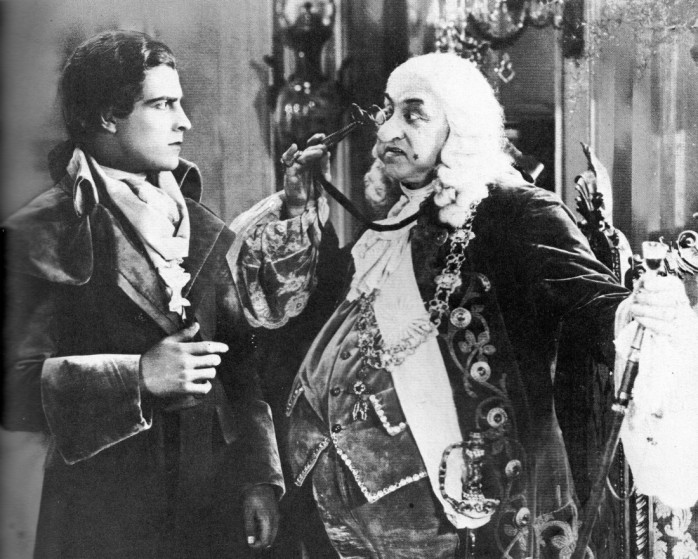
Agora
perseguido pelos soldados do rei, André se junta a um grupo de artistas itinerantes
como dramaturgo, depois de mostrar a todos sua eloquência e sabedoria. Agora
chamado simplesmente de Monsieur X, André está com o grupo há um ano quando ele
termina de escrever a ousada peça “Figaro – Scaramouche”. A peça estreia em um
enorme teatro de Paris, e o próprio André interpreta Scaramouche, mas seu rosto
é ocultado por uma máscara com um longo nariz.
Now being
persecuted by the King's soldiers, André joins a group of travelling artists as
a playwright, after he shows all his eloquence and wit. Now called simply
Monsieur X, André has been with the group for a year when he finishes writing
the daring play “Figaro – Scaramouche”. The play premieres in a huge theater in
Paris, and André himself plays Scaramouche, but his face is hidden from the
public by a mask with a long nose.

Tanto
Aline quanto o Marquês de La Tour estão na estreia da peça, mas apenas Aline
reconhece André. Acreditando que os dois estão juntos, André decide se casar
com a atriz Climène (Edith Allen)... mas ela também é seduzida pelo Marquês!
Mais sofrimento para André.
Both Aline
and the Marquis de La Tour attend the premiere of the play, but only Aline
recognizes André. Believing they are together, André decides to marry a fellow
actress, Climène (Edith Allen)... but she is seduced by the Marquis as well!
Heartache follows.

Mas e a
Revolução Francesa? Agora a Assembleia Nacional está reunida, e a nobreza
desesperada pode apenas usar sua habilidade com a espada para desafiar
deputados do povo. Por isso, Danton (George Siegman) convida André – não mais
artista, mas agora assistente de um professor de esgrima – para fazer parte da
Assembleia. Então, haverá lutas de espada, reviravoltas na trama e um monte de
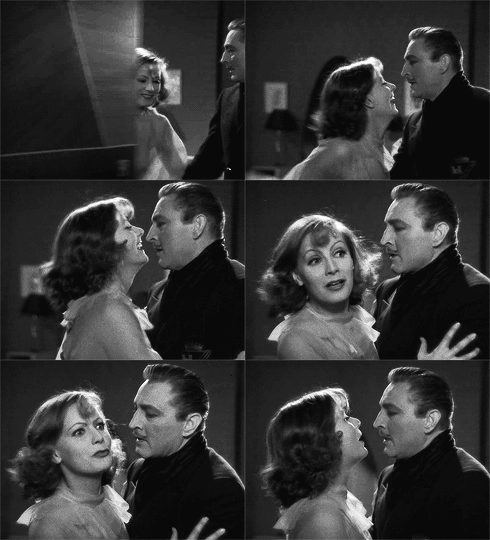
pessoas nas ruas de Paris, incluindo esta mulher muito exaltada:
But the French
Revolution was underway, wasn't it? Now the National Assembly is reunited, and
the desperate nobility can only use their ability with the sword to fight
deputies who speak for freedom. So, Danton (George Siegman) invites André – no
longer an artist, but a fencing teaching assistant – to take part in the
Assembly. Then, there will be sword fights, plot twists and a lot of fed up
people on the streets of Paris, including this overly excited woman:
 |
| GIF via Movies, Silently |
Feito pela
Metro Pictures um ano antes da fusão que a transformou em MGM, “Scaramouche” é
baseado num livro de 1921 escrito por Rafael Sabatini. O diretor Rex Ingram
escolheu seus colaboradores frequentes Novarro, Stone e Alice Terry para os
três papéis principais – e é interessante ver Lewis Stone como vilão,
considerando que anos depois ele interpretaria o afável Juiz Hardy, pai de Andy
Hardy em uma série de filmes.
Made by Metro
Pictures one year before it merged to become MGM, “Scaramouche” is based on a
1921 novel written by Rafael Sabatini. Director Rex Ingram chose his usual
collaborators Novarro, Stone and Alice Terry for the three main roles – and it’s
interesting to see Lewis Stone as a villain, considering that years later he would
play the affable Judge Hardy, Andy Hardy’s father in a series of movies.

Ramon
Novarro, embora tenha seus olhos brilhantes capturados pela câmera de Ingram,
infelizmente não está tão bonito como estaria dois anos depois em “Ben-Hur”
(1925). Alice Terry, por outro lado, não tem uma personagem com muitas camadas
para interpretar, mas está charmosa em todos os seus momentos em cena.
Ramon
Novarro, although with glowing eyes captured by Ingram’s camera, unfortunately,
is not as handsome here as he would be two years later in “Ben-Hur” (1925). Alice
Terry, on the other hand, doesn’t have a character with many layers to play,
but is charming every time she’s on screen.

“Scaramouche”
é um filme com muitas cartelas de texto, o que é compreensível: uma história
tão complexa não poderia ser contada com poucas cartelas. A história é tão
complexa e cheia de reviravoltas que em alguns momentos ela se torna enfadonha –
e todos sabemos que filmes mudos NÃO são chatos, tomando como exemplo o conto
pacifista de 1919 “Eu Acuso!”. Como bônus, o filme é muito fiel ao livro, ao
contrário do remake colorido de 1952.
“Scaramouche”
is a film with lots of intertitles, which is understandable: such a complex
story couldn't be told with only a few title cards. The tale is so complex and
so full of twists that sometimes the film gets a bit boring – and we all know
that silent films are NOT boring, take for instance the 1919 pacifistic tale “J’Accuse!”.
As a bonus point, the film is very faithful to the novel, unlike the 1952 color
remake.

Assim como
em todos os dramas históricos, “Scaramouche” também tem muitos cenários
lindamente decorados e incríveis figurinos, cabelos e maquiagens – detalhe:
todo mundo tem uma pinta no rosto, algumas delas desenhadas em forma de coração
ou estrela! Mas o destaque é para a reconstituição perfeita da Assembleia
Nacional.
As it happens
to most historical films, “Scaramouche” also has many beautifully decorated
sets and amazing costumes, hair and make-up – detail: everybody has a beauty
mark, some of them are drawn as hearts or stars! But the highlight is the
perfect reconstitution of the National Assembly.

Com poucas
lutas de espada emocionantes e alguns momentos chocantes – uma participação
histórica especial te surpreenderá – “Scaramouche” é um filme que mostra como o
cinema mudo podia ser visualmente belo. Na época, eles não precisavam de
diálogos, eles tinham rostos – e cenários e figurinos para impressionar
qualquer um.
With few
exciting sword fights and a few shocks – one historical cameo will surprise you
– “Scaramouche” is a film that shows how visually beautiful silent films can
be. At the time, they didn’t need dialogue, they had faces – and sets, and
costumes to amaze anyone.
This is my
contribution to the Costume Drama blogathon, hosted by Debbie at Moon in
Gemini.