} Crítica Retrô: Charles Boyer

Tradutor / Translator / Traductor / Übersetzer / Traduttore / Traducteur / 翻訳者 / переводчик

Showing posts with label Charles Boyer. Show all posts

Wednesday, May 29, 2024

Variações sobre um mesmo tema: O Demônio da Algéria (1937) e Argélia (1938)

 Variations on the same theme: Pépé Le Moko (1937) and Algiers (1938)


Todos sabemos que os norte-americanos não gostam de assistir a filmes com legendas. Todos também sabemos que os chefes dos estúdios estão sempre de olho no mercado estrangeiro, procurando por inspiração e sucessos para fazer remakes. Em 1938, Hollywood fez um remake de um filme que havia estreado apenas um ano antes na França. “Argélia” é um remake fidelíssimo, quase cena a cena, de “O Demônio da Algéria” (sic), que ainda consegue ser cinco minutos mais longo que o original. Ambos contam com ótimas performances e alguns nomes nos bastidores que merecem ser destacados.


It’s widely known that Americans don’t like to watch movies with subtitles. It’s also widely known that studio heads are always with an eye on the foreign market, looking for inspiration and successes to be remade. In 1938, Hollywood remade a film that had premiered in France only one year prior. “Algiers” is an almost shot-by-shot remake of “Pépé Le Moko” that still manages to be five minutes longer than the original. Both have great performances and a few names behind the cameras that we should highlight.


Nos últimos dez anos, cinco detetives tentaram e falharam em capturar o ladrão Pépé Le Moko (Jean Gabin / Charles Boyer). Seu esconderijo é bem conhecido: é a Casbah, bairro labiríntico de Argel onde vivem quarenta mil pessoas. Como dito em “Argélia”, a polícia não pode simplesmente entrar no bairro e prender Pépé porque “não se pode prender um rei no seu próprio palácio”.


In the last two years, five detectives tried and failed to capture the thief Pépé Le Moko (Jean Gabin / Charles Boyer). His hidi
ng place is well known: it’s the Casbah, a labyrinthine district of Argel where forty thousand people live. As it’s said in “Algiers”, the police can’t simply invade the Casbah and arrest Pépé because “you can’t arrest a king in his own palace”.

Uma noite, enquanto fugia de um grupo de policiais, Pépé conheceu Gaby (Mireille Balin / Hedy Lamarr) e se apaixonou por ela... e ainda mais pelas joias dela. Ela é uma socialite francesa que estava passeando pela Casbah e está disposta a voltar nem que seja para jantar e dançar com o belo ladrão. Fora da Casbah é muito perigoso para ele... será que Pépé se contentará com sua garota Inès (Line Noro / Sigrid Gurie) ou se arriscará indo atrás de Gaby?


While running away one night from a group of police officers, Pépé meets Gaby (Mireille Balin / Hedy Lamarr) and falls in love with her… falling deeper for her jewels. She is a French socialite who was touring the Casbah and is willing to come back if only to have dinner and a dance with the handsome thief. Outside the Casbah it’s too dangerous for him… will Pépé settle for his girl Inès (Line Noro / Sigrid Gurie) or will he risk going after Gaby?

“O Demônio da Algéria” é um bom filme por causa do charme e do talent de Jean Gabin, que na época já era uma superestrela. Num artigo para o website da Criterion, Michael Atkinson escreve sobre ele: “Gabin era quase como Garbo em sua habilidade de ancorar nossa atenção sem mover um músculo”. O mais novo de sete filhos de uma dona de café e um artista de cabaré, ele começou a atuar aos 15 anos, trabalhando subsequentemente tanto no Folies Bergéres quanto no Moulin Rouge, além de fazer turnê pela América do Sul com um grupo. Ele fez seu primeiro filme em 1928 e o último em 1976, ano em que faleceu. Ele apareceu num total de 97 filmes.


“Pépé Le Moko” works because of the charm and talent of Jean Gabin, then already a superstar. In an  essay for the Criterion website, Michael Atkinson writes this about him: “Gabin was almost Garbo-like in his ability to anchor our attention without moving a muscle”. The youngest of seven children of a coffee owner and a cabaret entertainer, he started acting at 15, working in subsequent years at both the Folies Bergéres and the Moulin Rouge, and also touring South America with a troupe. He made his first film in 1928 and the last in 1976, the year he passed away. He appeared in 97 films total.

Charles Boyer pode ser charmoso e francês – uma redundância –, mas a verdadeira estrela de “Argélia” é Hedy Lamarr, em seu primeiro filme em Hollywood. O produtor Walter Wanger no início queria Sylvia Sidney ou Dolores Del Río como a atriz principal, mas acabou decidindo pedir Lamarr emprestada da MGM. Diz-se que foi Charles Boyer que apresentou Lamarr para Wanger após uma festa. Apesar de ser o chamariz para o filme, Hedy Lamarr foi considerada inadequada pelo diretor John Cromwell, que disse que ela não sabia atuar e não tinha personalidade.


Charles Boyer may be charming and French – a redundancy –, but the real star of “Algiers” is Hedy Lamarr, in her first Hollywood movie. Producer Walter Wanger first wanted Sylvia Sidney or Dolores Del Río as the female lead, but decided to borrow Lamarr from MGM instead. It is said that it was Charles Boyer who introduced Lamarr to Wanger after a party. Despite being the one who called attention for the film, Hedy Lamarr was considered inadequate by director John Cromwell, who said she couldn’t act and had no personality.

O livro que serviu de inspiração foi, diz-se, inspirado em “Scarface” (1932) e deu origem a um filme sem o qual o cinema noir seria completamente diferente. “O Demônio da Algéria” foi a primeira adaptação cinematográfica de um a obra literária de Henri La Barthe, creditado com seu pseudônimo Ashelbé. O diretor Julien Duvivier, que no começo da década foi responsável por efetivamente fazer a carreira de Jean Gabin decolar, foi um dos roteiristas. A história seria filmada mais uma vez em 1948, num musical com Tony Martin, Märta Torén e Yvonne de Carlo.


The source novel was reportedly inspired by “Scarface” (1932) and it originated a movie without which film noir wouldn’t be what it was. “Pépé Le Moko” was the first cinematic adaptation of a literary work by Henri La Barthe, credited under his pseudonym Ashelbé. Director Julien Duvivier, who was in the beginning of the decade responsible for effectively launching Jean Gabin’s career, served as one of the screenwriters. The story would be filmed once more in 1948, as a musical starring Tony Martin, Märta Torén and Yvonne De Carlo.
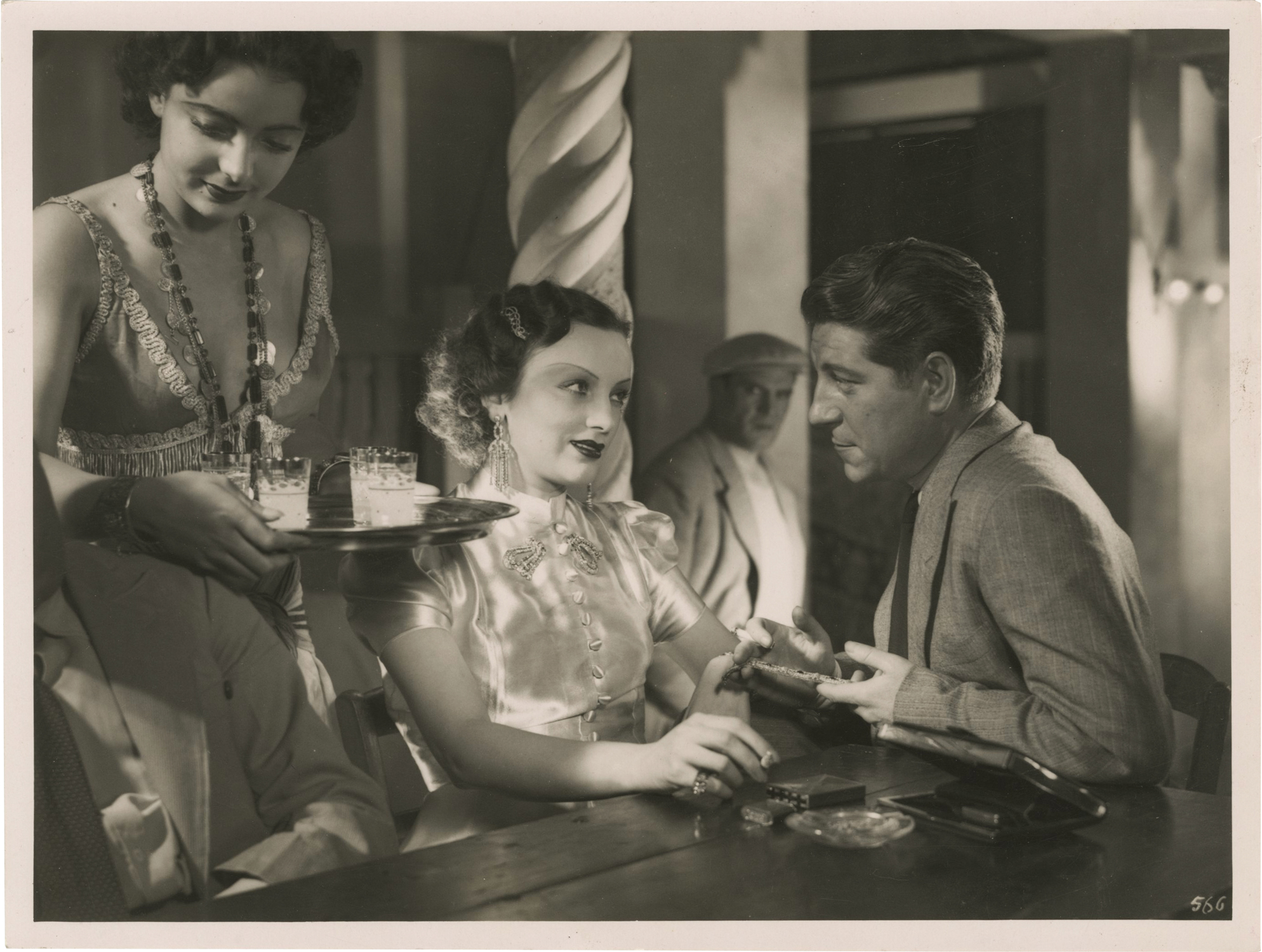
O diretor de fotografia de “Argélia” é o grande James Wong Howe. Nascido na China, sua família chegou a Washington quando ele tinha cinco anos. Ele foi boxeador profissional na adolescência e começou sua carreira no cinema como assistente de Cecil B. DeMille. “Argélia” deu a Howe a primeira de suas dez indicações ao Oscar, e ele ganhou duas vezes. Curiosidade: James Wong Howe e Charles Boyer nasceram no mesmo dia, 28 de agosto de 1899.


The director of photography in “Algiers” is the great James Wong Howe. Born in China, his family arrived in Washington when he was five. He was a professional boxer as a teenager and started his career in film as an assistant to Cecil B. DeMille. “Algiers” gave Howe his first of 10 Oscar nominations, and he would win twice. Curious info: James Wong Howe and Charles Boyer were born in the same day, August 28, 1899.

Em “Argélia” o personagem Regis (Gene Lockhart) tem mais tempo em cena que no filme original. Há basicamente uma sessão de tortura psicológica com ele quando Pépé descobre que Regis traiu seu amigo Pierrot e acompanhou o jovem até uma armadilha. Gene Lockhart foi indicado ao Oscar de Melhor Ator Coadjuvante por sua performance, mas não ganhou o prêmio.


In “Algiers” the character Regis (Gene Lockhart) has more screen time than in the original. There is basically a psychological torture session with him when Pépé finds out that Regis betrayed his pal Pierrot and accompanied the young man right into a trap. Gene Lockhart was nominated for the Best Supporting Actor Oscar for his performance, but didn’t win the award.

Quando Régis (Fernand Charpin) fala sobre Pépé ser mulherengo, ele retruca: “Eu dou a elas [às mulheres] meu corpo, mas mantenho para mim a cabeça”. Quando fala sobre sua linha de raciocínio para Inès, Pépé (interpretado por Charles Boyer) diz que “eu não penso com minha cabeça, mas com meu coração”. Estas frases definem as diferenças de construção de um mesmo personagem: o de Gabin é sexy e ousado, o de Boyer mais suave.


When Régis (Fernand Charpin) talks about Pépé’s womanizing habits, he says: “I give them [the women] my body, but I keep my head”. When talking about his thinking to Inès, Pépé (played by Charles Boyer) says that “I don’t think with my head, but with my heart”. These quotes settle the differences between the portrayals of the same character: Gabin’s is sexy and bold, Boyer’s is softer.

O sotaque francês e o jeito mulherengo do personagem de Boyer inspirou o personagem dos Looney Tunes Pepé Le Pew, apresentado ao público em 1945 com a frase de efeito “Venha comigo para a Casbah”. O filme de 1938 também inspirou “Casablanca”, com seu sucesso de bilheteria servindo de argumento para convencer a Warner Bros a aprovar o projeto do filme em 1942. A MGM, entretanto, não liberou Hedy Lamarr de seu contrato e “Casablanca” teve de ser feita com Ingrid Bergman como protagonista.


The French accent and the womanizing in Charles Boyer’s character inspired the Looney Tunes character Pepé Le Pew, introduced in 1945 with the catchphrase “Come with me to the Casbah”. The 1938 film also inspired “Casablanca”, with its success in the box-office serving as a point to convince Warner Bros to approve the project for the film in 1942. MGM, however, didn’t release Hedy Lamarr from her contract and “Casablanca” had to be made with Ingrid Bergman as the lead.

Um fato para horrorizar os amantes de cinema: enquanto era filmado o remake, Walter Wanger tentou destruir todas as cópias de “O Demônio da Algéria”. Que bom que ele não conseguiu! “O Demônio da Algéria” tem 3,8 estrelas no Letterboxd e sua nota no IMDb é 7,7, enquanto “Argélia” tem respectivamente 3,2 estrelas e nota 6,6. Ambos os filmes são muito bons de maneiras diferentes e vê-los em sequência, embora um pouco cansativo por causa da mesma história, dá origem a um divertido jogo de “encontrar diferenças”.


A fact that will horrify all film lovers: while shooting the remake, Walter Wanger tried to have all the copies of “Pépé Le Moko” destroyed. We’re happy his wish wasn’t granted! “Pépé Le Moko” has 3,8 stars on Letterboxd and its grade is 7,7 on IMDb, while “Algiers” has respectively 3,2 stars and grade 6,6. Both movies are extremely enjoyable and entertaining in their own ways, and a double feature, even though tiring with the same story, serves as a joyful game of “spot the differences”.

Saturday, February 16, 2019

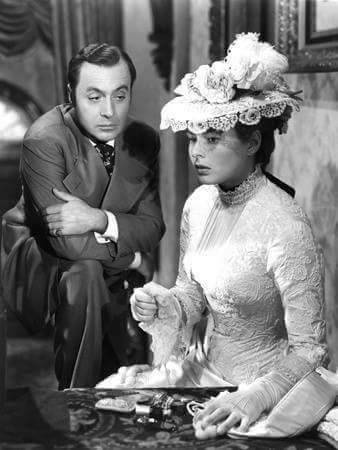
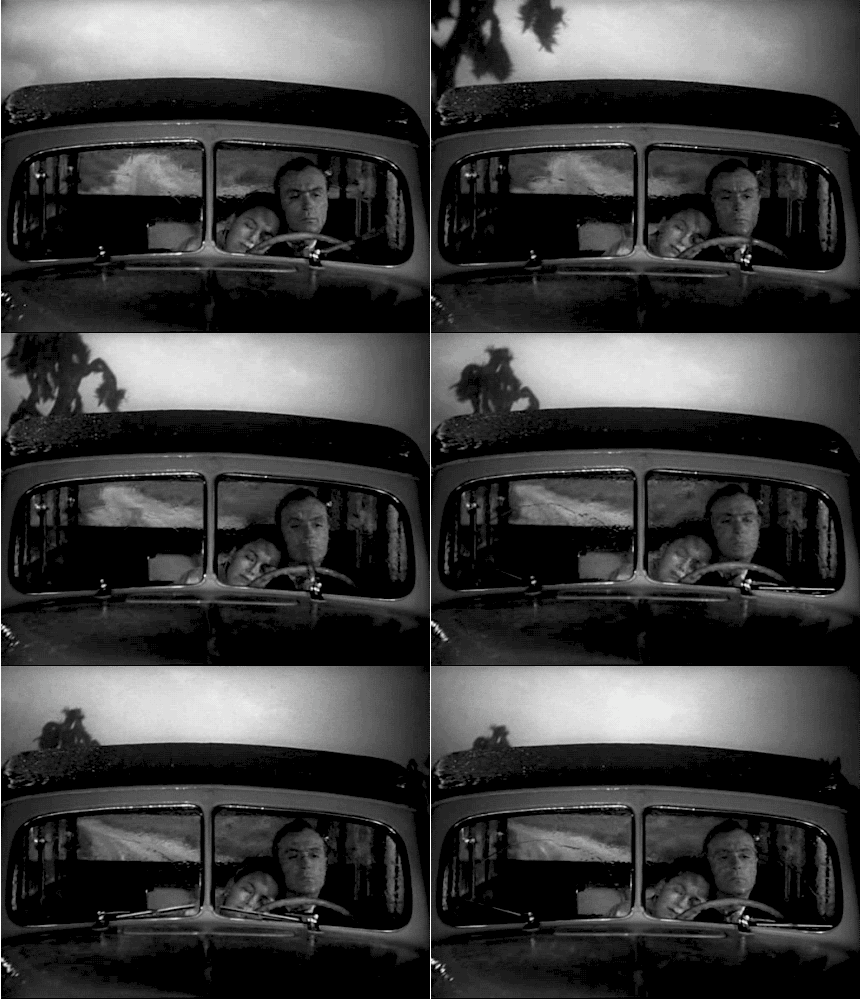
À Meia Luz (1944) / Gaslight (1944)


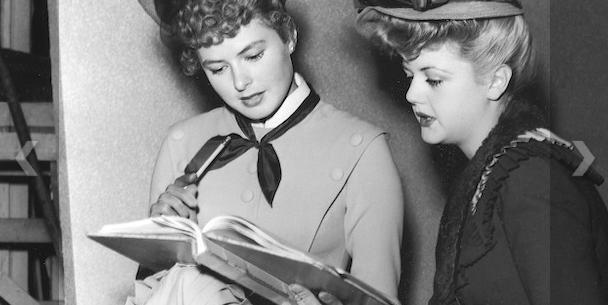
Este é o filme que deu a Ingrid Bergman seu primeiro Oscar de Melhor Atriz. Este é o primeiro filme feito pela atriz Angela Lansbury. Este é mais um filme com uma protagonista forte dirigido por George Cukor. E este é o filme que originou o termo “gaslighting”, que ainda pode ser usado até hoje em uma situação muito triste e sexista. Este é “À Meia Luz”, de 1944.

 This is the film that gave Ingrid Bergman her first Best Actress Oscar. This is the first film Angela Lansbury appeared in. This is another film with a strong female lead directed by George Cukor. And this is the film that gave us the verb “gaslighting”, one that can still be used today in a very unfortunate and sexist situation. This is 1944's “Gaslight”.


Paula Alquist (Ingrid Bergman) se muda da Inglaterra depois de uma tragédia acontecer em sua casa. Ela vai para a Itália estudar canto com o melhor maestro do país. Um dia, muitos anos depois de sua chegada, o maestro percebe que o coração dela não está no canto, e que ela está “feliz demais” para ser uma grande artista: ela só pode estar apaixonada. O maestro a libera para ser feliz como uma mulher casada e desistir do canto.

Paula Alquist (Ingrid Bergman) leaves England after tragedy strikes in her household. She goes to Italy to train as a singer under the best maestro in the country. One day, many years after her arrival, the maestro realizes her heart is not in the singing, and that she is “too happy” to be a great artist: she can only be in love. The maestro frees her to be happy as a married woman instead of as a singer.


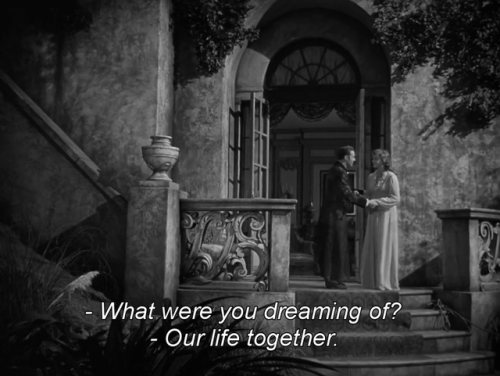
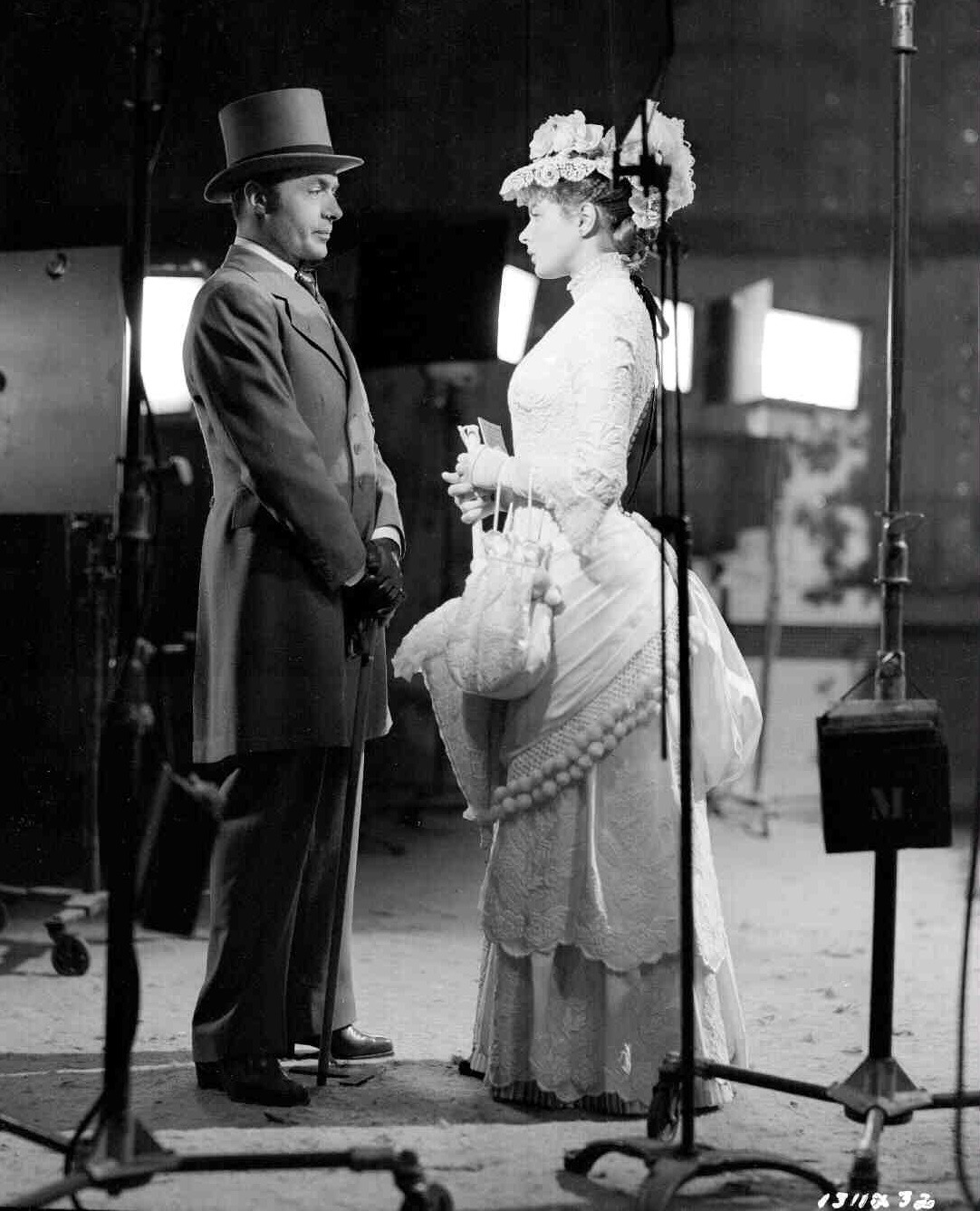
O homem por quem ela está apaixonada é o pianista que a acompanha nas lições de canto, Gregory Anton (Charles Boyer). Mas Paula é traumatizada e ingênua, e Gregory é esperto e manipulador: é por isso que ele a segue até seu lugar de descanso no Lago Como, e é assim que ele a convence a voltar para Londres, para a mesma casa em que a tia dela foi assassinada, depois do casamento.

The man she is in love with is the pianist that accompanies her in the singing lessons, Gregory Anton (Charles Boyer). But Paula is traumatized and naïve, and Gregory is smart and manipulative: that's why he follows her until her calm spot at Lake Como, and that's how he convinces her to go back to London, to the same house her aunt was murdered in, after they get married.


Gregory começa a dizer para Paula que ela está doente, e também que ela tem tido perdas de memória e tem perdido coisas ultimamente – e ela acredita nele. As observações dele fazem com que ela deixe de sair sozinha de casa, e Gregory também proíbe que venham visitas como Bessie Thwaites (Dame May Whitty), uma velhinha curiosa que adora um bom mistério, e Brian Cameron (Joseph Cotten), um homem intrigado.

Gregory starts telling Paula that she is sick, and also that she has been having memory lapses and losing things lately – and she believes him. His remarks prevent her from going out alone, and Gregory also forbids visitors like Bessie Thwaites (Dame May Whitty), a nosy old lady who loves a good mystery, and Brian Cameron (Joseph Cotten), a curious man.

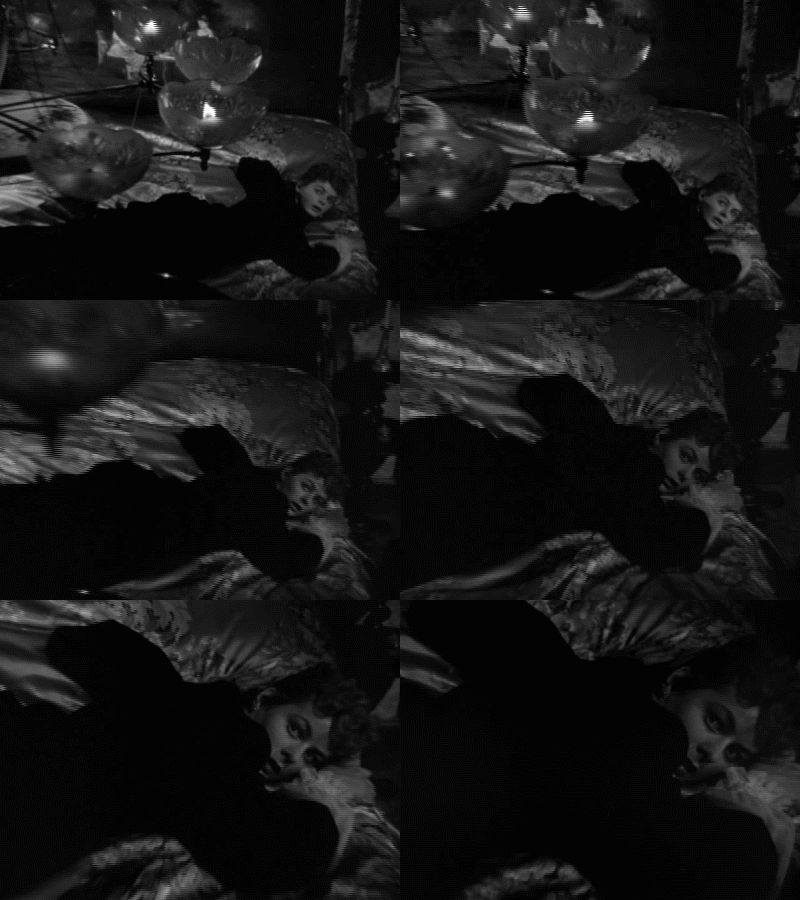
É através de tortura psicológica e sugestionamentos que Gregory manipula Paula. As luzes dos lampiões são uma metáfora aqui: conforme as luzes vão se extinguindo, Paula teme que sua sanidade também esteja indo embora. Por causa do filme, “gaslighting” se tornou o nome de uma técnica manipulativa que envolve o questionamento da realidade da vítima, para que todas as pessoas e até a própria vítima duvidem do que a vítima diz. Chamar as pessoas – em geral mulheres – de “loucas”, “insanas” e “histéricas” também é uma forma de fazer gaslighting.

It's through psychological torture and suggestion that Gregory manipulates Paula. The lights are a metaphor here: as they extinguish, Paula is afraid her sanity is extinguishing, too. Because of the film, “gaslighting” became the name of a manipulation technique that involves questioning the victim’s reality, so all people and even the victim start doubting what the victim says. Labeling people – usually women – as “crazy”, “insane” and “hysterical” is also gaslighting.


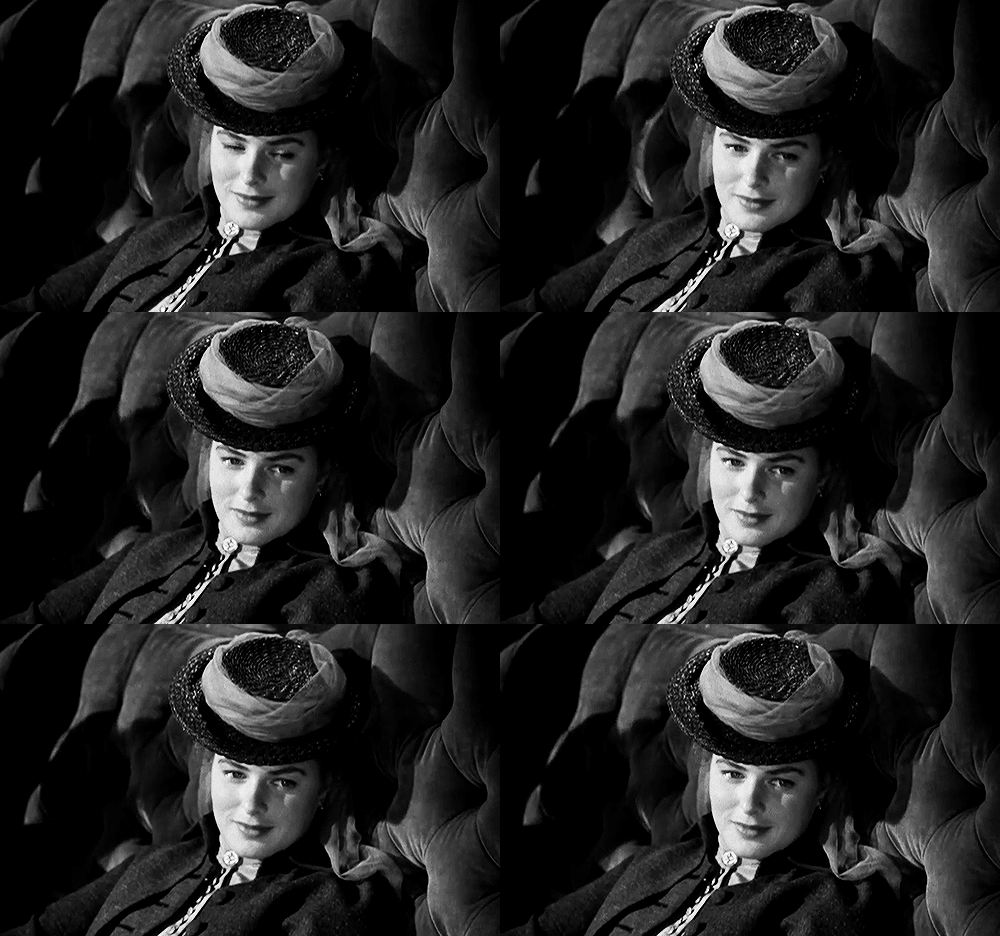
“À Meia Luz” pode ser considerado um filme noir? Há muitos elementos que fazem a resposta ser positiva: a fotografia em preto e branco com o uso de sombras, a importância da iluminação e das fontes de iluminação em diversos frames, o mistério e o suspense, o crime, a presença de Gregory como homme fatale - em contraste com as femme fatales do noir. Um elemento que poderia ser usado para refutar a hipótese é o fato de a história se passar no final do século XIX, mas na verdade há alguns filmes noir que não se passam no presente – sendo o principal exemplo o noir da Revolução Francesa “A Sombra da Guilhotina”(1949).

Can “Gaslight” be considered a noir film? There are many elements that make a case for a “yes”: the black and white photography with the use of shadows, the importance of lightning and sources of (gas)light in many frames, the mystery and suspense, the crime, Gregory as a homme fatale. One element that could be used to refute the hypothesis is the setting of the story in the late 19th century, but there are a few noir films not set in the present – the main example being the French Revolution noir “The Black Book”, from 1949.


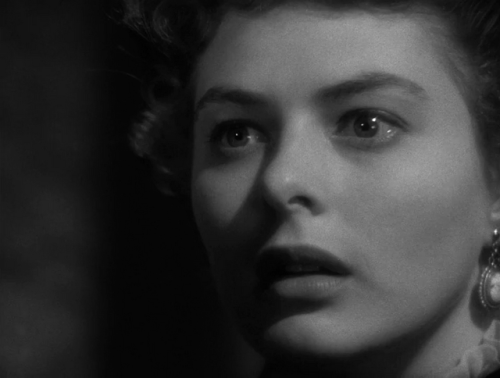
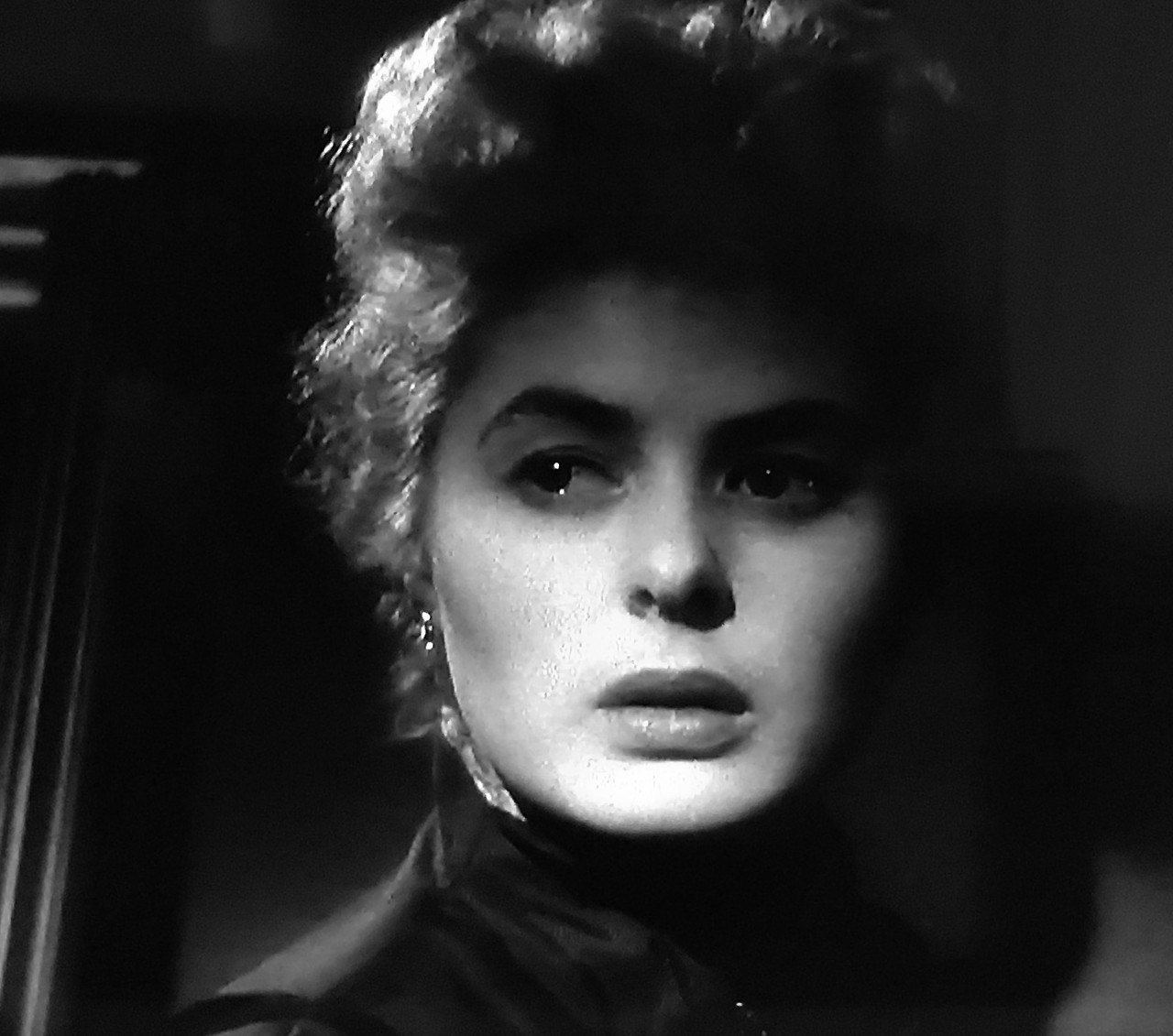
As atuações são extraordinárias. Ingrid Bergman tem olhos muito expressivos, e faz um monólogo poderoso perto do final do filme. Charles Boyer é incrivelmente sinistro, e desde o começo sabemos que suas intenções são as piores – em minha opinião, ele e Bergman mereciam o mesmo reconhecimento. Ambos foram indicados ao Oscar, mas apenas Ingrid ganhou – Boyer perdeu para Bing Crosby em “O Bom Pastor” (1944).

The performances are extraordinary. Ingrid Bergman has in her eyes her most expressive feature here, and she delivers her best monologue in a key scene near the ending. Charles Boyer is incredibly sinister, and from the start we know his intentions are no good – in my opinion, he and Bergman deserved the same recognition. Both were nominated for Oscars, but only Bergman won – Boyer lost to Bing Crosby for “Going My Way” (1944).


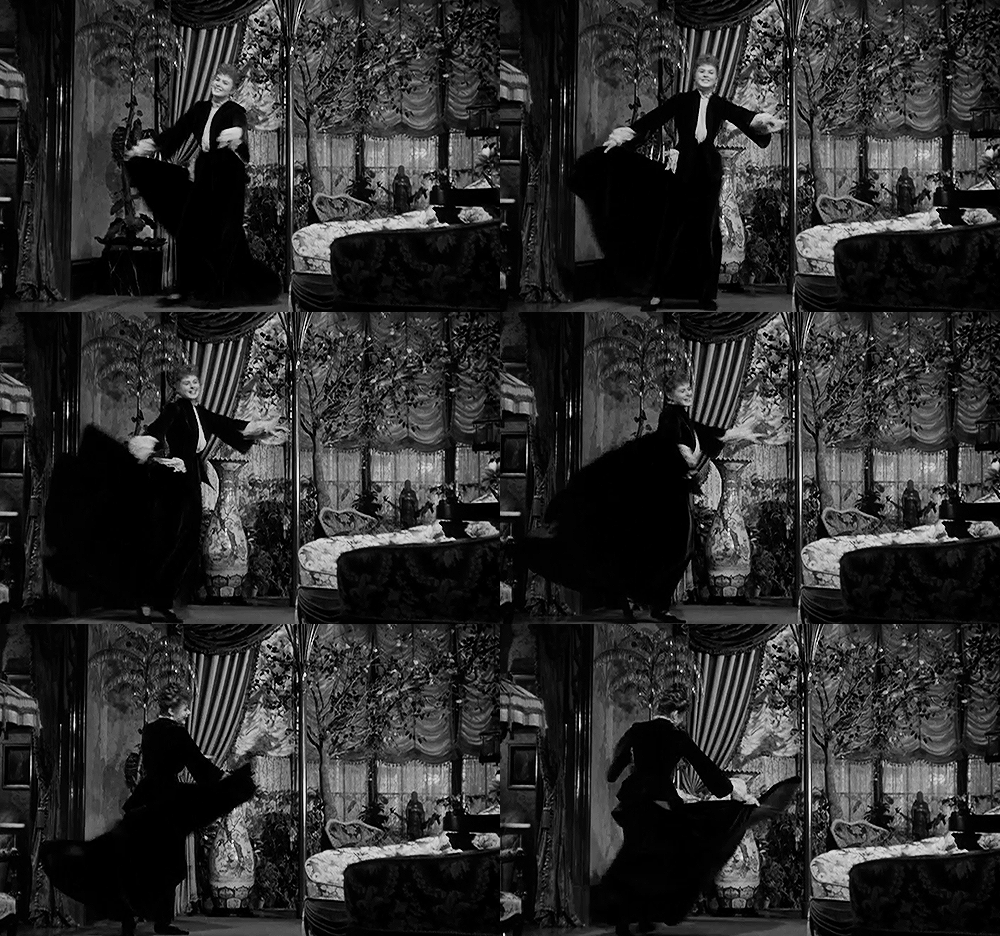
Há duas empregadas trabalhando para Paula e Gregory: Elizabeth (Barbara Everest) e Nancy (Angela Lansbury). Lansbury tinha apenas 17 anos quando fez o filme, e foi indicada ao Oscar de Melhor Atriz Coadjuvante. É algo curioso porque, como a vivaz Nancy, eu esperava que o papel dela fosse maior. O mesmo aconteceu com o papel de May Whitty: na minha opinião, ambas foram quase desperdiçadas. Angela Lansbury foi escalada para o papel em “À Meia Luz” quando o roteirista John van Druten convenceu David Selznick a fazer um teste com ela como favor à mãe dela, a também atriz Moyna McGill, que havia fugido da Inglaterra quando a guerra começou.

Working for Paula and Gregory there were two maids: Elizabeth (Barbara Everest) and Nancy (Angela Lansbury). Lansbury was only 17 when she made the film, and she was nominated for a Best Supporting Actress Oscar. It's curious because, as the flirty Nancy, I expected her role to be more substantial. The same happened to May Whitty's role: in my opinion, both were underused. Angela Lansbury became part of the “Gaslight” cast when screenwriter John van Druten convinced Selznick to audition her as a favor to their mother, also actress Moyna MacGill, who had fled England when the war started.


“À Meia Luz” teve origem em uma peça de teatro escrita por Patrick Angel, intitulada “Angel Street”. Em 1940, uma adaptação para o cinema foi feita na Inglaterra, estrelando Diana Wynyard (a protagonista de “Cavalgada”, de 1933) e Anton Walbrook (mais conhecido como Lermontov em “Os Sapatinhos Vermelhos”, de 1948). A MGM queria que todas as cópias desta versão fossem destruídas, mas felizmente algumas sobreviveram porque haviam sido guardadas sob o título original de “Angel Street”.

“Gaslight” originated from a stage play written by Patrick Hamilton and called “Angel Street”. In 1940, a film adaptation was made in England, starring Diana Wynyard (the lead of 1933's “Cavalcade”) and Anton Walbrook (best known as Lermontov in “The Red Shoes”, from 1948). MGM intended to have all copies of this version destroyed, but fortunately a few of them survived because the reels were labeled “Angel Street” and not “Gaslight”.


Misteriosa, surpreendente, com ótimas atuações e lindos cenários – o filme também ganhou o Oscar de Melhor Direção de Arte – Decoração em filme em Preto e Branco – “À Meia Luz” é uma pérola e uma obra-prima, que não apenas nos envolve e surpreende, mas também que explica um fenômeno que precisamos combater até hoje.

Chilling, surprising, with great performances and great sets – the film also won the Best Art Direction – Interior Decoration in a Black and White film Oscar – “Gaslight” is a gem and a masterpiece, that not only engages and amazes, but also explains a phenomenon we must combat until today.

This is my contribution to the Adoring Angela Lansbury blogathon, hosted by Gill at RealWeegieMidget Reviews.


Tuesday, July 3, 2018

A Porta de Ouro (1941) / Hold Back the Dawn (1941)


Todo mundo merece um lugar ao sol? Não sei ao certo, mas todo mundo quer um lugar ao sol. E geralmente a busca por este lugar cheio de alegria e satisfação envolve a migração. E o que acontece quando os imigrantes são parados no meio do caminho? Quando eles são proibidos de entrar no lugar que escolheram como sua nova casa? Você pode ligar a TV e encontrar respostas para estas questões agora mesmo, ou você pode ver “A Porta de Ouro”, um filme feito há mais de 75 anos.

Does everybody deserve a place in the sun? I’m not sure, but everybody wants a place in the sun. And often the pursuit of this place of happiness and fulfillment demands migration. And what happens when migrants are stopped midway their destiny? When they are forbidden to enter the place they chose as their new home? You could turn the TV and find answers for these questions right now, or you could watch “Hold Back the Dawn”, a film made over 75 years ago.
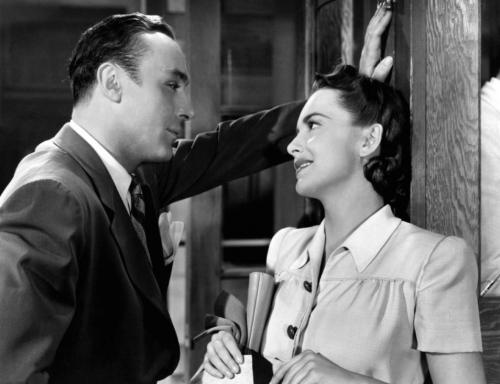
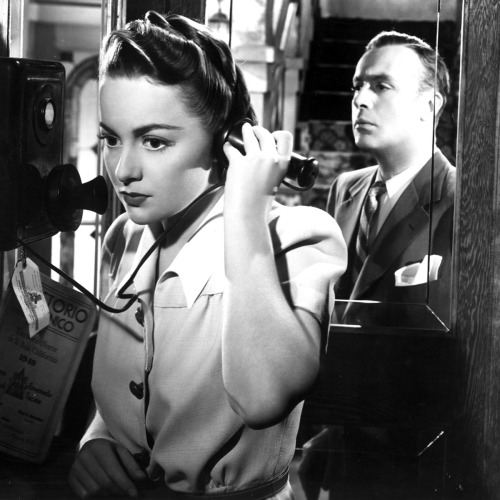
Georges Iscovescu (Charles Boyer) é um romeno que teve um probleminha na Europa e decidiu migrar para os EUA. Ele chega a uma escaldante cidade mexicana na fronteira, e descobre que, dos 150 mil imigrantes que o país deixava então entrar todos os anos, havia uma cota pequena para os romenos – e ele teria de esperar entre 5 e 8 anos para finalmente conseguir entrar no país legalmente. Por isso, ele e outros imigrantes de diversas nacionalidades ficam em um hotel até terem os documentos. O lugar tem um nome sugestivo: Hotel Esperanza.

Georges Iscovescu (Charles Boyer) is a Rumanian who had a little problem in Europe and decided to migrate to the United States. He reaches a hot Mexican city in the border, and finds out that, among the 150 thousand immigrants the US let in every year, there is only a very small quota for Rumanians – and he must wait from 5 to 8 years to finally be able to get in the US legally. So, he and other immigrants from several nationalities stay in a hotel until their visa is ready. The place has a suggestive name: Hotel Esperanza (Hope Hotel).
Mas a esperança não é a última que morre ali. Quando Georges chega ao hotel, um imigrante alemão havia se cansado de esperar e comete suicídio. No hotel, Georges encontra uma velha conhecida, Anita (Paulette Goddard), que lhe dá uma dica: é mais fácil e rápido ser admitido nos EUA se você se casar com uma norte-americana.

But hope is not the last one left standing there. When Georges arrives at Hotel Esperanza, a German immigrant has got tired of waiting and committed suicide. At the hotel Georges finds an old acquaintance, Anita (Paulette Goddard), who gives him a tip: it’s much easier and quicker to be admitted to the US if you marry an American.
Então, Georges começa a paquerar todas as norte-americanas que ele encontra. A primeira delas acaba sendo uma mulher casada, mas a segunda norte-americana que ele encontra é Emmy (Olivia de Havilland), uma professora que levou seus aluninhos bagunceiros para uma excursão no México durante o feriado de 4 de julho – uma atividade pedagógica que desafia a lógica, eu sei. Georges é charmoso e diz coisas lindas para ela, e o plano funciona: no dia seguinte, eles estão casados. O plano de Georges consistia, desde o começo, em se casar com Emmy, ser aceito nos EUA – escapando assim da vigilância do inspetor Hammock (Walter Abel) – e depois pedir a anulação do casamento e viver livremente nos EUA com Anita.

So, Georges starts hitting on all American women he sees. The first one happens to be already married, but the second American woman he finds is Emmy (Olivia de Havilland), a schoolteacher vacationing with her young and loud students in Mexico for the 4th of July holiday – something that defies the logic, I know. Georges is charming and says beautiful things to her, and the plan works: on the following day, they’re married. Georges’s plan has been, all along, to marry Emmy, be accepted in the US – thus escaping the vigilance of Inspector Hammock (Walter Abel) – then ask for an annulment and live freely there with Anita.
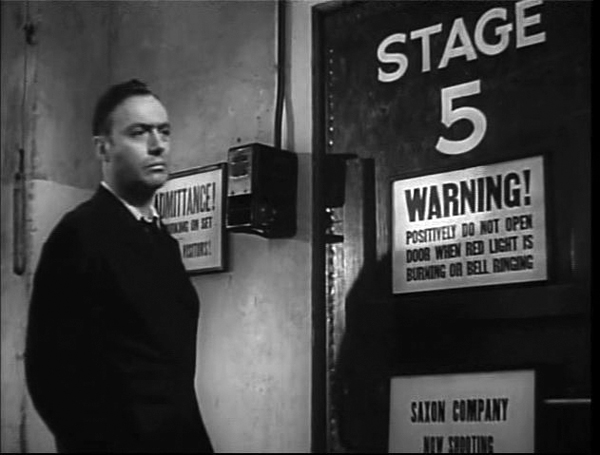
Há duas boas surpresas em “A Porta de Ouro”. Uma é a maneira como o filme começa: Georges está fugindo e entra em um estúdio de cinema, onde ele conta toda sua história de imigrante e falso amante para um diretor chamado Dwight Saxon (o próprio diretor do filme, Mitchell Leisen). O senhor Saxon estava filmando uma cena com Veronica Lake, e quando ele liberou a equipe, pôde finalmente ouvir a história de Georges. A outra boa surpresa é a lua de mel de Georges e Emmy em uma vila mexicana, onde eles participam de uma cerimônia religiosa. Não há nenhum estereótipo nesta parte do filme!

There are two nice surprises in “Hold Back the Dawn”. One is the way it starts: Georges is on the run and enters a film studio, where he tells his whole story as an immigrant and fake lover to a director called Dwight Saxon (director Mitchell Leisen himself). Mr. Saxon was filming a scene with Veronica Lake, and when he dismissed the team he was able to listen to Georges’s story. The other nice surprise is Georges’s and Emmy’s honeymoon in a Mexican villa, where they take part in a religious ceremony. There are no ugly stereotypes there!
Foi uma surpresa incrível e uma coincidência assustadora eu ter escolhido este filme para ver exatamente quando acontece um episódio que não pode ser considerado uma crise de imigração, mas um crime humanitário. Eu tento fugir da política, mas ela me persegue! Por falar em perseguir algo – um sonho - , em uma cena emblemática, um professor estrangeiro, no almoço de 4 de julho, recita para um oficial da imigração o poema na base na Estátua da Liberdade – um texto que prega valores que muitos americanos não apenas esqueceram, mas nos quais nunca sequer acreditaram.

It was an incredible surprise and a chilling coincidence that I chose to watch this movie exactly in the middle of an episode that can't be considered an immigration crisis, but a humanitarian crime. I try to stay away from politics, but they go after me! And talking about going after something, in an emblematic scene, a foreign professor, on the 4th of July lunch, recites to an immigration officer the poem on the basis of the Statue of Liberty – a text that shows values that many Americans not only have forgotten, but have never believed in the first place.
Um momento ruim aqui: Emmy fala dos EUA como a tão divulgada “terra de oportunidades” e compara o país com um lago que deve receber sempre novas correntezas para não ficar parado. Georges comenta: “o seu povo está construindo diques bem altos para parar estas correntezas”. A resposta dela? “Só para deixar o LIXO de fora”. Meu Deus. Isso poderia ter sido dito por um ultraconservador ontem mesmo.

A bad moment here: Emmy talks about the US as the so-called “land of opportunities” and compares the country to a lake that must keep receiving new streams to never go stank. Georges comments: “your people are building pretty high damps to stop these streams”. Her answer? “Just to keep out the SCUM”. Oh my God. This could have been said by an ultraconservative yesterday.

Não nos esqueçamos de que os roteiristas eram Charles Brackett e Billy Wilder – e Wilder era um imigrante, assim como as estrelas Charles Boyer (francês) e Olivia de Havilland (nascida no Japão). A maioria dos coadjuvantes também eram imigrantes, e formaram um grupo muito interessante que merecia muito mais destaque no filme.

Let's not forget that the screenwriters were Charles Brackett and Billy Wilder – and Wilder was an immigrant. So were the stars Charles Boyer (French) and Olivia de Havilland (born in Japan). Most of the supporting cast was also made of immigrants, and they were a very interesting group that deserved a lot more screen time.
Vamos dar uma olhada nestes personagens incríveis que esperam por seus vistos no Hotel Esperanza. Há o casal Kurz, Berta (Rosemary DeCamp) e Josef (Eric Feldary, vindo da antiga Áustria-Hungria). Eles esperam um bebê, e o sonho deles é que o bebê possa nascer sendo um cidadão norte-americano. Bonbois (interpretado por Curt Bois, um ator alemão que fez seu primeiro filme em 1908 e o último em 1988) é um nervoso cabeleireiro francês que serve de alívio cômico. Há também o porfessor Van Den Luecken (o ator belga Victor Francen) e suas duas filhas, Christine (Micheline Cheirel) e Anni (Madeleine Lebeau). Ambas eram atrizes francesas – e Madeleine é parte importante da icônica cena da Marselhesa em “Casablanca” (1942).

Let’s take a look at these amazing characters waiting for their visas at the Hotel Esperanza. There is the Kurz couple, Berta (Rosemary DeCamp) and Josef (Eric Feldary, from former Austria-Hungary). They are expecting a baby, and dream that him or her can be born an American citizen. Bonbois (played by Curt Bois, a German actor who made his first film in 1908 and his last in 1988) is a nervous French coiffeur who serves as the comic relief. There is also professor Van Den Luecken (Belgian actor Victor Francen) and his two daughters, Christine (Micheline Cheirel) and Anni (Madeleine Lebeau). Both actresses were French – and Madeleine is an important part of the iconic Marsellaise scene from “Casablanca” (1942).
Curt Bois in "Casablanca"
Madeleine LeBeau
Boyer é suave e charmoso como sempre. Olivia é adorável como sempre, tendo de ser ingênua a maior parte do tempo. Paulette Goddard está bem como uma femme fatale da fronteira. Mas os reais destaques são os imigrantes desesperados do hotel. Eles são a prova cabal e tangível de que a diversidade é o tempero da vida – e a melhor coisa deste filme.

Boyer is suave and charming as always. Olivia is lovely as always, having to be naïve most of the time. Paulette Goddard is good as a femme fatale of the border. But the true MVPs are the desperate migrants in the hotel. They are the real, touchable proof that diversity is the spice of life – and the best thing in this film.

This is my contribution to the third annual Olivia de Havilland blogathon, hosted by Laura and Crystal at Phyllis Loves Classic Movies and In the Good Old Days ofClassic Hollywood.


Monday, November 13, 2017

Descalços no Parque / Barefoot in the Park (1967)

Recém-casados. Desde a era do cinema mudo, muitos filmes já trataram de jovens casais apaixonados, prestes a começar a vida a dois. Buster Keaton fez, por exemplo, muitos curtas-metragens nos quais ele precisava se adaptar à nova vida – podemos citar dois deles: “Uma Semana” (1920) e “A Parentela da Esposa” (1922). Buster não foi o único a mostrar o lad0 divertido do casamento. Quarenta anos depois, os casais tinham o mesmo problema que os personagens de Buster – incompatibilidade.

Newlyweds. Since the silent era many, many films were made about young couples in love, about to start their life together. Buster Keaton had,  for instance, many short films in which he had to adapt to his new life – we can mention two of them: “One Week” (1920) and “My Wife’s Relations” (1922). Buster wasn’t the only one to show the fun side of the newlyweds’ life. Forty years later, couples had the same problem as Buster’s characters – incompatibility.
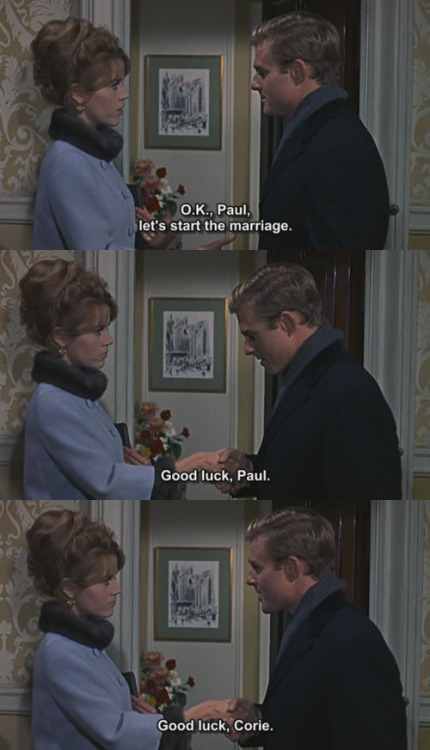
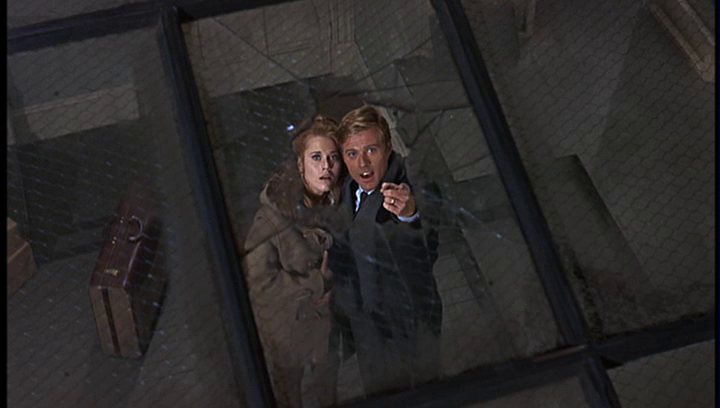
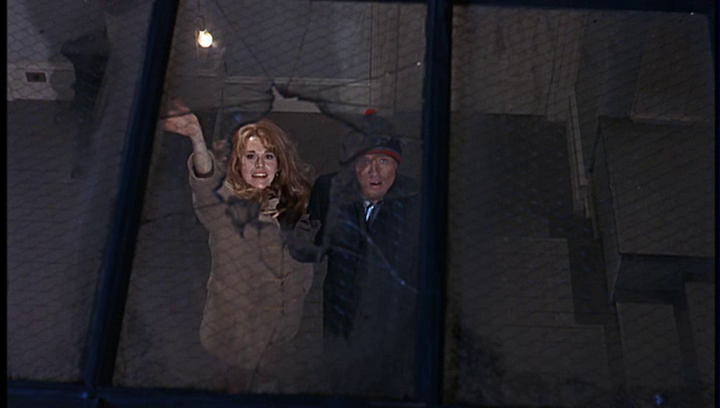
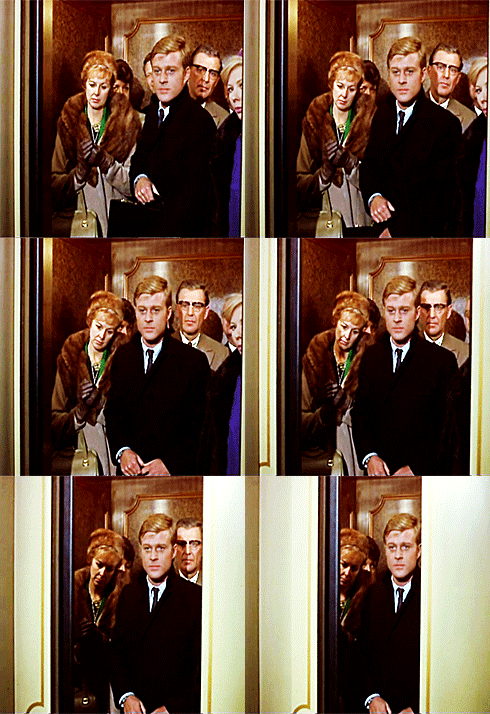
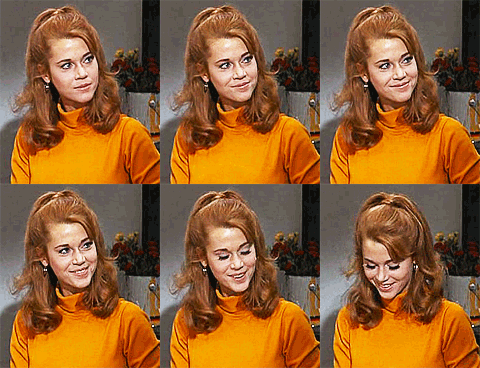
Corie (Jane Fonda) e Paul (Robert Redford) voltaram da lua de mel e se mudaram para seu novo apartamento em Nova York. Como você deve imaginar, este é o melhor lugar pelo qual o jovem casal pode pagar, então não é um apartamento muito espaçoso. Ele se localiza no último andar de um prédio sem escadas. E, ah, há um buraco na claraboia, algo perfeito para dias de verão, porém terrível para noites de inverno.

Corie (Jane Fonda) and Paul (Robert Redford) have just resumed their honeymoon and moved to their own apartment in New York City. As you may imagine, this is the best place the young couple can afford, so it’s not very big. It’s also on the last floor of a building that has no stairs. And, oh, there is a hole in the ceiling, perfect for sunny days but horrible in snowy nights.
Entretanto, este não é o maior problema deles. Parece que o amor os cegou e apenas agora eles veem como são diferentes. Paul é um advogado sério, que se preocupa com a carreira em primeiro lugar. Corie é uma dona de casa de espírito livre, que não vê problemas em socializar com vizinhos estranhos. Paul quer uma casa arrumada e uma carreira brilhante, enquanto Corie quer ter o marido ao seu lado e se divertir.

But this is not their biggest problem. It looks like love has blinded the young couple and only now they could see how different they are. Paul is a serious lawyer, who worries about his work more than anything else. Corie is a free-spirited housewife, who doesn’t care about mingling with weird neighbors. Paul wants a tidy home and a brilliant career, while Corie wants to have her husband next to her and to have fun.
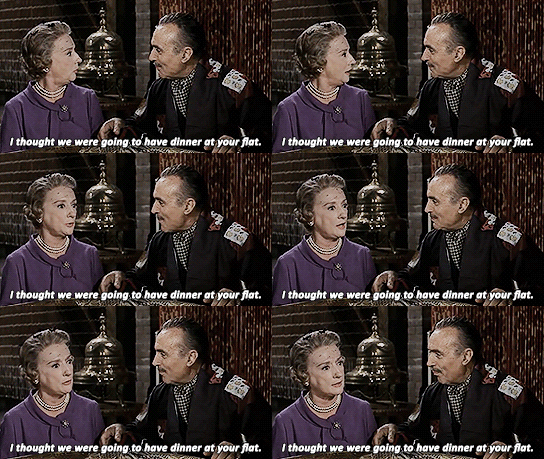
É comum que se diga que, quando você se casa com alguém, também se casa com a família desta pessoa. E, seguindo este raciocínio, quando você se muda para uma nova casa ou prédio você também acaba criando uma relação com seus vizinhos. E isto tudo nos leva a dois incríveis coadjuvantes: Ethel (Mildred Natwick), a mãe de Corie, e Victor Velasco (Charles Boyer), um vizinho excêntrico. Na sequência mais divertida do filme, Corie, Paul, Ethel e Victor saem para jantar.

It’s often said that when you marry someone, you also marry this person’s family. And, following the reasoning, when you move to a new house or building you end up creating a relationship with your neighbors. And this takes us to two amazing supporting characters: Ethel (Mildred Natwick), Corie’s mother, and Victor Velasco (Charles Boyer), an eccentric neighbor. In the funniest sequence of the movie, Corie, Paul, Ethel and Victor go out to dine.
Não posso elogiar suficientemente a noite louca que os quarto experimentam. Haverá ao menos um momento em que você vai chorar de rir – talvez por causa da comida estranha, talvez por causa das loucuras de Velasco. “Descalços no Parque” acabará lhe ensinando a comer knichi do jeito certo, a dançar a dança folclórica albanesa “Shama Shama” ou por que beber muito uzo lhe impedirá de fechar a mão.

I can’t say enough good things about the zany night out the four of them have. There will be at least a moment when you’ll laugh until you cry – maybe because of the weird food, or because of Velasco’s shenanigans. “Barefoot in the Park” will end up teaching you how to eat knichi properly, how to dance the Albanian folk song “Shama Shama” or why drinking too much uzo will prevent you from making a fist.
É interessante notar como, mesmo sendo baseado em uma peça de teatro, “Descalços no Parque” não parece ‘teatral’. Há poucos cenários, mas a sensação geral é de que o filme não fica confinado por causa disso. Isso acontece porque Neil Simon, o autor da peça, escreveu também o roteiro do filme. Simon não era novato no mundo do cinema e da TV – ele trabalhava desde 1948 em filmes e séries para a televisão.

It’s interesting how, even though the film is based on a stage play, “Barefoot in the Park” doesn’t look ‘staged’. There may be few settings, but the overall feeling of the movie is not something confined. This happens especially because Neil Simon, the play writer, was also responsible for the screenplay. Simon was no newcomer in the film and TV world – he had been working in TV movies and series since 1948.
Descalços no Parque” foi o terceiro de cinco filmes – até agora – em que Jane Fonda e Robert Redford contracenaram. Eles curiosamente começaram suas carreiras no cinema com o mesmo filme, “Até os Fortes Vacilam” (1960), mas Fonda era a estrela e Redford apenas um figurante. Começando com “Caçada Humana”, de 1966, Fonda e Redford se tornaram bons amigos, em especial porque têm o mesmo posicionamento político. Foi delicioso vê-los como um casal jovem e apaixonado em “Descalços no Parque”, e foi ótimo descobrir que eles se juntaram para uma nova empreitada...

Barefoot in the Park” was the third of five – so far – films Jane Fonda and Robert Redford made together. They actually made their screen debuts in the same movie, “Tall Story” (1960), but Fonda had a starring role and Redford was only an extra. Starting with 1966’s “The Chase”, Fonda and Redford became good friends, in special because of their similar political views. It was delightful to see them as a young and passionate couple in “Barefoot in the Park”, and it was great when they reteamed… 

This is my contribution to the Then and Now (Now and Then) blogathon, hosted by Realweegiemidget (and Thoughts All Sorts).

Related Posts Plugin for WordPress, Blogger...