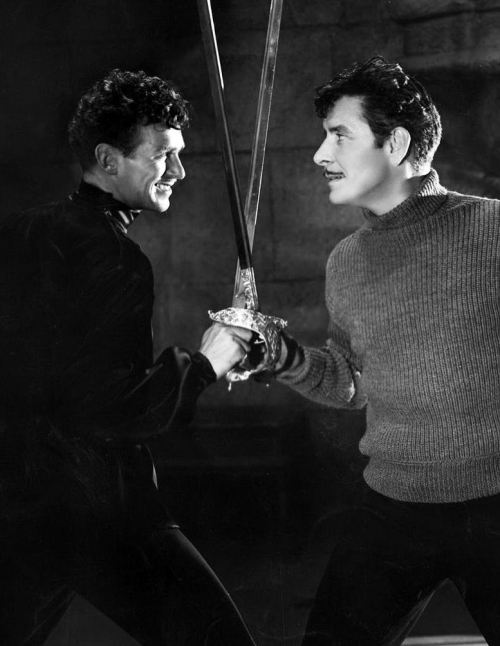
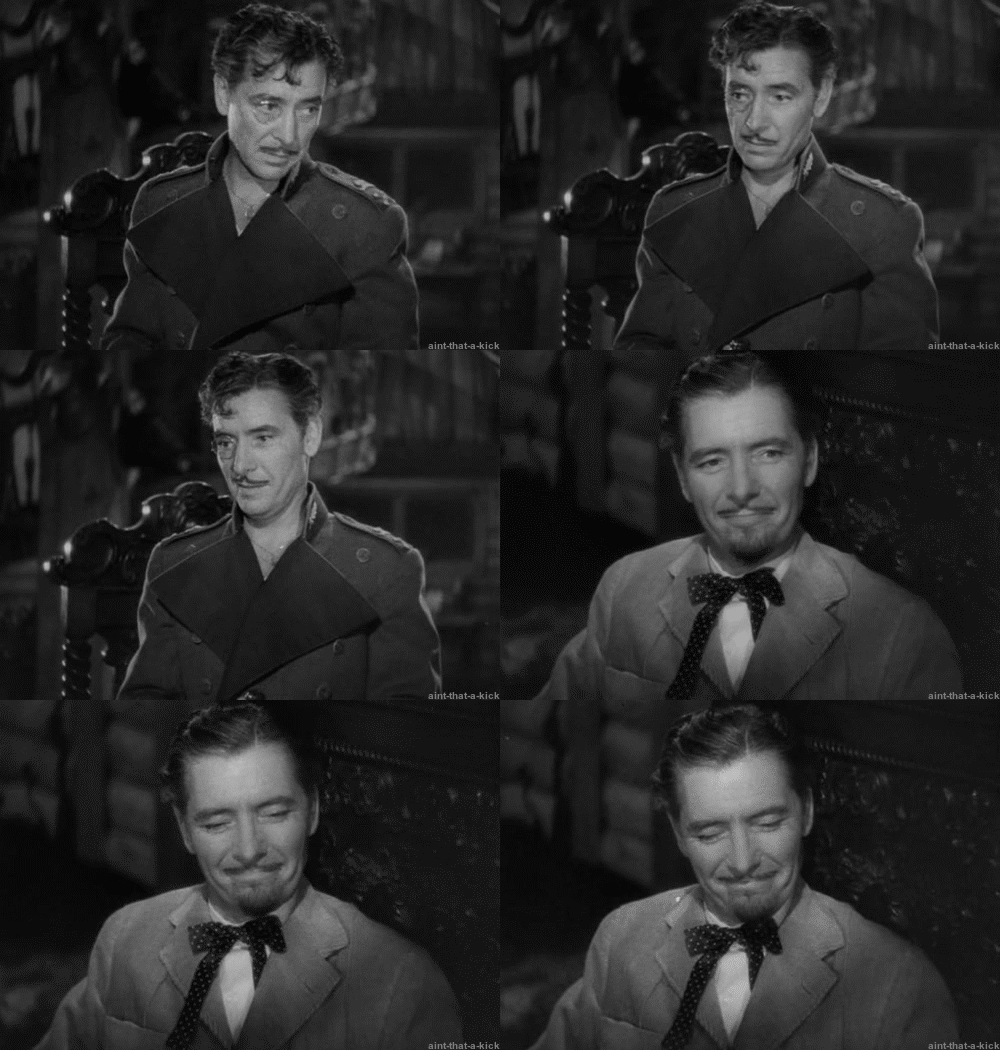
Quando os caminhos de Buster Keaton e de Douglas Fairbanks se cruzaram, aconteceu uma mudança: Keaton fez seu primeiro longa-metragem, “O Pesado” (1920), porque Fairbanks o recomendou para os estúdios Metro. Trinta e quatro anos depois, os caminhos de Buster se cruzaram com os de Douglas Fairbanks Jr. Na época, séries antológicas na TV eram populares, e com eles pessoas como Hitchcock e Fairbanks tinham programas próprios sem precisar se envolver demais com o trabalho toda semana – por exemplo, escrevendo, dirigindo ou gravando uma nova história toda semana, podendo apenas produzir e supervisionar o show. Doug foi o apresentador de “Douglas Fairbanks Presents” de 1953 a 1957 e, em 14 de julho de 1954, Doug teve a honra de apresentar Buster Keaton interpretando um personagem dramático de Gogol – algo que nunca pensamos que veríamos, mas que bom que isso aconteceu.
When Buster Keaton's path crossed with Douglas Fairbanks', change happened: Keaton made his first feature film, “The Saphead” (1920), because Fairbanks recommended him to Metro to play the lead. Thirty-four years later, Buster's path crossed with Douglas Fairbanks Jr's. At that time, anthology series on TV were quite popular, and with them people like Hitchcock and Fairbanks had a show to call their own without having to do a lot of hard work every week – I mean, they didn't have to write, direct or shoot a new story every week, they could only produce and oversee the show. Doug was the host of “Douglas Fairbanks Presents” from 1953 to 1957 and, on July 14th 1954, Doug had the honor to present Buster playing a dramatic character by Gogol – something we never thought we'd see, but we're glad it happened.

Como Doug diz, nossa história é ambientada em qualquer lugar – ou mesmo lugar nenhum. O tempo? Ontem ou hoje ou no futuro distante. O tema? Liberdade. Uma liberdade esquecida. Esquecer a liberdade é o que leva uma sociedade a aceitar o totalitarismo, e isto foi o que aconteceu antes da história começar. Tudo que sabemos é que o local está sob o comando de alguém chamado O Chefe (James Hayter), cuja foto está presente nas casas dos cidadãos – e até nos escritórios e nos quartos! - com as palavras “Ele SE IMPORTA” escritas abaixo da imagem.
As Doug says, the setting of our story is anywhere or nowhere. The time? Yesterday or today or tomorrows to come. The subject? Freedom. A forgotten freedom. Forgetting freedom is what leads a society to accept totalitarism, and this is what happened before the story begins. All we know is that the place is under someone called The Chief (James Hayter), whose photo hangs in citizens' houses – even in their offices and bedrooms! - with the words “He CARES” underneath the image.

Buster é O Homem, um burocrata comum que se importa mais com números e dados do que com pessoas. Mas é claro, as coisas e especialmente as pessoas devem estar em seus devidos lugares, seguindo uma classificação rígida! O Homem não se importa com pessoas, diversão ou moda – prova disso é que ele tem um sobretudo muito velho que precisa de conserto. Mas O Alfaiate (Sam Jaffe) convence O Homem a fazer um sobretudo novo em vez de consertar o antigo.
Buster is The Man, a common bureaucrat who cares more about numbers and data than with people. But of course, things and especially people must be in their proper places, following a rigid classification! The Man doesn't care about people, fun or fashion – a proof of that is that he has a very old overcoat needing mending. But The Tailor (Sam Jaffe) covinces The Man to make a new, expensive overcoat instead.

E o sobretudo muda O Homem. De repente seus colegas de trabalho o admiram, e a garota que vive em seu prédio passa a achá-lo bonito. Quando o sobretudo é roubado, O Homem começa a questionar a burocracia ao seu redor e se transforma naquele que realmente se importa – e isso, obviamente, será um grande problema e o levará a um encontro com O Chefe.
And the overcoat changes The Man. Suddenly his coworkers admire him, and the girl who lives in his building thinks he's handsome. When the overcoat is stolen, The Man starts questioning the bureaucracy around him and becomes the one who really truly cares – and this, of course, will be a huge problem and lead him to a meeting with The Chief.

É incrível ver quanto podia ser inserido em tão pouco tempo – 30 minutos menos os comerciais! Eu não quero parecer nostálgica e desprezar o que há de bom na TV moderna, mas hoje em geral vemos programas de TV com muitos personagens e histórias tolas contadas 30 minutos ou menos, enquanto nos anos 50, no começo da televisão, clássicos da literatura mundial eram adaptados para o novo meio e podiam ser brilhantemente contados em pouco tempo com um elenco enxuto.
It's amazing how so much could be packed in such a little time – 30 minutes minus the commercials! I don't want to sound nostalgic and dismiss the good modern TV, but now we often see TV shows with many characters and silly stories told in thirty minutes or less, when in the 1950s, the dawn of television, classics of world literature were adapted to the new medium and could be brilliantly told in a short time with an equally short cast.

Eu não li o conto de Gogol, mas pude passar os olhos brevemente por ele. O conto traz o nome do protagonista e é claramente ambientado na Rússia do século XIX – o que torna a história menos universal. O conto foi adaptado para as telas por Larry Marcus, que escreveu 10 episódios de “Douglas Fairbanks Presents”, foi responsável pela ótima adaptação de Agatha Christie “Testemunha de Acusação” (1957) e também escreveu o roteiro original do filme “O Bígamo” (1953).
I didn't read Gogol's story “The Cloak”, but I was able to briefly run my eyes through it. The story names the main character and the set is clearly 19th-century Russia – which makes it a less universal tale. The story was adapted to the screen by Larry Marcus, who wrote 10 episodes of “Douglas Fairbanks Presents”, was responsible for the great Agatha Christie adaptation “Witness for the Prosecution” (1957) and also wrote the original story for the film “The Bigamist” (1953).

A Wikipedia menciona 13 adaptações do conto para o cinema e a TV. Em “The Awakening”, há muitas mudanças importantes com relação ao original, e alguns elementos de “1984” de George Orwell podem ser vistos, como o poder que O chefe tem sobre todos, e a ideia de que todos estão sendo vigiados. Embora O Chefe seja uma figura que só aparece em uma curta cena, sua presença está por toda parte, e por causa disso nós já antipatizamos com ele e com o regime - e é ótimo ver Buster desafiar o regime. Quando Buster fala, você se surpreende. Quando ele grita e se rebela, você fica maravilhado com o que aquele homenzinho do rosto de pedra podia fazer.
Wikipedia lists 13 film and TV adaptations of the story. In “The Awakening”, there were many important changes from the original, and some elements from George Orwell's “Nineteen Eighty-Four” can be seen, like the power The Chief has over everybody, and the idea that everybody is under vigilance. Although The Chief is a figure that only appears in a small scene, his presence is everywhere, and because of that we already dislike him and the regime - and it’s great to see Buster standing up to the regime. When Buster talks, you are surprised. When he shouts and rebels, you're marveled at what that little stone-faced man could do.

Fairbanks viu Keaton como única opção para o papel principal. Ele disse: “Me pareceu uma bela ideia - uma ideia nova - colocá-lo em um papel sério, porque ele era tão bom ator e com grande talento. Funcionou muito bem; sua performance foi maravilhosa. Eu acredito que ele e Chaplin eram os maiores mestres da pantomima produzidos pelo cinema. Eles podiam expressar tanto com tão pouco.” Buster não ficou nervoso com a atuação dramática, garantiu sua esposa Eleanor: “Na comédia, ele tinha de criar tudo. No drama, você apenas decora suas falas e deixa outra pessoa se preocupar.”
Fairbanks saw nobody but Keaton in the main role. He said: "It struck me as a beautiful idea—a novel idea—to put him in a straight part, because he was such a beautiful actor and a great talent. It worked out very well; he gave a marvelous performance. I think that he and Chaplin were the supreme pantomimists that the screen has produced. They could convey so much with so little." Buster was not nervous about doing drama, and his wife Eleanor guaranteed it: “In comedy, he had to create everything. In drama, you just learn your lines and let someone else do the worrying."

Eu fiquei particularmente feliz quando um dos recursos narrativos que eu mais odeio - o final “tudo não passou de um sonho” - foi subvertido de maneira ousada e inspirada. Ao ter seu sobretudo levado, O Homem é despertado. Ser despertado para a realidade é em geral muito doloroso e traz vários problemas, e “The Awakening” mostra que, por causa disso, é preciso mais do que ser despertado: se manter desperto é algo completamente diferente, que muda a vida de uma pessoa.
I was particularly happy when one of my most hated narrative devices – the “it was all just a dream” finale – was subverted in a bold and inspired way. By having his overcoat taken, The Man has his awakening. To wake up for reality is often extremely painful and troublesome, and “The Awakening” shows that, because of this, there is more than waking up: staying woke – and here I may be using the double meaning the word has earned recently – is something completely different and life-changing.
This is my contribution to the 7th Annual Buster Keaton blogathon, hosted by Lea at Silent-ology.