} Crítica Retrô: Maciste

Tradutor / Translator / Traductor / Übersetzer / Traduttore / Traducteur / 翻訳者 / переводчик

Showing posts with label Maciste. Show all posts

Wednesday, October 13, 2021

40ª Giornate del Cinema Muto - 40th Pordenone Silent Film Festival

 
A melhor semana do ano, na minha humilde opinião, acabou de acabar. Esta semana diz respeito ao Festival de Cinema Mudo de Pordenone, um evento que sempre agrada aos amantes de cinema mudo como esta que vos escreve. Depois de uma edição completamente online em 2020, o festival voltou a ter exibições presenciais de filmes no norte da Itália, mas manteve uma versão online para nós, pobres almas que não pudemos comparecer – eu fui mentora do Collegium este ano porque fui membro do Collegium ano passado, mas não pude ir ao evento presencial porque não tomei as duas doses da vacina. Aqui estão minhas impressões sobre a programação online.

The best week of the year, in my humble opinion, is over. This week comprises the Pordenone Silent Film Festival, an event that never fails to appeal to silent film lovers like this girl writing here. Following an all-online edition in 2020, the festival went back to in-person screenings in the Italian north but kept an online version for us poor souls who couldn’t attend the event – I was a Collegium mentor this year because I was part of the Collegium last year, but couldn’t attend the in-person event as I’m not fully vaccinated. So here you have my impressions of the online progamme.

No ano passado encontrei um tema comum a todos os filmes: contraste. Em contraste, neste ano não encontrei um tema comum, mas dois dos filmes se aproximam na maneira como lidaram com – ou melhor, zombaram da – moralidade. Tanto em “Phil-for-Short” (1919) quanto no filme alemão “Moral” (1928) há defensores da moral querendo censurar os protagonistas: no primeiro filme, o guardião de Damophilia (Evelyn Greeley) quer que ela pare de se vestir como um menino, enquanto no segundo filme a artista Ninon D’Hauteville é vítima de um grupo de censores. Ambos os filmes foram muito bons, e tornados ainda melhores pelo acompanhamento musical.

Last year I found a common theme to all screenings: contrast. In contrast, this year I couldn’t find a common theme to all movies, but a couple of them were similar in the way they talked about – or rather mocked – morality. In both “Phil-for-Short” (1919) and in the German film “Moral” (1928) there are morality defenders wanting to censor the leads: in the earlier movie, Damophilia’s (Evelyn Greeley) guardian wants her to stop dressing as a boy, while in the later movie the artist Ninon D’Hauteville is the victim of a group of censors. Both film were very good, enhanced by great musical accompaniments.

"Phil-for-Short" (1919)

"Moral" (1928)

O filme de abertura da versão online do festival foi “The Joker” (1928), uma produção pan-europeia filmada em diversos países, inclusive na França durante o Carnaval de Nice. Trata-se de uma história de chantagem e enganação. O filme de encerramento foi “Maciste no Inferno” (1926) – certa feita mencionado por Federico Fellini como sendo o filme que o fez querer ser cineasta – uma história colossal sobre amor e poder estrelando Bartolomeo Pagano. “Maciste no Inferno” foi particularmente importante porque sua restauração foi possível com o uso de material oriundo da nossa Cinemateca Brasileira, atualmente fechada e ameaçada.

The opening film of the online version of the festival was “The Joker” (1928), a pan-European production shot in several countries, including in France during the Carnaval in Nice. It’s a story about blackmail and deception. The closing movie was “Maciste in Hell” (1926) – once mentioned by Federico Fellini as the film that made him want to become a filmmaker – a colossal tale of love and power starring Bartolomeo Pagano. “Maciste in Hell” was particularly important because its restoration was made possible with material from our Brazilian Cinematheque, that is currently closed and threatened.

"The Joker" (1928)

"Maciste in Hell" (1926)

Nesta Giornate assisti ao meu primeiro filme mudo australiano: “The Man from Kangaroo” (1920). É um faroeste decente estrelado por Snowy Baker – uma mistura de Tom Mix, Douglas Fairbanks e Johnny Weissmuller. Também assisti ao meu primeiro filme mudo sul-coreano, que não era mudo: “A Public Prosecutor and a Teacher” foi feito em 1948, logo após o final da Segunda Guerra Mundial e da ocupação japonesa, quando o país sofreu uma escassez de recursos para fazer filmes sonoros. Este bom melodrama tinha um Beyoncé byeonsa, ou seja, um narrador que interpretava a ação e a maior parte dos diálogos.

In this Giornate I watched my first Australian silent film: “The Man from Kangaroo” (1920). It’s a decent western starring Snowy Baker – a mix of Tom Mix, Douglas Fairbanks and Johnny Weissmuller. I also watched my first South Korean silent film, which wasn’t silent at all: “A Public Prosecutor and a Teacher” was made in 1948, right after World War II and the Japanese occupation had ended and the country suffered from a shortage of material to make sound films. This nice melodrama had a Beyoncé byeonsa, that is, a narrator that acted out the action and most of the dialog.

"The Man from Kangaroo" (1920)

"A Public Prosecutor and a Teacher" (1948)

Meu filme favorito da Giornate online foi mais uma vez o filme da terça à noite: “Fool’s Paradise” (1921), de Cecil B. DeMille, é tudo que um fã de cinema mudo pode querer. Ele tem literalmente de tudo no enredo: um veterano da Primeira Guerra Mundial ferido, uma cidade na fronteira cheia de poços de petróleo e homens mal-encarados, um cigarro explosivo, um cego, sotaques franceses, amor verdadeiro, um incêndio, uma viagem ao Sião e um sacrifício a crocodilos num templo. Poll Patchouli, interpretada pela grande Dorothy Dalton, rapidamente se tornou uma das minhas personagens mais queridas do cinema mudo.

My favorite film from the online Giornate was once again shown in a Tuesday night: Cecil B. DeMille’s “Fool’s Paradise” (1921) is everything a silent movie fan could ask for. It has literally everything in its plot: a wounded WWI veteran, a small town in the border full of oil wells and greasers, an exploding cigar, a blind man, French accents, true love, a fire, a trip to Siam and a sacrifice to crocodiles in a temple. Poll Patchouli, played by the great Dorothy Dalton, quickly became one of the silent movie characters dearest to my heart.


Esta edição também exibiu curtas-metragens. No segundo dia, cinco deles foram exibidos, quatro italianos e um francês. Eles incluíam um vislumbre dos estúdios Ambrosio em 1913, um alerta sobre ópio, uma animação stop-motion muito criativa e uma criança que vê os sentimentos da mãe em bolhas de sabão. Mais três curtas-metragens foram exibidos no último dia, todos dos estúdios Vitagraph no Brooklyn mas com temas japoneses – e um deles provavelmente tem Florence Turner fazendo yellowface. Nestes curtas da Vitagraph, a presença de uma atriz mirim chamou a minha atenção: a de Adele De Garde. No curta italiano “Le Bolle di Sapone”, a atriz mirim Maria Bay também teve uma boa performance.

This edition also showed short movies. On the second day five of them were shown, four from Italia and one from France. These included a sneak peek at Ambrosio studios in 1913, a cautionary tale about opium, a very creative stop-motion animation and a kid envisioning his mother’s feelings in soap bubbles. Three more shorts were shown in the last day, all from Vitagraph studios in Brooklyn but all with Japanese themes – and one of them that probably has Florence Turner in yellowface. In these Vitagraph shorts, the presence of a child star called my attention: Adele De Garde. In the Italian short “Air Bubbles”, child actress Maria Bay also had a fine performance.

"Ito, the Beggar Boy" (1910)

"Le Bolle di Sapone" (1911)

Nós, que estávamos em casa, tivemos um bom vislumbre de toda a programação do festival presencial. Muitas mulheres ganharam destaque, em frente às câmeras – como Ellen Richter de “Moral” e as “Nasty Women” de tantas comédias – e por trás das câmeras – como as mulheres roteiristas. “An Old Fashioned Boy”, de 1920, estava entre os filmes exibidos na programação dedicada às mulheres roteiristas. É um filme muito divertido que inclusive zombou da necessidade de se fazer quarentena, o que é muito curioso quando levamos em consideração nossos tempos pandêmicos.

We, the people at home, could get a nice glimpse of all the programmes that the in-person festival had. Many women were highlighted, in front of the camera – like Ellen Richter from “Moral” and the “Nasty Women” of so many comedies – and behind the camera – like the female screenwriters. “An Old Fashioned Boy”, from 1920, was among the films in the female screenwriters programme and it was a very funny movie that even mocked the need to quarantine, which is quite curious considering our pandemic times.


Eu gostei demais da Giornate deste ano, mas senti muita falta das nossas sessões do Collegium no Zoom, que foram tão especiais e enriquecedoras ano passado. A cada ano aprendemos algumas coisas na Giornate e uma das coisas que aprendi este ano é que o ato de ir ao cinema, para ser totalmente apreciado, deve ser um evento social.

I enjoyed this year’s Giornate immensely, but I really missed our Collegium Zoom sessions that were so special and enriching last year. Every year we learn some things from the Giornate, and one of the things I learned this year is that cinemagoing, to be fully enjoyed, must be a social event.

Para informações mais detalhadas sobre os filmes da 40ª Giornate del Cinema Muto, leia os posts da minha amiga Danielle.

Friday, June 21, 2013

Cabiria (1914)

Uma única frase resumiria o filme “Cabiria”, de 1914: não é fácil. Não foi fácil fazê-lo, há quase cem anos, e não são todos os espectadores, nem mesmo todos os cinéfilos, que apreciariam este filme. Com uma trama dividida em cinco episódios e passado no terceiro século antes de Cristo, este, que é um dos primeiros épicos do cinema, tem sua carga de patriotismo, às vésperas da Primeira Guerra Mundial, e muitas referências históricas.

A single sentence can summarize the film “Cabiria”, from 1914: it ain't easy. It wasn't easy to make it, almost a century ago, and not all viewers, not even the die-hard cinephiles, may like it.With a story told in five episodes and set in the third century b.D., this, one of cinema's first epics, has a strong patriotic feeling, just before World War I, and a lot of historical references. 

Cabiria é uma jovem princesa da Sicília, interpretada durante metade do filme por Carolina Catena, atriz infantil que atuou até 1915 e cuja biografia é tão obscura quanto um buraco negro. Quando ocorre uma erupção do vulcão Etna, ela está com sua babá, Croessa (Gina Marangoni), que faz de tudo para salvar a própria vida e a vida da menina. Junto com outros serviçais, Croessa e Cabiria escapam, mas chegam perto demais de um barco e são capturadas e levadas para Cartago para serem vendidas como escravas.

Cabiria is a young Sicilian princess, played during half of the picture by Carolina Catena, a child actress who worked until 1915 and whose biography is as obscure as a black hole. When the volcano Etna awakes, she is with her tutor, Croessa (Gina Marangoni), who does everything she can to save herself and the child. Croessa and Cabiria escape with other servants, but they get too close to a boat and are captured and sent to Carthage to be sold as slaves.

Cabiria e outras 99 crianças escravas são escolhidas como oferenda a um deus, e, portanto, devem ser queimadas na boca de uma imensa estátua em um templo igualmente impressionante. Croessa pede ajuda ao romano disfarçado Fulvius Axilla (Umberto Mozato) e ao escravo dele, Maciste (Bartolomeo Pagano), para resgatar Cabiria. Enquanto tudo isso acontece com as pessoas normais, um ataque a Roma vem sendo planejado por Aníbal (Emilio Vardanes), que aparece cruzando os Alpes, e Asdrúbal (Edoardo Davesnes), pai da princesa Sofonisba (Italia Almirante), cobiçada por muitos.

Cabiria and 99 other slave children are chosen to be sacrificed to a god, and for this they need to be burned at the mouth of a huge statue located in an equally impressive temple. Croessa asks Fulvius Axilla (Umberto Mozato), a Roman in disguise, for help. She also urges his slave, Maciste (Bartolomeo Pagano) to help rescue Cabiria. While all this is happening to the normal people, two noblemen plan to attack Rome: Anibal (Emilio Vardanes), who is seen crossing the Alps, and Asdrubal (Edoardo Davesnes), father of princess Sophonisba (Italia Almirante), a coveted princess.

Cabiria dá o nome ao filme, mas serve apenas de elo para a história. Ela liga os personagens e as situações reais, como as Guerras Púnicas (Roma contra Cartago). Mal se vê o rosto dela quando menina, e já moça, interpretada por Lidia Quaranta, também não está presente na tela durante muito tempo. Dependendo da origem do filme (como acontece na versão do YouTube), a atriz aparece creditada como Letizia Quaranta, irmã de Lidia.

The film is named after Cabiria, but the character is only a small piece in the story. She links the characters and the real-life situations, like the Punic Wars (Rome against Carthage). We barely see her face as a child, and as a young woman, played by Lidia Quaranta, she also doesn't have a lot of screen time. Depending on the source of the film (a YouTube version has this mistake), the actress appears with the name Letizia Quaranta, who was Lidia's sister. 

Uma escada humana / Human stairs

Muitos dos personagens representados aqui são figuras históricas verdadeiras, como todos os reis, cônsules e princesas envolvidos na guerra. Até o intelectual Arquimedes faz uma ilustre participação, criando uma engenhoca que destrói os navios romanos em uma sequência impressionante, difícil de imaginar que tenha sido filmada há quase cem anos (e tenha sido posta em prática há mais de dois mil anos!).

Many of the characters here are real historical figures, like all kings, consuls and princesses involved in the war Even the intellectual Archimedes has a cameo, creating a tool that destroys Roman ships in an impressive sequence that is difficult to imagine being filmed almost 100 years ago (and even more difficult to imagine it actually working over 2,000 years ago!).

Italia Almirante (também creditada como Italia Almirante-Manzini), intérprete da rainha Sofonisba, provavelmente a personagem feminina mais importante no enredo, tem ares de Theda Bara e não há palavras suficientes para elogiar sua atuação. Tinha como primos três atores e um diretor de cinema, e seus pais trabalhavam no teatro, mas traçou sua carreira de sucesso sem nepotismo. “Cabiria” consolidou sua carreira e transformou-a em diva do cinema mudo italiano. Aposentando-se após apenas um filme falado, em 1934, Italia fez uma turnê pela América do Sul, vindo a falecer em São Paulo em 1941, vítima de uma picada de inseto.

Italia Almirante (sometimes credited as Italia Almirante-Manzini), who plays princess Sophonisba, the most important female character in the film, looks a bit like Theda Bara and there are no words to compliment her acting. Three of her cousins were film actors, another cousin a director, her parents worked in the theater, but she achieved success without nepotism. “Cabiria” was a milestone in her career and turned her into a diva of the silent Italian cinema. After only one talkie, she retired in 1934 and started a tour through South America. She passed away in São Paulo in 1941 after being bitten by a bug.  

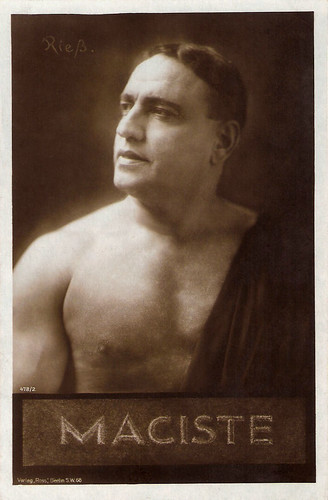
O personagem Maciste teve vida longa, apesar de um dos intertítulos do filme prever que ele não escaparia com vida. Em 1915, seguindo o sucesso do coadjuvante no épico, o diretor Giovanni Pastrone produziu um filme em que ele era o protagonista, dando origem a uma série de 26 filmes muito loucos estrelando Maciste e, por consequência, Bartolomeo Pagano. Nestas películas, o personagem foi sonâmbulo, policial, turista e atleta. Ele poderia aparecer em qualquer época e lugar. Nessas odisseias, quase todas disponíveis na Internet, também ficamos sabendo que Pagano era um ator branco que havia sido maquiado para parecer negro em sua primeira aparição no cinema. O absurdo só aumentou com o tempo e, com o renascimento de Maciste nos anos 50 e 60, somos informado de que ele se materializa em qualquer lugar que seja necessário a partir de pedras. Segundo Gabriele D’Annunzio, que colaborou no roteiro de “Cabiria”, Maciste é um dos nomes do herói Hércules, daí a força descomunal do personagem que, por sinal, nunca conquistava a protagonista. Mas nem tudo é bobagem no mundo do personagem: foi o filme “Maciste no Inferno”, de 1926, que influenciou Fellini a tornar-se cineasta.   

The character Maciste had a long life, even though one of the title cards of the film predicted he would not escape alive. In 1915, following the success of the supporting character of the epic, director Giovanni Pastrone produced a movie starring Maciste, and it was the beginning of a series of 26 very crazy movies starring Maciste and, of course, Bartolomeo Pagano. In these movies, the character was a sleepwalker, a cop, a tourist and an athlete. He could appear in any place or period. In these adventures, almost all of them available online, we learn that Pagano was a white actor who originally played Maciste in blackface in “Cabiria”. The absurdity only grew with time and, in the 1950s and 60s, when Maciste is reborn, we are told that he materializes himself in any place he's need through... rocks. According to Gabriele D'Annunzio, who worked with the script in “Cabiria”, Maciste is one of the names of the hero Hercules, what explains his super-human strength – but doesn't explain why he never got the girl in the end. But not everything is nonsense in this character's world: it was the film “Maciste in Hell”, from 1925, that influenced Fellini to become a filmmaker. 

O enredo é bastante denso, devido ao excesso de detalhes históricos, além das inovações que maravilharam D. W. Griffith e o inspiraram a filmar “Intolerância” (1916). O diretor Giovanni Pastrone cria cenas surpreendentes, aglomera multidões em frente às câmeras, comanda cenas perigosas até mesmo para dublês, reconstitui um passado distante e luxuoso e não dispensa muita ação, sendo pioneiro no uso de luzes artificiais e da movimentação de câmera (travelling).  

The plot is very dense, with a lot of historical details, and there are many innovations that marveled D.W. Griffith and inspired him to make “Intolerance” (1916). Director Giovanni Pastrone creates surprising scenes, agglomerates crowds in front of the cameras, commands scenes that are dangerous even for professional doubles, reconstructs a distant and luxurious past and uses a lot of action, being a pioneer in the use of artificial lighting and camera travellings. 

O custo de dois milhões de liras (250 mil dólares na época) compensou. Além do sucesso internacional, “Cabiria” conquistou a honra de ser o primeiro filme a ser exibido dentro da Casa Branca. Vindo de uma série italiana de épicos, como “Quo Vadis?” e “Os Últimos Dias Pompeia”, ambos de 1913, este filme consolidou o gênero, sendo suficiente para Scorsese afirmar que Pastrone inventou o gênero épico. E não foi à toa que os melhores épicos foram filmados justamente na Itália, ou melhor, na Cinecittà.

The cost of two million lire (250,000 dollars at the time) paid off. Besides the international success, “Cabiria” had the honor to be the first film to be shown inside the White House. Coming from a series of Italian epics, like “Quo Vadis?” and “The Last Days of Pompeii”, both from 1913, this film consolidated the genre, and Scorsese even said that Pastrone invented the epic. And it wasn't a coincidence that the best epics were filmed in Italy, that is, in the Cinecittà Studios.

Cabiria” (1914) está disponível no YouTube e no Internet Archive (neste, sem trilha sonora).

“Cabiria” is availabe at YouTube and Internet Archive (without a soundtrack in the latter). 


This is my second contribution to the Italian Film Culture Blogathon, hosted by the Nitrate Diva. In the banner, Italia Almirante and Anna Magnani.


P.S.: Deixem nos comentários a opinião geral de vocês sobre os filmes mudos. Ela será usada como pesquisa para um futuro post. 
Related Posts Plugin for WordPress, Blogger...