} Crítica Retrô: Italia Almirante

Tradutor / Translator / Traductor / Übersetzer / Traduttore / Traducteur / 翻訳者 / переводчик

Showing posts with label Italia Almirante. Show all posts

Friday, October 16, 2026

45ª Le Giornate del Cinema Muto / 45th Pordenone Silent Film Festival


A melhor semana do ano chegou e foi embora rapidamente, provando que o tempo voa quando estamos nos divertindo. A semana que prova que tanto do que foi feito durante a era do cinema mudo foi perdido, mas muito, MUITO mesmo, ainda está aí para ser visto e apreciado. Estou falando, obviamente, da Giornate del Cinema Muto, o Festival de Cinema Mudo de Pordenone. Mais uma vez acompanhei as exibições online e aqui estão minhas opiniões. Ah, antes, um pedido de desculpas: como o site não permitia tirar prints da tela, tive de tirar fotos com meu iPad e a qualidade não ficou tão boa.

The best week of the year arrived and went by quickly, proving that time flies when we’re having fun. The week that proves that so much of what was made during the silent film era is lost but there is also a lot, really A LOT, to be seen and enjoyed. I’m talking about, of course, the Giornate del Cinema Muto, the Pordenone Silent Film Festival. Once again I accompanied the online screenings and here are my thoughts. Oh, before that, I need to say I’m sorry: as the site didn’t allow to print the screen, I had to take photos with my iPad and the quality ended up a bit poor.

Uma das sessões mais intrigantes para mim desde o anúncio foi a “Weimar Sem Censura: Tabus e Transgressões no Cinema Alemão, 1919-1920”, formada por filmes feitos enquanto não havia censura na Alemanha, logo após a Primeira Guerra Mundial. O filme de abertura da Giornate online veio desta sessão: “A Igreja do Diabo” de 1919, produzido por uma companhia chamada, olhe só, Lucifer Film. Nele, duas pessoas vendem sua alma para o Diabo (Paul Rehkopf): Ane (Agnes Straub), que quer ter um filho próprio, e o Reverendo (Hans Mierendoff), que quer construir uma igreja grandiosa. O final foi um pouco decepcionante, mas foi um bom começo para a 45ª Giornate.

One of the most intriguing sections to me since it was announced was the “Weimar Uncensored: Taboos and Transgression in German Cinema, 1919-1920”, comprised of the films made when there was no censorship in Germany, right after World War I. The opening film from the online Giornate came from this program: 1919’s “The Devil’s Church”, produced by a company aptly titled Lucifer Film. In it, two people sell their souls to the Devil (Paul Rehkopf): Ane (Agnes Straub), in order to conceive her own child, and the local Reverend (Hans Mierendorff), in order to build a huge church for himself. The ending was a bit of a downer, but it was a good start for the 45th Giornate.


Lucifer Film on top

Também da sessão Weimar Sem Censura veio “Veneno Loiro” (1919), banido pouco depois de estrear. A causa é óbvia: o filme é sobre a vamp Loni (Hedda Vernon), que seduz, entre outros homens, seu amigo de infância Rolf (Ernst Deutsch) e consome a maior parte da herança do moço. Eu adoraria ver mais de Hedda Vernon, e poderia admitir que esse foi um dos meus filmes favoritos, ainda mais com aquele final!

Also from the Weimar Uncensored section came “Blonde Poison” (1919), banned shortly before it was released. The cause is unmistakable: it’s about vamp Loni (Hedda Vernon), who seduces, among other men, her childhood friend Rolf (Ernst Deutsch) and consumes most of his inheritance. I’d love to see more of Hedda Vernon, and I’d go on to say that this was one of my favorite screenings, especially for the ending!


Outra sessão intrigante só foi possível graças à colaboração entre arquivos espanhóis para exibir o que ainda existe do cinema mudo espanhol até 1919. Na oferta online o longa apresentado foi “La Voluntad que Vence” (1919), um filme tão cheio de ação e reviravoltas que pode ser comparado aos seriados da época. Escrevi com mais detalhes sobre ele no meu blog em inglês Lost and Found Films.

Another intriguing section was made possible by the groundbreaking collaboration between Spanish film archives to showcase what is extant from Spanish silent cinema up until 1919. In the online offer the feature presented was “La voluntad que vence” (1919), a film so full of action and twists that it could be compared to a serial. I wrote in more detail about it on my blog Lost and Found Films.


Gloria Swanson é o rosto do poster e catálogo da 45ª Giornate. Ela fez sua aparição no programa online através do quase completo “The Humming Bird” de 1924. Aqui Gloria interpreta um ladrão que todos acreditam ser um garoto, com base nas roupas que usa. Ainda há sequências faltando no filme que foram reconstruídas através de imagens, mas algo da emoção original foi perdida graças à perda das sequências originais.

Gloria Swanson is the face of the 45th Giornate poster and catalogue. She appeared in the online program in the form of the mostly found “The Humming Bird” from 1924. Here Gloria plays a thief that everybody believes to be a young boy, based on the clothes he wears. There were still missing sequences in the movie that were reconstructed through stills, but some of the original thrills for sure were lost with the loss of the original sequences.


Outra superestrela está de volta à Giornate online: Mary Pickford! Ela está aqui porque fez cinco filmes com um diretor que o festival está homenageando: Marshall Neilan, que Gloria Swanson descreveu como “o homem mais encantador de Hollywood!”. O filme aqui foi “M’Liss” (1918), a última colaboração entre Neilan, Pickford, a roteirista Frances Marion e o diretor de fotografia Walter Stradling. Pickford interpreta M’Liss – apelido de Melissa, se você, como eu, estava se perguntando – uma moleca que se apaixona pelo novo professor (Thomas Meighan) até que ele é acusado de matar  o pai bêbado da garota. Um filme adorável de Pickford, como sempre, além de uma oportunidade para ver uma galinha chamada Hildegarde em cenas cômicas!

Another female superstar is back to the online Giornate: Mary Pickford! She is here because she made five films with a director the festival is paying tribute to: Marshall Neilan, who Gloria Swanson described as “the most bewitching man in Hollywood!”. The film of choice was “M’Liss” (1918), the last collaboration between Neilan, Pickford, screenwriter Frances Marion and cinematographer Walter Stradling. Pickford plays M’Liss – short for Melissa, if you were wondering like I was – a tomboy who falls in love with the new schoolmaster (Thomas Meighan) until he’s accused of murdering her drunken father. A lovely Pickford as always, plus the opportunity to see a hen named Hildegarde in fun gags!


E mais uma diva do cinema mudo está presente: Italia Almirante Manzini, que ganhou uma retrospectiva nos últimos dois anos, em seu último filme mudo, “L’Arzigogolo” de 1924. É um evento especial porque as cartelas de texto estavam em português, pois uma cópia quase completa foi encontrada na Cinemateca Brasileira sob o título “O Bobo ou Amor que Redime”. Manzini interpreta uma mulher nobre casada chamada Violante que se apaixona pelo Bobo-da-Corte que trabalha para um homem que a cobiça. Ambientado em tempos medieavais, é um deleite para os olhos, com seus cenários e figurinos suntuosos!

And yet another silent screen diva is present: Italia Almirante Manzini, subject of a two-year retrospective, in her final silent film, 1924’s “L’Arzigogolo”. It is special because the title cards are in Portuguese, as a near complete copy was found in the Brazilian cinematheque under the title “O Bobo ou Amor que Redime” (The Jester or Love that Redeems). Manzini is a married noblewoman named Violante who falls in love with a Jester who entertains a man that covets her. Set in Medieval times, it was a Marvel to look at, complete with sultry sets and costumes!

Curtas-metragens são uma grande parte da Giornate. Houve “Uma Vítima das Circunstâncias” (1913), dos estúdios Thanhouser, um dos primeiros filmes a mostrar o procedimento que se segue à prisão de alguém. Outro curta veio da Espanha: “Miss Ledyia” de 1916, sobre uma mulher de férias na Galícia tentando evitar que a Rainha seja assassinada por um anarquista!

Shorts are a big part of the Giornate. There was “A Victim of Circumstances” (1913), from the Thanhouser Studio, one of the first to show what happens when one is arrested. Another short came from Spain: “Miss Ledyia” from 1916, about a woman on vacation in Galicia trying to stop the assassination of a Queen by an anarchist!

A Victim of Circumstances (1913)

Miss Ledyia (1916)

Por falar em curtas, houve uma seleção deles feitos pela dupla cômica formada pelo Sr e a (segunda) Sra Sidney Drew, provando que a comédia de situação, ou “sitcom”, não foi inventada pela televisão: ela apareceu na era muda como um contraponto à comédia pastelão ou “slapstick”. Outro ponto interessante é que Lucille McVey, a segunda Sra Sidney Drew, dirigiu quatro dos cinco curtas apresentados! Eu já havia assistido a um deles como parte da Silent Comedy Watch Party, então para mim esta sessão foi como reencontrar velhos amigos.

Speaking of shorts, there was a selection of them by the comedic duo Mr and (second) Mrs Sidney Drew, proving that the situation comedy, or “sitcom”, wasn’t invented by television: it appeared in the silent era as a counterpoint to slapstick comedy. Another interesting point is that Lucille McVey, the second Mrs Sidney Drew, directed four of the five shorts presented! I had already watched one of them as part of the Silent Comedy Watch Party, so for me it was like meeting old friends once again.

Seguindo em frente, a sessão de filmes de vanguarda este ano trouxe cinco curtas tchecos – dois deles eram filmes promocionais, o que significa que homens de negócios naquela época não tinham medo de contratar cineastas experimentais para anunciar seus negócios! Entre a seleção, foi ótimo assisitir a “Hands on Tuesday” (1935), que estabelece um diálogo com um dos meus filmes mudos preferidos de todos os tempos, “Amor Pedestre” de 1914. Mas o melhor de todos foi o filme pacifista, “The Story of a Soldier”, de 1934, sobre um soldado que tem de voltar ao front depois dos horrors da Primeira Guerra Mundial. Ah, se eles soubessem!

Moving forward, the section of Avant-Garde films this year brought five Czech shorts – two of them were promotional films, meaning that businessmen back then weren’t afraid of hiring experimental filmmakers to advertise their businesses! Among the selection, it was great to watch “Hands on Tuesday” (1935), which establishes a dialogue with one of my favorite silent films ever, 1914’s “Amor Pedestre”. But the best of the batch was the pacifist film, “The Story of a Soldier”, from 1934, about a soldier having to go back to the front after the nightmares of World War I. If only they knew!

Prague in the Glow of Lights (1928)


Fechando a seleção de curtas houve a apresentação de cinco filmes da região do Lácio, onde se localiza Roma. Tivemos um grande drama romântico (meu favorito), um micro-épico religioso, uma história pós-Medieval de recusa e vingança, uma propaganda para carros da Fiat e um filme caseiro. Agora é uma boa hora para mencionar que muitos dos longas eram precedidos por “phantom tram rides”, ou seja, curtas bem curtinhos feitos acoplando uma câmera na frente de um bonde e deixando ela graver as paisagens urbanas e rurais. Foi divertido!

Closing the selection of shorts there were five films from the region of Lazio, where Rome is. There was a great drama of love (my favorite from the batch), a religious micro-epic, a post-Medieval story of refusal and revenge, an ad for Fiat cars and a home movie. Now it’s a good time to mention that many screenings were preceded by phantom tram rides, that is, split-reel films obtained by attaching a camera in front of a tram and let it record the landscapes, both urban and rural. They were amusing!   

Le Roman de Magdalena (1913)

San Paolo (1910)

One of the phantom tram rides

Além de “The Story of a Soldier”, outro curta que eu amei foi “Stellina, la Pêcheuse de Venise” de 1912, porque não era apenas emocionante, mas também colorido! Este curta foi o filme de abertura para o longa sueco “The Gyurkovics Boys” (1920), sobre os filhos mais velhos de uma família de 12. Enquanto Bandi (Nils Asther) toma conta da propriedade, Géza (Gösta Ekman) se torna um cadete e vive aventuras amorosas. Eu fiquei particularmente impressionada com a atriz e co-roteirista Pauline Brunius. Se eu não puder aprender mais sobre ela, eu vou dar um tiro na testa (uma referência para quem viu o filme)!

Besides “The Story of a Soldier”, another short I loved was “Stellina, la Pêcheuse de Venise” from 1912, because it wasn’t only engaging, but also stencil-colored! This short opened for the Swedish feature “The Gyurkovics Boys” (1920) about the oldest boys in a family of 12 kids. While Bandi (Nils Asther) takes care of the property, Géza (Gösta Ekman) becomes an officer cadet and lives amorous adventures. I was particularly impressed by actress and co-screenwirter Pauline Brunius. If I can’t learn more about her, I’ll shoot myself on the forehead (a reference for those who watched the film)!

Stellina (1912)

Pauline Brunius gracing my screen

Terminando o festival com sucesso, tivemos mais uma vez Marshall Neilan, desta vez como ator – no exclusivo para o streaming “Don’t Monkey with the Buzz Saw” (1914) – e finalmente como o diretor do filme de Colleen Moore “Apuros da Nobreza” (1927). Moore interpreta uma órfã decidida que quer ser parte da alta sociedade. As cartelas de texto eram hilárias. E assim chega ao fim mais uma edição da Giornate, e começa minha espera pela próxima – mas vou assisti-la online ou presencialmente?  

Finishing the festival successfully, we had once again Marshall Neilan, this time as an actor – in the streaming-exclusive short “Don’t Monkey with the Buzz Saw” (1914) – and finally as the director of Colleen Moore’s vehicle “Her Wild Oat” (1927). Moore plays a feisty orphan wanting to be part of high society. The title cards were hilarious! And like this another edition of the Giornate came to an end, and my wait for the next edition begins – but will I attend it online or in person?

Neilan as an actor

Poor Colleen

Rich Colleen


Tuesday, October 14, 2025

44ª Giornate del Cinema Muto / 44th Pordenone Silent Film Festival

 Não curto muito celebrar meu aniversário. Gosto bastante das festividades do Natal. Mas minha época favorita do ano é outra: a semana quando acontece a Giornate del Cinema Muto. Desde a pandemia, o time por trás do festival vem sendo fantástico por oferecer uma programação online com um pouco de tudo que é exibido in loco em Pordenone, para os fãs do cinema mudo ao redor do mundo. Estou entre esses fãs espectadores pelo quinto ano consecutivo e aqui está um vislumbre desta semana mágica.

I’m not very fond of celebrating my birthday. I really like the parties around Christmas. But my favorite time of the year is another: the week when the Pordenone Silent Film Festival happens. Since the pandemic, the Giornate team has been kind enough to offer an online program with a little bit of everything that is shown in loco in Pordenone, for silent film fans around the world. I’m among them for the fifth consecutive year and here is an overview of this magic week.


O festival online começou com “Saias / A Little Bit of Fluff”, feito quando o som já estava chegando ao mundo do cinema – o glorioso ano de 1928. É uma farsa deliciosa sobre os vizinhos Bertram (Syd Chaplin), recém-casado, e Mamie (Betty Balfour), uma artista. A trama gira em torno das estripulias dele quando sua esposa deveria estar fora de casa e inclui ainda uma questão sobre um colar de pérolas e diamantes.

The online Giornate kicked off with “A Little Bit of Fluff”, from when sound was already arriving in the film world - the glorious year of 1928. It was a delightful farce about neighbors Bertram (Syd Chaplin), recently married, and Mamie (Betty Balfour), a showgirl. It revolves around his shenanigans when his wife is supposed to be out of town and also the ownership of a pearl and diamonds necklace.


Mais cedo este ano eu escrevi sobre o recentemente restaurado “Satan Fait la Noce”, de 1907. Na Giornate eu encontrei um Louis Feuillade mais contido fazendo uma série de filmes intitulados “A Vida como Ela É” entre 1911 e 1912. A restauração destes curtas estava ótima e as cópias perfeitas. Através deles fui introduzida a uma das maiores estrelas francesas da época Suzanne Grandais. A composição abaixo, de “Le Nain” de 1912, foi mais tarde imitada mas permanece como uma prova surpreendente de que o primeiro cinema era muito mais elaborado que comumente se pensa. Outro curta revelador da série foi “Erreur Tragique”, com um filme dentro do filme, com o protagonista vendo sua esposa com outro homem num filme exibido num cinema em Paris.

Earlier this year I’ve reviewed the recently recovered short “Satan Fait la Noce”, from 1907. At the Giornate I found a less mischievous Louis Feuillade making a series of films titled “Life As It Is” between 1911 and 1912. The restoration of these shorts was amazing and the prints were pristine. Through them I was introduced to one of the biggest French stars of the era, Suzanne Grandais. The shot below, from 1912’s “Le Nain”, was later imitated but remains a surprise proof that early film was much more elaborated than most think. Another revealing short of the series was “Erreur Tragique”, with a film-within-the-film, with the lead seeing his wife with another man in the film showing at a Paris movie theater.


Pela primeira vez na Giornate tive a chance de revisitar alguns “velhos amigos”, filmes que eu já havia visto antes. O primeiro foi o curta de abertura da programação online, “The Bond”, um filme patriótico com páthos. O esforço para venda de bônus de guerra pareceria propaganda sem-graça nas mãos de um cineasta menos habilidoso, mas Chaplin faz algo divertido e aprazível. Aliás, Chaplin e seus imitadores foram o foco de uma série na Giornate deste ano, e o que seguiu naturalmente a “the Bond” foi um filme do mesmo ano estrelando Billy West, reconhecido pelo próprio Chaplin como o melhor imitador de Chaplin. “His Day Out” foi divertido e quase tão bom quanto um filme do Vagabundo original. 

For the first time at the Giornate I had the chance to revisit some “old friends”, films I’ve watched before. The first one was the opening short for the online program, Chaplin’s “The Bond”, a film that is patriotic yet has pathos. The effort to sell liberty bonds would look like a dull propaganda in the hands of a less talented filmmaker, but Chaplin makes it fun and heartwarming. By the way, Chaplin and Chaplin imitators were the focus of a series at this year’s Giornate, and the natural follow-up to “The Bond” was a film from the same year with Billy West, acknowledged by Chaplin himself as the best Chaplin imitator. “His Day Out” was fun and almost as good as a film from the original Tramp.


O outro velho amigo que eu reassisti na Giornate foi a versão de 1913 de “Os Últimos Dias de Pompeia”. Cinco anos atrás (!) eu escrevi sobre as duas versões – dos estúdios Pasquali e Ambrosio – da história, ambos feitos em 1913. A Giornate apresentou a versão de Ambrosio, dirigida por Eleuterio Rodolfi. Eu não podia dizer não para uma restauração do filme, ainda mais com um tempo de exibição um pouco mais longo que o que eu vi. Falando em velhos amigos, houve também na Giornate um filme de Maurice Tourneur, que dirigiu um dos meus filmes mudos favoritos, “O Pássaro Azul / The Blue Bird”, de 1918. Mas eu vou falar mais sobre “A Urze Branca / The White Heather” no meu blog Lost and Found Films.

The other old friend I rewatched at the Giornate was the 1913 “The Last Days of Pompeii”. Five years ago (!) I reviewed the two versions - from the Pasquali and Ambrosio studios - of the story both made in 1913 in Italy. The Giornate screened the Ambrosio version, directed by Eleuterio Rodolfi. I couldn’t say no to a restoration of the print, with a slightly longer runtime. Speaking of old friends, there was also at the Giornate a film by Maurice Tourneur, who directed one of my favorite silents, 1918’s “The Blue Bird”. But I’ll talk more about “The White Heather” (1919) on my blog Lost and Found Films.


Além de “The Bond”, houve espaço para outro tipo de propaganda em Pordenone, mas bem diferente: propaganda soviética feita na Ucrânia e destinada para crianças! Primeiro exibiram “Robinson on His Own” (1929), sobre um garotinho nerd chamado Vasja (Boria Bohdanovskyi) que gosta de ler livros de aventura (norte-americanos) e decide partir em sua própria aventura. Foi tipo Madame Bovary ou Dom Quixote para crianças: cuidado com o que você lê!

Besides “The Bond”, there was plenty of space for another kind of propaganda in Pordenone, yet a very different one: Soviet propaganda made in Ukraine and aimed at children! First they showed “Robinson on his Own” (1929), about a nerdy boy named Vasja (Boria Bohdanovskyi) who likes to read (American) adventure novels and decides to go on his own adventure. It was kind of Madame Bovary or Don Quijote for children: beware at what you read!


O segundo filme de propaganda soviética com / para crianças foi “Adventures of a Penny” (também 1929), ambientado em tempos czaristas, quando crianças da classe trabalhadora fumavam e só podiam brincar nas ruas. A história é do traquinas Fedka (Kolia Kopelian) em suas muitas aventuras, sempre invadidas pelo rico e mimado Tolya (Mark Orlov). Este filme teve um excelente acompanhamento musical de Olga Podgaiskaya, completado por um coro de crianças no começo e no final.

The second Soviet propaganda film with / for children was “Adventures of a Penny” (also 1929), set in Tsarist times, when working-class children smoked and could only play on the streets. It follows naughty Fedka (Kolia Kopelian) in his many adventures, always perpassed by the rich and spoiled Tolya (Mark Orlov). This movie had a great musical accompaniment by Olga Podgaiskaya, complete with a children’s chorus in the beginning and end.


Os estúdios Ambrosio se fizeram presentes novamente com “O Torpedeamento do Oceânia” (191), feito por Augusto Genina em seu quinto ano como cineasta e estrelando Ileana Leonidoff em seu primeiro papel no cinema, e já como vilã. Algo curioso é que todas as cartelas de texto de “Os Últimos Dias de Pompeia” estão marcadas com o número 899, enquanto as cartelas aqui têm o número 1159. Isso significa que quase 300 filmes foram feitos pelos estúdios Ambrosio em quatro anos? Talvez. E não pense que Ambrosio só fazia filmes sobre desastres: o afundar do navio ocupa só a primeira curta parte do filme, o resto envolve um casal de “aventureiros” e uma herdeira numa corrida por uma herança. Outra coisa bacana de se ver é o uso de um avião como parte da trama, meros dez anos depois que Santos Dumont o inventou.

Ambrosio studios was present once again in “Il Siluramento dell’Oceania” (1917), made be Augusto Genina on his fifth year as a filmmaker and starring Ileana Leonidoff in her first film role – and as a villain. One curious thing is that all title cards from “The Last Days of Pompeii” are marked with the number 899, while all the title cards here have the number 1159. Does it mean that almost 300 films were made by Ambrosio in four years? Maybe. And don’t think that Ambrosio only made movies about disasters: the sinking of the ship is only the short first part, the rest of the movie involves a couple of “adventurers” and the rightful heiress in a race to secure an inheritance. Another nice thing to see is an airplane as a plot device, mere ten years after Santos Dumont invented it.


Falando em navios, o filme que se seguiu ao Oceânia na programação foi “O Navio Sangrento / The Blood Ship” (1927). Ele segue um marinheiro ingênuo (Richard Arlen) que embarca no Golden Bough, um navio comandado pelo sádico capitão Angus Swope (Walter James). Com Jacqueline Logan como interesse amoroso do personagem de Arlen e Hobart Bosworth num papel incomum em sua carreira, este é um filme relativamente curto com muita ação e plot twists.

Speaking of ships, the film that followed the Oceania in the program was “The Blood Ship” (1927). It follows a naïve sailor (Richard Arlen) who goes aboard the Golden Bough, a ship commanded by the sadistic Captain Angus Swope (Walter James). With Jacqueline Logan as a love interest for Arlen’s character and Hobart Bosworth playing against type, this is a short-ish film with lots of action and plot twists.


Uma série na Giornate permitiu que o público redescobrisse o imenso talento de Italia Almirante Manzini, que curiosamente morreu aqui no Brasil – mas NÃO em decorrência de uma picada de aranha, como comumente se diz. Em “A Sombra / L’Ombra”, um drama de 1923 em sete partes, Italia interpreta Berta, uma mulher da alta sociedade que repentinamente fica paralisada do pescoço para baixo. Como ela passa anos nesta condição, sob esta “sombra”, seu marido Gerardo (Alberto Collo) se transforma num famoso pintor e forma uma nova família com a amiga de Berta Elena (Liliana Ardea). Ele terá coragem de contar a verdade para Berta? Ou Berta milagrosamente se recuperará? Quem viu sabe!

A series at the Giornate allowed the audience to rediscover the huge talent of Italia Almirante Manzini, who curiously died here in Brazil - but NOT from a spider bite as it’s often claimed. In “The Shadow / L’Ombra”, a 1923 drama in seven parts, Italia plays Berta, a high-society woman who suddenly becomes paralyzed from the neck down. As she passes years under this condition, under this “shadow”, her husband Gerardo (Alberto Collo) becomes a famous painter and forms a new family with Berta’s friend Elena (Liliana Ardea). Will he get the courage to tell the truth to Berta? Will Berta make a miracle recovery? Watch and see!


Em seguida, “The Lady with the Mask / Die Dame mit der Maske” (1928), baseado em ideia original de Henrik Galeen – a mesma mente por trás de “Nosferatu” de 1922. A história se passa na Alemanha num período de hiperinflação, que abala o mundo do Barão von Seefeld (Max Gülstorff) e de sua filha Doris (Arlette Marchal). Também com dívidas está o diretor de uma revista de teatro que é obrigado a dar um papel para Kitty (Dita Parlo), amante do homem para quem o diretor deve dinheiro. Doris encontra, numa casa de penhores, seu velho amigo Alexander (Vladimir Gajdarov), que é figurante na revista e sugere que ela vá ao teatro tentar um papel. Ela consegue um papel, mas quer permanecer anônima, e a saída é usar uma máscara na revista, pois seu distinto pai não pode saber o que ela está fazendo para ganhar dinheiro. Então uma subtrama sobre a recuperação de um par de botas é inserida, e o resultado é suspense e diversão. Filmes mudos alemães nunca me decepcionam, e com este até aprendi algumas palavras com as cartelas de texto.

Next, “The Lady with the Mask / Die Dame mit der Maske” (1928), from an original idea by Henrik Galeen - the same mind behind 1922’s “Nosferatu”. The story happens in Germany in a period of hiperinfaltion, which makes things difficult for the Baron von Seefeld (Max Gülstorff) and his daughter Doris (Arlette Marchal). Also in debt is the director of a theater revue that is forced to cast Kitty (Dita Parlo), the lover of the man the director owes money to. Doris meets at a pawnshop her old friend Alexander (Vladimir Gajdarov), who is an extra at the revue and suggests she should go to the theater and maybe grab a role. She gets a role, but wants to remain uncredited, so the way out is performing wearing a mask, since her distinguished father can’t know what she is doing for money. Then a subplot about the recovery of a pair of boots is inserted, and the result is suspense and fun. German silents never fail to amuse me, and in this I even learned a few words in the title cards.


Even the flowers wear a mask!

No último dia a programação fechou o ciclo com a Chaplin Connection mais uma vez. Desta vez o curta foi “Soldier Man” (1926), que serve ao mesmo tempo como proto “O Grande Ditador” e um remix de “Carlitos nas Trincheiras” com um twist. Estrelando Harry Langdon, a gag com a vaca explodindo foi a mais engraçada. E mais diversão estava reservada para nós com o filme de encerramento, “Are Parents People?”. Nele, uma jovem chamada Lita (Betty Bronson) descobre, em choque, que seus pais (Adolphe Menjou e Florence Vidor) vão se separar. O fato de Lita ser expulsa do colégio interno só a ajuda em seu plano de fazer seus pais se preocuparem por algo em comum – ela mesma – e assim se reconciliarem.

On the last day the program came full circle with the Chaplin Connection all over again. This time the short was “Soldier Man” (1926), one that serves at the same time as a proto “The Great Dictator” and a retelling of “Shoulder Arms” with a twist. Starring Harry Langdon, the gag with the cow exploding was the funniest. And more fun was in storage for us with the closing film, “Are Parents People?”. In it, a young woman named Lita (Betty Bronson) learns with shock that her parents (Adolphe Menjou and Florence Vidor) are separating. Lita being expelled from boarding school only helps her plan to make her parents worry about a common subject - herself - and thus reconcile.


Os curtas na programação foram todos muito bons, e fiquei intrigada com aqueles que formaram parte da série que o diretor da Giornate Jay Weissberg chamou de “The World that Was, the World to Come”. Estes curtas, travelogues ou filmados por encomenda, nos permitem ver tempos, lugares e pessoas que se foram há muito tempo. Cidades destruídas pela guerra, como Aleppo na Síria e Kharkiv na Ucrânia, voltam à vida à nossa frente. Mesmo o Rio de Janeiro, na era do cinema mudo a capital do Brasil, foi o assunto do curta “La Capital de Brésil”, que inclusive me ensinou algumas coisas – aqui, duas observações: dê uma olhada no artigo sobre o filme no catálogo, escrito pelo diretor premiado em Cannes Kleber Mendonça Filho, e há surpresa genuína na inclusão de pessoas negras nos círculos da alta sociedade, mas lembremo-nos de que o Brasil é um país profundamente racista e o era ainda mais nos anos 30, mas havia na época o mito da “democracia racial”, que defendia uma coexistência pacífica entre brancos e negros. Bobagem.

The shorts in the program were all very good, and I was intrigued by the ones in a series the Giornate director Jay Weissberg called “The World that Was, the World to Come”. These shorts, either travelogues or commissioned works, allow us to see times, places and people long gone. Cities destroyed by the war, like Aleppo in Syria and Kharkiv in Ukraine, come back to life in front of us. Even Rio de Janeiro, during the silent era the capital of Brazil, got the treatment and the short “La Capital de Brésil” even taught me a couple of things - here, two thoughts by Jay are worth mentioning: do take a look at the catalogue notes for the film, written by the Cannes-winning director, Kleber Mendonça Filho, and the surprise of the existence of an elite that includes black people is genuine, but let’s remember that Brazil is a very racist country and was even more in the 1930s, but there was at the time the myth of the “racial democracy”, claiming that white and black people in the country lived harmoniously. Bullshit.


Além da tela dividida em “Le Nain”, houve outros truques de câmera bacanas, como a reflexão na taça em “Saias”, visto abaixo, os binóculos sem uma lente em “Robinson on his Own”, entre outros. Além disso, houve muitas metáforas visuais em “Sketches of a Soviet City” (1929). Surpreendentemente, houve momentos em que o som foi necessário, e aqui destaco dois momentos de “The Lady with the Mask”: quando o colega de quarto de Alexander está usando um martelo para pregar uma nota na porta da frente, e a festa após a estreia, quando Charleston foi executado na trilha sonora.

Besides the split-screen in “Le Nain”, there were other cool camera tricks, such as the reflection at the glass in “A Little Bit of Fluff”, seen below, the binoculars without a glass in “Robinson on his Own”, among others. Moreover, there were plenty of visual metaphors in “Sketches of a Soviet City” (1929). Surprisingly, there were moments when sound was necessary, and here I highlight two moments from “The Lady with the Mask”: when Alexander’s roommate is using a hammer to hang a note at the front door and the premiere after party, when Charleston was executed on the soundtrack.


O que eu mais amo sobre os filmes mudos é que eu posso saber muito sobre eles e muitos estão perdidos, mas há sempre algo mais para aprender com a imensa quantidade que há disponível. E isso foi mais uma vez reforçado pela incrível Giornate deste ano.


What I love the most about silent movies is that I may know a lot about them and there is so much lost, but there is always more to learn with the mammoth amount that is available. And this was again reinforced by this year’s amazing Giornate.

Friday, June 21, 2013

Cabiria (1914)

Uma única frase resumiria o filme “Cabiria”, de 1914: não é fácil. Não foi fácil fazê-lo, há quase cem anos, e não são todos os espectadores, nem mesmo todos os cinéfilos, que apreciariam este filme. Com uma trama dividida em cinco episódios e passado no terceiro século antes de Cristo, este, que é um dos primeiros épicos do cinema, tem sua carga de patriotismo, às vésperas da Primeira Guerra Mundial, e muitas referências históricas.

A single sentence can summarize the film “Cabiria”, from 1914: it ain't easy. It wasn't easy to make it, almost a century ago, and not all viewers, not even the die-hard cinephiles, may like it.With a story told in five episodes and set in the third century b.D., this, one of cinema's first epics, has a strong patriotic feeling, just before World War I, and a lot of historical references. 

Cabiria é uma jovem princesa da Sicília, interpretada durante metade do filme por Carolina Catena, atriz infantil que atuou até 1915 e cuja biografia é tão obscura quanto um buraco negro. Quando ocorre uma erupção do vulcão Etna, ela está com sua babá, Croessa (Gina Marangoni), que faz de tudo para salvar a própria vida e a vida da menina. Junto com outros serviçais, Croessa e Cabiria escapam, mas chegam perto demais de um barco e são capturadas e levadas para Cartago para serem vendidas como escravas.

Cabiria is a young Sicilian princess, played during half of the picture by Carolina Catena, a child actress who worked until 1915 and whose biography is as obscure as a black hole. When the volcano Etna awakes, she is with her tutor, Croessa (Gina Marangoni), who does everything she can to save herself and the child. Croessa and Cabiria escape with other servants, but they get too close to a boat and are captured and sent to Carthage to be sold as slaves.

Cabiria e outras 99 crianças escravas são escolhidas como oferenda a um deus, e, portanto, devem ser queimadas na boca de uma imensa estátua em um templo igualmente impressionante. Croessa pede ajuda ao romano disfarçado Fulvius Axilla (Umberto Mozato) e ao escravo dele, Maciste (Bartolomeo Pagano), para resgatar Cabiria. Enquanto tudo isso acontece com as pessoas normais, um ataque a Roma vem sendo planejado por Aníbal (Emilio Vardanes), que aparece cruzando os Alpes, e Asdrúbal (Edoardo Davesnes), pai da princesa Sofonisba (Italia Almirante), cobiçada por muitos.

Cabiria and 99 other slave children are chosen to be sacrificed to a god, and for this they need to be burned at the mouth of a huge statue located in an equally impressive temple. Croessa asks Fulvius Axilla (Umberto Mozato), a Roman in disguise, for help. She also urges his slave, Maciste (Bartolomeo Pagano) to help rescue Cabiria. While all this is happening to the normal people, two noblemen plan to attack Rome: Anibal (Emilio Vardanes), who is seen crossing the Alps, and Asdrubal (Edoardo Davesnes), father of princess Sophonisba (Italia Almirante), a coveted princess.

Cabiria dá o nome ao filme, mas serve apenas de elo para a história. Ela liga os personagens e as situações reais, como as Guerras Púnicas (Roma contra Cartago). Mal se vê o rosto dela quando menina, e já moça, interpretada por Lidia Quaranta, também não está presente na tela durante muito tempo. Dependendo da origem do filme (como acontece na versão do YouTube), a atriz aparece creditada como Letizia Quaranta, irmã de Lidia.

The film is named after Cabiria, but the character is only a small piece in the story. She links the characters and the real-life situations, like the Punic Wars (Rome against Carthage). We barely see her face as a child, and as a young woman, played by Lidia Quaranta, she also doesn't have a lot of screen time. Depending on the source of the film (a YouTube version has this mistake), the actress appears with the name Letizia Quaranta, who was Lidia's sister. 

Uma escada humana / Human stairs

Muitos dos personagens representados aqui são figuras históricas verdadeiras, como todos os reis, cônsules e princesas envolvidos na guerra. Até o intelectual Arquimedes faz uma ilustre participação, criando uma engenhoca que destrói os navios romanos em uma sequência impressionante, difícil de imaginar que tenha sido filmada há quase cem anos (e tenha sido posta em prática há mais de dois mil anos!).

Many of the characters here are real historical figures, like all kings, consuls and princesses involved in the war Even the intellectual Archimedes has a cameo, creating a tool that destroys Roman ships in an impressive sequence that is difficult to imagine being filmed almost 100 years ago (and even more difficult to imagine it actually working over 2,000 years ago!).

Italia Almirante (também creditada como Italia Almirante-Manzini), intérprete da rainha Sofonisba, provavelmente a personagem feminina mais importante no enredo, tem ares de Theda Bara e não há palavras suficientes para elogiar sua atuação. Tinha como primos três atores e um diretor de cinema, e seus pais trabalhavam no teatro, mas traçou sua carreira de sucesso sem nepotismo. “Cabiria” consolidou sua carreira e transformou-a em diva do cinema mudo italiano. Aposentando-se após apenas um filme falado, em 1934, Italia fez uma turnê pela América do Sul, vindo a falecer em São Paulo em 1941, vítima de uma picada de inseto.

Italia Almirante (sometimes credited as Italia Almirante-Manzini), who plays princess Sophonisba, the most important female character in the film, looks a bit like Theda Bara and there are no words to compliment her acting. Three of her cousins were film actors, another cousin a director, her parents worked in the theater, but she achieved success without nepotism. “Cabiria” was a milestone in her career and turned her into a diva of the silent Italian cinema. After only one talkie, she retired in 1934 and started a tour through South America. She passed away in São Paulo in 1941 after being bitten by a bug.  

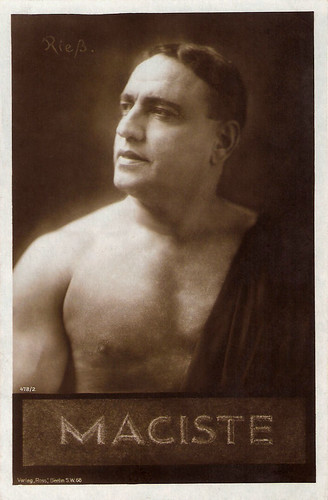
O personagem Maciste teve vida longa, apesar de um dos intertítulos do filme prever que ele não escaparia com vida. Em 1915, seguindo o sucesso do coadjuvante no épico, o diretor Giovanni Pastrone produziu um filme em que ele era o protagonista, dando origem a uma série de 26 filmes muito loucos estrelando Maciste e, por consequência, Bartolomeo Pagano. Nestas películas, o personagem foi sonâmbulo, policial, turista e atleta. Ele poderia aparecer em qualquer época e lugar. Nessas odisseias, quase todas disponíveis na Internet, também ficamos sabendo que Pagano era um ator branco que havia sido maquiado para parecer negro em sua primeira aparição no cinema. O absurdo só aumentou com o tempo e, com o renascimento de Maciste nos anos 50 e 60, somos informado de que ele se materializa em qualquer lugar que seja necessário a partir de pedras. Segundo Gabriele D’Annunzio, que colaborou no roteiro de “Cabiria”, Maciste é um dos nomes do herói Hércules, daí a força descomunal do personagem que, por sinal, nunca conquistava a protagonista. Mas nem tudo é bobagem no mundo do personagem: foi o filme “Maciste no Inferno”, de 1926, que influenciou Fellini a tornar-se cineasta.   

The character Maciste had a long life, even though one of the title cards of the film predicted he would not escape alive. In 1915, following the success of the supporting character of the epic, director Giovanni Pastrone produced a movie starring Maciste, and it was the beginning of a series of 26 very crazy movies starring Maciste and, of course, Bartolomeo Pagano. In these movies, the character was a sleepwalker, a cop, a tourist and an athlete. He could appear in any place or period. In these adventures, almost all of them available online, we learn that Pagano was a white actor who originally played Maciste in blackface in “Cabiria”. The absurdity only grew with time and, in the 1950s and 60s, when Maciste is reborn, we are told that he materializes himself in any place he's need through... rocks. According to Gabriele D'Annunzio, who worked with the script in “Cabiria”, Maciste is one of the names of the hero Hercules, what explains his super-human strength – but doesn't explain why he never got the girl in the end. But not everything is nonsense in this character's world: it was the film “Maciste in Hell”, from 1925, that influenced Fellini to become a filmmaker. 

O enredo é bastante denso, devido ao excesso de detalhes históricos, além das inovações que maravilharam D. W. Griffith e o inspiraram a filmar “Intolerância” (1916). O diretor Giovanni Pastrone cria cenas surpreendentes, aglomera multidões em frente às câmeras, comanda cenas perigosas até mesmo para dublês, reconstitui um passado distante e luxuoso e não dispensa muita ação, sendo pioneiro no uso de luzes artificiais e da movimentação de câmera (travelling).  

The plot is very dense, with a lot of historical details, and there are many innovations that marveled D.W. Griffith and inspired him to make “Intolerance” (1916). Director Giovanni Pastrone creates surprising scenes, agglomerates crowds in front of the cameras, commands scenes that are dangerous even for professional doubles, reconstructs a distant and luxurious past and uses a lot of action, being a pioneer in the use of artificial lighting and camera travellings. 

O custo de dois milhões de liras (250 mil dólares na época) compensou. Além do sucesso internacional, “Cabiria” conquistou a honra de ser o primeiro filme a ser exibido dentro da Casa Branca. Vindo de uma série italiana de épicos, como “Quo Vadis?” e “Os Últimos Dias Pompeia”, ambos de 1913, este filme consolidou o gênero, sendo suficiente para Scorsese afirmar que Pastrone inventou o gênero épico. E não foi à toa que os melhores épicos foram filmados justamente na Itália, ou melhor, na Cinecittà.

The cost of two million lire (250,000 dollars at the time) paid off. Besides the international success, “Cabiria” had the honor to be the first film to be shown inside the White House. Coming from a series of Italian epics, like “Quo Vadis?” and “The Last Days of Pompeii”, both from 1913, this film consolidated the genre, and Scorsese even said that Pastrone invented the epic. And it wasn't a coincidence that the best epics were filmed in Italy, that is, in the Cinecittà Studios.

“Cabiria” (1914) está disponível no YouTube e no Internet Archive (neste, sem trilha sonora).

“Cabiria” is availabe at YouTube and Internet Archive (without a soundtrack in the latter). 


This is my second contribution to the Italian Film Culture Blogathon, hosted by the Nitrate Diva. In the banner, Italia Almirante and Anna Magnani.


P.S.: Deixem nos comentários a opinião geral de vocês sobre os filmes mudos. Ela será usada como pesquisa para um futuro post. 
Related Posts Plugin for WordPress, Blogger...