} Crítica Retrô: Urban Gad

Tradutor / Translator / Traductor / Übersetzer / Traduttore / Traducteur / 翻訳者 / переводчик

Showing posts with label Urban Gad. Show all posts

Saturday, March 8, 2025

Urban Gad: explorando o trabalho de um pioneiro do cinema

 Urban Gad: exploring the work of a film pioneer

Um dos melhores acontecimentos do fim do ano - além do Natal e de todas as festas - é receber as estatísticas do Letterboxd. O Year in Review é muito esperado pelos cinéfilos. Este ano tive uma surpresa: meu diretor mais assistido de 2024 foi Urban Gad. Isso tem uma explicação: no começo do ano mergulhei fundo nos primeiros trabalhos de Asta Nielsen e muitos destes filmes foram dirigidos por Gad. Agora me volto novamente ao cinema dinamarquês e a Gad em particular. Vamos conhecer este mestre.

One of the best things that happen when a year ends - besides Christmas and all the parties - is receiving stats from Letterboxd. The Year in Review is much expected by us movie nerds. This year I had a surprise: my most watched director of 2024 was Urban Gad. This has an explanation: in the beginning of the year I dived deep into Asta Nielsen’s early roles and many of these movies were directed by Gad. Now I look again to Danish cinema and to Gad in particular. Let’s meet this master.

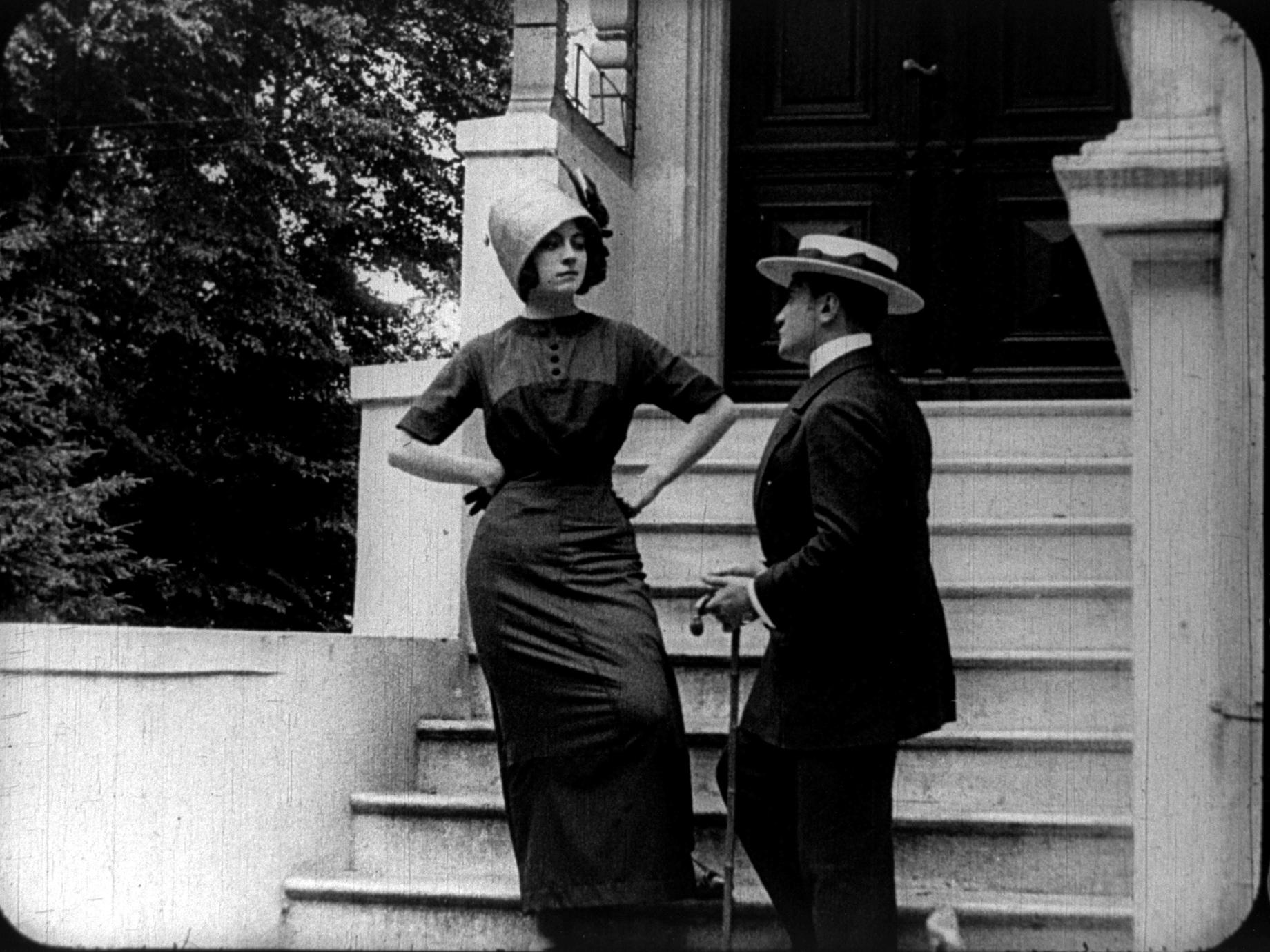
Peter Urban Bruun Gad nasceu em 1879 - sua mãe era a dramaturga e mestre em boas maneiras Emma Gad - e faleceu em 1947. Seu segundo filme foi “O Abismo” de 1910 e foi de cara um grande sucesso internacional, algo novo não apenas para o cinema dinamarquês, mas para o cinema em geral. O IMDb lista para Gad 71 filmes como diretor e 36 como roteirista, todos no cinema mudo. É hora de dar uma olhada em alguns deles.

Peter Urban Bruun Gad was born in 1879, his mother being playwright and master of good manners Emma Gad, and died in 1947. His second film was “The Abyss” from 1910 and it was already a big hit internationally, something new not only to Danish cinema, but to cinema as a whole. IMDb lists 71 films as a director and 36 as screenwriter, all in the silent era. Time to take a look at some of them.

De 1911 vem “The Strange Bird / Der Fremde Vogel”. Asta Nielsen estrela como May Mannering, que se apaixona pelo camponês Paul (Carl Cleving) durante as férias. A família dela é contra o relacionamento, então os pombinhos fogem, mas a tragédia os encontra - como o filme anuncia na primeira cartela de texto, trata-se de uma “tragédia de amor”.

From 1911 comes “The Strange Bird / Der Fremde Vogel”. Asta Nielsen stars as May Mannering, who falls in love with the local Paul (Carl Cleving) during a vacation. Her family is against the relationship, so the lovebirds run away, but tragedy hits them - as the film is announced in the main title card, it’s a “love tragedy”.

Também de 1911 é “The Great Moment / In dem großen Augenblick”. O filme traz Annie (Asta Nielsen) às voltas com um dilema: aceitar ou recusar uma proposta para dar sua filha para adoção. Três anos depois de aceitar a proposta, Annie tenta recuperar a criança. É curioso que a adoção também seja o foco de outro filme dinamarquês, “A Garota da Agulha” (crítica em inglês AQUI), indicado a Melhor Filme Internacional no Oscar de 2025. A história do filme recente é ambientada após a Primeira Guerra Mundial, pouco tempo depois de este filme de Gad e Nielsen ter sido feito. Nele, o incêndio no clímax é bem impressionante. 

Also from 1911 is “The Great Moment / In dem großen Augenblick”. The film revolves around Annie (Asta Nielsen) accepting or refusing to give her baby daughter up for adoption. Three years after she accepts the offer, Annie tries to get her daughter back. It’s curious because adoption was the focus of another Danish film, “The Girl with the Needle”, nominated for Best International Film at the Oscars in 2025. The story of the modern movie is set in the aftermath of World War I, not long after this Gad-Nielsen film was made. In it, the climatic fire is pretty impressive.

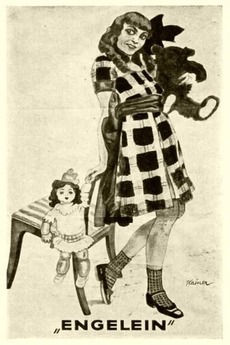
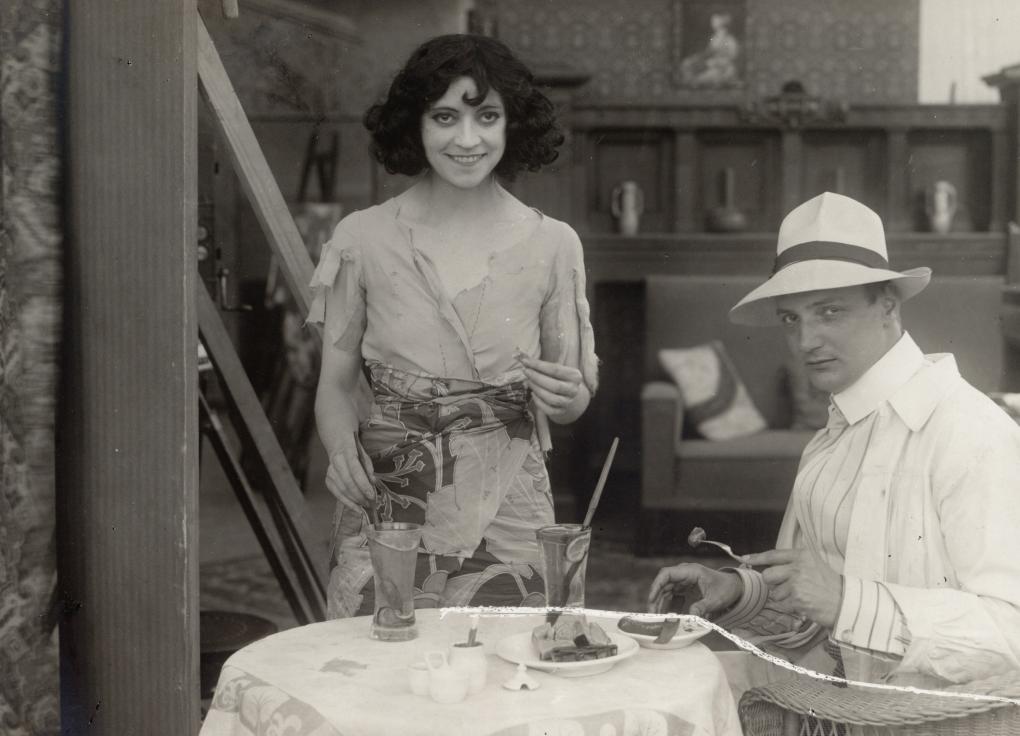
Agora algo diferente: uma comédia! “Little Angel / Engelein” nos apresenta a um casal que tem de mentir sobre a idade da filha para garantir uma herança. Mas depois a moça de 17 anos, Jesta (Asta Nielsen), tem de fingir ter apenas 12 anos para seu tio Peter (Max Landa). O problema é que Jesta tem um namorado, Theodor (Fred Immler) e uma cunhada, Meta (Adele Reuter-Eichberg), que está atrás do tio Peter. Esta comédia é bem divertida e prova que Nielsen tem talentos variados. Dois anos depois, sob a direção de Edmund Edel, Nielsen fez uma sequência do filme, chamada “The Guinea Pig”. 

Now something different: a comedy! “Little Angel / Engelein” introduces us to a couple who has to lie about their daughter’s age in order to secure an inheritance. But then 17-year-old Jesta (Asta Nielsen) has to pass as a 12-year-old for her Uncle Peter (Max Landa). The problem is that Jesta has a boyfriend, Theodor (Fred Immler), and a sister-in-law, Meta (Adele Reuter-Eichberg), who is after Uncle Peter. This comedy was a lot of fun, proving Nielsen’s many eclectic talents. Two years later, under Edmund Edel’s direction, Nielsen made a sequel to this movie, called “The Guinea Pig”.


Vamos ouvir a opinião do próprio Gad. No primeiro livro dinamarquês sobre teoria do cinema, “Filmen – Dens Midler og Maal” (Filme - Seus Meios e seus Fins), de 1919, ele declarou (tradução minha a partir do inglês): “O ator deve se posicionar entre animais selvagens, ou deve pular e escalar, colocando-se sob risco de cair de grandes alturas, ou saltar de ou para vários meios de transporte a toda velocidade”. Embora tenhamos visto mais melodrama do que outro gênero em sua filmografia, eles com certeza têm momentos de total emoção. 

Let’s hear from Gad himself. On the first Danish book about film theory, “Filmen – Dens Midler og Maal” (Film – Its Means and Ends) from 1919, he declared: “The actor must either place himself among wild animals, or he must carry out jumps or climbing feats that put him at risk of plummeting from great heights, or leap from or to various means of transport at full speed”. Although we’ve seen more melodramas from him this time, they sure had their thrills.

Não pude evitar a comparação de Gad com outro mestre do cinema mudo dinamarquês, Benjamin Christensen. Chamado de primeiro autor cinematográfico do país pelo site oficial dedicado ao Cinema Mudo Dinamarquês, Christensen nasceu em 1879, assim como Gad, mas dirigiu apenas 19 filmes. Sua estreia como diretor foi “The Mysterious X” (também conhecido como “Sealed Orders”, 1914), em que ele também foi roteirista e protagonista. Christensen interpreta o tenente Van Hauen, cuja esposa (Karen Sandberg) é assediada pelo espião Conde Spinelli (Hermann Spiro), que rouba alguns documentos confidenciais de Van Hauen e trama para acusá-lo de traição. No que é provavelmente o primeiro MacGuffin do cinema, um elefante de papel domina sonhos e causa discórdia. 

I couldn’t avoid comparing Gad with another master of the Danish silent screen, Benjamin Christensen. Called the first real author of Danish cinema by the website dedicated only to Danish Silent Film, Christensen was born in 1879, like Gad, but directed only 19 titles. His directorial debut was “The Mysterious X” (also known as “Sealed Orders”, 1914), that he also co-wrote and starred in. Christensen plays the lieutenant Van Hauen, whose wife (Karen Sandberg) is being courted by the spy Count Spinelli (Hermann Spiro), who steals some top secret papers from Van Hauen and frames him to be found guilty of treason. In what is probably cinema’s first MacGuffin, a paper elephant dominates dreams and causes mayhem.

As carreiras de Urban Gad e Asta Nielsen estavam intimamente ligadas. Eles eram mais que uma dupla dinâmica de diretor e atriz como D. W.Griffith e Lillian Gish, eles formaram um casal 20 antes de Mary Pickford se casar com Douglas Fairbanks e criar o conceito de super casal. Contemporâneos de outra dupla, os comediantes John Bunny e Flora Finch, Gad e Nielsen eram algo completamente novo no cinema da época.

The careers of Urban Gad and Asta Nielsen were totally connected. They were more than a dynamic duo of director and actress - like D.W. Griffith and Lillian Gish, they were a power couple even before Mary Pickford married Douglas Fairbanks and invented the concept of power couple in cinema. Contemporary to another duo, the comedians John Bunny and Flora Finch, Gad and Nielsen were something completely new in cinema in their time.

Vou repetir a conclusão do meu já mencionado artigo sobre o início de carreira de Asta Nielsen: o Primeiro Cinema - de 1895 a 1915 - é tão comumente desprezado, mas não deveria ser. Tragicamente, a maior parte dele se perdeu, mas cada pérola que encontrarmos deste período deve ser vista, discutida e apreciada.

I’ll repeat here the conclusion of my aforementioned article about Asta Nielsen’s early career: early cinema - or the First Cinema, from 1895 to 1915 - is so often taken for granted and overlooked but it shouldn’t be. Tragically most of it is lost, but every gem we can find from this period should be seen, discussed and enjoyed. 

This is my contribution to the Silent Pioneers Blogathon, hosted by
Classic Film and TV Corner.

Friday, January 19, 2024

O Abismo (1910) / The Abyss (1910) / Afgrunden (1910)


Muito tempo atrás, as estrelas de cinema não recebiam crédito nem no começo nem ao final dos filmes. Esta foi a maneira que os primeiros cineastas encontraram para evitar que atores e atrizes ficassem famosos demais, o que os faria demandar salários maiores. Mas logo antes de descobrirem que a Cachinhos Dourados era a atriz canadense Mary Pickford, que iria se tornar uma superestrela nos EUA, outra superestrela apareceu do outro lado do Atlântico: Asta Nielsen. Com uma dança lasciva em seu primeiro filme, “O Abismo / Afgrunden” de 1910, Nielsen se tornou uma sensação do dia para a noite.


Once upon a time, film stars didn’t receive credit on screen. It was the way the first filmmakers found to not let the actors and actresses become too famous, which would lead to a claim for higher salaries. But just before Little Goldilocks was discovered to be Canadian actress Mary Pickford, who would become a superstar in American cinema, another superstar emerged on the other side of the Atlantic: Asta Nielsen. With a lascivious dance in her first film, 1910’s “The Abyss / Afgrunden”, Nielsen became an overnight sensation.

Um homem e uma mulher se conhecem num bonde. O homem é Knud Svane (Robert Dinesen) e a mulher é Magda Vang (Asta Nielsen). Knud convida Magda para passar uns dias em sua casa de campo durante o verão, e lá ela o convence a assistir a uma performance de um circo itinerante. No circo Magda conhece o artista Rudolf Stern (Paul Reumert), se apaixona e foge com ele. Ela terá seu felizes para sempre? Veremos depois de 38 minutos de projeção.


A man and a woman meet on a trolley. The man is Knud Svane (Robert Dinesen) and the woman is Magda Vang (Asta Nielsen). Knud invites Magda to his country home during summer, and there she convinces him to watch a performance from a traveling circus. At the circus Magda meets performer Rudolf Stern (Paul Reumert), falls in love and runs away with him. Will she get a happily ever after? After 38 minutes of projection, we shall see.

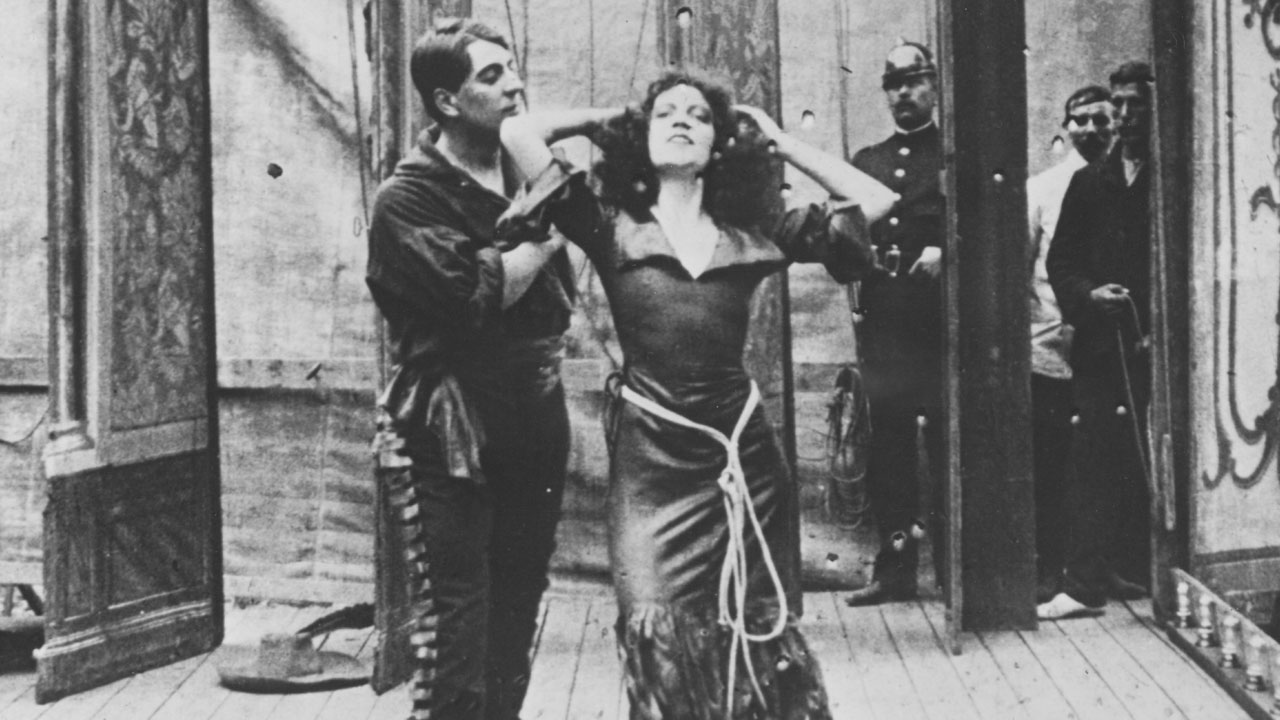
A sequência de dança sugestiva, chamada de “dança Gaucho”, envolve Asta Nielsen esfregando seu corpo, totalmente vestida, num homem que está amarrado por uma corda. A sequência foi considerada escandalosa e censurada nos EUA, Noruega e Suécia, mas foi uma sensação no resto da Europa. Hoje, não vemos nada de errado nem mesmo de sensual na sequência, o que mostra como os tempos mudaram.


The suggestive dance sequence, called “the Gaucho dance”, involves Asta Nielsen rubbing her fully dressed body in a man who is tied with a rope. The sequence was considered scandalous and censored in the US, Norway and Sweden but was a sensation in the rest of Europe. Nowadays, we see nothing wrong nor even sensual about the sequence, a sign of how times have changed.

“O Abismo” foi escrito e dirigido por Urban Gad, que se casaria com Asta em 1912. Eles se mudariam para a Alemanha no mesmo ano, onde Nielsen teria uma bem-sucedida carreira, com Gad dirigindo-a em 30 filmes. Eles se separaram em 1918, quando também terminou a parceria profissional. Asta Nielsen ficou tão famosa em tão pouco tempo que em 1911 foi eleita a maior estrela de cinema numa enquete feita na Rússia.


“The Abyss” was written and directed by Urban Gad, who would marry Asta in 1912. They would move to German that same year, where Nielsen enjoyed a successful career, with Gad directing her in 30 movies. They split in 1918, when the professional partnership also ended. Asta Nielsen became so famous and so quickly that in 1911 she was voted the biggest film star in a poll held in Russia.

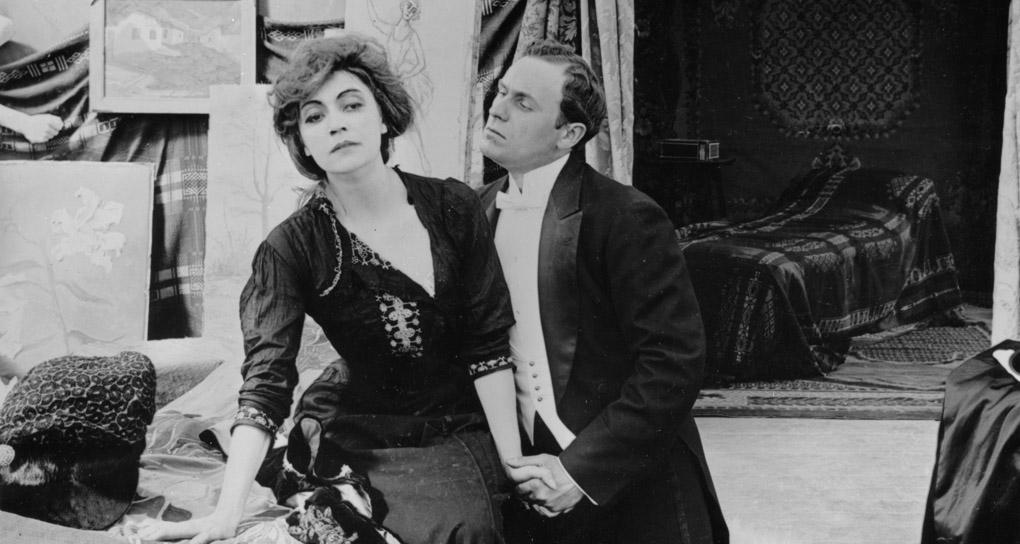
Em 1911, Nielsen fez “A Bailarina / Balletdanserinden” com o diretor August Blom, logo antes de partir para Berlim. Neste filme, ela interpreta Camille, uma bailarina que faz sucesso nos palcos, mas sua vida pessoal é mais complicada: ela está apaixonada por Jean (Johannes Poulsen), que a trai com uma mulher casada, Yvette Simon (Karen Poulsen). Depois de posar para um pintor, Paul (Valdemar Psilander), ela fica dividida entre os dois homens.


In 1911, Nielsen made “The Ballet Dancer / Balletdanserinden” with director August Blom, just before leaving to Berlin. In this movie, she plays Camille, a ballet dancer who finds professional success on stage, but her personal life is more complicated: she is in love with Jean (Johannes Poulsen), who cheats on her with a married woman, Yvette Simon (Karen Poulsen). After posing for a painter, Paul (Valdemar Psilander), she becomes torn between the two men.

Também de 1911 é “O Sonho Negro / Den Sorte Drøm”, um dos mais antigos longas-metragens preservados, no qual Nielsen interpreta a acrobata equestre Stella, por quem dois homens se apaixonam. Ela escolhe o Conde Waldberg (Valdemar Psilander), desprezando o joalheiro Hirsch (Gunnar Helsengreen). Há um duelo entre os dois homens num jogo de cartas, no qual Waldberg perde todas as suas posses, e Stella tem de intervir, sem que ele saiba, roubando um colar de Hirsch. O ciúme consome Waldberg e o que se segue é uma tragédia.


Also from 1911 is “The Black Dream / Den Sorte Drøm”, one of the earliest surviving feature-length films, in which Nielsen plays the equestrian acrobat Stella, with whom two men fall in love. She chooses Count Waldberg (Valdemar Psilander) over the jeweler Hirsch (Gunnar Helsengreen). There is a duel between the two men in the card table, when Waldberg loses all his possessions, and Stella has to intervene, without him knowing, by stealing a necklace from Hirsch. Jealousy consumes Waldberg and tragedy follows.

Já na Alemanha em 1912, Asta Nielsen e Urban Gad fizeram o melodrama “Pobre Jenny / Die Arme Jenny”, no qual ela interpreta o papel-título, uma jovem mulher que precisa cuidar de seus irmãozinhos. Um dia ela é beijada por um homem, Eduard Reinhold (Leo Peukert) contra a vontade dela, mas ela aceita sair com ele. Depois de passar a noite com o homem, ela é expulsa de casa. Ela então vai para a cidade grande e se torna dançarina... até que ela reencontra Eduard e percebe que não esqueceu seu primeiro amor.


Already in German in 1912, Asta Nielsen and Urban Gad made the melodrama “Poor Jenny / Die Arme Jenny”, in which she plays the title role, a young woman who has to take care of her little siblings. One day she is kissed by a man, Eduard Reinhold (Leo Peukert), against her will, but agrees to go out with him. After spending the night with him, she is expelled from home. She then goes to the big city and becomes a dancer… until she meets Eduard again and realizes she didn’t forget her first love.

Também em 1912, Nielsen e Gad se juntaram novamente para fazer “A Garota sem Pátria / Das Mädchen ohne Vaterland”. Neste curta, Asta interpreta a cigana Zidra, que é contratada por um homem do exército para uma missão secreta. Esperteza e sedução serão suas armas, mas ela não imaginava que se apaixonaria pelo tenente que tem de espionar.


Also in 1912, Nielsen and Gad teamed up again to make “A Romany Spy / Das Mädchen ohne Vaterland”. In this short, Asta plays gypsy girl Zidra, who is hired by a military man for a secret mission. Smartness and seduction will be her weapons, but she didn’t imagine that she would fall in love with the lieutenant she was supposed to spy on.

Os filmes de Asta Nielsen do começo da década de 1910 não apenas mostram por que ela se tornou uma superestrela mas também nos convencem de que o primeiro cinema é muito mais sofisticado do que o senso comum nos faz acreditar. As histórias são atraentes, com tramas complexas, e as técnicas do fazer cinematográfico ainda estavam sendo desenvolvidas, por isso há muita experimentação. Acima de tudo, há Asta Nielsen e sua persona cinematográfica sexy e ousada, perfeita para a primeira superestrela do cinema.


Asta Nielsen’s films from the early 1910s not only show why she became a superstar but also convince us that early cinema is much more sophisticated than the common sense made us believe. The storytelling is compelling, with complex plots, and the filmmaking techniques were still being developed, so there is experimentation. Above all, there is Asta Nielsen and her sexy, bold screen persona, perfect for the first female film superstar.
Related Posts Plugin for WordPress, Blogger...