} Crítica Retrô: vilão

Tradutor / Translator / Traductor / Übersetzer / Traduttore / Traducteur / 翻訳者 / переводчик

Showing posts with label vilão. Show all posts

Sunday, May 26, 2019

As muitas faces de Bafo, o vilão da Disney


The many faces of Pete, Disney villain
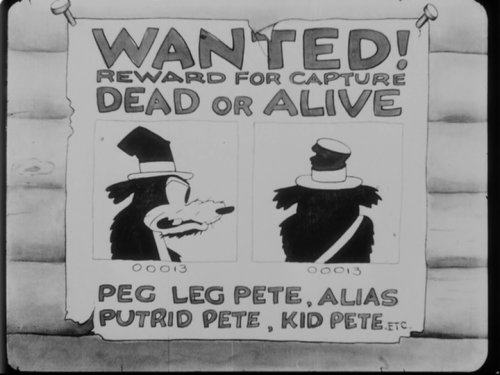


Ao longo dos anos, ele incomodou o Mickey, o Donald, o Pateta e outros tantos personagens. Ao redor do mundo, seu nome muda: nos EUA, ele é simplesmente Pete, no Brasil ele é João Bafo de Onça, ou apenas Bafo, nos Países Baixos ele é Boris Boef (Boris Canalha) e na Turquie ele é Barut (Pólvora). Seu nome verdadeiro, revelado em uma HQ de 1960, é Clodovil P. Pedrosa. E tem mais: ele é detentor de alguns recordes da animação, mudou muito através dos anos e, mesmo sendo um cara do mal, ainda tem muitos fãs.

Over the years, he has bullied Mickey Mouse, Donald Duck, Goofy and their loved ones. Around the world, his name changes: in the US, he is simply Pete, in Brazil he is João Bafo de Onça (John Jaguar-Breath) or only “Bafo” for short, in the Netherlands he is Boris Boef (Boris Crook) and in Turkey he is Barut (Gunpowder). His full name is revealed in a comic book from 1960: Percy P. Percival. There is more: he holds a few cartoon records, changed a lot through years and, even being a bad guy, still has a lot of fans.


Aqui vem a primeira descoberta chocante: Bafo é um gato. E esta é a segunda descoberta chocante: Bafo é mais velho que o Mickey – na verdade, ele é o mais velho personagem da Disney ainda em uso. Bafo foi criado como um urso antagonista para um curta-metragem de 1925 que misturava animação e uma atriz de verdade: “Alice Solves de Puzzle”. Nele, Bafo, um colecionador de palavras cruzadas, quer roubar uma palavra cruzada da pequena Alice, que então precisa da ajuda de Julius, um gato preto que é igualzinho ao gato Félix, para se salvar. Eu devo dar spoilers do final? Acho que sim: no final, Bafo é, bem, empalado. Mas esta não seria a última vez que nós o veríamos.

Here comes the first shocking discovery: Pete is a cat. And this is the second shocking discovery: Pete is older than Mickey – actually, he is the oldest Disney character still in use. Pete was developed as a bear for a 1925 short film that mixed animation and live-action, “Alice Solves the Puzzle”. In it, Pete, a crossword puzzle collector, wants to steal a puzzle from little Alice, who then needs the help of Julius, a black feline who looks exactly like Felix the cat. Should I spoil the end? I guess so: in the end, Pete is, well, impaled. But it wouldn’t be the last time we’d see him.


Pete não atazanava apenas a Alice nos seus primeiros anos: em 1927 ele começou a aparecer como vilão nas aventuras de Osvaldo, o Coelho Sortudo, iniciando por “The Ocean Hop”, no qual Bafo trapaceia para chegar primeiro a Paris de avião em uma corrida atravessando o Atlântico. Em “Hungry Hobos” (1928), entretanto, Osvaldo e Bafo são dois amigos mendigos perseguidos por um policial – e Bafo não pensará duas vezes para sacrificar Osvaldo e escapar.

Pete not only bothered Alice in his initial years: in 1927 he also started appearing as the villain in Oswald the Lucky Rabbit’s adventures, starting with “The Ocean Hop”, in which Pete cheats to arrive first in Paris by plane after crossing the Atlantic. In “Hungry Hobos” (1928), however, Oswald and Pete are two hobo pals persecuted by a cop – and Pete won’t think twice to sacrifice Oswald to escape.


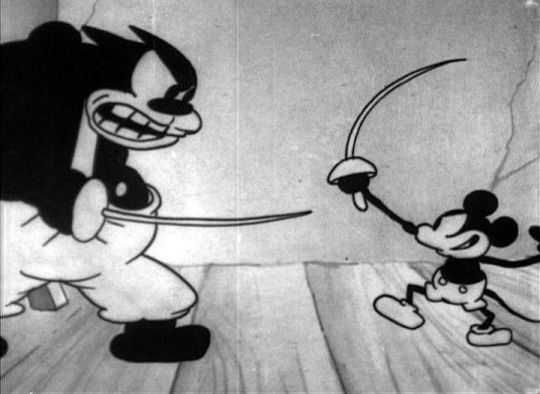
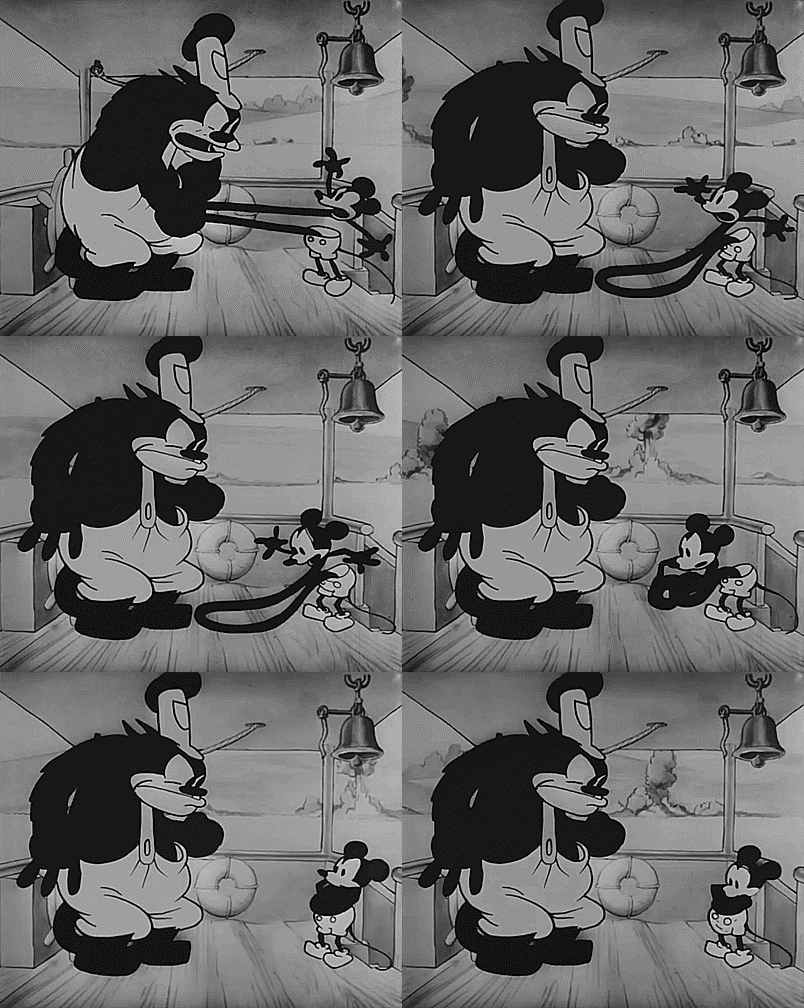
Em algum momento em 1928, Bafo mudou de urso para gato preto, símbolo do azar. Faz todo sentido um gato incomodar um rato, não? Por isso Bafo estava lá, na estreia do Mickey em “O Vapor Willie” (1928), para atrapalhar a vida de Mickey e Minnie no barco. Outro curta-metragem com Mickey e Bago, “O Gaucho Galopante”, uma paródia de Douglas Fairbanks, foi feito antes de Willie, mas só estreou depois deste. Bafo pode não ter conseguido o que queria em suas primeiras tentativas, mas nas décadas seguintes ele continuaria importunando nossos heróis.

Sometime in 1928, Pete changed from a bear to a black cat, the symbol of bad luck. It makes total sense to have a cat bullying a mouse, doesn’t it? That’s why Pete was there, in Mickey’s debut, “Steamboat Willie” (1928), to make Mickey and Minnie’s lives in the boat miserable. Another short with Mickey and Pete, “The Gallopin’ Gaucho”, a Douglas Fairbanks spoof, was developed before Willie, but only opened after it. Pete may not have succeeded in his first attempts, but in the coming decades he kept on trying to bother our heroes.

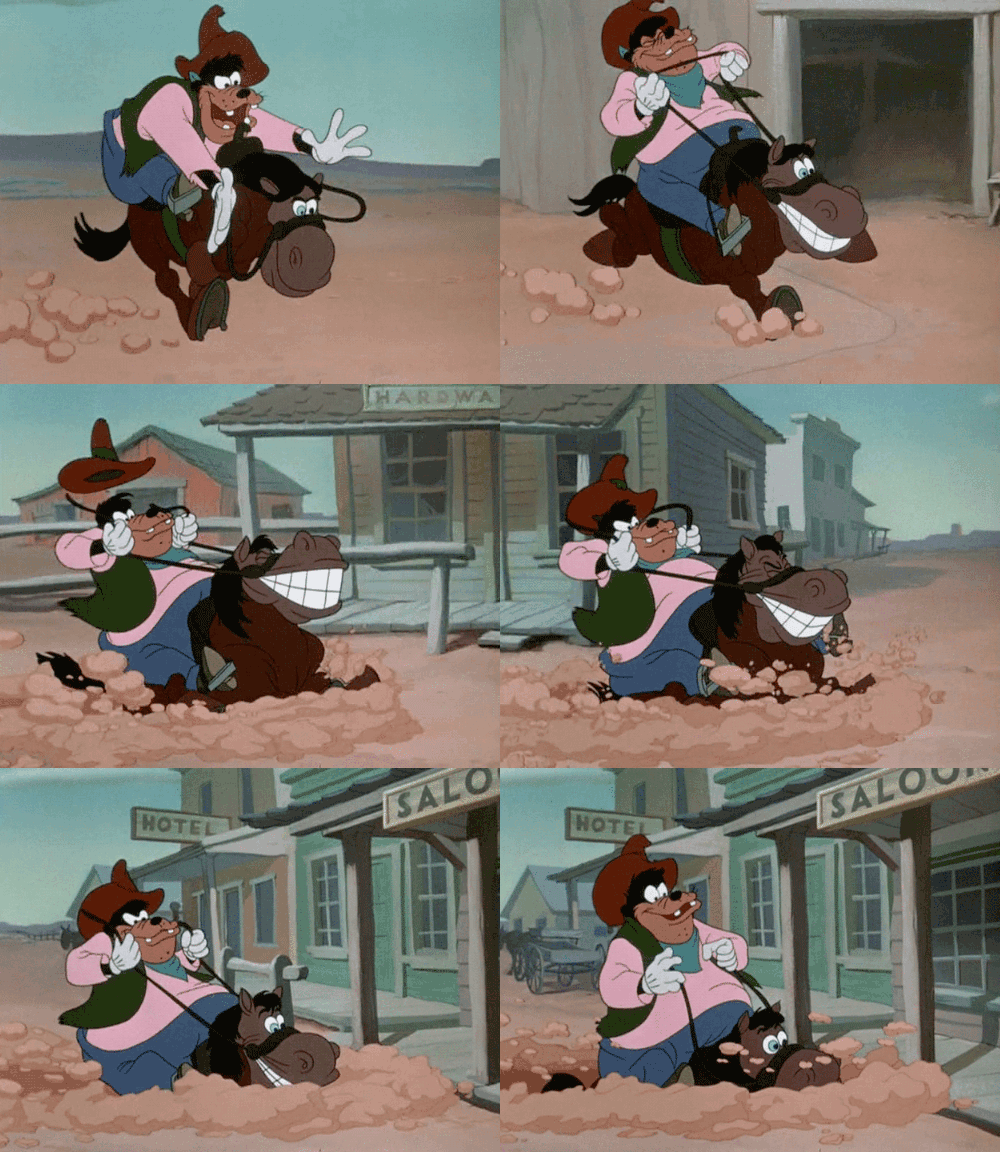
No começo dos anos 30, o animador Norman Ferguson decidiu remodelar Bafo para fazê-lo se parecer mais com o ator Wallace Beery. Bafo estreou o novo estilo em “The Klondike Kid” (1932), baseado no filme de Chaplin de 1925, “Em Busca do Ouro” - um curta-metragem que também tem uma breve aparição do Pateta. Neste e em muitos curtas dos anos 30, a função do Bafo é tentar sequestrar Minnie... e falhar.

In the early 1930s, animator Norman Ferguson decided to re-stylize Pete in order to make him look more like screen heavy Wallace Beery. Pete’s new look was first seen in “The Klondike Kid” (1932), based on Chaplin’s “The Gold Rush”, from 1925 – a short that also has a cameo by Goofy. In this and many of the 1930s shorts, Pete’s function was to try to kidnap Minnie… and fail.
 
Wallace Beery

Entretanto, Bafo não estava incomodando só o Mickey. No final dos anos 20 e começo dos anos 30, Bafo aparecia tanto nos curtas da Disney quanto nos de Osvaldo, produzidos por Charles Mintz. Nos curtas de Osvaldo, Bafo permaneceu com seu velho estilo, e uma vez até teve a aparência de um coelho! Dirigidos por Walter Lantz, estes desenhos do estúdio Universal com Osvaldo e Bafo eram mais nonsense e desafiam mais a ciência do que a Disney.

But Pete wasn’t only bothering Mickey. In the late 1920s and the early 1930s, Pete appeared in both Disney shorts and Charles Mintz-produced Oswald shorts. In those shorts he remained with his earlier look, and once even appeared as a rabbit! Directed by Walter Lantz, those Universal studios cartoons with Oswald and Pete had even more nonsense and science-defying gags than the Disney ones.


A perna de pau do Bafo sempre foi curiosa: em alguns curtas de Alice e de Osvaldo, a perna de pau ou não aparecia ou mudava de perna, enquanto em “O Vapor Willie” ela sequer apareceu. Na minha opinião, nos seus primeiros anos, mais magro e com a perna de pau, Bafo se parecia com Arthur Bannister (Everett Sloane), em “A Dama de Xangai” (1947).

Pete’s peg-leg was always a curious thing: in some Alice and Oswald shorts the peg-leg either didn’t appear or changed legs, while in “Steamboat Willie” it didn’t appear at all. In my opinion, Pete, in his earlier years, skinnier and with the peg-leg, looked like Arthur Bannister (Everett Sloane) in “The Lady from Shanghai” (1947).


Já na era dos desenhos coloridos, Bafo foi um vilão enquanto Donald era policial em “Officer Duck”- e Donald teve de se vestir de bebê para prendê-lo, provando que Bafo tem na verdade um coração mole. Depois ele apareceu em mais alguns “curtas normais” no começo dos anos 40 e seis curtas feitos para o esforço de guerra entre 1942 e 1943. Neles, Bafo era o mal-humorado superior de Donald no exército.

Already in the color cartoon era, Pete was a villain to Donald’s police officer in “Officer Duck” (1939) – and Donald had to dress as a baby to arrest him, proving that Pete is actually a soft guy. He then appeared in more “regular shorts” in the early 1940s and six shorts made for the war effort between 1942 and 1943. In these, Pete was Donald’s grumpy superior at the army.


Nos anos 50, Bafo foi por pouco tempo rival do Pateta e de Tico e Teco. Então 30 anos se passaram até “Um Conto de Natal do Mickey”, como o Fantasma do Natal por Vir. Ele também apareceu em alguns episódios de Ducktales como vários personagens.

In the 1950s, Pete was briefly a rival to both Goofy and Chip and Dale. Then 30 years passed until “Mickey’s Christmas Carol” (1983), as the Ghost of Christmas Yet to Come. He also appeared in the first Ducktales as several characters.

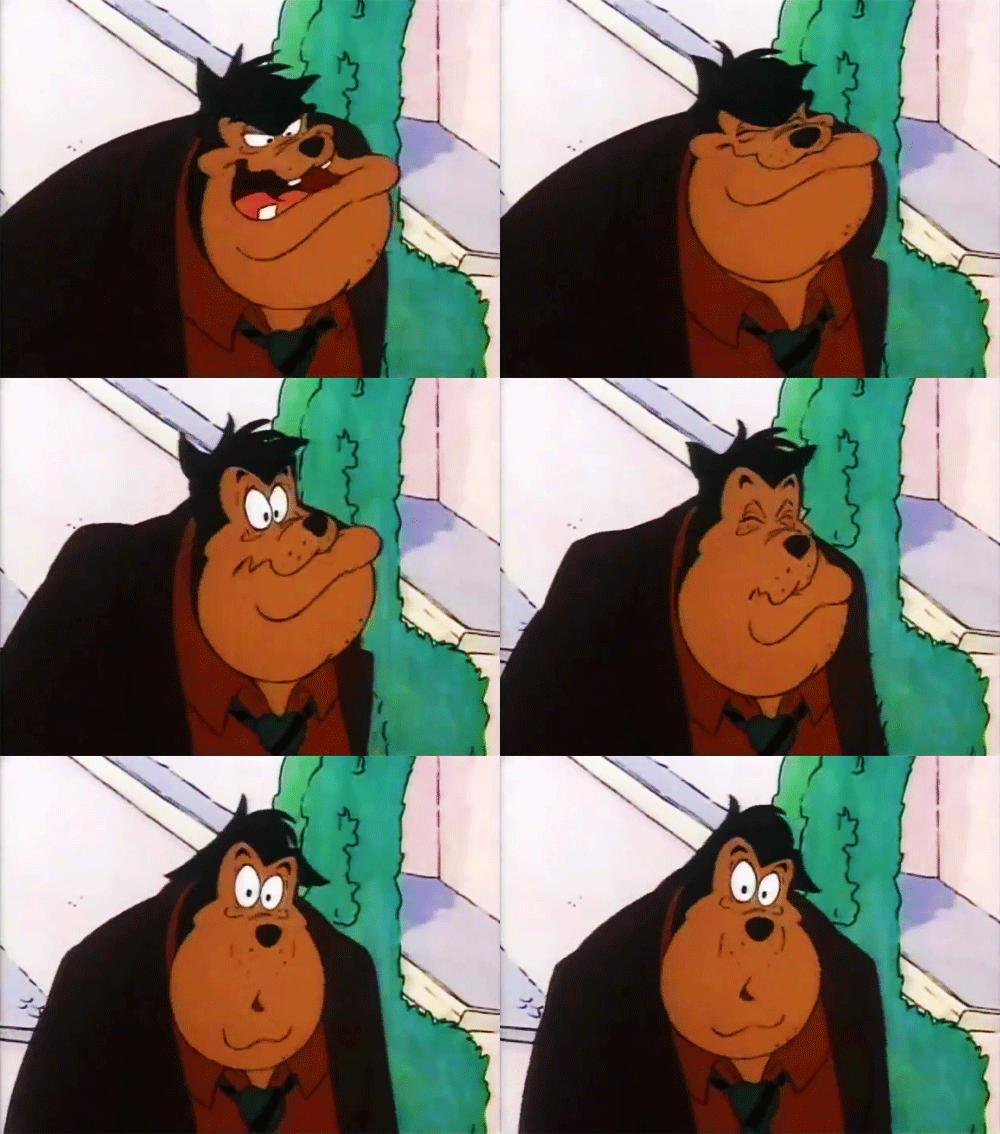
Nos anos 90, Bafo se tornou um cara quase legal em uma das minhas animações favoritas da época: “A Turma do Pateta”. Nela, Bafo era vizinho do Pateta e vítima constante das trapalhadas dele. Bafo não era mau nessa versão, mas sim estressado e um pouco arrogante. Ele tinha uma loja de carros usados e vivia com a família.

In the 1990s, Pete became an almost nice guy in one of my favorite cartoon series of the time: “Goof Troop”. In it, he was Goofy’s neighbor and a constant victim of Goofy’s clumsiness. Pete was not bad in this iteration, but rather nervous and a bit arrogant. He had a used cars dealership and lived with his family.
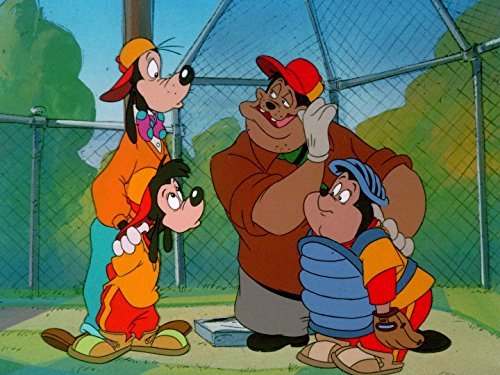

Está na hora de conhecer a família do Bafo, não é? Em um jogo de xadrez com as peças no formato dos personagens, Bafo tinha uma irmã chamada Penélope, vestida como cantora de saloon. Eu me pergunto se ela morreu de cólera. Por um lado mais feliz, Bafo tinha uma linda família na série “A Turma do Pateta”: a esposa Peg, o filho BJ e a filha Matraca. A mãe e a avó de Bafo apareceram em um episódio de “O Clube do Mickey”.

It is time to get to know Pete’s family, right? In a chess game with the characters as pieces, Pete had a sister named Penelope, dressed as a saloon singer. I wonder if she died from cholera. In happier notes, Pete has a whole family in the series “Goof Troop”: wife Peg, son PJ and daughter Pistol. His mother and grandmother also appeared in one episode of “House of Mouse”.

Vovó Bafo / Gram-Gram Peg-Leg

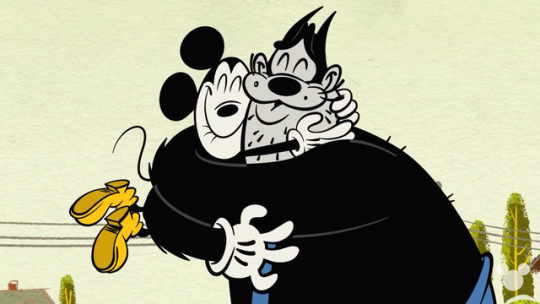
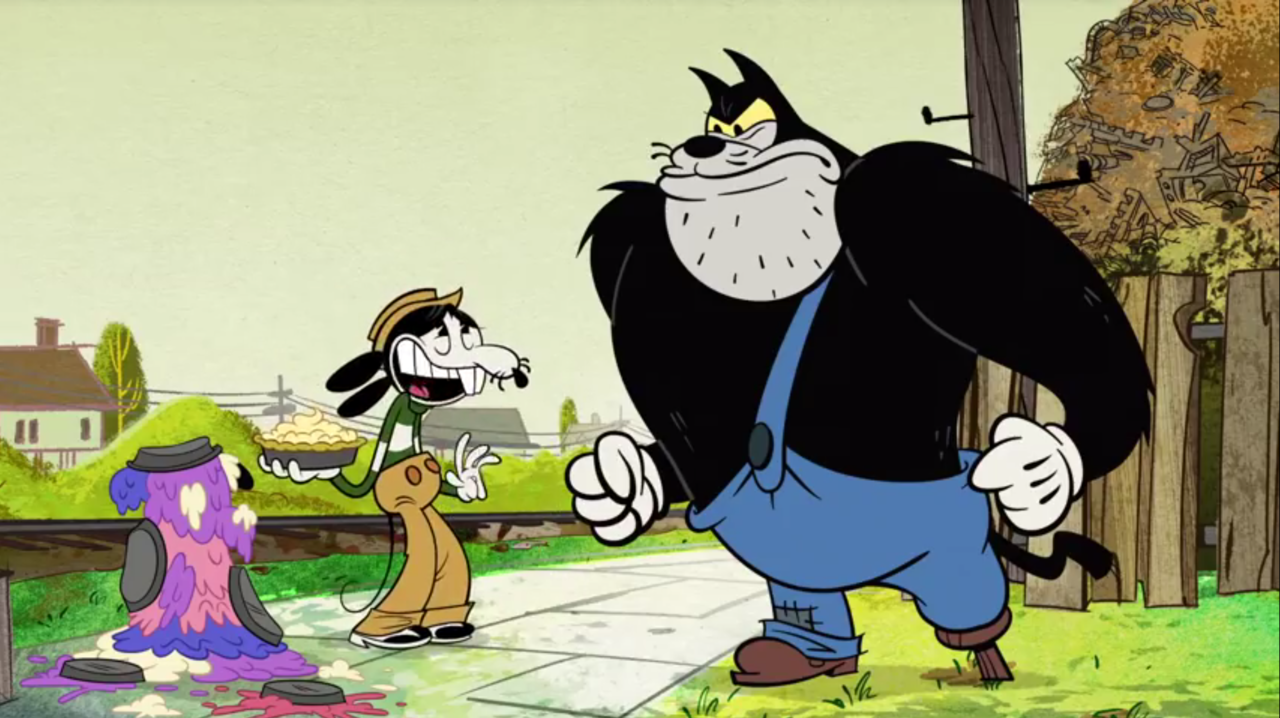
O recente novo design dos principais personagens da Disney foi polêmico, e fãs ficaram divididos. Começando em 2014, Bafo quase voltou às origens, ganhando sua perna de pau de volta e sendo retratado como um vilão com sentimentos. Muitas pessoas odiaram o novo estilo, mas todos concordamos com uma coisa: com ou sem sua perna de pau, Bafo – o mais velho personagem da Disney e o único personagem animado a “trabalhar” em dois estúdios ao mesmo tempo – é um dos mais importantes vilões da história da animação.

The recent redesign of the main Disney characters was a polemic one, and fans were divided. Starting in 2014, Pete almost comes full circle, getting his peg-leg back and being portrayed as a villain with feelings. Many people hated the redesign, but we all agree with a thing: with or without his peg-leg, Pete – the oldest Disney character and the only animated character to “work” at two studios at the same time – is one of the most important villains in the history of animation.  

This is my contribution to the Great Villain blogathon, hosted by Ruth, Kristina and Karen at Silver Screenings, Speakeasy and Shadows and Satin.


Sunday, September 2, 2018

Fred MacMurray, Billy Wilder e a luxúria


Fred MacMurray, Billy Wilder and lust


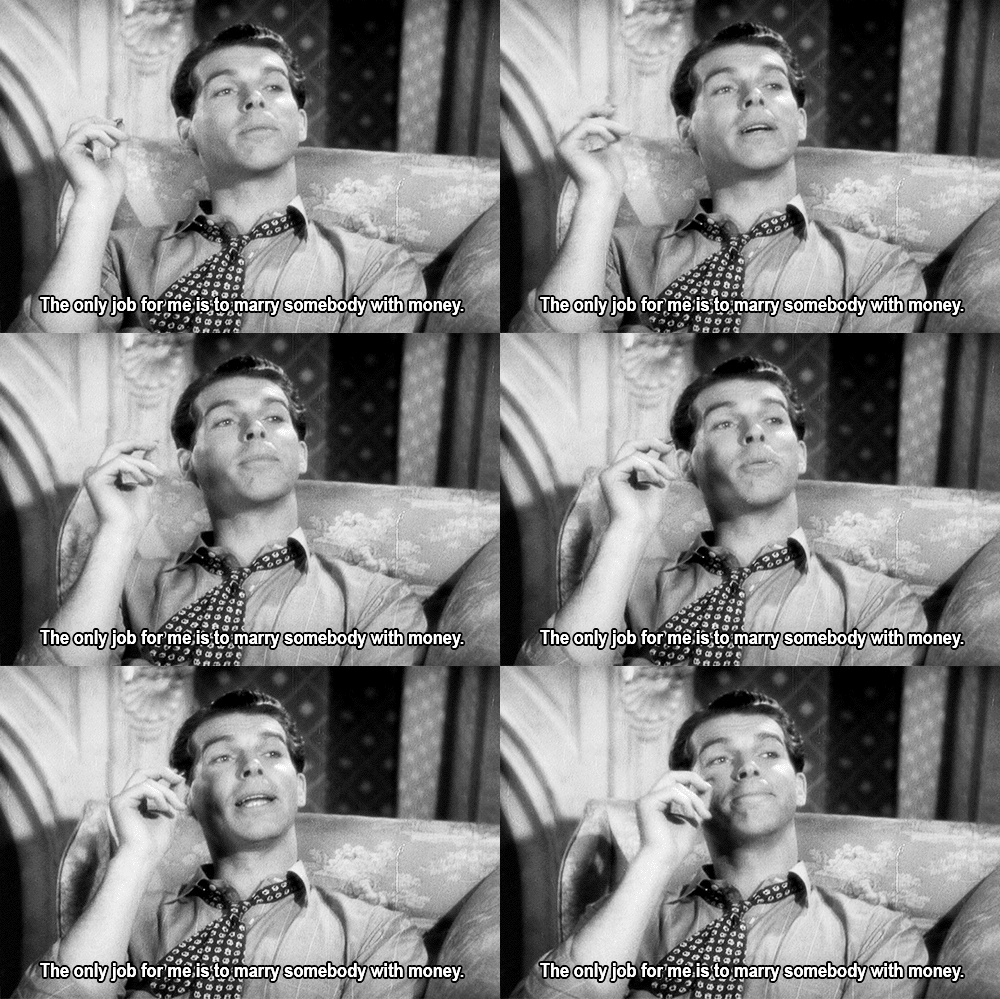
Quer você queira ou não, um ator ou atriz desenvolve uma persona – especialmente nos dias do sistema de estúdio – para ser facilmente reconhecido pelo público e também para que o estúdio o utilize em papéis estereotipados. Isso aconteceu com Fred MacMurray, mais conhecido por interpretar caras bacanas pais de família, pais que tinham resposta para tudo e que poderiam ser ao mesmo tempo um pouco atrapalhados e muito sábios. Mas ele não fazia estes papéis quando trabalhava com Billy Wilder.

Whether you want it or not, a performer usually develops a persona – especially in the Studio System days – in order to be easily recognizable by the public and also typecasted by the studio. This happened to Fred MacMurray, better known as a lovely guy, a family man, a dad who knew it all and who could be at the same time a bit clumsy and very wise. But he didn't play by these rules when he was working with Billy Wilder.
 
1935
Billy Wilder desafiou os limites de MacMurray e tirou tudo de pior que existe na mente humana para encher seus personagens de ambição e luxúria – e, assim, Wilder dirigiu MacMurray nas duas melhores performances da carreira do ator, em que ele fez papéis muito diferentes dos habituais e, ironicamente, estas são as performances pelas quais MacMurray é mais conhecido hoje.

Billy Wilder went wild (LOL) with MacMurray, and took the worst he could have in his mind in order to infuse his characters with ambition and lust – and, by doing this, Wilder directed MacMurray in the two best performances of his career, in which he played against type and, ironically, these are the performances that today he has the biggest chance to be recognized for.


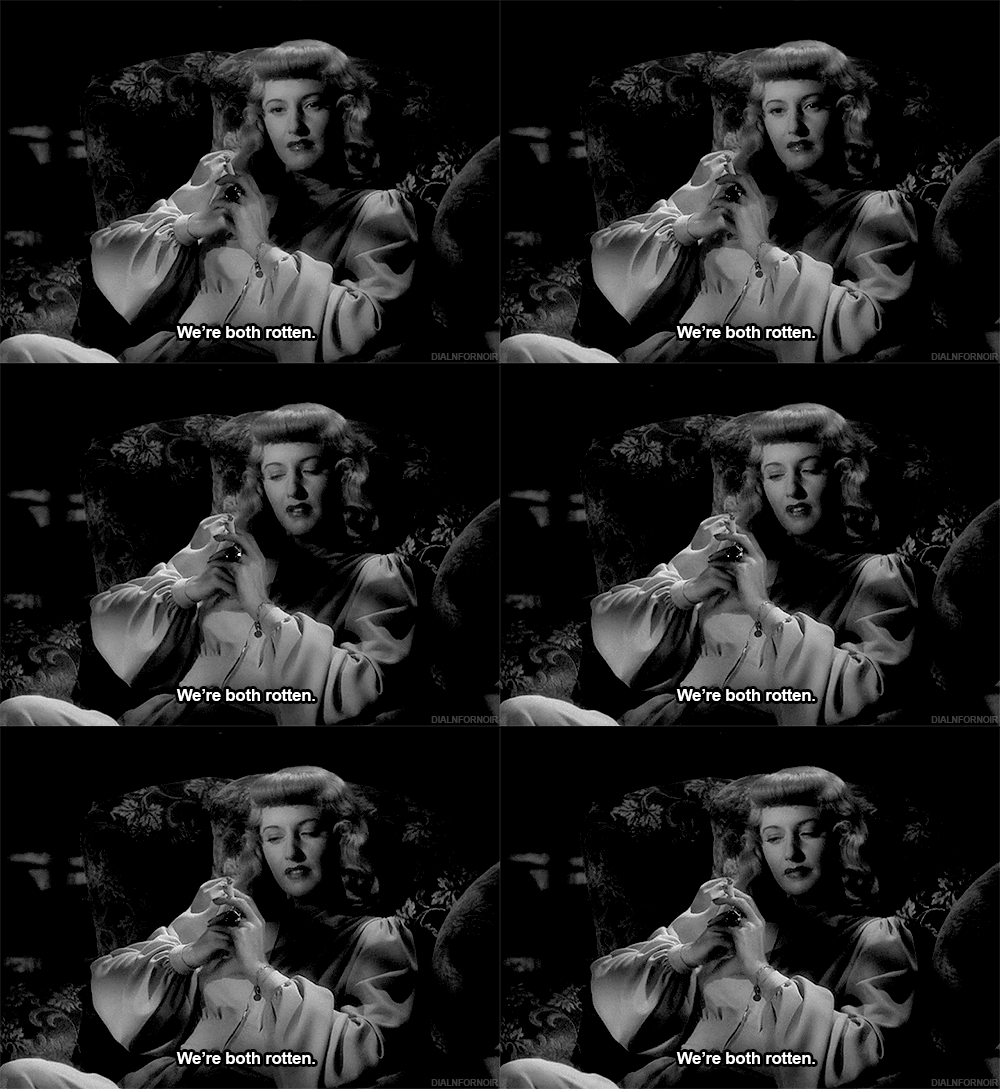
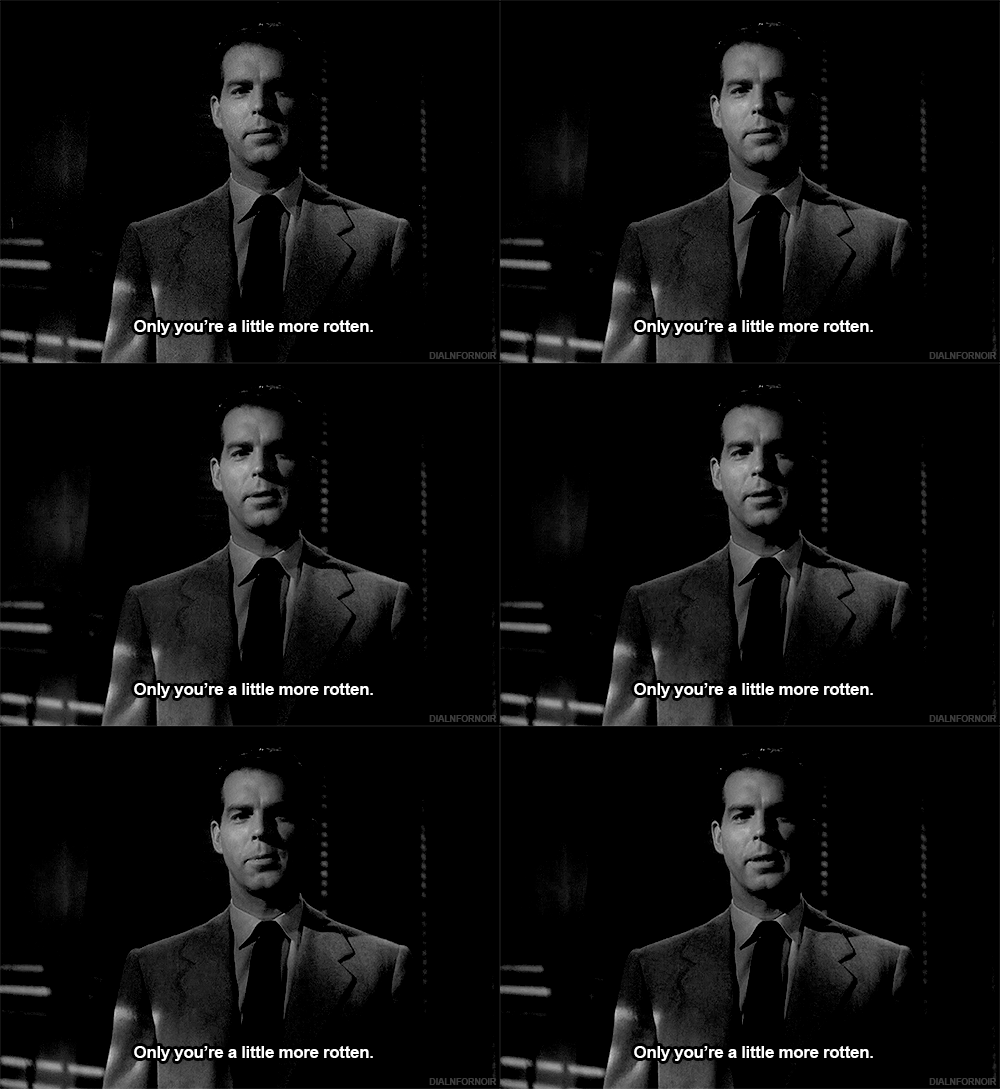
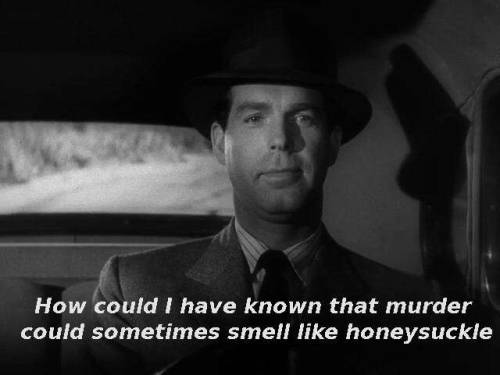
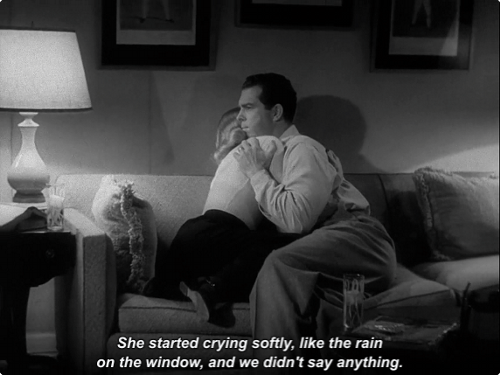
“Pacto de Sangue” (1944) é um dos melhores filmes noir de todos os tempos. Nele, Fred MacMurray é Walter Neff, o perfeito panaca que é seduzido pela femme fatale Phyllis Dietrichson (Barbara Stanwyck) e convencido a fazer parte do plano para matar o marido dela e ficar com o dinheiro do seguro. Obviamente, Walter não é um completo imbecil. Ele tem boa memória e boa atenção aos detalhes, habilidades que são importantes para o crime.

“Double Indemnity” (1944) is one of the best film noir of all time. In it, Fred MacMurray is Walter Neff, the perfect stupid man who is dragged down by femme fatale Phyllis Dietrichson (Barbara Stanwyck) and convinced to take part in her plan to kill her husband and get the insurance money. Of course, Walter is not totally idiot. He has a good memory and pays a lot of attention to detail, skills that are important for the crime.


Walter é movido por luxúria, por seu desejo sexual por Phyllis e periodicamente impedido de continuar por causa de sua amizade com Barton Keyes (Edward G. Robinson) – ou talvez haja também luxúria envolvida, porque algumas teorias apontam para um subtexto homossexual no filme. Só depende da maneira como cada pessoa interpreta o filme.

Walter is moved by lust, by his sexual desire for Phyllis and periodically stopped by his friendship with Barton Keyes (Edward G. Robinson) – or maybe there is also lust involved here, because some theories point at a gay subtext in the movie. It only depends on how each person interprets the movie.


Em 1943, Barbara Stanwyck era a atriz mais bem paga de Hollywood, e Fred MacMurray era o ator mais bem pago. Entretanto, foi coincidência que eles tenham se juntado para fazer “Pacto de Sangue”. Ambos estavam relutantes no início. Stanwyck foi facilmente convencida por Wilder a aceitar o papel, quando ele disse a ela para ser ousada, mas a história com MacMurray foi outra. Walter Neff era um anti-herói, e o papel já havia sido recusado por grandes atores como James Cagney, Spencer Tracy e Alan Ladd. Até o próprio MacMurray recusou o papel, dizendo que ele não era capaz de fazê-lo, mas Wilder insistiu, dia após dia, até que o ator se rendeu. No começo, MacMurray disse para Wilder: “Você está cometendo o maior erro da sua vida!”, e no fim, confessou: “Eu jamais sonharia que aquele seria o melhor filme que eu faria”.

In 1943, Barbara Stanwyck was the highest paid actress in Hollywood and Fred MacMurray, the highest-paid actor. It was, however, a coincidence that they ended up doing “Double Indemnity”. Both were reluctant at first. Stanwyck was easily convinced by Wilder, who told her to be fearless, but it was another thing with MacMurray. Walter Neff was an anti-hero and the role was refused by A-listers like James Cagney, Spencer Tracy and Alan Ladd. Even MacMurray himself turned down the role, saying he couldn’t do it, but Wilder insisted, day after day, until the actor compromised. At first, MacMurray said to Wilder: “You’re making the mistake of your life!”, and in end, he confessed: “I never dreamed it would be the best picture I ever made”.


MacMurray voltou a trabalhar com Wilder 16 anos depois. Na época, ele já era um favorito na Disney, tendo feito alguns filmes fofos para a família no estúdio do Mickey. O ano era 1960 e o filme era “Se Meu Apartamento Falasse”. Fred MacMurray interpretava Sheldrake, o chefe de C.C. Baxter (Jack Lemmon). Sheldrake usa o apartamento de seu empregado para ter encontros sexuais com outras mulheres sem correr o risco de ser descoberto pela esposa. A presa atual é Fran Kubelik (Shirley MacLaine), que é ascensorista no prédio de Sheldrake. Mais uma vez, o personagem de MacMurray é movido pela luxúria.

MacMurray reteamed with Wilder 16 years later. By then, MacMurray was already a Disney favorite, having made some cute family flicks for the Mickey Mouse studio. The year was 1960 and the film was “The Apartment”. Fred MacMurray played Sheldrake, C.C. Baxter's (Jack Lemmon) boss. Sheldrake uses his employee's apartment to have sexual encounters with other women far from his wife. The current prey is Fran Kubelik (Shirley MacLaine), who is an elevator operator at Sheldrake's building. Once again, MacMurray's character is drove by lust.


Sheldrake é simplesmente nojento – provavelmente o personagem menos simpático que MacMurray interpretou em toda sua carreira. Além de trair a esposa e enganar a senhorita Kubelik, ele também cria uma situação difícil para Baxter. E Sheldrake simplesmente não se importa. Ele quer ter prazer e evitar problemas. Quando a senhorita Kubelik para de lhe proporcionar prazer e se torna um problema, ele simplesmente a dispensa, e não se importa se isso for colocar a vida dela em perigo.

Sheldrake is simply disgusting – probably the least likeable character MacMurray ever played. Besides cheating on his wife and making empty promises to Miss Kubelik, he also creates a difficult situation for Baxter. And Sheldrake simply doesn’t care. He wants to have pleasure and avoid problems. When Miss Kubelik stops giving him pleasure and becomes a problem, he simply dumps her, and doesn’t even care if this puts her life in danger.


Convenhamos: se refletirmos sobre a maioria dos outros personagens de MacMurray, nos perguntamos como eles podem sequer transar. Quer dizer, em “Bon Voyage, Enfim Paris!”, ele tem dois filhos, mas é tão ingênuo e atrapalhado que se perde no esgoto parisiense. Em “Quando o Coração não Envelhece” (1967), ele é um pai trapalhão que tem um jacaré de estimação chamado George. Em outros filmes da Disney, como “O Fantástico Super-Homem” (1961) e “Nunca é Tarde para Amar” (1966), ele começa o filme como um cara solteiro, e depois de um namoro atrapalhado e fofo, acaba casado. O MacMurray da Disney não conhece luxúria – por isso ele é aceito pela Disney, e por isso ele não é tão interessante quanto o MacMurray de Billy Wilder.

Let's face it: if we think about most of MacMurray's characters, we ask ourselves how they could even get laid. I mean, in “Bon Voyage” (1962), he has two children, but is so naïve and absent-minded that he gets lost in the Parisian sewer. In “The Happiest Millionaire” (1967), he is a goofy father who has a pet alligator called George. In other Disney films, like “The Absent-Minded Professor” (1961) and “Follow Me, Boys!” (1966), he starts the movie as a single man, and after a sweet but clumsy dating process, he ends up married. The Disney MacMurray has no lust – that's why he is accepted by Disney, and that's why he is not as interesting as the Billy Wilder MacMurray.
 
1967
Billy Wilder e Fred MacMurray poderiam ter feito outro filme juntos. O ator foi um dos nomes considerado para o papel de Joe Gillis em “Crepúsculo dos Deuses” (1950), mas todos nós sabemos que William Holden foi escalado em seu lugar. Gillis é outro personagem que se deixa levar pela luxúria, e eu penso que MacMurray teria sido um ótimo Gillis. Mesmo sem este filme na parceria, nós não podemos negar que MacMurray nunca esteve tão bem quanto ao lado de Billy Wilder.

Billy Wilder and Fred MacMurray could have done another film together. The actor was considered for the role of Joe Gillis in “Sunset Boulevard” (1950), but we all know William Holden was cast instead. Gillis is another character very much driven by lust, and I imagine MacMurray would have played a great Gillis. Even without this movie in their partnership, we can’t deny that MacMurray did his best when he went a little Wilder.  

This is my contribution to the Fred MacMurray blogathon, hosted by Laura at Phyllis Loves Classic Movies.

Thursday, May 19, 2016

Puxe a Alavanca, Max! Professor Fate e a vilania

Pull the Button, Max! Professor Fate and villainy

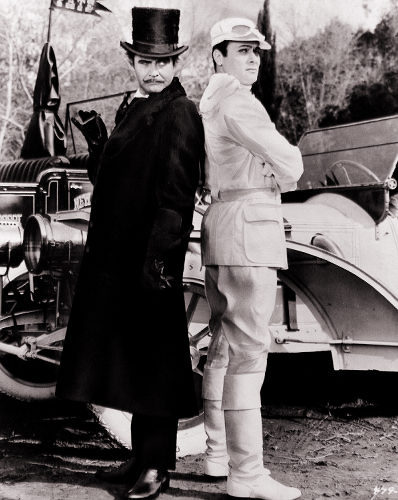
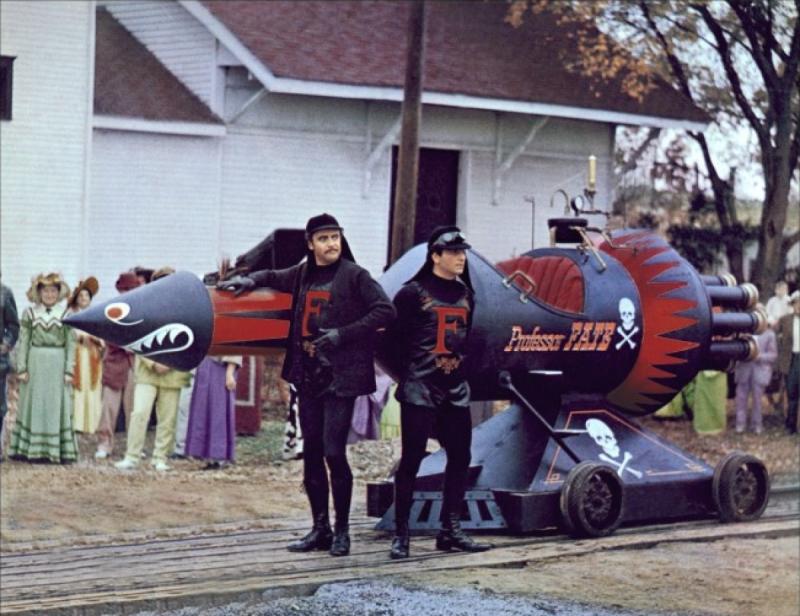
Um grande filme de comédia feito por um dos melhores diretores do gênero. Um filme que é, além do mais, uma ode ao cinema mudo. Um vilão que é simplesmente mau – e adora isso. E mais: um vilão que serviu de molde para outros tantos. A atuação que Jack Lemmon considerava sua melhor. São estes os ingredientes de “A Corrida do Século”, um filme dominado pelo maravilhoso vilão Professor Fate.

A great comedy movie made by one of the best directors in the genre. A film that is also an ode to silent film. A villain that is simply up to no good – and loves it! And more: a villain that was an inspiration to many others. It’s the performance Jack Lemmon considered his best. These are the ingredients of “The Great Race”, a film dominated by the wonderful villain Professor Fate.
O Grande Leslie (Tony Curtis) entra em uma corrida transcontinental de Nova York a Paris. A repórter Maggie DuBois (Natalie Wood) faz de tudo para cobrir o grande evento, como jornalista e como participante. Quem quer atrapalhar a proeza de Leslie é o Professor Fate (Jack Lemmon), e ele será capaz de todas as trapaças imagináveis, sempre com a ajuda (ou os atos atrapalhados) de Max (Peter Falk).

The Great Leslie (Tony Curtis) joins a transcontinental car race from New York to Paris. Journalist Maggie DuBois (Natalie Wood) also wants to take part in the event, both as a reporter and a competitor. And to stop Leslie from winning we have Professor Fate (Jack Lemmon), a man willing to do any kind of cheating, always with Max’s (Peter Falk) help (or rather the confusing acts).
O filme é ambientado em 1908, e foi concebido por Blake Edwards como uma homenagem às comédias do cinema mudo. A grande guerra de tortas, a confusão das portas e os créditos são as homenagens mais óbvias. Entretanto, o que não ajuda muito na reputação do cinema silencioso é a construção estereotipada do Professor Fate como vilão. Ele é uma cópia óbvia de Snidely Whiplash, o antagonista de Dudley Do-Right criado em 1961, em uma paródia dos filmes mudos. É de Snidely que vem a imagem errada de que os vilões dos filmes de 100 anos atrás se limitavam a amarrar moças na linha do trem.

The film is set in 1908 and was envisioned by Blake Edwards as a tribute to silent film comedies. The huge pie fight, the confusion of the doors and the credits are the most obvious tributes. However, something that does not help with the reputation of silent films is the stereotyped construction of Professor Fate as a villain. He is an obvious copy of Snidely Whiplash, the villain who fought Dudley Do-Right since 1961, in a silent film parody. From Snidely we see coming the wrong image of silent film villains tying girls to railroad tracks.
E Maggie está muito longe de ser uma donzela indefesa. A personagem é a mais bem construída do filme, e sua independência ressoa bem tanto em 1965 quanto hoje.

Maggie is far from being a damsel in distress. Her character is the best one in the movie, and her independence makes a good impression both in 1965 and nowadays.

Talvez mais interessante ainda que “A Corrida do Século” seja o desenho animado que ela inspirou. Sim, eu estou falando da inesquecível Corrida Maluca. O Professor Fate inspirou Dick Vigarista, seu incompetente capanga Max deu origem a Muttley, o grande Leslie se tornou Peter Perfeito e, obviamente, Maggie DuBois foi a inspiração para Penélope Charmosa.

Even more interesting than “The Great Race” is the cartoon it inspired. Yes, I'm talking about the unforgettable Wacky Races. Professor Fate inspired Dick Dastardly, his incompetent minion Max originated the dog Muttley, the Great Leslie became Peter Perfect and, obviously, Maggie DuBois was the inspiration for Penelope Pitstop.
Professor Fate e Dick Vigarista nos ajudaram a acostumar desde cedo com a ideia de que os vilões podem também ser os personagens mais importantes. Para quem cresceu, como eu, cercado de Disney, contos de fadas, lutas do bem contra o mal e esperanças de “felizes para sempre”, torcer para o vilão era um ato de rebeldia. Mas torcer para um vilão que humano e bastante atrapalhado é totalmente aceitável.

Professor Fate and Dick Dastardly helped us get acquainted since an early age with villains that are also the most important characters in a film or cartoon. If you, like me, grew up with Disney, fairy tales, bad against evil and hopes of “happily ever after”, rooting for a villain was an act of rebellion. But rooting for a human, goofy villain is perfectly OK.  

A persona do vilão todo vestido de preto, com capa, cartola e bigode, e sempre pronto para vilanias vem de 1940, da sátira “O Vilão Ainda a Perseguia”. Silas Cribbs, interpretado por Alan Mowbray, quer destruir o personagem de Richard Cromwell, quebrando com frequência a quarta parede para compartilhar seus planos malignos com a plateia. Todas as atuações neste filme são muito exageradas e Silas definitivamente não é um vilão para ser levado a sério.
The image of the villain all dressed in black, with cape, top hat and a moustache, always ready to be bad, comes from 1940, from the satire “The Villain Still Pursued Her”. Silas Cribbs, played by Alan Mowbray, wants to destroy Richard Cromwell’s character, and frequently breaks the fourth wall to share his evil plans with the audience. All the performances in this film are much exaggerated, and Silas definitely isn’t a villain to be taken seriously.
Silas Cribbs, Snidely Whiplash, Dick Vigarista, Professor Fate: quatro vilões com muito em comum. São carismáticos, engraçados e fadados ao fracasso. São vilões que são simplesmente maus – não há explicação para a vilania. Eles nasceram vilões, morrerão vilões e farão maldades enquanto viverem. Agora, se o plano maligno vai ou não funcionar, esta é outra história.

Silas Cribbs, Snidely Whiplash, Dick Dastardly, Professor Fate: four villains with a lot in common. They are charismatic, funny and always fail. They are simply mean villains – there is no explanation for their preference of evil. They were born villains, will die villains and will do villainies as long as they live. But, will the evil plan work? That’s another story!

This is my contribution to the Third Annual Great Villain Blogathon, hosted by evil trio Ruth, Kristina and Karen at Silver Screenings, Speakeasy and Shadows and Satin.

Saturday, April 19, 2014

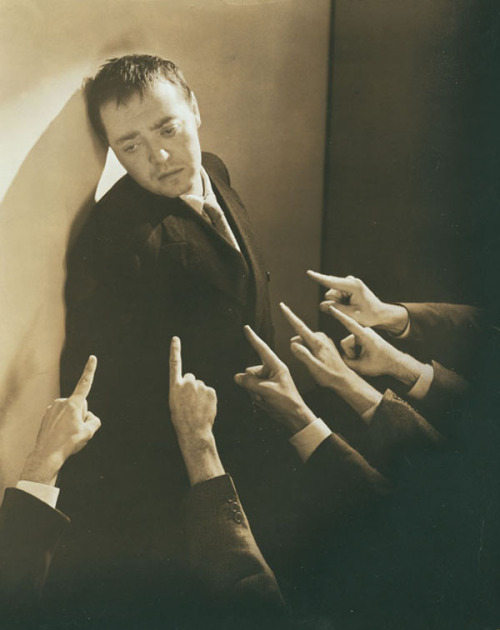
Peter Lorre: o vilão subestimado

Peter Lorre: the underrated villain

Aos 27 anos ele matava criancinhas. Aos 30 tinha um penteado esquisito e sequestrou uma garota de férias em uma estação de esqui. Aos 37 fez parte de um bando complicado que procurava uma estátua valiosa. Aos 39 matou duas pessoas para conseguir passes para sair do Marrocos direto para Portugal e escapar da Segunda Guerra Mundial. Aos 50 era o assistente medroso do capitão meio maluco de um submarino. E aos 59 foi um mágico transformado em corvo. Essas foram algumas das muitas vidas de Peter Lorre no cinema. Baixinho (1,61m), meio gorducho, olhos esbugalhados, sotaque inconfundível, nunca foi sequer indicado ao Oscar. Mas interpretou alguns personagens de arrepiar os cabelos.  

At 27 he killed little children. At 30 he had a weird hairdo and kidnapped a girl from a ski station. At 37 he was part of a complicated group chasing a valuable statuette. At 39 he killed two people in order to get a pass to leave Morocco to Portugal and escape World War II. At 50 he was the coward assistant to an insane submarine captain. And at 59 he was a magician turned into a crow. These were some of the many lives Peter Lorre lived in the movies. Short (5’ 3 1/2’’), kinda fat, bulging eyes, unmistakable accent, he was never nominated for an Oscar. But he surely played some chill-inducing characters!
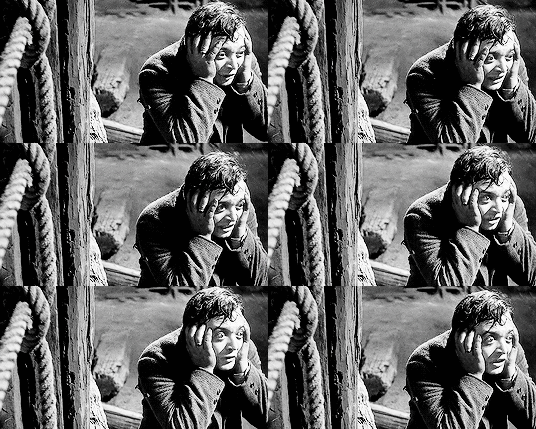
Seu papel mais famoso e de maior destaque é sem dúvida o de protagonista de “M” (1931). A película, escrita pelo diretor Fritz Lang com sua brilhante esposa Thea von Harbou, conta a história de uma cidade apavorada por um assassino de crianças. Com o noticiamento dos crimes, as crianças passam a ser proibidas de saírem na rua e o povo todo fica em alerta. Juntam-se nessa caçada a população, a polícia e até os bandidos, que não querem encontrar o culpado apenas para ganharem a recompensa, mas para acabarem com a intensa vigilância da polícia na cidade toda, o que dificulta seus “negócios”.

His most famous role is without a doubt as the leading man in “M” (1931). The film, written by director Fritz Lang alongside his brilliant wife Thea von Harbou, tells the story of a city haunted by a children’s murderer. As the news about the crimes spread, children are forbidden to go outside and everybody becomes watchful. In this hunt we have the people, the police and even the criminals, who want to find the murderer not only because of the reward, but also to end the police alert that is minding with their “business”.

Antes de “M”, Peter Lorre fugiu de casa aos 17 anos, fez comédias no teatro e participou de dois filmes, um deles sem receber créditos. Aqui, apesar de ser o protagonista, vemos primeiro sua sombra, reconhecemo-lo pelo assobio (mas quem assobiava por trás das câmeras era Fritz Lang) e então ele se mostra. Sua cena mais marcante é sem dúvida o tribunal improvisado, em que Lorre arrasa na interpretação.

Before “M”, Peter Lorre ran away from home at age 17, did comedies in theater and was in two movies, going uncredited in one of them. Here, even though he is the lead, we see his shadow first, get to know him by his whistle (it was actually Fritz Lang whistling behind the camera) and then we see him. His most remarkable scene is without a doubt the improvised judgement, in which Lorre gives a breathtaking performance.
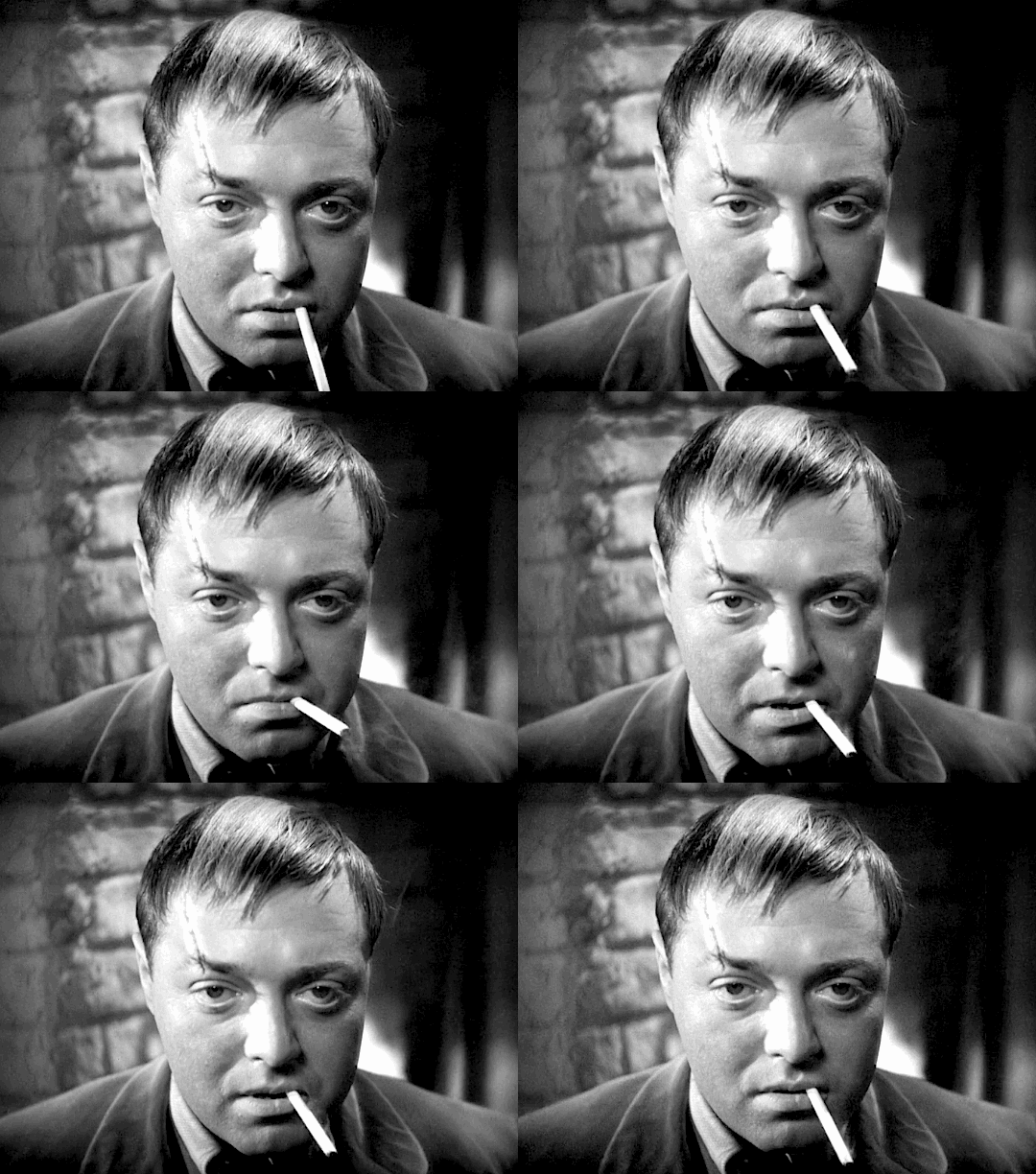
Mas vamos a um vilão com mais presença, e presença caricatural, devo dizer. Impressionado com “M”, Hitchcock convidou Lorre, recém-saído da Alemanha Nazista, para seu filme “O homem que sabia demais” (1934). Nele, uma família tem suas férias em uma estação de esqui interrompidas quando a filha é sequestrada. O sequestrador? Lorre, com uma mecha branca no cabelo que o faz parecer um gambá. O motivo do sequestro? A mãe, Jill Lawrence (Edna Best) presenciou um assassinato e ficou conhecendo detalhes sobre uma conspiração. 

Now we’ll talk about a villain with a caricatural presence. Impressed by “M”, Hitchcock invited Lorre, who had just fled Nazi Germany, to do appear in his movie “The Man who Knew Too Much” (1934). In it, a family on vacation in a ski station finds trouble when the daughter is kidnapped. Who is the kidnapper? Lorre, with a white lock of hair that makes he look like a skunk. The reason for kidnapping the girl? The girl’s mother, Jill Lawrence (Edna Best) witnessed a murder and heard details about a conspiracy.

Lorre ainda não era fluente em inglês quando filmou “O homem que sabia demais”, e aprendeu suas falas foneticamente (embora algumas fontes afirmem que ele teve três meses para dominar a língua antes de começar a filmar). Mas isso não importa: Abbott, seu personagem, é o mais memorável do filme. Além do cabelo de gambá, ele tem uma cicatriz bem acima do olho direito. Lorre foi às pressas para a cerimônia de seu primeiro casamento, com a atriz Celia Lovsky, sem tirar a maquiagem de Abbott!

Lorre was not yet fluent in English when he shot “The Man who Knew Too Much”, and he learned his lines phonetically (although some sources claim that he was given three months to learn English before the shoot started). But this doesn’t matter: his character, Abbott, is the most memorable in the film. Besides the skunk hair, he has a scar right above his right eye. Lorre went running to his first wedding, to actress Celia Lovsky, without removing his makeup!
Querida, cheguei! / Honey, I'm here!
Os fãs mais comprometidos de Hitchcock dizem que a versão de 1934 é melhor que seu remake, também dirigido por Hitchcock em 1956. Eu tenho de concordar, e grande parte dessa superioridade se deve à presença de Peter Lorre como vilão. Ele inclusive participa daquela que considero a melhor briga do cinema, envolvendo cadeiras voadoras em uma pequena igreja. O casal de sequestradores do garotinho no filme de 1956 não parece de todo perigoso, e nem sequer deixa sua marca de maldade. Outro ponto positivo da versão original é que Jill é a grande heroína. Embora Doris Day cante “Que Sera, Sera” e grite para evitar uma tragédia em 1956, a Jill de Edna Best é mais independente, e usa com sangue frio sua habilidade com armas.

The most hardcore Hitchcock fans say that the 1934 version is better than the remake, also directed by Hitchcock in 1956. I have to agree with them, and a lot of what makesi t superior is Lorre’s presence as the villain. He even takes part in what I consider to be the best fight in film history, involving flying chairs inside a small church. The couple that kidnaps the little boy in the 1956 film doesn’t look as dangerous as Lorre alone was. Another positive point in the original version is that Jill is the hero. Although Doris Day sang “Que Sera, Sera” and screamed to avoid a tragedy in 1956, Jill, as played by Edna Best, is more independent, and is not afraid to use her gun.
O sucesso de Lorre nestes dois filmes foi estrondoso. Ele voltou a trabalhar com Hitchcock em “Agente Secreto”, de 1936, mas então já estava estereotipado: em Hollywood se tornou o vilão estranho, o maníaco que mora ao lado, o pária da sociedade. Lutou a vida toda contra um vício em morfina, adquirido após complicações de uma cirurgia em 1927. Mesmo assim, ele conquistou admiradores: em um anúncio para seu primeiro filme americano, “Mad Love” (1935), ele é descrito como o melhor ator da época por ninguém mais, ninguém menos que Charles Chaplin.

Lorre’s success in these two films was huge. He worked again with Hitchcock in “Secret Agent” (1936), but by then he was already stereotyped: in Hollywood he became the strange villain, the maniac next door, the pariah. He fought during his whole life against an addiction to morphine that started after a complicated surgery in 1927. But this didn’t stop him from getting admirers: in an add for his first American film, “Mad Love” (1935), he is described as the best actor of his time by none other than Charles Chaplin.
Crime and Punishment, 1935
Apesar de parcerias bem-sucedidas com Sidney Greenstreet e Humphrey Bogart (Peter inclusive convenceu Bogie a se casar com Lauren Bacall!), sua carreira sofreu com seu ganho rápido de peso depois dos 50 anos, quando enfrentava um problema glandular. Mas isso não deixou Lorre esquecido! Porque, para pessoas como eu, que preferem os vilões, Peter Lorre merece um lugar de honra no Hall da Fama do cinema mundial.

Although he had successful partnershps with Sydney Greenstreet and Humphrey Bogart (Peter even convinced Bogie to marry Lauren Bacall!), his career suffered as he gained weight quickly after turning 50, when he faced a glandular issue. But this hasn’t made him a forgotten actor! Because, for people like me, who prefer the villains, Peter Lorre deserves a place of honor in the world cinema Hall of Fame.

This is my contribution for The Great Villain Blogathon, hosted by Ruth at Silver Screenings, Karen at Shadows & Satin and Kristina at Speakeasy.  
Related Posts Plugin for WordPress, Blogger...