} Crítica Retrô: Goofy

Tradutor / Translator / Traductor / Übersetzer / Traduttore / Traducteur / 翻訳者 / переводчик

Showing posts with label Goofy. Show all posts

Sunday, May 26, 2019

As muitas faces de Bafo, o vilão da Disney


The many faces of Pete, Disney villain
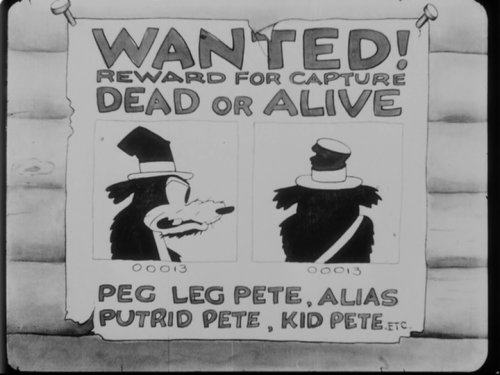


Ao longo dos anos, ele incomodou o Mickey, o Donald, o Pateta e outros tantos personagens. Ao redor do mundo, seu nome muda: nos EUA, ele é simplesmente Pete, no Brasil ele é João Bafo de Onça, ou apenas Bafo, nos Países Baixos ele é Boris Boef (Boris Canalha) e na Turquie ele é Barut (Pólvora). Seu nome verdadeiro, revelado em uma HQ de 1960, é Clodovil P. Pedrosa. E tem mais: ele é detentor de alguns recordes da animação, mudou muito através dos anos e, mesmo sendo um cara do mal, ainda tem muitos fãs.

Over the years, he has bullied Mickey Mouse, Donald Duck, Goofy and their loved ones. Around the world, his name changes: in the US, he is simply Pete, in Brazil he is João Bafo de Onça (John Jaguar-Breath) or only “Bafo” for short, in the Netherlands he is Boris Boef (Boris Crook) and in Turkey he is Barut (Gunpowder). His full name is revealed in a comic book from 1960: Percy P. Percival. There is more: he holds a few cartoon records, changed a lot through years and, even being a bad guy, still has a lot of fans.


Aqui vem a primeira descoberta chocante: Bafo é um gato. E esta é a segunda descoberta chocante: Bafo é mais velho que o Mickey – na verdade, ele é o mais velho personagem da Disney ainda em uso. Bafo foi criado como um urso antagonista para um curta-metragem de 1925 que misturava animação e uma atriz de verdade: “Alice Solves de Puzzle”. Nele, Bafo, um colecionador de palavras cruzadas, quer roubar uma palavra cruzada da pequena Alice, que então precisa da ajuda de Julius, um gato preto que é igualzinho ao gato Félix, para se salvar. Eu devo dar spoilers do final? Acho que sim: no final, Bafo é, bem, empalado. Mas esta não seria a última vez que nós o veríamos.

Here comes the first shocking discovery: Pete is a cat. And this is the second shocking discovery: Pete is older than Mickey – actually, he is the oldest Disney character still in use. Pete was developed as a bear for a 1925 short film that mixed animation and live-action, “Alice Solves the Puzzle”. In it, Pete, a crossword puzzle collector, wants to steal a puzzle from little Alice, who then needs the help of Julius, a black feline who looks exactly like Felix the cat. Should I spoil the end? I guess so: in the end, Pete is, well, impaled. But it wouldn’t be the last time we’d see him.


Pete não atazanava apenas a Alice nos seus primeiros anos: em 1927 ele começou a aparecer como vilão nas aventuras de Osvaldo, o Coelho Sortudo, iniciando por “The Ocean Hop”, no qual Bafo trapaceia para chegar primeiro a Paris de avião em uma corrida atravessando o Atlântico. Em “Hungry Hobos” (1928), entretanto, Osvaldo e Bafo são dois amigos mendigos perseguidos por um policial – e Bafo não pensará duas vezes para sacrificar Osvaldo e escapar.

Pete not only bothered Alice in his initial years: in 1927 he also started appearing as the villain in Oswald the Lucky Rabbit’s adventures, starting with “The Ocean Hop”, in which Pete cheats to arrive first in Paris by plane after crossing the Atlantic. In “Hungry Hobos” (1928), however, Oswald and Pete are two hobo pals persecuted by a cop – and Pete won’t think twice to sacrifice Oswald to escape.


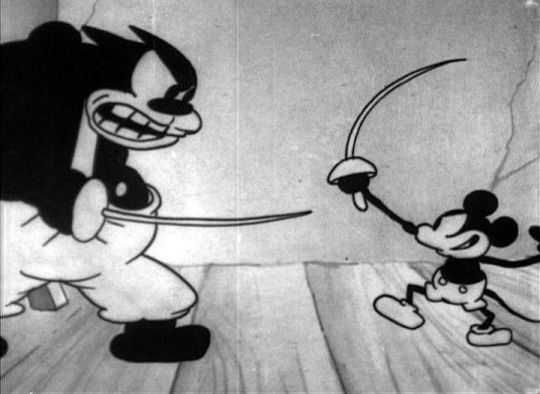
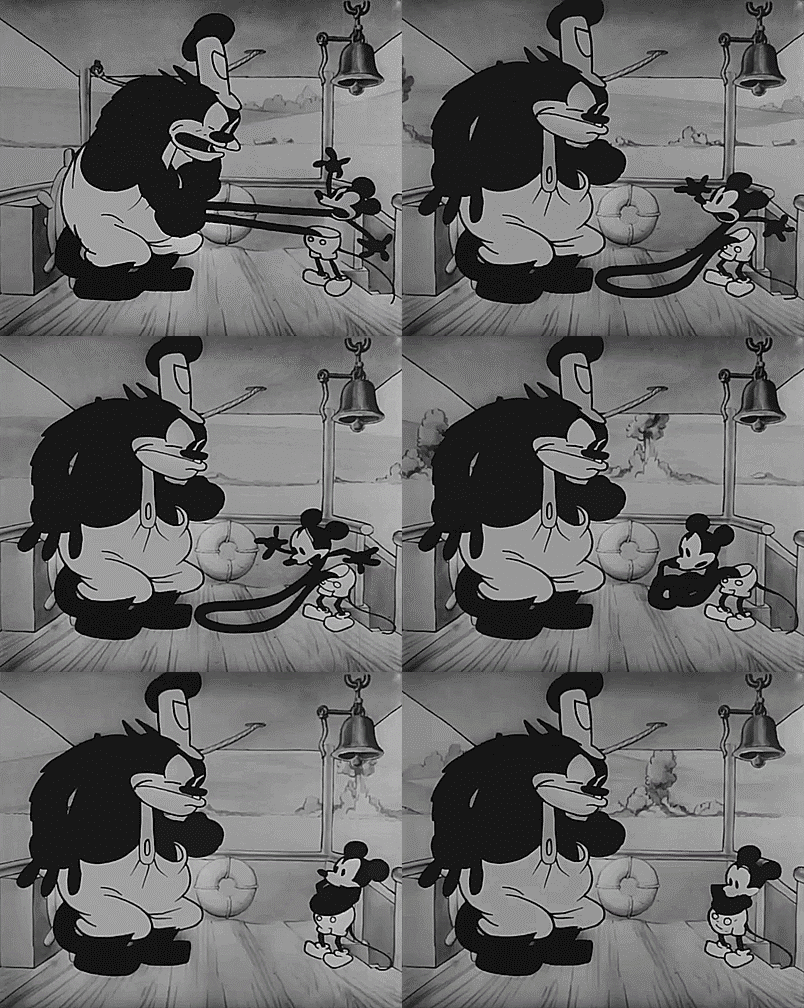
Em algum momento em 1928, Bafo mudou de urso para gato preto, símbolo do azar. Faz todo sentido um gato incomodar um rato, não? Por isso Bafo estava lá, na estreia do Mickey em “O Vapor Willie” (1928), para atrapalhar a vida de Mickey e Minnie no barco. Outro curta-metragem com Mickey e Bago, “O Gaucho Galopante”, uma paródia de Douglas Fairbanks, foi feito antes de Willie, mas só estreou depois deste. Bafo pode não ter conseguido o que queria em suas primeiras tentativas, mas nas décadas seguintes ele continuaria importunando nossos heróis.

Sometime in 1928, Pete changed from a bear to a black cat, the symbol of bad luck. It makes total sense to have a cat bullying a mouse, doesn’t it? That’s why Pete was there, in Mickey’s debut, “Steamboat Willie” (1928), to make Mickey and Minnie’s lives in the boat miserable. Another short with Mickey and Pete, “The Gallopin’ Gaucho”, a Douglas Fairbanks spoof, was developed before Willie, but only opened after it. Pete may not have succeeded in his first attempts, but in the coming decades he kept on trying to bother our heroes.

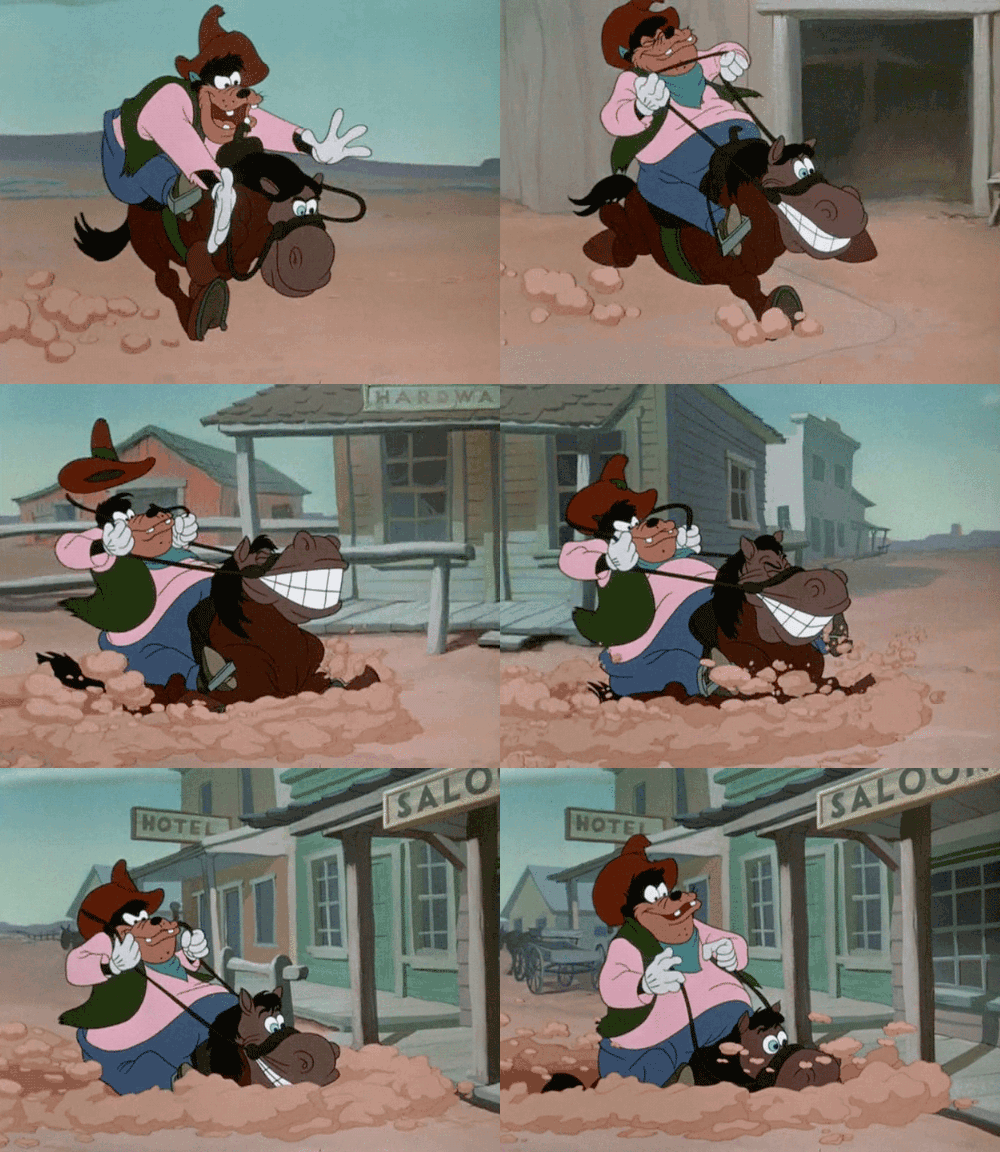
No começo dos anos 30, o animador Norman Ferguson decidiu remodelar Bafo para fazê-lo se parecer mais com o ator Wallace Beery. Bafo estreou o novo estilo em “The Klondike Kid” (1932), baseado no filme de Chaplin de 1925, “Em Busca do Ouro” - um curta-metragem que também tem uma breve aparição do Pateta. Neste e em muitos curtas dos anos 30, a função do Bafo é tentar sequestrar Minnie... e falhar.

In the early 1930s, animator Norman Ferguson decided to re-stylize Pete in order to make him look more like screen heavy Wallace Beery. Pete’s new look was first seen in “The Klondike Kid” (1932), based on Chaplin’s “The Gold Rush”, from 1925 – a short that also has a cameo by Goofy. In this and many of the 1930s shorts, Pete’s function was to try to kidnap Minnie… and fail.
 
Wallace Beery

Entretanto, Bafo não estava incomodando só o Mickey. No final dos anos 20 e começo dos anos 30, Bafo aparecia tanto nos curtas da Disney quanto nos de Osvaldo, produzidos por Charles Mintz. Nos curtas de Osvaldo, Bafo permaneceu com seu velho estilo, e uma vez até teve a aparência de um coelho! Dirigidos por Walter Lantz, estes desenhos do estúdio Universal com Osvaldo e Bafo eram mais nonsense e desafiam mais a ciência do que a Disney.

But Pete wasn’t only bothering Mickey. In the late 1920s and the early 1930s, Pete appeared in both Disney shorts and Charles Mintz-produced Oswald shorts. In those shorts he remained with his earlier look, and once even appeared as a rabbit! Directed by Walter Lantz, those Universal studios cartoons with Oswald and Pete had even more nonsense and science-defying gags than the Disney ones.


A perna de pau do Bafo sempre foi curiosa: em alguns curtas de Alice e de Osvaldo, a perna de pau ou não aparecia ou mudava de perna, enquanto em “O Vapor Willie” ela sequer apareceu. Na minha opinião, nos seus primeiros anos, mais magro e com a perna de pau, Bafo se parecia com Arthur Bannister (Everett Sloane), em “A Dama de Xangai” (1947).

Pete’s peg-leg was always a curious thing: in some Alice and Oswald shorts the peg-leg either didn’t appear or changed legs, while in “Steamboat Willie” it didn’t appear at all. In my opinion, Pete, in his earlier years, skinnier and with the peg-leg, looked like Arthur Bannister (Everett Sloane) in “The Lady from Shanghai” (1947).


Já na era dos desenhos coloridos, Bafo foi um vilão enquanto Donald era policial em “Officer Duck”- e Donald teve de se vestir de bebê para prendê-lo, provando que Bafo tem na verdade um coração mole. Depois ele apareceu em mais alguns “curtas normais” no começo dos anos 40 e seis curtas feitos para o esforço de guerra entre 1942 e 1943. Neles, Bafo era o mal-humorado superior de Donald no exército.

Already in the color cartoon era, Pete was a villain to Donald’s police officer in “Officer Duck” (1939) – and Donald had to dress as a baby to arrest him, proving that Pete is actually a soft guy. He then appeared in more “regular shorts” in the early 1940s and six shorts made for the war effort between 1942 and 1943. In these, Pete was Donald’s grumpy superior at the army.


Nos anos 50, Bafo foi por pouco tempo rival do Pateta e de Tico e Teco. Então 30 anos se passaram até “Um Conto de Natal do Mickey”, como o Fantasma do Natal por Vir. Ele também apareceu em alguns episódios de Ducktales como vários personagens.

In the 1950s, Pete was briefly a rival to both Goofy and Chip and Dale. Then 30 years passed until “Mickey’s Christmas Carol” (1983), as the Ghost of Christmas Yet to Come. He also appeared in the first Ducktales as several characters.

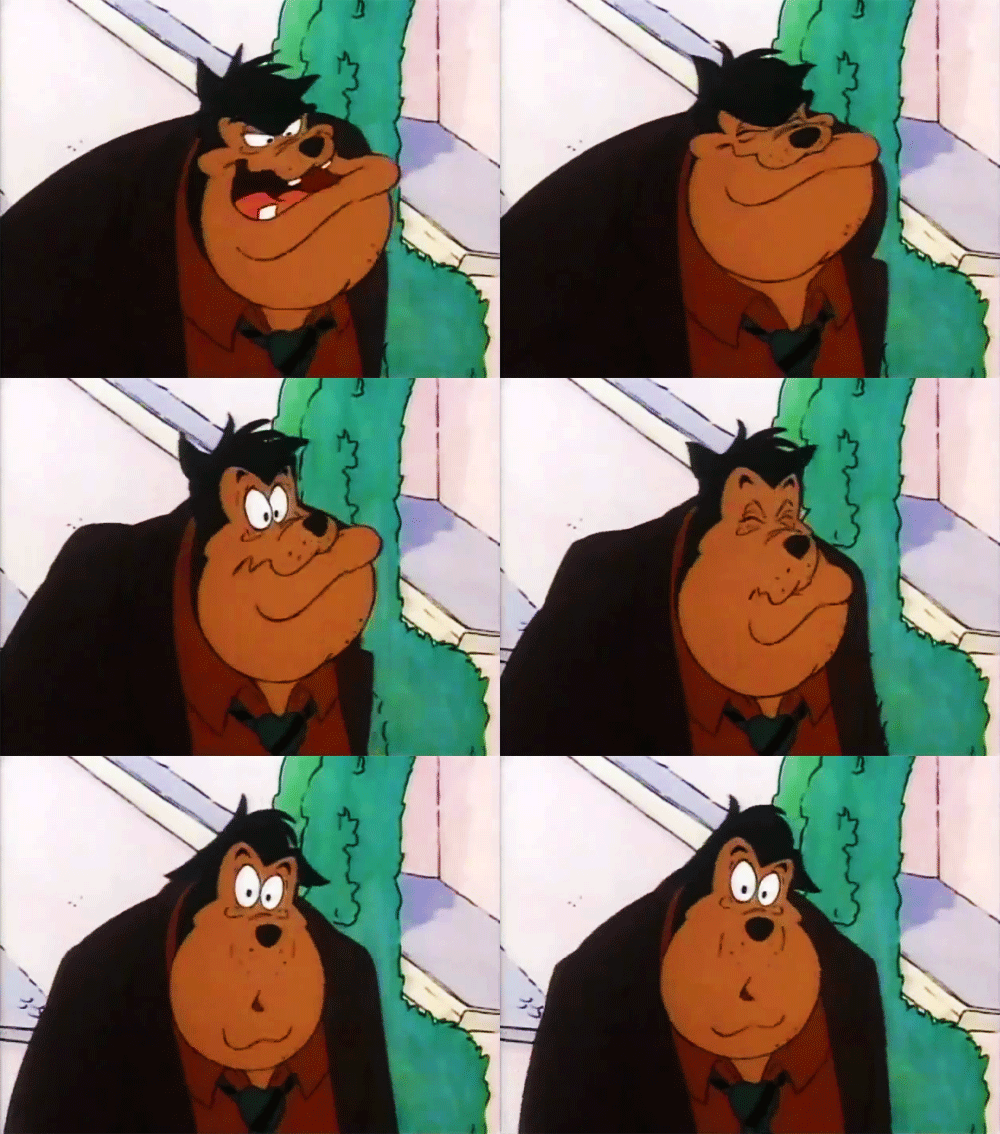
Nos anos 90, Bafo se tornou um cara quase legal em uma das minhas animações favoritas da época: “A Turma do Pateta”. Nela, Bafo era vizinho do Pateta e vítima constante das trapalhadas dele. Bafo não era mau nessa versão, mas sim estressado e um pouco arrogante. Ele tinha uma loja de carros usados e vivia com a família.

In the 1990s, Pete became an almost nice guy in one of my favorite cartoon series of the time: “Goof Troop”. In it, he was Goofy’s neighbor and a constant victim of Goofy’s clumsiness. Pete was not bad in this iteration, but rather nervous and a bit arrogant. He had a used cars dealership and lived with his family.
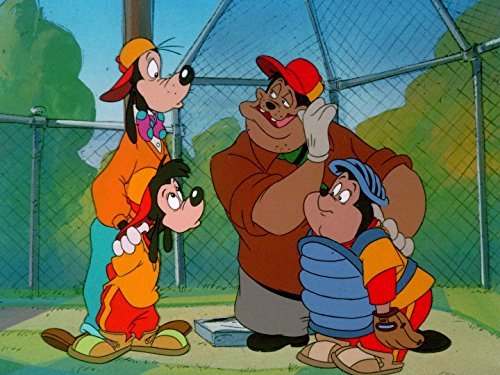

Está na hora de conhecer a família do Bafo, não é? Em um jogo de xadrez com as peças no formato dos personagens, Bafo tinha uma irmã chamada Penélope, vestida como cantora de saloon. Eu me pergunto se ela morreu de cólera. Por um lado mais feliz, Bafo tinha uma linda família na série “A Turma do Pateta”: a esposa Peg, o filho BJ e a filha Matraca. A mãe e a avó de Bafo apareceram em um episódio de “O Clube do Mickey”.

It is time to get to know Pete’s family, right? In a chess game with the characters as pieces, Pete had a sister named Penelope, dressed as a saloon singer. I wonder if she died from cholera. In happier notes, Pete has a whole family in the series “Goof Troop”: wife Peg, son PJ and daughter Pistol. His mother and grandmother also appeared in one episode of “House of Mouse”.

Vovó Bafo / Gram-Gram Peg-Leg

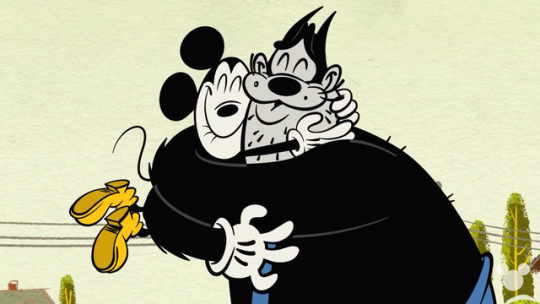
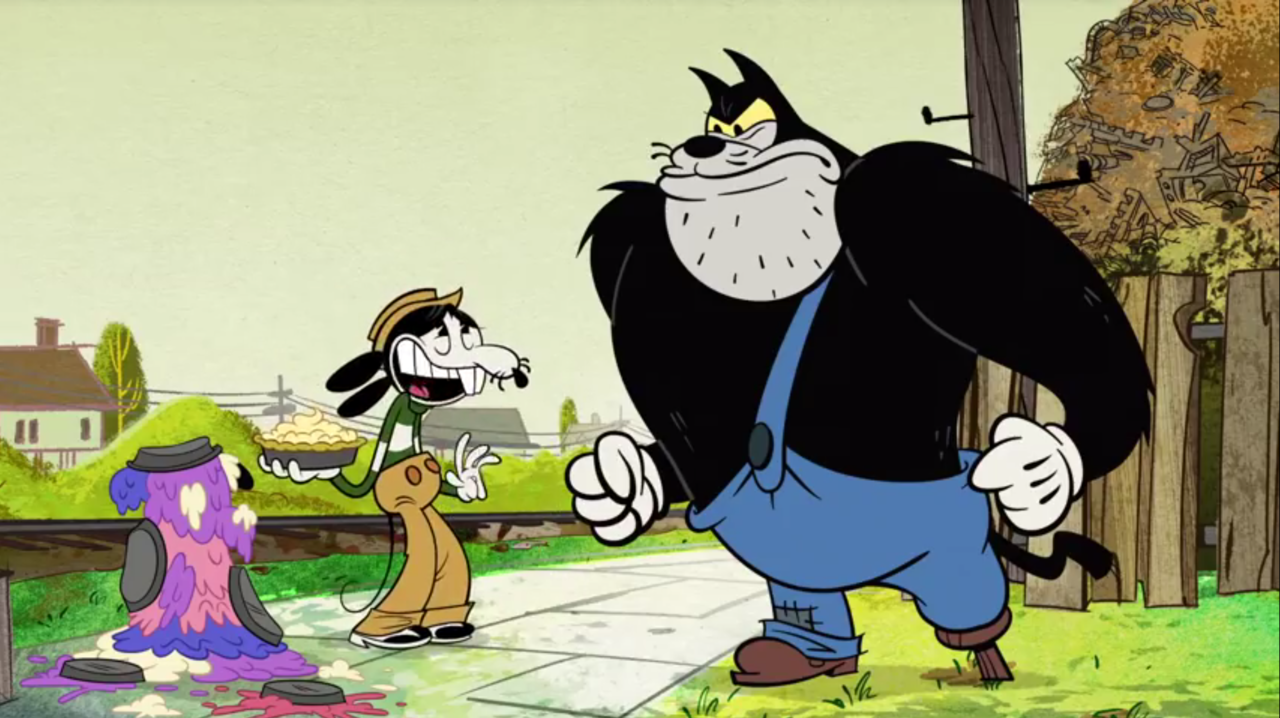
O recente novo design dos principais personagens da Disney foi polêmico, e fãs ficaram divididos. Começando em 2014, Bafo quase voltou às origens, ganhando sua perna de pau de volta e sendo retratado como um vilão com sentimentos. Muitas pessoas odiaram o novo estilo, mas todos concordamos com uma coisa: com ou sem sua perna de pau, Bafo – o mais velho personagem da Disney e o único personagem animado a “trabalhar” em dois estúdios ao mesmo tempo – é um dos mais importantes vilões da história da animação.

The recent redesign of the main Disney characters was a polemic one, and fans were divided. Starting in 2014, Pete almost comes full circle, getting his peg-leg back and being portrayed as a villain with feelings. Many people hated the redesign, but we all agree with a thing: with or without his peg-leg, Pete – the oldest Disney character and the only animated character to “work” at two studios at the same time – is one of the most important villains in the history of animation.  

This is my contribution to the Great Villain blogathon, hosted by Ruth, Kristina and Karen at Silver Screenings, Speakeasy and Shadows and Satin.


Friday, September 18, 2015

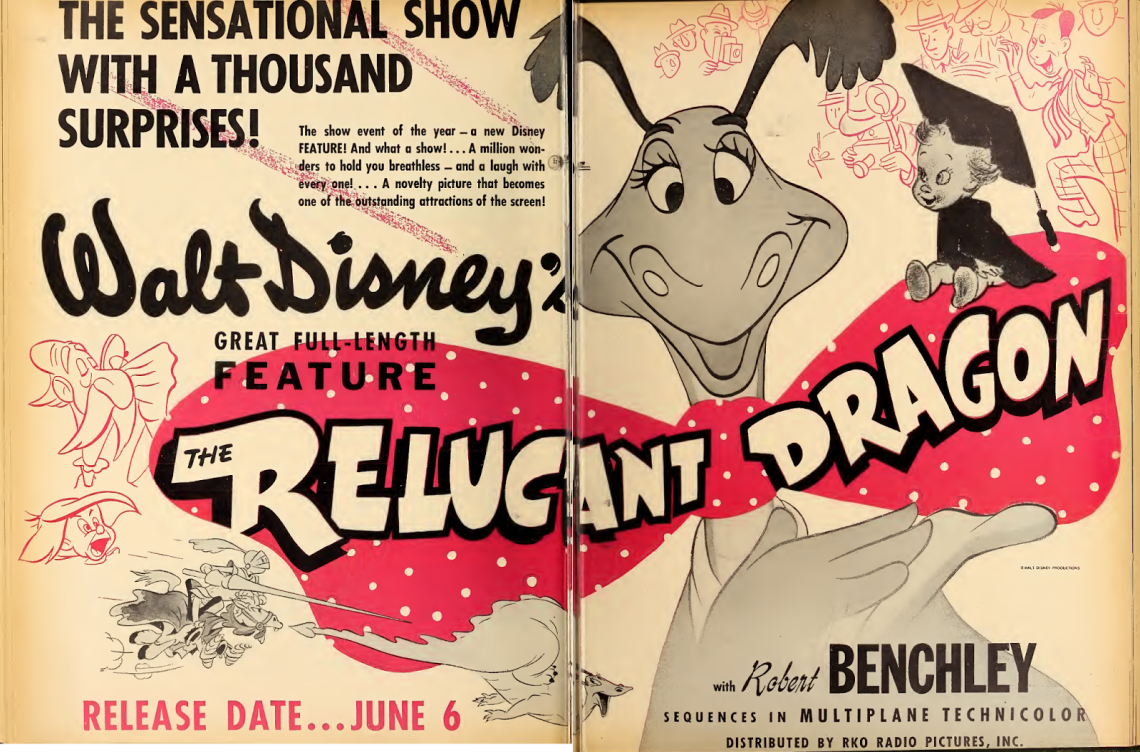
O Dragão Relutante (1941) / The Reluctant Dragon (1941)

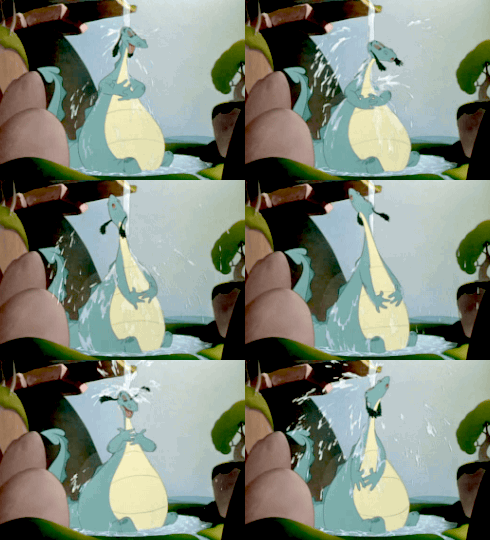
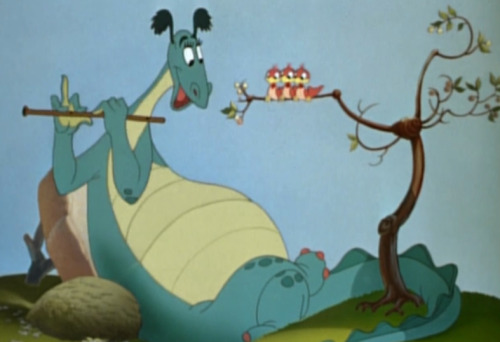
Eu tinha seis anos de idade, talvez um pouco mais, e adorava as fitas de vídeo (sim, do tempo do VHS) da Disney. Cada fita vinha com algumas propagandas de outras fitas, verdadeiros trailers feitos especialmente para aqueles lançamentos em vídeo. E um destes trailers era de “O Dragão Relutante” (ou “O Dragão Dengoso”, como também ficou conhecido aqui no Brasil). Desde o primeiro momento do trailer adorei aquele dragão fofo, que preferia escrever poemas a fazer coisas assustadoras de dragão.

I was six years old, maybe a little older, and I loved the Disney home video tapes (yes, I’m from the VCR era). Each tape came with ads from other tapes, true trailers exclusively made for those home video releases. And one of these trailers advertised “The Reluctant Dragon”. Since the first minute I loved that cute dragon, who’d rather write poems than do frightening dragon stuff.


Mas foram necessários muitos anos para que eu finalmente assistisse a “O Dragão Relutante”. As fitas de vídeo viraram objetos de museu, o DVD assumiu o posto, e até o Blu-Ray apareceu, e eu ainda não havia visto “O Dragão Relutante”. Foi quando, em dezembro de 2014, o canal americano TCM (o canal mais abençoado de todos os tempos, e também o paraíso dos fãs de cinema clássico) exibiu o filme como parte de sua série Treasures from the Disney Vault. Foi então que eu relembrei aquele trailer que tinha me marcado tanto na infância, e adicionei “O Dragão Relutante” às minhas resoluções cinematográficas de 2015. O resultado? Foi muito bom ter esperado tanto para ver o filme.

But it took me many years to finally watch “Th Reluctant Dragon”. The VCR tapes became museum artifacts, the DVD became popular, and even the Blu-Ray appeared, and I haven’t watched “The Relucatant Dragon”. In December, 2014 the American TCM (the most blessed channel of all times, and also paradise for classic film fans) exhibited the film as part of Treasures of the Disney Vault series. Then I was reminded of that trailer that had stuck with me since childhood, and I added “The Reluctant Dragon” to my 2015 film resolutions. The result? It was very good to have waited so long to watch the movie.


As crianças com certeza gostariam de “O Dragão Relutante”, mas são os adultos que conhecem um pouco sobre a história do cinema em geral e da Disney em particular que apreciarão mais ainda. Porque o filme é muito mais que um dragão bonzinho. É uma visita aos bastidores dos Walt Disney Studios, uma rara visão do processo criativo das imagens e sons que encantam as plateias, e uma fonte inesgotável de sorrisos.

The kids would certainly enjoy “The Reluctant Dragon”, but adults - who know a little about film history in general and Disney history in particular - are the ones who will appreciate it even more. Because the film is much more than a nice dragon. It’s a visit to the Walt Disney Studios, a rare vision of the creative process that makes images and sounds that enchant the audiences, and an infinite source of smiles.


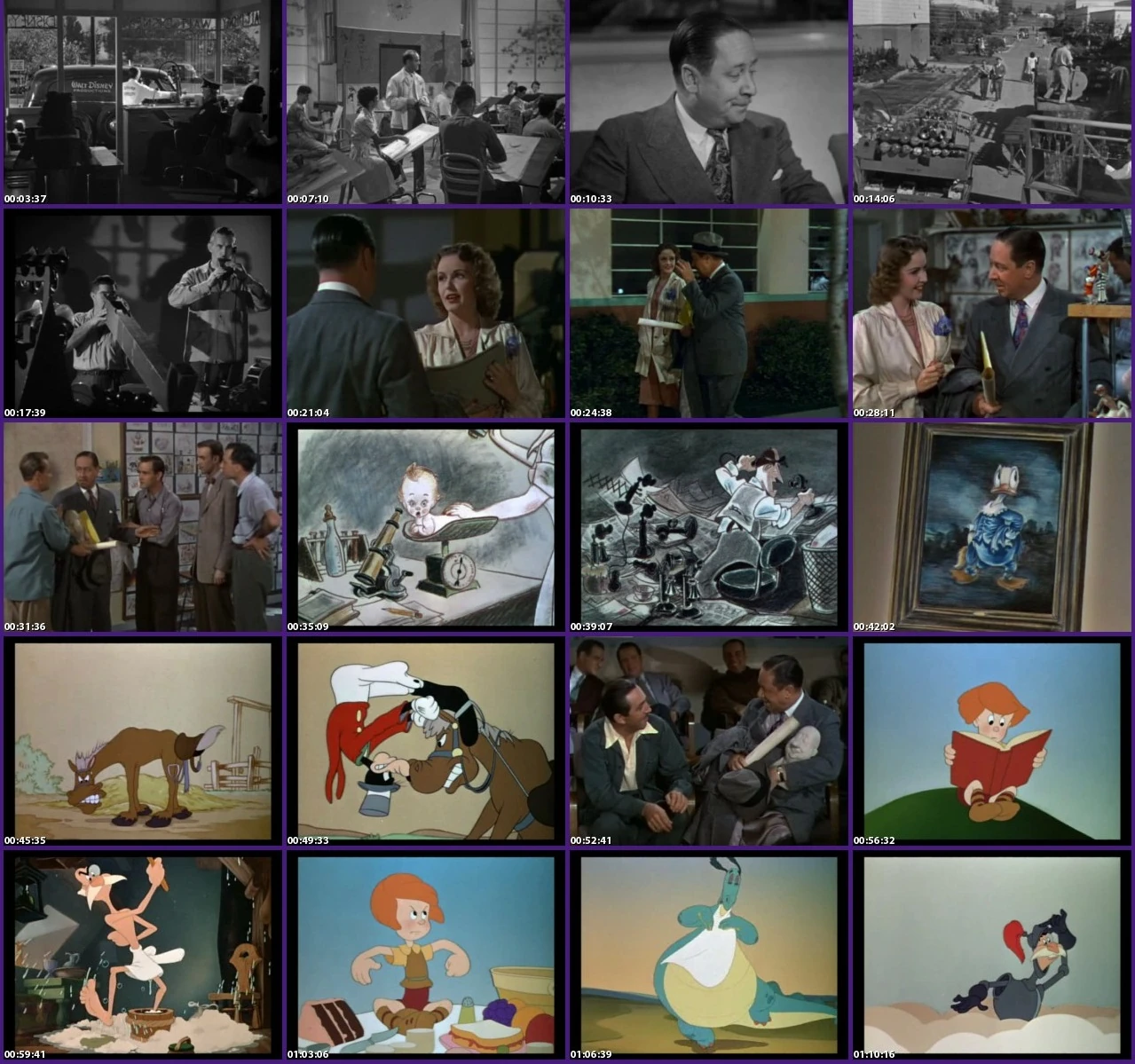
Robert Benchley é convencido pela esposa a tentar vender uma história para Walt Disney. Aí já começa a diversão: fica claro que a esposa (Nana Bryant) é quem manda, e talvez este detalhe do relacionamento não seja tão divertido para as crianças quanto o é para os adultos. Robert é levado em um tour pelos Estúdios Disney por um jovem e sem graça guia turístico, Humphrey (Buddy Pepper), e logo Robert consegue escapar dele. Ele então passa pela sala dos desenhistas (onde claramente “Dumbo” está sendo gerado), pela sala de dublagem (onde somos apresentados a Clarence Nash, que dubla o Pato Donald), pela sala de efeitos especiais e chega, magicamente, à sala do Technicolor.

Robert Benchley is advised by his wife to try to sell a story to Walt Disney. Fun starts here: it’s clear that the wife (Nana Bryant) is the boss, and maybe this relationship detail isn’t as for for children as it is for adults. Robert is taken for a tour through the Walt Disney Studios by a young and funnyless guide, Humphrey (Budy Pepper), and soon Robert can escape the tour. He then goes through the drawing room (where “Dumbo” is being made), by the dubbing room (where we’re introduced to Clarence Nash, who dubs Donald Duck), by the special effects room and he finally arrives, magically, to the Technicolor room.


Aqui temos uma mudança digna de Dorothy na Terra de Oz: ao fechar a porta Robert entra em um mundo de cores, e ele próprio reconhece que está agora sendo visto em Technicolor. Lá ele conhece o processo de animação do famoso desenho em que Donald tem problemas ao ordenhar uma vaca (aposto que este desenho fez parte de sua infância!). Depois ainda passamos pela “sala do arco-íris” (onde os desenhos recebem cores, e onde vemos Bambi pela primeiríssima vez!), a sala das esculturas (olhe lá Chernabog, que foi motivo de pesadelos para todos que viram “Fantasia”), a sala dos animadores (Pateta!) e finalmente nos encontramos com Walt Disney e com o próprio dragão relutante.

Here we have a change similar to Dorothy’s in the Land of Oz: when he closes the door Robert enters a world of colors, and he even know he’s now being seen in Technicolor. There he gets to know the animation process behind the cartoon in which Donald has trouble trying to milk a cow (I bet this cartoon was part of your childhood!). Then we go through the “Rainbow Room” (wher drawings receive colors, and we see Bambi for the very first time!), the “Sculptures Room” (take a look at Chernabog, who was the source of nightmares for everybody who has seen “Fantasia”) and the “Animators Room” (Goofy!) and we finally meet Walt Disney and the reluctant dragon himself.


Além de Clarence Nash, que dificilmente seria reconhecido pelas crianças, há ainda outras pequenas pérolas que só adultos e cinéfilos notariam: a trilha sonora reproduz as músicas do maior êxito de Disney até então, “Branca de Neve e os Sete Anões” (1937), o lendário animador Ward Kimball apresenta o primeiro desenho da série “Goffy How To”, Einstein, Freud e Dalí viram personagens animados. E quem é aquele desenhista segurando o modelo do bebê Weems? Ninguém mais ninguém menos que Alan Ladd, mais bonito que nunca!

Besides Clarence Nash, who wouldn’t be recognized by the kids, there are other little treasures that only older cinephiles would notice: the soundtrack brings songs from the most successful Disney movie until then, “Snow White and the Seven Dwarves” (1937), the legendary animator Ward Kimball presents the first cartoon from the series “Goody How To”, Einstein, Freud and Dalí become animated characters. And who is that animator holding the baby Weems model? It’s Alan Ladd, more handsome than ever!

Alan Ladd, Robert Benchley
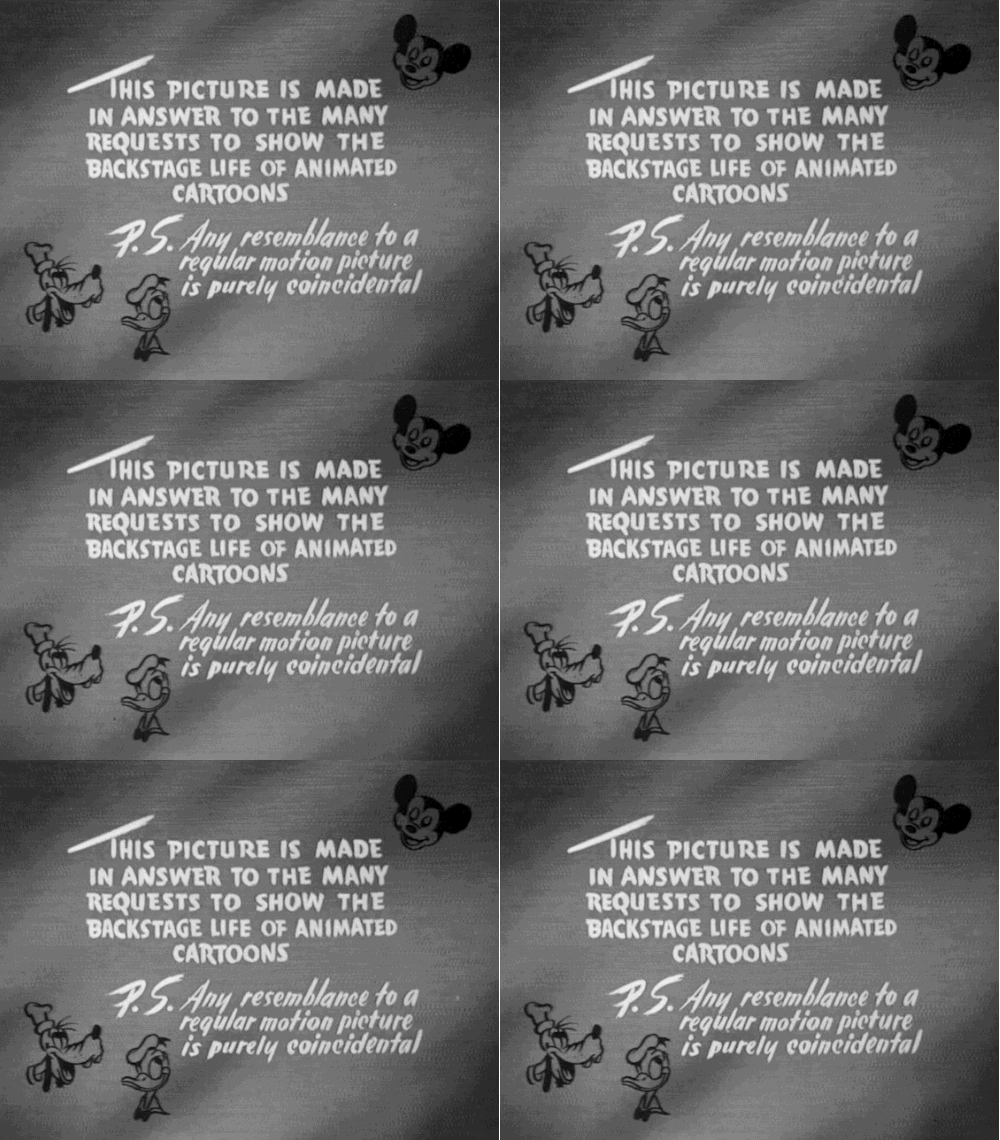
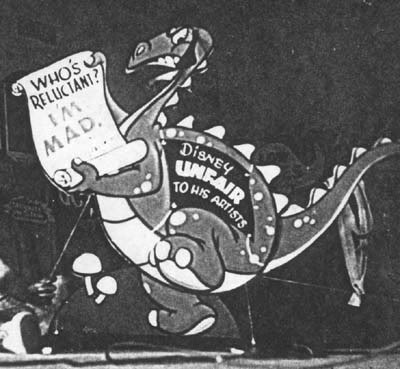
“O Dragão Relutante” estreou durante uma greve dos animadores dos Estúdios Disney, que se mobilizaram para boicotar o filme. Houve um problema envolvendo o Código Hays e o umbigo do dragão (!!) que quase impediu a estreia. Mas o prejuízo foi principalmente resultado da decepção do público, que esperava um filme completamente animado, e não uma mistura de animação e live-action. Este aviso no começo do filme não adiantou:

“The Reluctat Dragon” premiered during an animator’s strike, when Disney Studios animators organized to boycott the film. There was a problem involving the Hays Office and the dragon’s belly button (!!) that almost cancelled the premiered. But the box-office failure came because the public was disappointed – they were waiting for a completely animated film, and not a mix of animation and live-action. This warning in the beginning of the film didn’t work: 

Cartaz criado pelos animadores em greve
Os Estúdios Disney talvez não fossem um lugar maravilhoso como o filme tenta mostrar (a música que acompanha a entrada de Robert nos estúdios é “Whistle While You Work”), mas sem dúvida são um lugar onde sonhos são criados. Se não fosse o TCM, talvez eu não me lembrasse do desejo de ver este filme. E, se não fosse “O Dragão Relutante”, eu talvez não estaria pensando em como eu amo os clássicos Disney.

Disney Studios maybe weren’t the mrvelous place the film tries to show (the song that accompanies Robert’s entrance at the studios is “Whistle While You Work”), but without a doubt it’s the place where dreams are mde. If it wasn’t for TCM, maybe I wouldn’t remember my childish desire to wacth this film. And, if it wasn’t for “The Reluctant Dragon”, maybe I wouldn’t be thinking about how much I love Disney classics.  

This is my contribution to the TCM Discoveries Blogathon, hosted by the knowledgeable Nora at her blog The Nitrate Diva. #LetsMovie

Monday, March 31, 2014

Tudo que sei sobre beisebol, eu aprendi no cinema

Nelly Kelly loved baseball games,
Knew the players, knew all their names.
You could see her there ev'ry day,
Shout "Hurray"
When they'd play.
Her boyfriend by the name of Joe
Said, "To 
Coney Isle, dear, let's go",
Then Nelly started to fret and pout,
And to him, I heard her shout:
Take me out to the ball game,
Take me out with the crowd;
buy me some 
peanuts and Cracker Jack,
I don't care if I never get back.
Let me root, root, root for the home team,
If they don't win, it's a shame.
For it's one, two, three strikes, you're out,
At the old ball game.
Antes de tudo: eu não entendo nada de esportes. Seguindo o bom e velho estereótipo nerd, eu detesto esportes. Por isso, não é de se espantar que eu saiba muito pouco sobre beisebol. E, estando no Brasil, isso talvez não fizesse muita falta para mim, afinal, eu sei um pouco sobre futebol, o esporte favorito da nação. Mas o beisebol é parte importante da cultura americana, e aparece em muitos filmes. Para entendê-los, é necessário saber um mínimo sobre o beisebol. E foi graças a esses filmes que eu aprendi um pouquinho sobre o esporte. Não a ponto de me tornar a Nelly Kelly da música acima, mas...

Gene Kelly e Frank Sinatra interpretaram jogadores de beisebol que eram também artistas de vaudeville em “A Bela Ditadora / Take me out to the ball game” (1949). E foi esse filme que me ensinou que, além de O’Brien, Ryan e Goldberg, citados na música, há outros seis jogadores num time, totalizando nove. E essa música em particular me ensinou também que um jogo de beisebol é dividido em innings. Mas “O’Brien to Ryan to Goldberg” não é a música mais importante do filme. A mais importante é a que dá título ao filme, composta em 1908. A história de Gene e Frank como jogadores de beisebol se passa entre 1909 e 1911, mas a letra que eles cantam para “Take me out to the ball game” é de 1927. Incongruências à parte, essa música é o hino do beisebol.


Também de 1908 é o poema “Casey at the bat” (a letra original de “Take me out...” apresentava Katie Casey, e não Nelly Kelly), adaptado para as telas do cinema mudo e animado pelos estúdios Disney em 1946. A rima divertida não acabou por aí, pois em 1954 Disney atacou de novo com “Casey bats again”, mostrando desta vez o time de beisebol formado pelas filhas de Casey. 

Além de Gene Kelly, havia outros fãs de beisebol em Hollywood. Um dos mais notáveis é Joe E. Brown (segundo meus avós, o apelido dele aqui no Brasil era “boca larga”), mais conhecido pelo papel de Osgood Fielding III em “Quando mais quente melhor / Some like it hot” (1959). Antes de se apaixonar por Jack Lemmon em roupas de mulher, Joe protagonizou filmes sobre beisebol: “De bom tamanho / Elmer the Great” em 1933 e “Alibi Ike” em 1935. Ambos foram adaptados para o rádio poucos anos depois, e Joe reprisou seu papel.


Joe E. Brown fez outro filme sobre beisebol, “Fumo e Fumaça / Fireman, save my children” (1932), mas seu fanatismo pelo esporte ia além das telas: na vida real, ele serviu muitas vezes como radialista em dias de transmissão de jogos. O filho de Joe também era fanático pelo esporte e foi empresário do time Pittsburgh Pirates por mais de 20 anos.

Por falar em comediantes e beisebol, há também a famosíssima sequência “Who’s on First?”, retirada do filme de Abbott e Costello “The Naughty Nineties”, de 1945. Embora eles já tenham feito essa cena anteriormente, aqui ela aparece por completo:

Vamos voltar um pouco no tempo, para o cinema mudo. A comédia era o gênero que mais usava o beisebol, embora o esporte tivesse seu lugar até mesmo nas cinebiografias do período, como “The Babe Ruth Story” (1920), em que o próprio jogador encena sua vida de maneira bem fantasiosa. Já na comédia, Buster Keaton, interpretando um nerd, tenta com muita atrapalhação aprender a jogar beisebol em “Amores de Estudante /College” (1927). E podemos ir um pouco mais longe, com “The Busher” (1919), divertido filme sobre beisebol que traz John Gilbert como antagonista (!).

Se estes filmes todos foram informação demais para você, leitor, não se preocupe. Um único filme é suficiente para transformar qualquer um em perito no esporte. Em menos de oito minutos você pode aprender tudo sobre beisebol... com a Disney:
 This is my contribution to the Big League Blogathon, hosted byTodd at Forgotten Films. Nelly Kelly loved baseball games…

Related Posts Plugin for WordPress, Blogger...