} Crítica Retrô: Harry Liedtke

Tradutor / Translator / Traductor / Übersetzer / Traduttore / Traducteur / 翻訳者 / переводчик

Showing posts with label Harry Liedtke. Show all posts

Monday, February 20, 2023

Madame DuBarry (1919)


Onde estão as mulheres da História? Comumente negadas posições de poder e apagadas dos relatos, elas podem ser encontradas em livros de História como notas de rodapé ou por causa de sua ligação com homens poderosos. Uma das mulheres deste último grupo é Madame DuBarry (1743-1793), amante do Rei Luís XV e uma das múltiplas vítimas da guilhotina na Revolução Francesa.  A vida de Madame DuBarry foi tão interessante que era óbvio que serviria de inspiração para os cineastas. Um destes cineastas inspirados foi Ernst Lubitsch, que filmou sua versão da história em 1919, num filme estrelado por Pola Negri.


Where are the women in History? Often denied positions of power and erased from accounts, they can be found in History books as either footnotes or in mentions thanks to their liaisons with powerful men. One woman from the latter group is Madame DuBarry (1743-1793), King Louis XV’s mistress and one of many people to die in the guillotine during the French Revolution. Madame DuBarry’s life was so interesting that it’d be obvious that it would inspire filmmakers. One of the filmmakers inspired was Ernst Lubitsch, who made his own version of her story in 1919, starring Pola Negri.


Foi por acaso que a chapeleira Jeanne Vaubernier (Pola Negri) se aproximou da realeza francesa. Uma caixa de chapéus que ela levava foi pisoteada pelo cavalo do espanhol Don Diego (Magnus Stifter). Mesmo estando em um relacionamento com Armand (Harry Liedtke), ela aceitou o convite de Don Diego para ir até a casa dele numa tarde de domingo - e lá ela conheceu o Conde DuBarry (Eduard von Winterstein). Quando Armand mata Don Diego num duelo improvisado durante um baile, Jeanne rapidamente corta relações com Armand e vai viver com o Conde DuBarry, mesmo ele sendo abusivo com ela.


It was by chance that hatmaker Jeanne Vaubernier (Pola Negri) became close to French royalty. Her hatbox was stomped by the horse belonging to Spaniard Don Diego (Magnus Stifter). Despite being in a relationship with Armand (Harry Liedtke), she accepted Don Diego’s invitation to go to his residence on Sunday afternoon - and there she met the Count DuBarry (Eduard von Winterstein). When Armand kills Don Diego in an improvised duel during a ball, Jeanne quickly cuts ties with Armand and goes to live with Count DuBarry, even though he’s abusive towards her.


Um dia, o Rei Luís XV (Emil Jannings) vê Jeanne nos jardins reais. Ela é levada até o rei e os dois logo começam um relacionamento. Jeanne fica falada e, para ser respeitável novamente, ela se casa com o irmão do Conde DuBarry, Wilhelm. Agora Madame DuBarry, condessa, ela é a mulher mais poderosa da França, uma vez que é também amante do rei. Igualmente desprezada pelas mulheres da corte e pela gente comum, Madame DuBarry também esconde o fato de que ainda nutre sentimentos por Armand.


One day, King Louis XV (Emil Jannings) sees Jeanne in the royal gardens. She is brought to the king’s presence and the two soon start an affair. Jeanne becomes the talk of the town and, in order to be respectable again, she marries Count DuBarry’s brother Wilhelm. Now Madame DuBarry, a countess, she’s the most powerful woman in France, as she’s also the king’s mistress. Equally despised by the women in the court and by the common folks, Madame DuBarry also hides the feelings she still had for Armand.

“Madame DuBarry” foi dirigido por Ernst Lubitsch - sim, o mesmo Lubitsch que anos mais tarde encantou Hollywood com o “toque de Lubitsch”. Lubitsch havia começado sua carreira como ator, fazendo seu primeiro filme em frente às câmeras em 1913. Seu primeiro filme atrás das câmeras foi feito no ano seguinte, e até 1920 Lubitsch alternava trabalhos como diretor e ator. Ele teve grande êxito fazendo tanto dramas históricos - como “Madame DuBarry” - e comédias durante a era muda.


“Madame DuBarry” was directed by Ernst Lubitsch - yes, the same Lubitsch who years later amazed Hollywood with the “Lubitsch touch”. Lubitsch had started his career as an actor, making his first film in front of the cameras in 1913. His first film behind the cameras was made the following year, and until 1920 Lubitsch alternated works as director and actor. He found great success with both historical dramas - like “Madame DuBarry” - and comedies during the silent era.


Pola Negri é perfeita para o papel-título icônico. Flertando o tempo todo, ela tem um momento bastante breve para brilhar ao se vestir de homem para espionar os planos revolucionários de Armand. Sua cena mais curiosa, entretanto, acontece quando ela perde a cabeça ao ver o caixão de Luís XV. Muitos relatos afirmam que Pola também perdeu a cabeça no funeral de seu então namorado Rodolfo Valentino em 1926, então esta cena basicamente prevê um dos momentos mais icônicos da vida real de Pola Negri.


Pola Negri is perfect for the iconic title role. Flirtatious all the time, she has a too brief moment to shine when dressed as a male to spy on Armand’s revolutionary plans. Her most curious scene, however, happens when she loses her mind when she sees Louis XV’s coffin. Many accounts tell us that Pola also made a huge scene in the funeral of her then beau Rudolph Valentino in 1926, so this scene basically foresees one of Pola’s most iconic real life moments.
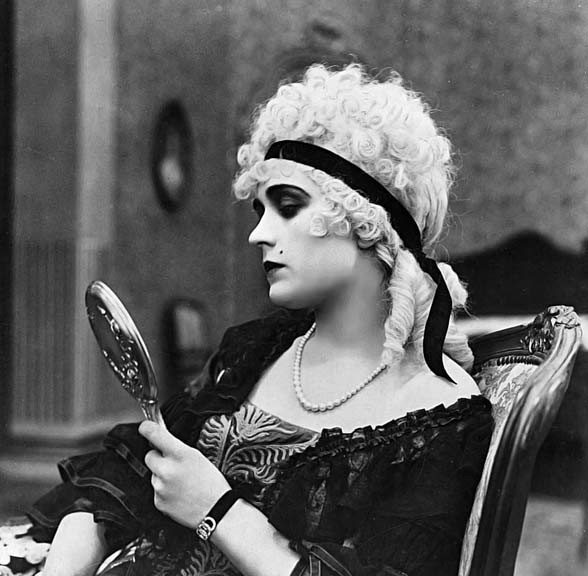

Os figurinos e cenários são, obviamente, o destaque. O vestido que Pola Negri usa quando Madame DuBarry é apresentada à corte é de tirar o fôlego, perfeitamente exagerado. Também gostei de ver um homem com “papilotes” no cabelo. As cenas com multidões são muito bem dirigidas e a pessoa responsável pela direção de arte foi Kurt Richter, um colaborador constante de Ernst Lubitsch.


The costumes and sets are, of course, outstanding. The dress Pola Negri wears when Madame DuBarry is introduced to the court is breathtaking, as well as perfectly exaggerated. I also liked seeing a guy with “papilottes” on his hair. The scenes with crowds are beautifully staged and the person responsible for the art direction was Kurt Richter, a constant collaborator of Ernst Lubitsch.


A versão de “Madame DuBarry” que eu vi tinha cartelas de texto tanto em alemão quanto em francês, e também legendas em português. Desta forma, pude praticar meu alemão enquanto assistia a esta bela restauração levada a cabo pelo Instituto F.W. Murnau em 2013. Melhorar meu alemão é uma das grandes metas que tenho para 2023, e é ainda melhor que eu possa fazer isso com filmes.


The version of “Madame DuBarry” I watched had title cards in both German and French, and also Portuguese closed captions. This way, I could improve my German while watching this beautiful restoration made by the F.W. Murnau Institute in 2013. Improving my German is one big goal I have for 2023, and it’s even better if I can do this with movies.


Suntuoso e divertido, “Madame DuBarry” é um ótimo filme com dois grandes nomes da época do cinema mudo: o diretor Lubitsch e a atriz Pola Negri. O filme foi um grande sucesso em Hollywood quando estreou em 1921, sob o título “Paixão”. Pode não ser um filme “obrigatório” para os fãs de cinema mudo, mas é uma maravilhosa produção de encher os olhos.


Lavish and entertaining, “Madame DuBarry” is a great silent film with two big players in the silent film era: director Lubitsch and actress Pola Negri. The film was a huge success in Hollywood when it arrived in 1921 under the title “Passion”. It may not be a “mandatory” viewing for silent film fans, but it’s a wonderful production and a feast for the eyes.

Wednesday, September 28, 2022

As Finanças do Grão-Duque (1924) / The Finances of the Grand Duke (1924)


Quantas obras-primas podem ser feitas numa vida? E quantas obras-primas podem ser feitas por alguém cuja carreira durou apenas 12 anos, produzindo 21 filmes? Este alguém é Friedrich Wilhelm Murnau, ou F.W. Murnau. Suas três obras-primas mais conhecidas são “Nosferatu” (1922), “A Última Gargalhada” (1924) e “Aurora” (1927), com uma possível obra-prima no atualmente perdido “Os Quatro Diabos” (1928). Trabalhando sem parar, Murnau fez outros filmes, não tão perfeitos quanto suas obras-primas, mas filmes que merecem ser vistos de qualquer maneira - devemos nos lembrar de que apenas 12 dos filmes de Murnau estão atualmente disponíveis. No mesmo ano em que Murnau fez “A Última Gargalhada”, ele fez outro filme ambicioso, “As Finanças do Grão-Duque”.


How many masterpieces can be made in a lifetime? And how many masterpieces can be made by someone whose career lasted for only 12 years and 21 films? This someone is Friedrich Wilhelm Murnau, or F.W. Murnau. His three best known masterpieces are “Nosferatu” (1922), “The Last Laugh” (1924) and “Sunrise” (1931), with a possible masterpiece in the currently lost “4 Devils” (1928). Working steadily, Murnau delivered other movies to the world, not as perfect as his masterpieces, but movies that deserved to be seen anyway - we should be reminded that only 12 of Murnau’s films are currently available. The same year Murnau made “The Last Laugh”, he made another ambitious film, “The Finances of the Grand Duke”.

As coisas não vão bem para Ramon XII, o Grão-Duque de Abacco (Harry Liedtke). Ele tem uma dívida enorme para com Marcowitz (Guido Herzfeld) e precisa pagar tudo em três dias, ou o Grão-Ducado de Abacco não mais pertencerá a ele. Uma solução cai do céu com uma carta da Princesa Olga da Rússia (Mady Christians), que deseja se casar com o Grão-Duque apesar das circunstâncias financeiras.


Things are not going well for Ramon XII, the Grand Duke of Abacco (Harry Liedtke). He has an enormous debt with Marcowitz (Guido Herzfeld) and needs to pay everything in three days, or the Grand Dukedom of Abacco will no longer belong to the Grand Duke. A solution falls from heaven as a letter from Princess Olga of Russia (Mady Christians), who wants to marry the Grand Duke despite his financial situation.

Mas há muito mais. O homem de negócios Bekker (Hermann Vallentin) está interessado em comprar Hermosa Point, parte do território de Abacco, para explorar as reservas de enxofre. O Grão-Duque não aceita a proposta de cinco milhões de Bekker em troca de Hermosa Point. Incapaz de ouvir um “não” como resposta, Bekker descobre quatro desajustados e se oferece para patrocinar o golpe que eles querem dar no Grã-Duque. Mais personagens aparecem, como o aventureiro Philipp Collins (Alfred Abel), que terá um papel de destaque na história.


 But there is much more. Businessman Bekker (Hermann Vallentin) is interested in buying Hermosa Point, part of Abacco’s territory, to explore the sulfur reservations. The Grand Duke doesn’t accept Bekker’s five million in exchange of Hermosa Point. Unable to hear “no” as an answer, Bekker finds four misfits and offers to fund their coup against the Grand Duke. More characters appear, like the adventurer Philipp Collins (Alfred Abel), who will have a role in the story.

Os 77 minutos de projeção são divididos em seis capítulos. A pessoa responsável pelo roteiro é ninguém menos que Thea von Harbou, então já casada com Fritz Lang. É curioso notar que Von Harbou escolhe Marcowitz - um homem com sobrenome judeu - como a fonte primária de problemas para o Grão-Duque. Todos nós sabemos que Von Harbou não fugiu da Alemanha com a ascensão do nazismo e era inclusive simpática ao partido. É sempre “interessante” observar pedacinhos de antissemitismo em seu trabalho anterior a 1933.


The 77 minutes of the film are divided in six chapters. The person responsible for the script is none other than Thea von Harbou, then already Fritz Lang’s wife. It’s curious to notice that Von Harbou chooses Marcowitz - a man with a Jewish last name - as the first source of problems for the Grand Duke. We all know that Von Harbou didn’t leave Germany with the rise of the Nazis and was even sympathetic to the party. It’s always “interesting” to notice bits of anti-Semitism in her early work.

Alguns rostos familiares do cinema mudo alemão, como Alfred Abel, que interpreta Philipp Collins, aparecem aqui e ali. Outro rosto familiar é mais difícil de distinguir: Max Schreck, que interpretou o papel-título em “Nosferatu”, é um dos revolucionários. O personagem de Schreck é simplesmente chamado de “o sinistro”.


Some familiar faces of German silent film, like Alfred Abel, who plays Philipp Collins, pop up here and there. Another familiar face is harder to distinguish: Max Schreck, who played the title role in “Nosferatu”, is one of the insurrectionists. Schreck’s character is simply named “the sinister one”.

A história é muito complexa, com muitos personagens e situações entrelaçadas, por vezes fica um pouco complicado seguir o andamento dos fatos.  Felizmente, no começo de cada capítulo há uma descrição da ação, algo que ajuda muito. Vale mencionar que a história não foi inventada pot Thea von Harbou: “As Finanças do Grão-Duque” foi baseado num livro de Frank Heller, escritor sueco.


The story is very complex, with many characters and intertwined situations, and sometimes it becomes a bit hard to follow. Luckily, in the beginning of each chapter there is a description of the action, something that comes in handy. It’s worth mentioning that the story wasn’t invented by Thea von Harbou: “The Finances of the Grand Duke” was based in a book by Frank Heller, a Swedish writer.

Algumas fontes dizem que este filme é uma comédia - aliás, a única comédia de Murnau. Pode não ser um filme cheio d humor, pois “As Finanças do Grão-Duque” é mais uma farça, dependendo de identidades falsas que só são reveladas no último minuto. Há muito absurdo non filme, mas ele não deixa de ser agradável e divertido. Vendo mais um dos bons filmes de Murnau, continuamos esperando e tendo esperança de que mais filmes dele sejam encontrados e redescobertos pelas plateias modernas.


 Some sources say that this film is a comedy - Murnau’s only comedy, by the way. It may not be very humorous, as “The Finances of the Grand Duke” is more of a farce, relying heavily on fake identities not revealed until the last minute. There is a lot of absurd in the movie, but it is enjoyable and entertaining. As we watch another of Murnau’s good movies, we keep waiting and hoping that more of his movies are found and rediscovered by modern audiences.

This is my contribution to the Silent Movie Day blogathon, hosted by Lea and Crystal at Silent-ology and In the Good Old Days of Classic Hollywood


Related Posts Plugin for WordPress, Blogger...