} Crítica Retrô: Katharine Hepburn

Tradutor / Translator / Traductor / Übersetzer / Traduttore / Traducteur / 翻訳者 / переводчик

Showing posts with label Katharine Hepburn. Show all posts

Friday, October 31, 2025

Adivinhe Quem vem para Jantar (1967) / Guess Who’s Coming to Dinner (1967)


Eu fui apresentada a Sidney Poitier pela minha professora de português do Ensino Fundamental II, que passou “Ao Mestre, com Carinho” (1968) para nós na sexta série. Quando eu comentei sobre ter visto o filme, uma das amigas da minha mãe confessou que era apaixonada por Poitier por causa de dois filmes: aquele que eu recém havia visto e “Adivinhe Quem vem para Jantar”. Uns quatro anos mais tarde eu fui apresentada à dupla dinâmica e romântica de Katharine Hepburn e Spencer Tracy. Assisti a alguns dos nove filmes que eles fizeram juntos, mas ainda não era a hora de assistir à colaboração final deles. A hora finalmente chegou.

I was introduced to Sidney Poitier by my middle school grammar teacher, who showed “To Sir, With Love” (1968) for us in sixth grade. When I talked about seeing the movie, one of my mom’s friends confessed she was in love with Poitier because of two films: that one I’d just watched and “Guess Who’s Coming to Dinner”. Some four years later I was introduced to the dynamic and romantic duo of Katharine Hepburn and Spencer Tracy. I watched some of the nine films they made together, but it wasn’t time to watch their final collaboration. The time finally arrived.

Um homem e uma mulher descem de um avião, conversando animadamente e com intimidade. Ele é negro, ela é branca. Um motorista de táxi se surpreende, assim como a plateia, quando eles se beijam no banco de trás do táxi, uma cena vista pelo retrovisor. Ele é o doutor John Prentice (Sidney Poitier), e ela é Joanna Drayton (Katharine Houghton, sobrinha na vida real de Hepburn). Eles se conheceram há somente dez dias, mas já têm certeza de que querem se casar e viver felizes para sempre. O obstáculo? Preconceito.

A man and a woman come off a plane, chatting with excitement and closeness. He’s black, she’s white. A taxi driver is surprised, as we in the audience also are, when they kiss in the back of the taxi, a scene seen by the rear mirror. He is doctor John Prentice (Sidney Poitier) and she is Joanna Drayton (Katharine Houghton, Hepburn’s real-life niece). They have known each other for only 10 days, but they are sure that they want to get married and live happily ever after. The obstacle? Prejudice.

Não é um problema o fato de John ter sido casado e tido um filho, afinal, sua esposa e a criança morreram num acidente de trem oito anos antes. John brinca que Joanna “não tem como saber quando estou com as bochechas vermelhas” e esta é sua maneira de fazer piada sobre um assunto sério. A mãe de Joanna, Christina (Katharine Hepburn), já mostrou surpresa e desapontamento em seu olhar quando ela pôs os olhos em John. O pai dela, Matt (Spencer Tracy), também está embasbacado e decide investigar o doutor Prentice. E eles têm que ser rápidos: John pega um voo naquela noite, e na semana seguinte ele e Joanna se casam em Genebra. Os Draytons darão ao casal sua bênção? 

There is no problem that John had been married and had a son, after all, wife and kid died in a train accident eight years before. John jokes that Joanna “can’t know when I’m blushing” and this is his way to joke about a serious issue. Joanna’s mother Christina (Katharine Hepburn) already showed surprise and disappointment in her look when she laid eyes on John. Her father Matt (Spencer Tracy) is also flabbergasted and decides to investigate Doctor Prentice. And they must be quick: John grabs a plane that night, and the following week he and Joanna will get married in Geneva. Will the Draytons give the couple their blessing?

O preconceito vem também da empregada dos Draytons, Tillie (Isabel Sanford). Ela é direta quando diz para Joanna que não pode se casar com John porque ele é negro. Joanna aponta que Tillie é da mesma cor que John, e por isso por que ela pode amar Tillie e não John? Às vezes o racismo está tão internalizado que negros falam e fazem coisas racistas. 

The prejudice also comes from the Draytons’ maid, Tillie (Isabel Sanford). She is blunt and candid as she says that Joanna can’t marry John because he’s black. Joanna points out that Tillie is the same color as John, so why can she love Tillie and can’t love John? Sometimes racism is so internalized that black people talk and do racist things.

Por outro lado, há aqueles que parecem ser daltônicos com o assunto, como a própria Joanna e um amigo dos Draytons, Monsenhor Ryan (Cecil Kellaway). Ele diz que já viu um bom número de casais interraciais e eles provavelmente vivem melhor porque há mais esforço, consideração e compreensão entre eles para fazer o casamento funcionar. A última lei Jim Crow de segregação havia sido revogada em 1965, e o curioso caso do casal Loving acontecido em 1958 e, como o pai de John o lembra, o casamento interracial era então ainda ilegal em 16 estados.  

On the other hand, there are those who seem to be colorblind about the issue, like Joanna herself and a friend of the Draytons, Monsignor Ryan (Cecil Kellaway). He says he’s seen a good amount of interracial couples and they probably live better together because there is more effort, consideration and comprehension between them to make the marriage work out. The last Jim Crow segregation law had been overruled in 1965, and the curious case of the Loving couple had happened in 1958 and, as John’s father reminds him, interracial marriage by then was still illegal in 16 states.

Em “Old Films, Young Eyes” (resenha em inglês AQUI), a autora Simone Elias transcreve uma fala da avó, que assistiu ao filme perto da estreia: “Na época, foi visto como um filme realmente revolucionário, por causa de uma mulher branca e um homem negro se apaixonando, formando uma relação saudável, e se casando”. Eram tempos revolucionários: pouco antes da estreia, o casamento interracial foi permitido em todos os estados. Era um passo em direção ao progresso.  

In “Old Films, Young Eyes”, author Simone Elias transcribes a quote by her grandmother, who watched the film near its premiere: “At the time, it was thought to be a breakthrough, a real revolutionary movie, because of a white woman and a black man falling in love, forming a healthy relationship, and getting married.” These were revolutionary times: months before the premiere, interracial marriage was allowed in all states. It was a step towards progress.

Spencer Tracy - ganhador de dois Oscars de Melhor Ator - e Sidney Poitier - um Oscar de Melhor Ator - são o primeiro e o segundo nomes nos créditos, e em terceiro lugar vem Katharine Hepburn, que ganharia seu segundo Oscar por esse filme, mais de 40 anos após a primeira vitória. Poitier, Tracy e Hepburn foram todos indicados ao Oscar pelo filme, mas só ela ganhou - uma vitória merecida, pois seus olhos expressivos podiam dizer mais que um monólogo. Mas são os olhos de Tracy que se enchem d’água quando ela fala sobre a melhor época do relacionamento deles - como você deve saber, Tracy e Hepburn estiveram romanticamente envolvidos por 25 anos.

Spencer Tracy - two Best Actor Oscars - and Sidney Poitier - one Best Actor Oscar - are billed first and second, and third comes Katharine Hepburn, who would win her second Oscar for this film, more than forty years after her first win. Poitier, Tracy and Hepburn were all nominated for Oscars for the film, but only she won - a win she deserved, as her expressive eyes could tell more than a long monologue. But it’s Tracy’s eyes that fill with water when she talks about the best time of their relationship - as you may know, Tracy and Hepburn were romantically involved for 25 years.

O diretor e produtor Stanley Kramer nasceu em Nova York em 1913 e era judeu - ele sabia por experiência própria o que era preconceito e discriminação. De acordo com o IMDb, ele produziu 35 títulos entre 1942 e 1979 e dirigiu 19 filmes, sendo indicado ao Oscar nove vezes, mas ganhou apenas o prêmio honorário Irving Thalberg Memorial Award em 1962. Para “Adivinhe Quem vem para Jantar”, tanto Kramer quanto Hepburn usaram seus salários como garantia porque Tracy estava muito doente durante as gravações e a garantia monetária era necessária se ele falecesse antes do fim das gravações. Tracy faleceu 17 dias após o fim das gravações. 

Director and producer Stanley Kramer was born in New York in 1913 and was Jewish - he knew a lot from his own experience about bigotry and discrimination. According to IMDb, he produced 35 titles from 1942 to 1979 and directed 19 films, being nominated for nine Oscars, but won only the Irving Thalberg Memorial Award in 1962. For “Guess Who’s Coming to Dinner”, both Kramer and Hepburn used their salaries as backing because Tracy was too sick while filming and the backing was necessary if he died before the filming was done. Tracy died 17 days after the shooting ended.

Sem dúvida inspirado pelo filme de 1967, no Brasil em 1973 estreou “Compasso de Espera”, no qual Jorge, um escritor e publicitário, se apaixona por Cristina, uma modelo. Ele é negro, ela é branca. No Brasil existe o mito da “democracia racial”, que diz que não existe racismo no país, mas está longe da verdade. O casal interpretado por Zózimo Bulbul e Renée de Vielmond sofre preconceito sobretudo de estranhos. 

Without a doubt inspired by the 1967 film, in Brazil in 1973 premiered the film “Compasso de Espera”, in which Jorge, a writer and publicist, falls in love with Cristina, a model. He’s black, she’s white. In Brazil there is the myth of “racial democracy”, according to which there isn’t racism in the country, but the contrary is true. The couple, played by Zózimo Bulbul and Renée de Vielmond, faces backlash especially from strangers.

A relação entre pais e filhos é desafiadora, e nela ambos os lados podem enfrentar situações que jamais imaginaram - como os Draytons vendo sua filha apaixonada por um homem negro. Mas os obstáculos que enfrentamos podem nos ensinar que somos mais fortes do que pensamos. Como alguém que descobre um novo sabor de sorvete favorito, nos acostumamos com coisas novas. 

The parents-children relationship is a challenging one, in which both sides might face situations they never dreamed about - like the Draytons seeing their daughter falling in love with a black man. But the obstacles we face can teach us that we’re stronger than we thought. Like someone who discovers a new favorite ice cream flavor, we get used to new things.

Saturday, June 17, 2023

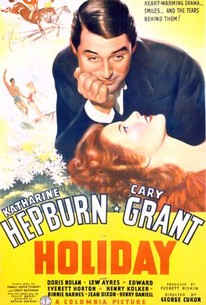
Boêmio Encantador (1938) / Holiday (1938)

 “Boêmio Encantador” é o terceiro de quatro filmes que Katharine Hepburn e Cary Grant fizeram juntos. Os outros três são “Vivendo em Dúvida” (1935), “Levada da Breca” (1938) e “Núpcias de Escândalo” (1940). “Boêmio Encantador” é o pior do quarteto, e isso pode ser porque ele é teatral demais – mas ainda é um filme bacana.
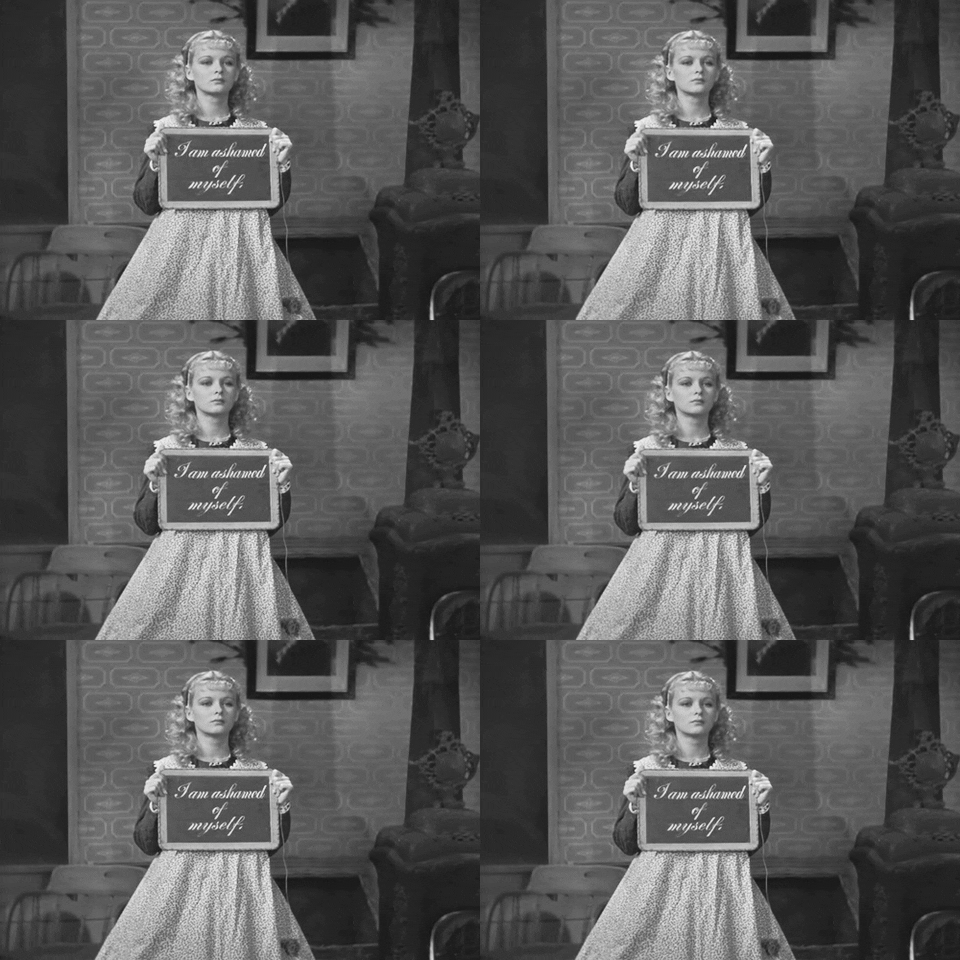
 

“Holiday” is the third of four movies Katharine Hepburn and Cary Grant made together. The other three are “Sylvia Scarlett” (1935), “Bringing Up Baby” (1938) and “The Philadelphia Story” (1940). “Holiday” is the worst of the bunch, and this may be because it’s too theatrical – but still a nice movie.

A trama é bem simples. Johnny Case (Grant) conhece Julia Seton (Doris Nolan) há apenas dez dias, mas acredita que está pronto para se casar com ela. O que ele não esperava descobrir é que Julia vem de uma família extremamente rica – sua casa é tão grande que tem um elevador – e que o pai dela tem tudo preparado para o casal: ele planejou a futura casa deles e quer que seu futuro genro aceite um emprego no banco dele... mas o pobre Johnny só quer sair de férias para clarear as ideias.


The plot is pretty simple. Johnny Case (Grant) has known Julia Seton (Doris Nolan) for ten days, but believes he’s ready to marry her. What he didn’t expect to discover is that Julia comes from an extremely rich family – her house is so big that it has an elevator – and her father has everything prepared for the soon-to-be newlyweds: he’s planned their future house and wants his future son-in-law to take a job at his bank… but poor Johnny only wants a holiday to clear his mind.

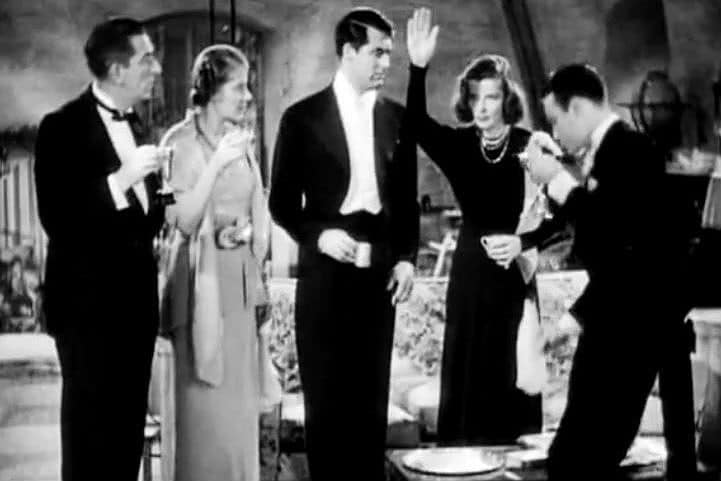
A família da noiva é fora de série: temos o irmão mais novo de Julia, o alcoólatra Ned (Lew Ayres) e a vivaz irmã mais nova Linda (Hepburn). Linda queria dar uma festa de noivado simples e íntima para Julia e Johnny, mas o pai dela decide dar uma imensa festa de véspera de Ano Novo para anunciar o noivado para toda a alta sociedade. Esta festa é o assunto da maior parte do filme.


The future in-laws Johnny meets are out of this world: there is Julia’s alcoholic younger brother Ned (Lew Ayres) and vivacious younger sister Linda (Hepburn). Linda wanted to throw a simple and intimate engagement party to Julia and Johnny, but her father decides to throw a huge New Year’s Eve party to announce their engagement to all of high society. This party takes the biggest bulk of the film.

Linda decide não se juntar à festa e fica na sala de jogos da casa, onde podemos encontrar vários brinquedos da infância dos irmãos – um tempo mais simples e mais feliz para eles. No meio da festa se juntam a ela os amigos de Johnny, Nick e Susan Potter, interpretados por Edward Everett Horton e Jean Dixon. Logo Johnny e Ned também se juntam a eles na sala de jogos, onde a verdadeira diversão está – e talvez também o amor verdadeiro.


Linda decides to not join the party and stays in the house’s playroom, where we can find several toys from the siblings’ childhood – a simpler, happier time for them. In the middle of the party she’s joined by Johnny’s close friends Nick and Susan Potter, played by Edward Everett Horton and Jean Dixon. Soon Johnny and Ned also join them in the playroom, where the true fun is – and maybe also true love.

“Boêmio Encantador” foi uma peça de teatro que estreou em 1928 e teve 229 performances. Donald Ogden Stewart, que escreveu o roteiro do filme, havia interpretado Nick Potter no teatro, e Katharine Hepburn foi substituta na peça. A peça de Philip Barry – que também escreveu “Núpcias de Escândalo” – já havia sido adaptada para as telas em 1930, e Edward Everett Horton também interpretou Nick Potter neste filme.


“Holiday” was a theater play that opened in 1928 and ran for 229 performances. Donald Ogden Stewart, who wrote the screenplay for the movie, had played Nick Potter in the theater, and Katharine Hepburn was an understudy in the play as well. The play by Philip Barry – who also wrote “The Philadelphia Story” – had already been adapted to the screen in 1930, and Edward Everett Horton was in this film as Nick Potter.

Katharine Hepburn não foi a primeira escolha para o papel de Linda. O papel era supostamente de Irene Dunne, e Ginger Rogers e Joan Bennett também foram nomes cotados antes de Hepburn ser emprestada da RKO para a Columbia - o que foi ótimo, uma vez que ela está perfeita no papel. O diretor George Cukor queria que Rita Hayworth interpretasse Julia, mas a novata foi considerada sem experiência suficiente para o papel, que ficou com Doris Nolan.


Katharine Hepburn wasn’t the first choice to play Linda. The role was supposed to go to Irene Dunne, and Ginger Rogers and Joan Bennett were also considered before Hepburn was loaned from RKO to Columbia - a great deal, as she is perfect in the role. Director George Cukor wanted Rita Hayworth to play Julia, but the newcomer wasn’t considered to be too inexperienced for the role, that went to Doris Nolan.

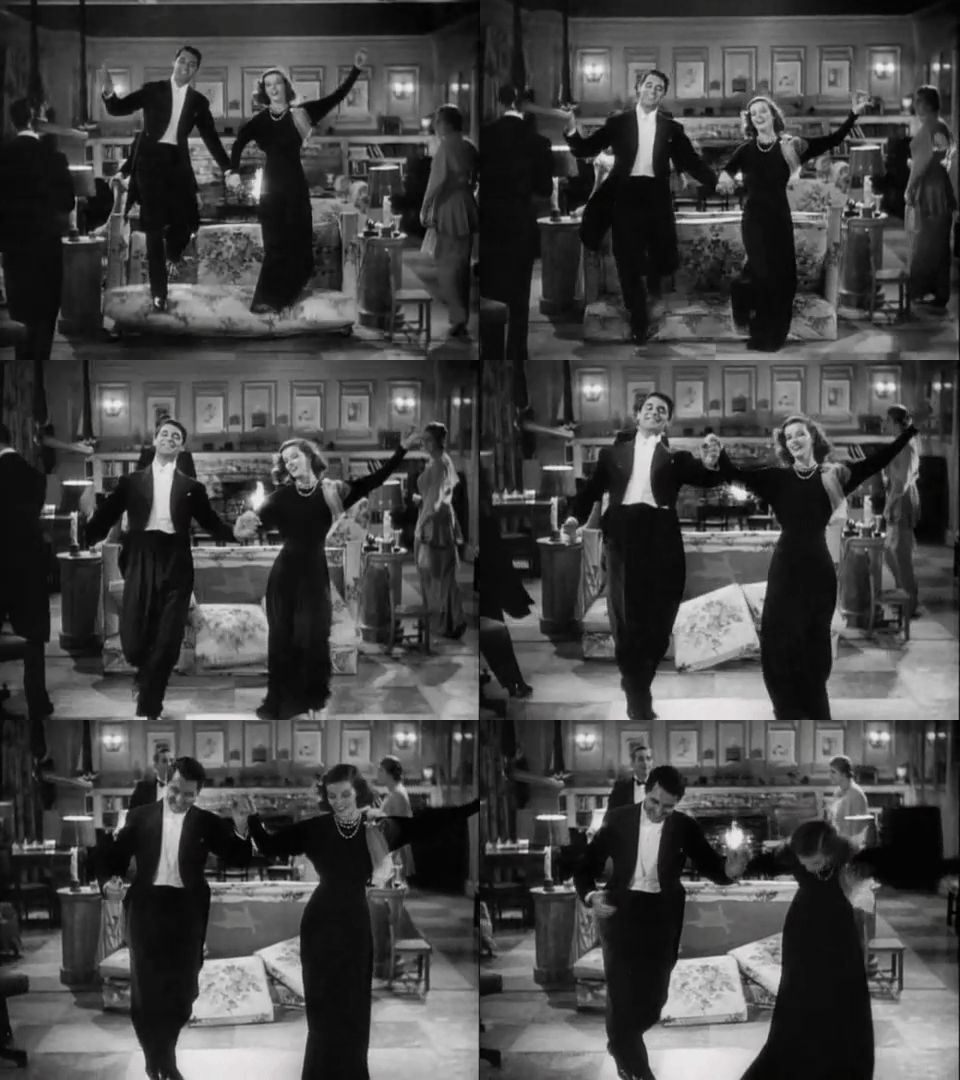
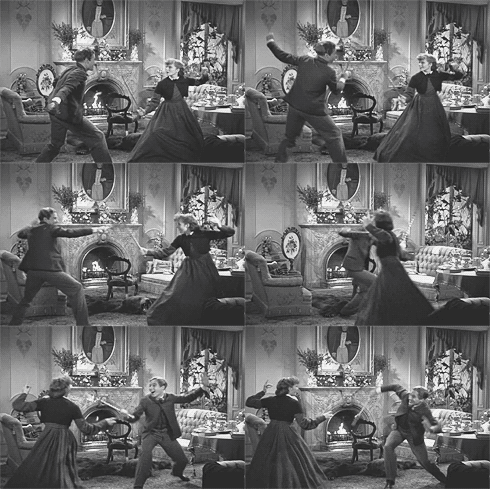
“Boêmio Encantador” é certamente um filme sofisticado, mas também verborrágico. Há muita falação – especialmente quando estão solucionando a situação toda – e só um pouco de ação. O momento com mais ação é a acrobacia de Grant e Hepburn, um momento que você pode já ter visto em forma de GIF. Menos famoso que os outros três filmes feitos pela dupla dinâmica Grant e Hepburn, “Boêmio Encantador” pode ser charmoso, mas também é um pouco chato e previsível. Uma pena, mas nem todos os filmes podem ser obras-primas.


“Holiday” is certainly a sophisticated film, but also a “talky” one. There is too much talking – especially when they are solving the whole situation – and just a little action. The moment with the most action is Grant’s and Hepburn’s tumbling trick, a moment you might have already seen as a GIF. Less famous than the other three films made by the dynamic duo Grant and Hepburn, “Holiday” may be charming, but it’s also a bit boring and predictable. Too bad, but we can’t have only masterpieces.


 This is my contribution to The Intruder blogathon, hosted by Silver Scenes. 

Sunday, February 21, 2021

Lost in Translation: odd classic film titles in Portuguese – Part 1


I was talking with some fellow bloggers about classic movies when a thought crossed my brain: I had to memorize the titles of classic films at least twice, once in their original English and once as they were translated in Brazilian Portuguese – and I'm not considering the times I get to know the titles in Spanish or in Portuguese from Portugal, which is a different trip! As I kept thinking about that I was reminded how this is a blog with a global audience, and you guys certainly would get a kick out of some odd translations of classic film titles here in Brazil. I chose 12 of my favorite, most curious oddities to begin with:

Alice Adams” (1935) became “The Woman Who Knew How to Love”

The Awful Truth” (1937) is known as “Cupid is a Stubborn Brat”

Bringing Up Baby” (1938) received as title a slang that means “Naughty” or “Mischievous”

The Philadelphia Story” (1940) became “Wedding of Scandal


Mr and Mrs Smith” (1941) was exhibited as “A Crazy Couple” (a slang was also used here)

Sullivan's Travels” (1941) went on as “Human Contrasts”

Lifeboat” (1944) was too simple, so it became “A Boat and Nine Destinies”

The Heiress” (1949) was exhibited as “Too Late”

People Will Talk” (1952) went on as “They Say It's a Sin”

An Affair to Remember” (1957) is remembered here as “Too Late to Forget”

North by Northwest” (1959) got renamed as “International Intrigue”

One, Two, Three” (1960), a favorite of mine, got the clever title “Cupid has no Flag”

I hope you liked these and soon I'll come back with Part 2!

Saturday, October 12, 2019

Amor Eletrônico (1957) / Desk Set (1957)


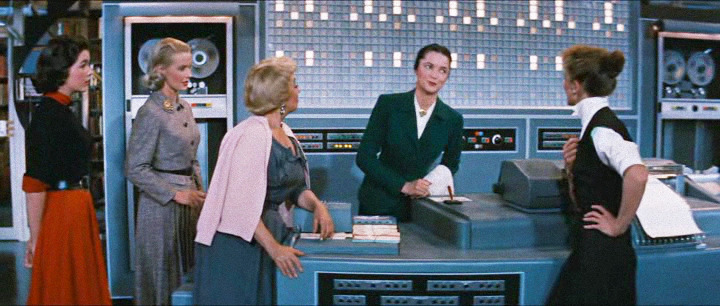
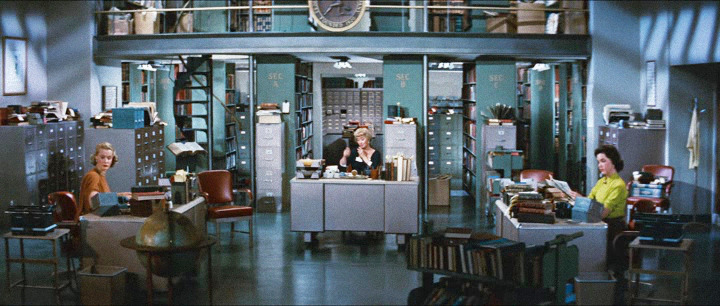
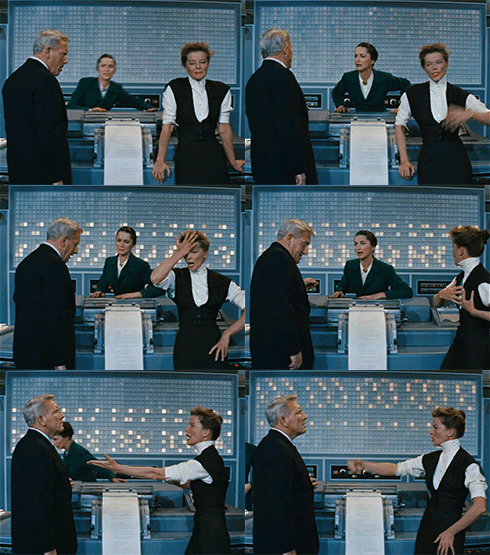
Muitas profissões desapareceram no último século, em especial por causa de mudanças na tecnologia. Entre essas profissões, temos condutores de coches, telefonistas, ascensoristas, cortadores de gelo e pessoas que empilhavam os pinos de boliche após cada tacada. “Amor Eletrônico” é um filme sobre uma dessas profissões desaparecidas: o quarteto feminino principal trabalha no departamento de referências de uma empresa de telecomunicações, pesquisando informações para pessoas que ligam fazendo perguntas.

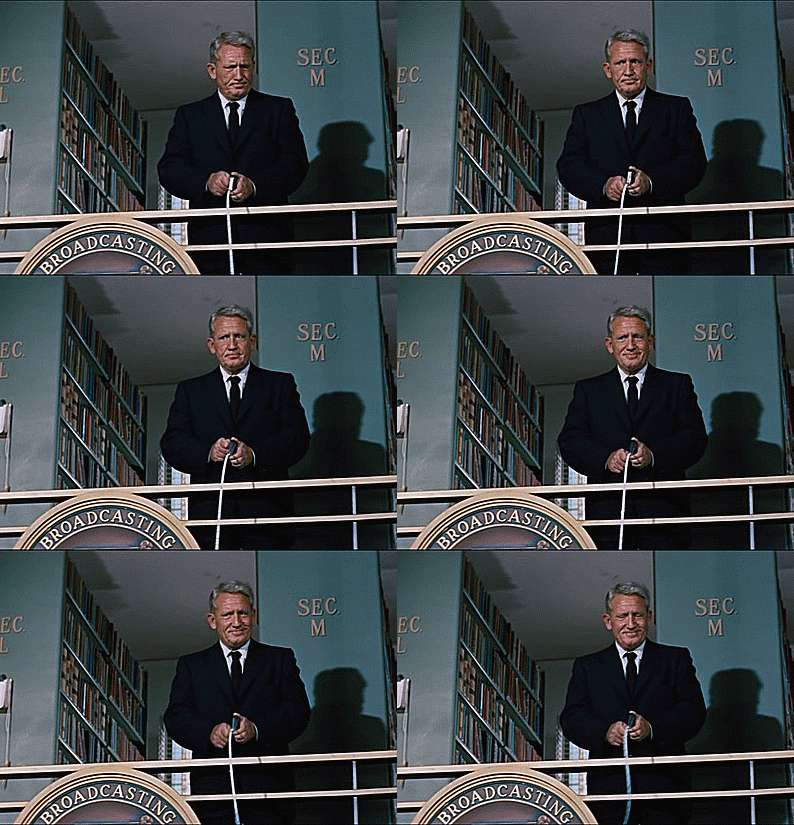
Many professions have disappeared in the last century, in special because of technological changes. Among those professions, we have carriage conductors, switchboard operators, elevator operators, ice cutters and bowling alley pinsetters. “Desk Set” is a film about one of these vanished professions: our leading female quartet work in the reference department of a broadcasting company, researching info for people who call them with questions.


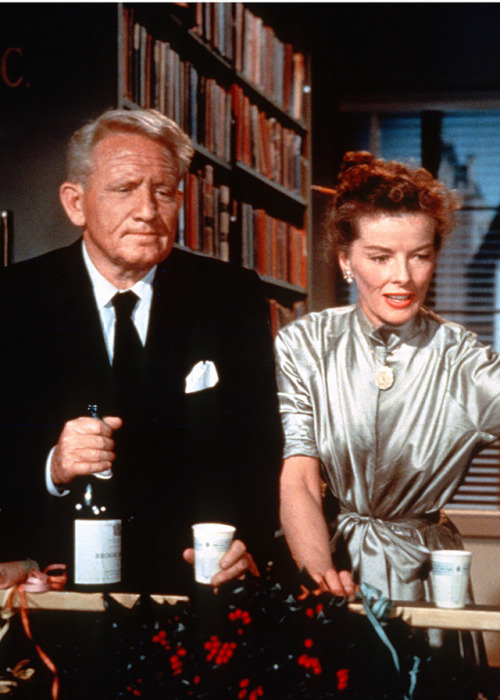
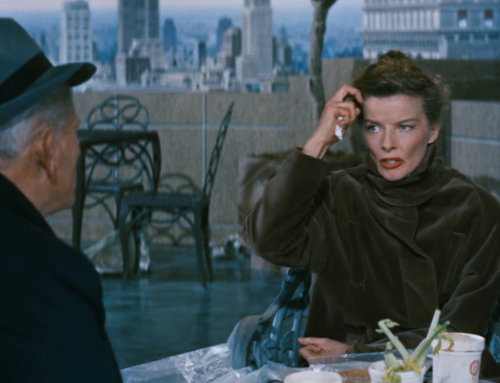
Mas as meninas estão prestes a se tornar obsoletas. Richard Sumner (Spencer Tracy) é um engenheiro contratado pela empresa delas para instalar um “cérebro eletrônico” para substituir o departamento de referências. Entretanto, ele não pode contar a verdade sobre o que está fazendo para as meninas, e deve questionar a chefe do departamento de referências, Bunny Watson (Katharine Hepburn), acerca do trabalho que elas fazem lá antes de trazer o cérebro eletrônico.

But the girls are about to become obsolete. Richard Sumner (Spencer Tracy) is an engineer hired by their company to install an “electronic brain” to replace the reference department. However, he can’t tell the truth about what he’s doing to the girls, and he must inquire the head of the reference department, Bunny Watson (Katharine Hepburn), about the work done there before the electronic brain is brought over.


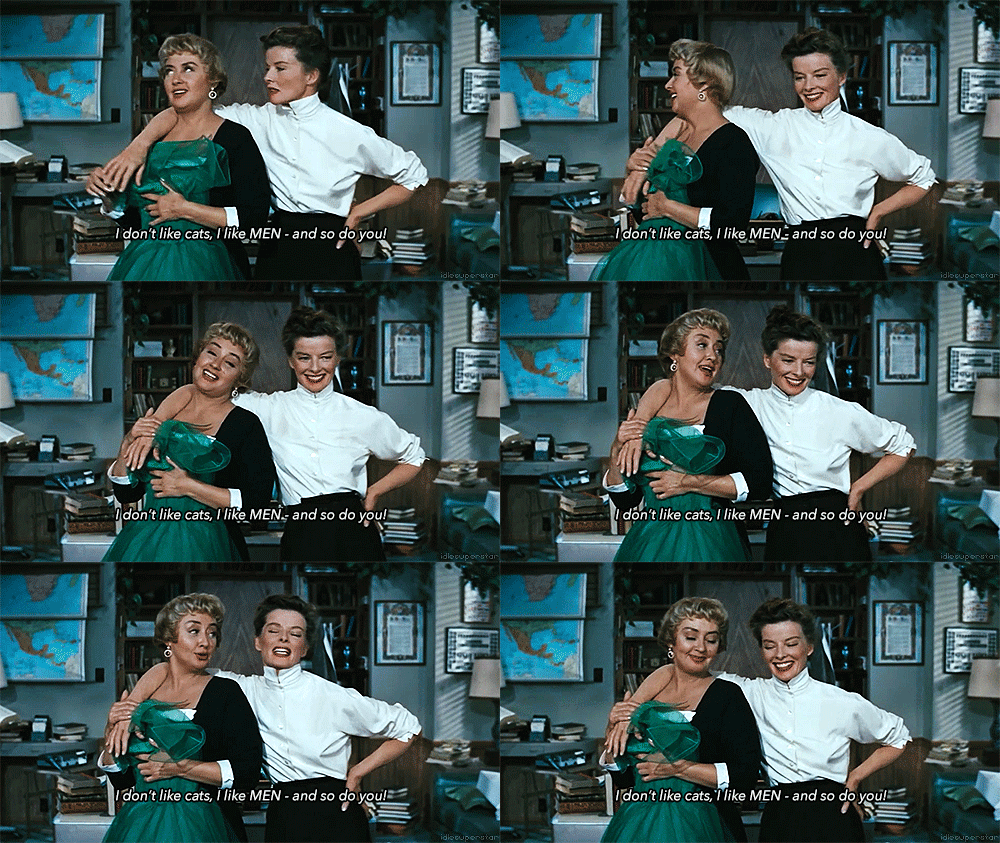
Joan Blondell está interpretando mais uma vez a melhor amiga esperta, uma personagem que ela interpretava com perfeição desde o começo dos anos 1930. Como amiga de Bunny, Peg Costello a aconselha a parar de acreditar nas promessas vazias do namorado. Bunny vive uma relação complicada com seu chefe, Mike Cutler (Gig Young), já há sete anos. Gig Young interpreta o terceiro elemento do triângulo amoroso - ou, como eu gosto de dizer, ele é o Ralph Bellamy dos anos 1950 e 60.

Joan Blondell is back at playing the witty best girl friend, a character she excelled in playing in the early 1930s. As Bunny’s best friend, Peg Costello advises her to stop believing in her boyfriend’s empty promises. Bunny is in a complicated relationship with her boss, Mike Cutler (Gig Young), that has been on for seven years. Gig Young plays the second element of a romantic triangle here - or, as I like to call, he is the Ralph Bellamy of the 1950s and 60s.


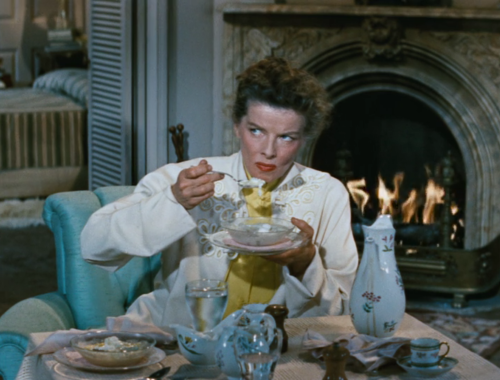
Este é o oitavo de nove filmes que Hepburn e Tracy fizeram juntos. “Amor Eletrônico” é uma comédia romântica - muitas de suas parcerias eram comédias, como “A Mulher do Dia” (1942), “A Costela de Adão” (1949) e “A Mulher Absoluta” (1952). De fato, há muitos momentos cômicos no filme, incluindo o jantar no apartamento de Bunny e a festa de Natal da empresa. Hepburn e Tracy estão ótimos como sempre, e podemos sentir que eles estavam se divertindo enquanto faziam o filme.

This is the eighth of nine films Hepburn and Tracy together. “Desk Set” is a romantic comedy - many of their partnerships were comedies, like “Woman of the Year” (1942), “Adam’s Rib” (1949) and “Pat and Mike” (1952). Indeed, there are many humorous moments in the film, including the dinner at Bunny’s apartment and the Christmas party at the office. Hepburn and Tracy are delightful as well, and we can feel they were having a good time shooting the film.


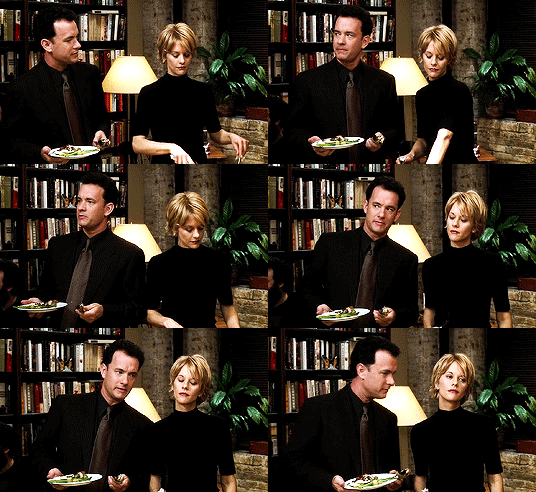
A dupla responsável pelo roteiro é Phoebe e Henry Ephron, pais de Nora Ephron. Como coincidência interessante, Nora mais tarde escreveu e dirigiu “Mensagem para Você” (1998), um filme que também é sobre uma mulher que se apaixona por um homem cujo trabalho poderá deixá-la desempregada - no caso, Meg Ryan interpretava a dona de uma pequena livraria e Tom Hanks era o dono de uma grande rede de livrarias. Há mais uma conexão curiosa com o cinema clássico aqui: “Mensagem para Você” é um remake da comédia de 1940 de Ernst Lubitsch, “A Loja da Esquina”.

The duo responsible for the screenplay is Phoebe and Henry Ephron, Nora Ephron’s parents. As a nice coincidence, Nora later wrote and directed “You’ve Got Mail” (1998), a film also about a woman who falls in love with a man whose work may leave her unemployed - in that case, Meg Ryan played the owner of a small bookstore and Tom Hanks the owner of a big branch of libraries. There is one more nice classic film connection here: “You’ve Got Mail” is a remake of the 1940 Ernst Lubitsch comedy “The Shop Around the Corner”.

"A Loja da Esquina / The Shop Around the Corner"
"Mensagem para Você / You've Got Mail"

Como podemos ver no filme, antes da internet, as pessoas ligavam para departamentos de referências sempre que precisavam de alguma informação - por exemplo, os versos exatos de um poema ou os nomes das renas do Papai Noel - em especial em empresas de telecomunicações como a do filme. É interessante ver que este departamento só tem mulheres como funcionárias - e Peg diz em uma cena que há só homens no departamento legal. De fato, as meninas do departamento de referências são bibliotecárias, e há mais bibliotecárias do que bibliotecários: de acordo com o censo norte-americano, atualmente 83% dos bibliotecários são mulheres, e nos anos 1930 essa porcentagem era muito maior: incríveis 92%!

As we can see in the movie, before the internet, people called reference departments whenever they wanted any information - for instance, the exact words of a poem or the names of Santa Claus’ reindeers - in special in broadcasting companies like the one in the film. It’s interesting to see that this department has only women working in - and Peg later says that there are only men in the legal department. Indeed, the girls at the reference department are librarians, and there are more female librarians than male ones: according to the US census, today 83% of librarians are female, and in the 1930s this percentage was much higher: a whopping 92%!


Eu adoraria trabalhar no mesmo departamento de referências de Miss Watson, Miss Costello, Miss Saylor e Miss Blair. Estar cercada de livros - estar cercada de conhecimento! - o dia todo é emocionante. Além disso, eu sou muito boa em memorizar informações inúteis e curiosidades estranhas. Talvez eu pudesse ser uma especialista em cinema clássico, assim como Miss Costello é especialista em fatos sobre baseball.

I’d love to work in the same reference department as Miss Watson, Miss Costello, Miss Saylor and Miss Blair. Being around books - being around knowledge! - all day long is exciting. Moreover, I excel at keeping useless information and weird trivia memorized. Maybe I could be an expert in classic film info, just like Miss Costello is an expert in baseball facts.


Quando Miss Warriner (Neva Patterson) chega para instalar o EMMARAC, o cérebro eletrônico, as meninas do departamento de referências mantêm seus empregos apenas para inserir no cérebro todas as informações que elas possuem - e então elas serão demitidas. EMMARAC foi baseado em computadores da IMB, e assim como todos os computadores primitivos, ele era muito grande, do tamanho de uma casa. Agora temos smartphones que cabem na palma de nossas mãos e são mais poderosos do que qualquer computador primitivo. Mas uma coisa não mudou: se o usuário não conseguir usar o cérebro eletrônico com sabedoria - fazendo a questão certa para chegar à resposta correta, e interpretando a resposta - o cérebro eletrônico é inútil, mesmo com toda a informação do mundo.

As Miss Warriner (Neva Patterson) arrives to install EMMARAC, the electronic brain, the girls from the reference department are kept there only to feed the brain with all the available information they have - and then they will be fired. EMMARAC was based on a real computer by IBM, and as all other primitive computers, it was very big, the size of a room. Now we have smartphones that are the size of our hands and are also more powerful than any primitive computer. But one thing remains: if the user can’t use the electronic brain properly - by asking the precise question to get a precise answer, and by interpreting this answer - the electronic brain is useless, even with all the information in the world.


Embora tenha sido recebido com críticas moderadas em 1957, hoje muitas pessoas consideram “Amor Eletrônico” a mais divertida das colaborações de Hepburn e Tracy. No site Rotten Tomatoes, o filme tem 100% de aprovação. Não há dúvidas de que o filme envelheceu bem, não apenas com humor atemporal, mas também com um tema ainda relevante: homem contra máquina, o coração humano contra o cérebro metálico. Ainda estamos debatendo sobre as profissões que se tornarão obsoletas graças à tecnologia, e bibliotecárias são geralmente citadas em listas de profissões que em breve desaparecerão. Como Katharine Hepburn mostra no filme - e eu, como estudante de biblioteconomia, concordo - nos sempre precisaremos de cérebros humanos preparados para lidar com a informação. Nenhum computador saberá como usar e interpretar informações sabiamente ou, digamos, escrever uma crítica de filme como essa.

Although it was received with moderate reviews in 1957, many people today consider “Desk Set” to be the funniest of the Hepburn / Tracy collaborations. On Rotten Tomatoes, the film holds a 100% rate of approval. There is no doubt the film stands the test of time, not only with atemporal humor, but also with a still relevant theme: man versus machine, the human heart versus the metallic brain. We’re still debating about what professions will become obsolete thanks to technology, and librarians are often cited in lists of professions doomed to disappear. As Katharine Hepburn shows in this movie - and, as a library science student, I agree - we’ll always need prepared human brains to handle information. No computer will know how to properly use and interpret information or, let’s say, write a movie review like this.


This is my contribution to the Second Spencer Tracy and Katharine Hepburn blogathon, hosted by Crystal and Michaela at In the Good Old Days of Classic Hollywood and Love Letters to Old Hollywood.

Saturday, July 20, 2019

As Quatro Irmãs (1933) / Little Women (1933)


Cristóvão Colombo! Essa é a expressão usada pela heroína Jo March sempre que fica surpresa ou maravilhada. Eu também usei a expressão enquanto assistia à versão de 1933 de “As Quatro Irmãs”, uma história emocionante sobre vida familiar e sacrifício na década de 1860 – uma história tão linda que ainda mexe conosco e ecoa os laços de família que cultivamos na década de 2010.

Christopher Columbus! This is the expletive used by the heroine Jo March whenever she is surprised or amazed. I also used the expletive as I watched the 1933 version of “Little Women”, a heartfelt story about family life and sacrifice in the 1860s – a story so beautiful it still moves and echoes the family ties we experience in the 2010s.


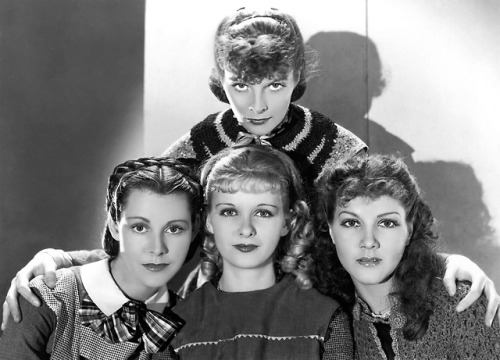
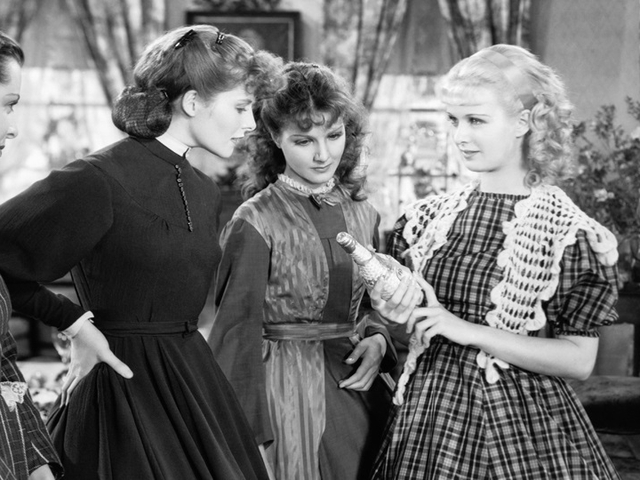
As irmãs March ficam em casa com a mãe enquanto o pai está lutando na Guerra Civil Americana. Meg (Frances Dee) é a mais velha, uma garota obediente. Josephine ou Jo (Katharine Hepburn) é uma moleca criativa e atrapalhada. Beth (Jean Parker) é uma tímida pianista. Amy (Joan Bennett) é a mais nova, uma garota levada.

The March sisters and their mother stay home while the father is fighting in the American Civil War. Meg (Frances Dee) is the eldest, an obedient girl. Josephine or Jo (Katharine Hepburn) is a creative and clumsy tomboy. Beth (Jean Parker) is a shy piano player. Amy (Joan Bennett) is the youngest, a spunky girl.


As meninas têm a mãe, chamada de Marmee (Spring Byington) e uma tia sovina e em geral antipática (Edna May Oliver). Os vizinhos das meninas são o Senhor Laurence (Henry Stephenson) e o neto dele, Laurie (Douglass Montgomery). Quando Jo vai a Nova York, ela fica em uma pensão e lá conhece o Professor Bhaer (Paul Lukas).

The girls have their mother, called Marmee (Spring Byington) and a stingy and often unsympathetic aunt (Edna May Oliver). The girls’ neighbors are the Mr Laurence (Henry Stephenson) and his grandson Laurie (Douglass Montgomery). When Jo goes to New York, she stays in a boarding house and there she meets Professor Bhaer (Paul Lukas).


Cada garota tem uma história diferente, e temas como amor, viagem, autodescoberta, correr atrás dos sonhos e morte estão presentes. Eu adoro a maneira como cada personagem se desenvolve, e ninguém é o mesmo no começo e no final. Isso é verdade, por exemplo, para Amy, que no começo é uma menina sapeca e não muito esperta, em idade escolar, e se torna uma mulher charmosa e talentosa, sendo mostrada como uma boa pintora e ótima companhia.

Each girl has a developing storyline, and themes like love, travelling, self-discovery, pursuit of dreams and death are present. I love how each character really develops, and nobody is the same in the beginning and in the end. This is true, for instance, for Amy, who in the beginning is a naughty and not very bright schoolgirl, and develops into a charming and talented woman, being seen as a good painter and a good companion.


Joan Bennett, então com 22 anos, estava grávida da segunda filha durante as filmagens de “As Quatro Irmãs” – Joan teve quatro filhas. O figurinista Walter Plunkett teve de adaptar o figurino dela para esconder a barriga – o que nem sempre funcionou. Se você prestar atenção, verá algo mais interessante no figurino: as irmãs quase sempre trocam peças de roupa umas com as outras, o que simboliza a ligação afetiva entre elas.

Joan Bennett, then 22, was pregnant with her second daughter during the filming of “Little Women” – Joan would go on to have four daughters. Costume Designer Walter Plunkett had to adapt her wardrobe to hide the growing bump – which sometimes was impossible to do. If you look closely, you can see something more interesting about the costumes: the sisters often trade costumes with each other, which symbolizes the bond they have.


Joan Bennett teve muitas fases em sua carreira, todas bem marcadas por mudanças no visual. Durante sua primeira fase importante, como uma jovem heroína romântica, ela tinha cabelo loiro com muitos cachos – como aqui em “As Quatro Irmãs”. Eu sua segunda fase importante, como femme fatale em filmes noir, seu cabelo foi pintado de preto e seus cachos se tornaram mais esparsos.

Joan Bennett had several phases in her career, all well marked by changes in her look. During her first important phase, as a romantic young heroine, she had blond hair with tight curls – like here in “Little Women”. In her second important phase, as a noir femme fatale, her hair was died black and her curls were sparse.
 
Joan Bennett, 1933
Joan Bennett, 1945
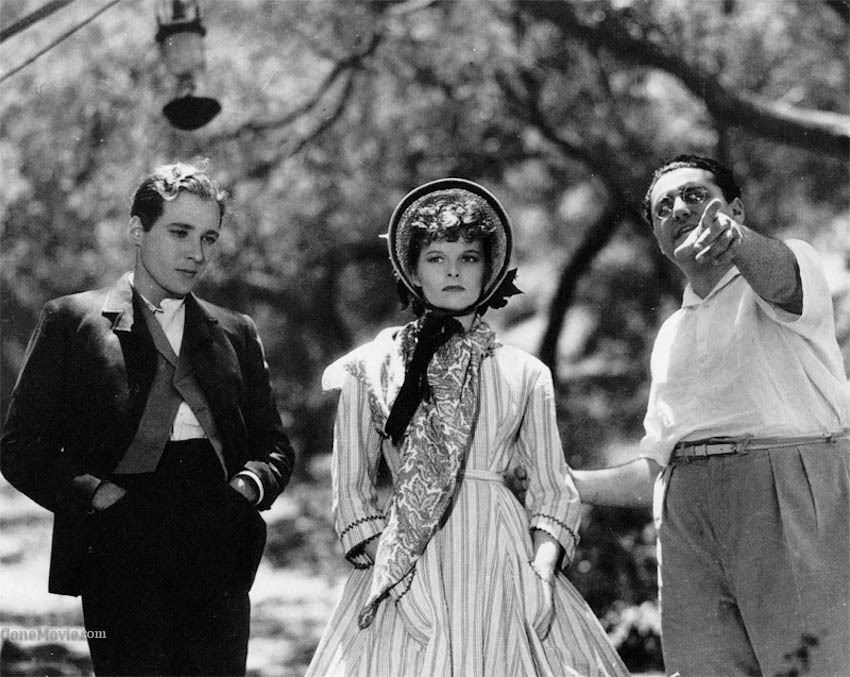
Você pode ver no rosto das atrizes que elas estavam se divertindo muito enquanto faziam o filme. Katharine Hepburn estava em seu ambiente, interpretando uma moleca esperta – ela e Louisa May Alcott, autora do livro “Little Women”, foram assim quando jovens. Elogiar Katharine é algo que eu faço com frequência, mas nunca é um exagero. Frances Dee é a mais conservadora das irmãs, e Jean Parker – do filme “Sós no Mundo” (1934) – é a mais doce. Douglass Montgomery – por vezes creditado como Kent Douglass – é um mocinho decente para a forte heroína de Hepburn. De fato, os sonhos de Jo eram grandes demais para o ambiente doméstico.

You can see in the actresses’ faces that they were having a wonderful time doing the film. Katharine Hepburn was in her environment, playing a smart tomboy – like she was and like Louisa May Alcott, the author of the book “Little Women”, was. Praising Katharine is something I often do, but it’s never an exaggeration. Frances Dee is the most conservative of the sisters, and Jean Parker – from the film “Two Alone” (1934) – is the sweetest. Douglass Montgomery – sometimes billed Kent Douglass – is a decent leading man to a much stronger Hepburn. Indeed, Jo’s dreams are too big for her home environment.


“As Quatro Irmãs” foi um imenso sucesso para a RKO e ganhou o Oscar de Melhor Roteiro Adaptado. Por ter estreado durante a Grande Depressão, o filme alimentou as almas nostálgicas que sentiam falta de tempos mais simples e mais felizes. Ele também conquistou o Vaticano, que listou “As Quatro Irmãs” em sua lista de 45 grandes filmes, publicada em 1995.

“Little Women” was a huge success for RKO and won the Best Adapted Screenplay Oscar. Released during the Depression, it fed the nostalgic souls who longed for simpler and happier times. It also conquered the Vatican, who listed “Little Women” in its list of 45 great films, published in 1995.


O livro de Louisa May Alcott foi adaptado para telas grandes e pequenas mais de 30 vezes até agora. Esta versão de 1933 é uma das melhores adaptações, graças às adoráveis performances e à direção de George Cukor, que sempre trabalhou bem com atrizes. Mais do que isso, o filme nos recorda que pequenos momentos com quem amamos são a coisa mais importante da vida.

Louisa May Alcott’s book was adapted to both the big and the small screen more than 30 times so far. This 1933 version is one of the best adaptations, thanks to its lovely performances and to George Cukor’s direction, who always worked well with his actresses. Moreover, it reminds us that little moments with our loved ones were and are the most important thing in life.


This is my contribution to the Joan Bennett blogathon, hosted by Crystal at In the Good Old Days of Classic Hollywood.


Related Posts Plugin for WordPress, Blogger...