} Crítica Retrô: Marion Davies

Tradutor / Translator / Traductor / Übersetzer / Traduttore / Traducteur / 翻訳者 / переводчик

Showing posts with label Marion Davies. Show all posts

Friday, May 18, 2018

The Hollywood Revue of 1929

O que era moda em 1929? E o que era novidade? Para responder a ambas as perguntas, você apenas tem de assistir a “Hollywood Revue”, de 1929, que foi de fato o primeiro grande musical da MGM. O filme traz todas as grandes estrelas que tinham contrato com o estúdio – exceto Greta Garbo, Ramon Novarro e Lon Chaney, que prezavam muito pela privacidade – e ele apresenta sequências em two-strip Technicolor, efeitos especiais de encolhimento e muita música e dança.

What was in vogue in 1929? And what was brand new? To answer both these questions, you just have to watch “The Hollywood Revue of 1929”, truly MGM’s first ever extravaganza. The film brings all the big stars under contract with the studio – except Greta Garbo, Ramon Novarro and Lon Chaney, who were very worried with privacy – and it also presents sequences in two-strip Technicolor, downsizing special effects and a lot of singing and dancing.
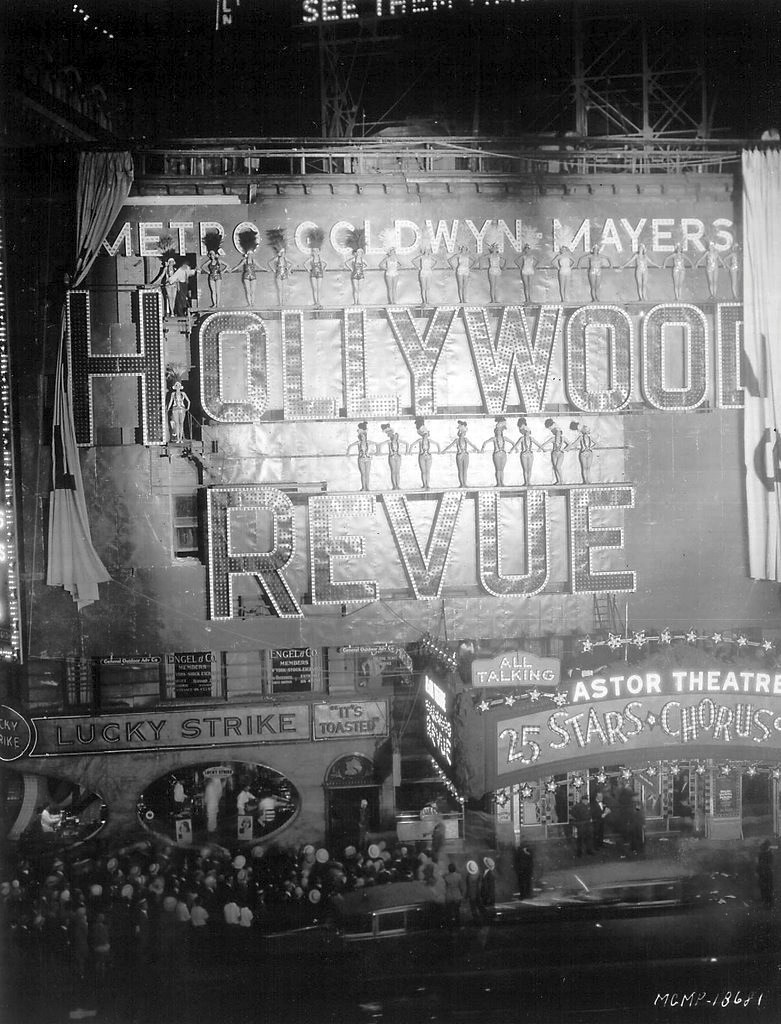
“Hollywood Revue” é vaudeville filmado para a tela do cinema – e completo com um pequeno intervalo entre os atos. E deveria ser assim mesmo: os shows do chamado “teatro de revista” não tinham uma história única, mas sim apresentavam diversas atrações. Em um palco gigantesco e impressionante, os mestres de cerimônia Conrad Nagel e Jack Benny – representando, respectivamente, o mundo do cinema e o mundo do teatro – apresentam vários números, alguns cheios de piadas, mas a maioria musical. É como se a MGM quisesse dizer: “nossas maiores estrelas conseguem cantar, dançar e falar!”

“The Hollywood Revue of 1929” is vaudeville on the screen – complete with intermission. And of course it is this way: a “revue” is a theatrical show without a plot, presenting several attractions. In a huge, impressive stage, masters of ceremonies Conrad Nagel and Jack Benny – representing, respectively, the movie world and the theater world – present several numbers, some of them full of jokes, but the majority is all about music. It's like MGM wanted to say: “our greatest stars CAN SING, CAN DANCE AND CAN TALK!”
Joan Crawford
Não podemos negar que o tempo não foi bom com o filme, e muitas das piadas hoje não têm graça. Entretanto, Marie Dressler, Polly Moran e Bessie Love formam um trio divertido, e o Gordo e o Magro estão engraçados como sempre ao interpretarem dois mágicos atrapalhados – sendo que o Magro não fala uma palavra! Quem também não fala nada é Buster Keaton, que substitui Carla Laemmle – que usava um provocante biquíni de duas peças – como a filha dançarina de Poseidon, deus dos mares.

We can't deny that time hasn't been kind to the film, and many of the jokes fall flat nowadays. However, Marie Dressler, Polly Moran and Bessie Love make a funny trio, and Laurel and Hardy are they usual selves as two clumsy magicians – even though Laurel doesn't say a word! Another one who doesn't say a word is Buster Keaton, who replaces Carla Laemmle – who was in a risky two-piece swimsuit – as the dancing daughter of Poseidon, the god of the sea.
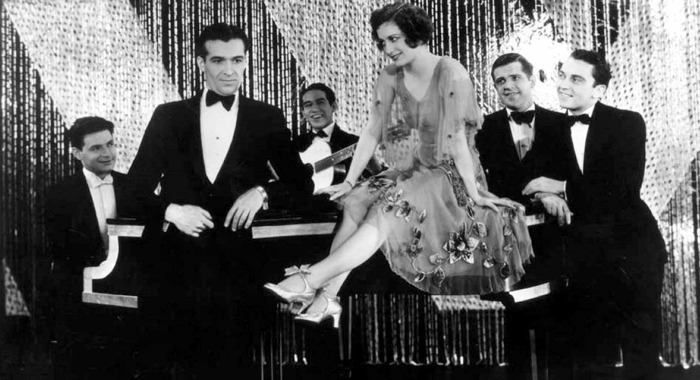
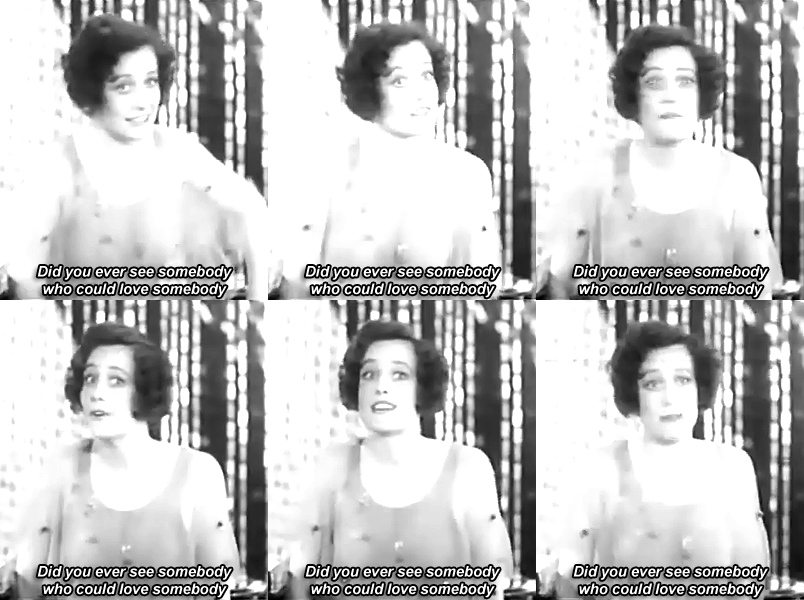
Joan Crawford é fofa cantando e dançando “Gotta Feeling for You”. Joan é melhor dançarina que cantora, e é óbvio que ela não canta e dança ao mesmo tempo, porque, mesmo havendo a música, seus lábios não se mexem. Não há nada de extraordinário no número de Joan, mas quando as dezenas de dançarinos se juntam no palco, tudo fica melhor: o trabalho de coreografia com o grupo é maravilhoso, e os dançarinos comumente chamam mais atenção que as músicas e os cantores.

Joan Crawford is cute singing and dancing “Gotta Feeling for You”. Joan is a better dancer than singer, and it’s obvious that she is not singing and dancing at the same time, because her mouth does not move, even though the song goes on. There is nothing extraordinary in Joan's number, but when the dozens of dancers join any number, things get much better: the chorus is very well-coordinated and choreographed, and they often distract us from the music and the singers.
Mas o que é aquilo no número “Lon Chaney is Gonna Get You If You Don’t Watch Out?” E uma coreografia ao estilo de Busby Berkeley! Este é um momento interessante, provavelmente influenciado pela Broadway, que é onde Berkeley trabalhava na época. É também uma coincidência curiosa, considerando que Busby Berkeley trabalhou na MGM na década de 1940.

But what is that in the number “Lon Chaney is Gonna Get You If You Don’t Watch Out”? It is a Busby Berkeley-style choreography! It's an interesting bit, much probably coming from Broadway, where Berkeley worked at the time, and a curious coincidence, considering that Berkeley worked at MGM in the 1940s.
Regular Broadway
Berkeley Broadway
O popular cantor de vaudeville Charles King diz ao galã de cinema Conrad Nagel que “hoje, você precisa fazer amor com palavras e música”. Charles menciona uma música que ele interpretara em “Melodia da Broadway” (1929) chamada “You Were Meant For Me”. Para a surpresa de todos, e em especial de Charles, Nagel senta em um piano e interpreta lindamente a música para Anita Page. Mas era tudo um truque, nunca revelado durante o filme: na verdade, era o próprio Charles King que dublou Conrad Nagel na cena! Com ou sem dublagem, Nagel sobreviveu à chegada do cinema falado e teve uma longa carreira como coadjuvante no cinema e na televisão até 1967.

Popular vaudeville singer Charles King says movie star Conrad Nagel that “today, you've got to make love with words and music”. Charles mentions a song he interpreted in “Broadway Melody” (1929) called “You Were Meant For Me”. For everybody’s surprise, and especially Charles’, Nagel sits in a piano and sings the song beautifully to Anita Page. But it all was a trick, not revealed in the movie: actually, it was King himself who dubbed Conrad Nagel’s singing voice! With or without dubbing, Nagel survived the talkie revolution, and had a long career as a supporting player on film and TV until 1967.
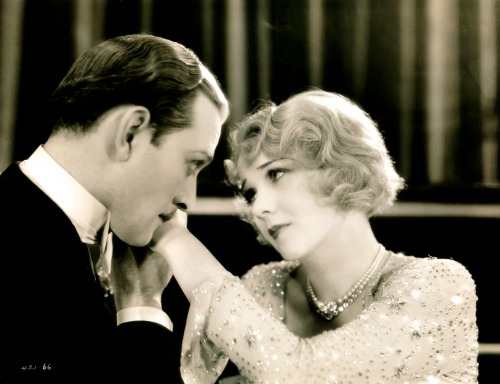
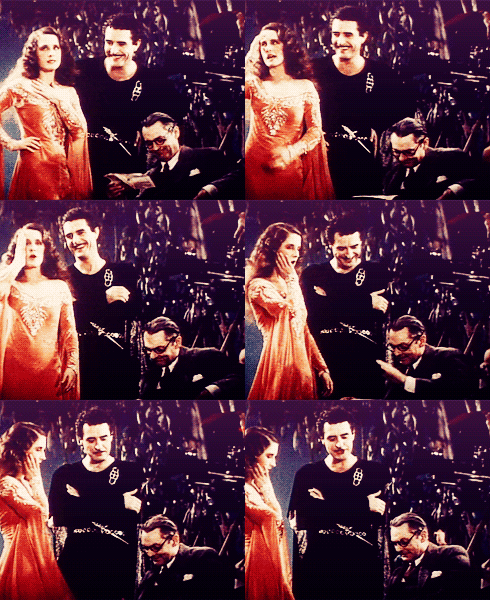
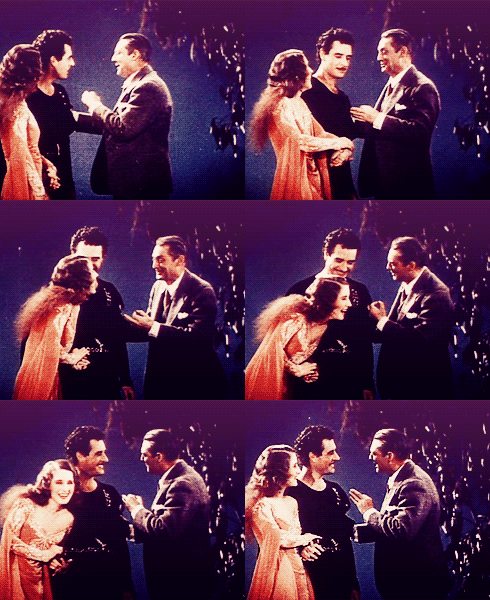
E se falamos sobre a transição do cinema mudo para o falado, precisamos mencionar a surpreendente e inteligente sequência de Romeu e Julieta. Filmada em two-strip Technicolor, suas estrelas são John Gilbert e Norma Shearer. A voz de Gilbert é boa, e esta pequena sequência já é suficiente para nos mostrar que a história sobre “a voz de taquara rachada” que é usada para justificar o fracasso de Gilbert no cinema falado é uma falácia. A sequência, já interessante, se torna ainda mais legal quando o diretor da cena, interpretado por Lionel Barrymore, diz aos atores para modernizar as falas, e eles refazem a cena da sacada de Romeu e Julieta usando gírias dos anos 1920.

If we're talking about the silent-to-talkie transition, we must mention the impressive and clever Romeo and Juliet sequence. Shot in two-strip Technicolor, it stars John Gilbert and Norma Shearer. Gilbert's voice is fine, and this simple sequence is enough to show us that the “funny voice story” that is used to justify his short career in talkies is a myth. The already cool sequence becomes even nicer when the scene's director, played by Lionel Barrymore, tells them to modernize the dialogue, and they redo the balcony scene in Romeo and Juliet with 1920's slang.
A MGM foi o primeiro estúdio a apresentar uma revista como esta, cheia de estrelas, e a fórmula foi rapidamente copiada por outros estúdios. A Warner Brothers foi o estúdio seguinte, fazendo “A Parada das Maravilhas / The Show of Shows”, filmado quase totalmente em two-strip Technicolor. Depois veio a Fox, com “Dias Felizes”, e então a Paramount com “Paramount em Grande Gala / Paramount on Parade” (1930). A Fox também fez as revistas menores “Fox Movietone Follies” em 1929 (antes da MGM, este filme foi perdido) e em 1930 (o filme sobrevive).

MGM was the first studio to present an all-star revue, and the formula was quickly copied by other studios. Warner Brothers followed with “Show of Shows”, almost fully shot in two-strip Technicolor. The next studio to make a revue was Fox, with “Happy Days”, followed by Paramount with “Paramount on Parade”, from 1930. Fox did also the smaller revues “Fox Movietone Follies” in 1929 (before “Hollywood Revue of 1919”, this film is now lost) and 1930 (still extant).
Se você não gosta de musicais, não chegue perto de “Hollywood Revue”. Quer dizer, se você não suporta um musical com uma história, você é capaz de se imaginar vendo um musical SEM uma história? Caso contrário, se você ama musicais, história do cinema ou se você é um historiador amador e curioso, “The Hollywood Revue of 1929” é um documento interessante – na falta de termos melhores. Afinal, se não é por causa das coisas estranhas que você encontra no processo, por que você estuda história?

If you don’t like musicals, don’t go near “The Hollywood Revue of 1929”. I mean, if you can’t stand a musical with a plot, can you imagine yourself sitting through a musical WITHOUT a plot? On the contrary, if you love musicals, film history or if you are a curious history buff, “The Hollywood Revue of 1929” is an interesting document – for lack of better terms. Because, if not for the weird things you find along the way, why do you study history?

This is my contribution to The MGM Musical Magic Blogathon, hosted by Annette at Hometowns to Hollywood.
Wednesday, March 9, 2016

Muito além de Rosebud: descobrindo Marion Davies

Beyond Rosebud: discovering Marion Davies

É sabido que “Cidadão Kane” (1941) foi inspirado na vida do magnata das comunicações William Randolph Hearst. Em certo ponto do filme, Kane toma como amante a cantora sem talento Susan Alexander (Dorothy Comingore), e decide fazer dela uma estrela. Para a posteridade, ficou a impressão de que foi isso que Hearst fez com sua amante, a atriz Marion Davies (cujo órgão sexual era chamado por Hearst exatamente de Rosebud, segundo boatos). Marion era, entretanto, uma talentosa comediante que teve, sim, sua carreira auxiliada por Hearst, mas que com certeza teria sucesso também sem ele.

It’s widely known that “Citizen Kane” (1941) was inspired in William Randolph Hearst’s, the mogul of comunications, life. At a certain point of the film, Kane takes untalented singer Susan Alexander (Dorothy Comingore) as his lover and decides to turn her into a star. That’s why so many people think Hearst did the same with his lover, actress Marion Davies (whose sexual parts were called exactly Rosebud by Hearst, according to gossips). Marion was, however, a talented comedienne who indeed had her career molded by Hearst, but there is no doubt that she would have succeeded even without him.


Marion Cecelia Douras nasceu no Brooklyn e seguiu os passos da irmã mais velha, tornando-se dançarina na adolescência. Logo ela se tornou uma Ziegfeld Girl, e o cinema era seu próximo passo. O filme de estreia, “Runaway, Romany” (1917) foi também escrito por Marion. Apesar de não ter feito muito sucesso com esta primeira empreitada, ela continuou atuando, e “Cecilia of the Pink Roses” (1918) foi o filme que chamou a atenção de Hearst.

Marion Cecelia Douras was born in Brooklyn and followed her older sister’s footsteps, becoming a dancer as a teenager. Soon she became a Ziegfeld Girl, and the movies were her next natural step. Her debut movie, “Runaway, Romany” (1917) was also written by her. This wasn’t a big hit, but Marion kept on acting, and it was the film “Cecilia of the Pink Roses” (1918) the one who called Hearst’s attention. 


Como qualquer magnata apaixonado, Hearst decidiu construir um estúdio de cinema só para Marion. A Cosmopolitan Productions surgiu em 1918, teve seu auge nos anos 20 e se diversificou nos anos 30, quando até John Ford trabalhou lá. Até 1923 a sede dos estúdios era em Nova York e os sócios de Hearst no empreendimento eram os estúdios Paramount. Entre 1924 e 1934 Hearst se associou à MGM para distribuir os filmes da Cosmopolitan Productions, e a partir de 1934 o novo distribuidor foi a Warner Brothers.

Like any mogul in love would do, Hearst decided to build a movie Studio for Marion. Cosmopolitan Productions was created in 1918, had its heyday in the 1920s and became a more diverse studio in the 1930s, when even John Ford worked there. Until 1923 the headquarters were in New York and the movies were distributed in Hollywood by Paramount. Between 1924 and 1934 MGM was the distributor of the Cosmopolitan Productions, and from 1934 onwards the distributor was Warner Brothers.


E foi na Cosmopolitan que Marion se aventurou no drama épico pela primeira vez. Seu grande sucesso no gênero veio com “When Knighthood was in Flower” (1922), em que ela interpreta a princesa Mary Tudor, apaixonada por um simples soldado mas atormentada pela sede de poder do irmão, o rei Henrique VIII (Lyn Harding), que insiste em casá-la com o esquelético rei da França. As expressões de Marion em alguns close-ups são preciosas, e a pompa da produção impressiona: são grandes cenários, vistosos figurinos, milhares de extras e uma bela luta de espadas.

And it was at Cosmopolitan that Marion worked in an epic drama for the first time. Her big hit in this genre came with “When Knighthood was in Flower” (1922). In this film she plays Princess Mary Tudor, who is in love with a simple soldier. She is bothered by her brother’s, King Henry VII’s (Lyn Harding), obsession with power: he insists in marrying her to the skinny king of France. Marion’s expressions in some close-ups are precious, and the fancy production is impressive: there are huge sets, big dresses, thousands of extras and an exciting sword fight.


Sem dúvida, o melhor filme de Marion Davies, o primeiro que eu vi com ela e aquele que todos deveriam ver é “Fazendo Fita / Show People” (1928). Nele, Marion interpreta a singela Peggy Pepper, uma moça do interior que vai para Hollywood para se transformar em uma grande atriz dramática. O único emprego que ela consegue, por intermédio de Billy Boone (William Haines) é em uma comédia slapstick ao melhor estilo Keystone Cops. Billy diz que é necessário levar alguns reveses na comédia antes de ter sua grande chance no drama. Não demora para que Peggy seja notada por um grande estúdio, mas quando realiza seu sonho (justamente em um épico ao estilo dos que trouxeram elogios a Marion Davies), ela esquece seus amigos dos velhos tempos da comédia.

Without a doubt, Marion’s best film, the first I’ve seen her in and the one that everybody must see is “Show People” (1928). Marion plays Peggy Pepper, a girl who goes to Hollywood to become a successful drama actress. The only job she gets, thanks to Billy Brone (William Haines), is in a slapstick comedy, very similar to the Keystone Kops. Billy says it is necessary to take some pies in the face in comedy movies in order to have a chance at doing drama. It’s not long until Peggy calls the attention of a big studio, but when she fulfills her dream (in an epic movie like the ones that brought fame to Marion Davies), she forgets her old friends from comedy. 


Gosto de pensar que a Marion Davies da vida real se assemelhava muito com sua personagem em “Show People”: determinada, vivaz, ótima no drama mas absolutamente fantástica na comédia (todo mundo precisa ver as imitações que Marion faz de outras atrizes do cinema mudo em “Filhinha Querida / The Patsy”, de 1928). Tanto é que foi a esta que ela dedicou sua breve carreira no cinema falado.

I like to think that, in real life, Marion Davies was a lot like her character from “Show People”: bold, charming, good in drama but absolutely fantastic in comedy (everybody must see Marion’s imitations of other silent film actresses in “The Patsy”, from 1928). Indeed, when talkies came she focused in comedies.

Em “Cain e Mabel” (1936), Marion é Mabel, uma garçonete transformada em estrela de teatro por um publicitário. Para alavancar ainda mais a carreira de Mabel, ele decide inventar um romance da moça com o pugilista em ascensão Larry Cain (Clark Gable, sem bigode). A primeira interação entre os dois não foi nem um pouco amigável, mas eles precisam continuar se vendo para que o esquema publicitário funcione. Você já sabe o que vai acontecer, não é?

In “Cain and Mabel” (1936), Marion plays Mabel, a waitress who becomes a theater star thanks to a publicist. To make her even more famous, he decides to tell the tabloids that she is dating the up and coming boxer Larry Cain (Clark Gabel, sans moustache). Their first meeting is not pleasant at all, but they must go on with the farse to make the story believable. You already know what happens next, don’t you?  


O último filme de Marion, “Desde os Tempos de Eva / Ever Since Eve” (1937) tem uma premissa ridícula: Marge (Marion) não consegue um emprego fixo porque é muito bonita e é sempre assediada por seus chefes. Assim, ela prefere se demitir a lutar contra os vermes que a assediam. Quando o escritor Freddy Matthews (Robert Montgomery) anuncia que precisa de uma datilógrafa ghostwriter para ajudá-lo a terminar seu livro, Marge se candidata à vaga, mas vai trabalhar disfarçada para que seu “problema” não se repita. O filme, apesar de tudo, ainda consegue ter bons momentos, em especial as cenas em um restaurante praiano. A comédia sobre dupla identidade funciona bem, apenas o motivo que começa tudo é antiquado e envelheceu mal.

Marion’s last movie, “Ever Since Eve” (1937), has a ridiculous plot: Marge (Marion) can’t keep a job because she is too beautiful and she’s often harassed by her bosses. So, she prefers to quit and not fight against the rotten men harassing her. When writer Freddy Matthews (Robert Montgomery) is looking for a ghostwriter typist to help him finish his book, Marge applies for the job, but dresses as an ugly woman so her “problem” won’t happen again. The film, despite everything, still has funny moments, like the scenes in the beach restaurant. The double identity comedy works well, only the reason to start it all is odd.


Surpreendentemente, acredita-se que apenas um de seus filmes estja perdido: “The Cinema Murder” (1919). No entanto, relativamente poucos dos 49 títulos de sua filmografia estão disponíveis para o público em DVD ou streaming. É uma lástima que seja tão difícil conhecer os trabalhos desta grande atriz, injustiçada por um mito do cinema, mas que merece toda a admiração dos cinéfilos.

Surprisingly, it looks like there is only one of her films lost: “The Cinema Murder” (1919). However, relatively few of her 49 films are available on DVD or via streaming. It’s too bad that this great actress can’t be seen by more people. She was the victim of a cinematic injustice, and deserves all the cinephiles’ admiration.


This is my contribution to the Marathon Stars Blogathon, hosted by my friends Virginie and Crystal at The Wonderful World of Cinema and In the Good Old Days of Classic Hollywood.
Related Posts Plugin for WordPress, Blogger...