} Crítica Retrô: casamento

Tradutor / Translator / Traductor / Übersetzer / Traduttore / Traducteur / 翻訳者 / переводчик

Showing posts with label casamento. Show all posts

Friday, March 6, 2020

Pleasure Cruise (1933)


Todos nós desejamos felicidade e tranquilidade na vida – mas não no cinema. Aqueles de nós que querem se casar desejam poucas brigas e nenhum ciúme – mas quem quer ver um filme sobre um casal que não tem absolutamente nenhum problema? No cinema, quanto mais problemático for um casamento, melhor, seja o filme uma comédia ou um drama. Na comédia pre-Code de 1933 “Pleasure Cruise”, um marido ciumento segue a esposa em um cruzeiro – e planeja ensinar-lhe uma lição da maneira mais nojenta possível.

We all long for happiness and calm in life – but not on screen. Those of us who want to get married wish few fights and no jealousy – but who wants to watch a movie about a couple that has absolutely no problems? On film, the most troubled a marriage is, the better, no matter if the movie is a comedy or a drama. In the 1933 pre-Code comedy “Pleasure Cruise”, a jealous husband follows his wife in a cruise trip – and plans to teach her a lesson in the vilest way.


Da primeira vez que vemos Andrew Poole (Roland Young), ele está leiloando todos os seus pertences e dando uma festa para os amigos enquanto suas coisas estão sendo levadas embora. Ele pretende desmanchar o noivado com Shirley (Genevieve Tobin), agora que está pobre, mas ela não aceita. Ele tem uma carreira promissora como escritor pela frente e ele tem um emprego, o que significa que eles podem se casar e ela pode sustentar a casa enquanto o livro dele não é publicado.

The first time we see Andrew Poole (Roland Young), he's auctioning all his belongings and throwing a party for his friends while his things are being taken away. He intends to break the engagement with his fiancée, Shirley (Genevieve Tobin), now that he is poor, but she doesn't want it. He has a promising career ahead as a writer and she has a job, which means that they can get married and she can be the breadwinner of the household while his book is not published.


Da próxima vez que vemos Andrew, ele é um homem casado usando um avental – que, no cinema, é um sinal de castração – e organizando as compras na cozinha. É seu aniversário de um ano de casamento, mas ele se esqueceu. Sua amiga Judy (Minna Gombell) o visita e traz flores para ele presentear Shirley. Enquanto cozinha, ele confessa para Judy que tem ciúmes dos colegas de trabalho de Shirley – em uma vinheta criativa e divertida, vemos que estes colegas não são nada do que ele imagina.

The next time we see Andrew, he is a married man wearing an apron – which, in a movie, is a sign of emasculation – and organizing the things he bought in the kitchen. It's his one-year wedding anniversary, but he has forgotten it. His friend Judy (Minna Gombell) visits him and brings flowers for him to give Shirley. While cooking, he confesses to Judy that he's jealous of Shirley's male coworkers – in a creative and fun vignette, we see that they're nothing like he imagines.


Naquela tarde, Andrew e Shirley saem para dar uma volta, e começam a discutir porque ela diz que não sairia do emprego se ele conseguisse um trabalho. Ela então sugere que ele vá pescar para descansar. Ironicamente, ele sugere que ela faça uma viagem num cruzeiro sozinha, e fica chocado quando ela aceita a ideia e imediatamente compra a viagem. Mas ele não pode ir pescar em paz, por isso ele consegue um emprego no mesmo cruzeiro em que ela viaja para ficar de olho nela – sem ser visto, obviamente.

Andrew and Shirley go out for a stroll in the rain that evening, and start arguing because she says she wouldn’t give her job up if he found a job. She then suggests for him to go on a fishing trip to rest. He ironically suggests for her to go solo on a pleasure cruise, and is shocked when she accepts the idea and immediately books the trip. But he can't go fishing in peace, so he gets a job in the same cruise she's travelling to watch her – without being seen, of course.


Fingindo ser barbeiro, Andrew tenta manter todos os homens longe de Shirley, contando mentiras sobre ela. Ao mesmo tempo, ele precisa escapar das investidas da Sra. Signus (Uma O’Connor), uma senhora que adora flertar. Para tornar as coisas mais complicadas, a cabine de Shirley é do lado da cabine da Sra. Signus, e Andrew frequentemente entra na cabine da Sra. Signus para espiar Shirley pelo buraco da fechadura.

Posing as a barber, Andrew tries to keep all men far from Shirley, telling lies about her. At the same time, he needs to escape Mrs Signus (Una O'Connor), a very flirty older lady. To make things more complicated, Shirley's cabin is next to Mrs Signus, and Andrew frequently enters Mrs Signus' cabin only to spy on Shirley through the keyhole.


Assim como muitos outros filmes do começo da era falada, “Pleasure Cruise” teve uma versão em língua estrangeira gravada ao mesmo tempo e enviada para países que não falavam inglês. A versão em espanhol, “No Dejes La Puerta Abierta”, era estrelada pelo brasileiro Raul Roulien e pela espanhola Rosita Moreno. Raul e Rosita fizeram muitas versões em espanhol de filmes em inglês nos estúdios Fox.

Like many other early talkies, “Pleasure Cruise” had a foreign language version shot at the same time for non-English speaking markets. The Spanish version, “No Dejes la Puerta Abierta” (Don't Leave the Door Open), starred Brazilian import Raul Roulien and Spanish actress Rosita Moreno. Roulien and Moreno did a lot of Spanish versions of English-speaking films at Fox studios.


Podemos perceber que este filme foi feito antes do Código Hays pelo primeiro frame. Quando o filme começa, vemos as costas de uma mulher nua e alguém ordena “vire-se”. Para nosso alívio, vemos que se trata de uma pintura, não de uma mulher nua – e os cineastas sorriem porque acabaram de nos enganar. Além disso, há muitas – e eu quero dizer MUITAS – insinuações sexuais no filme.

We can see this a pre-Code by the very first frame. When the film begins, we see a naked woman's back and someone orders “turn around”. To our relief, we realize it's a painting, not a naked woman – and the filmmakers smile as they see they fooled us. Besides that, there is a lot – and I mean a LOT – of sexual innuendo in this film.


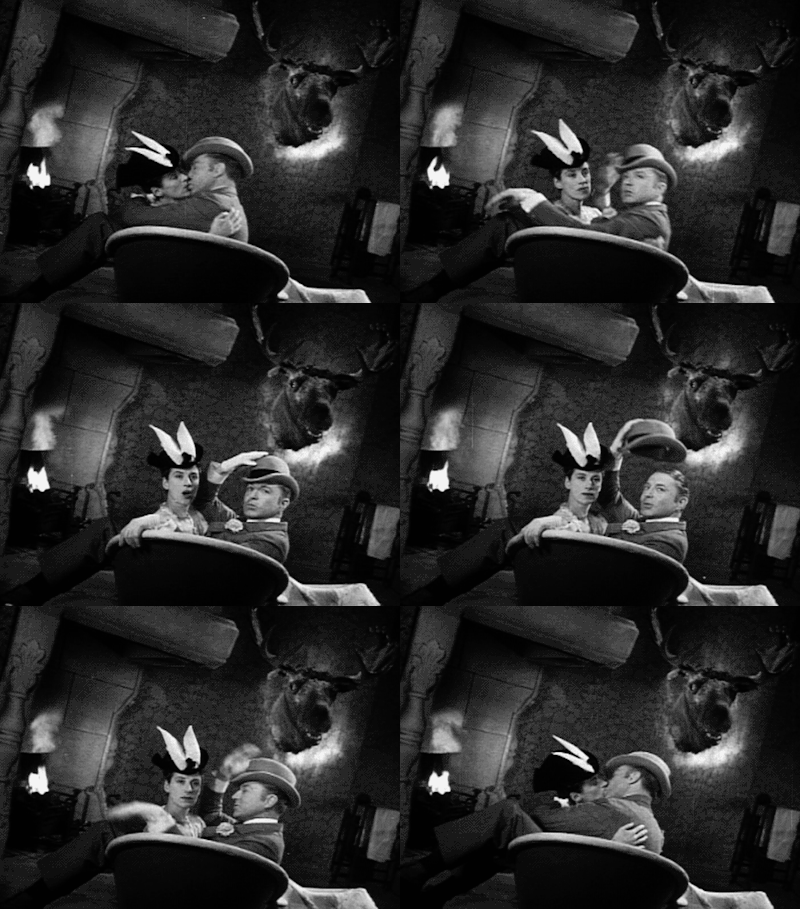
Algumas transições chamaram minha atenção por causa da criatividade envolvida. Quando Andrew e Shirley saem da casa deles, a câmera foca nos pés do casal. No momento seguinte, eles estão saindo da igreja, casados. No próximo momento, ainda com a Marcha Nupcial tocando, Andrew está caminhando sozinho, depois de fazer compras para casa. Em outra sequência, um chuveiro aberto se transforma em chuva caindo do lado de fora de uma janela e, mas tarde, a passagem do tempo é simbolizada pela chuva que para de cair em uma poça. Um balão estoura e uma grande festa no cruzeiro acaba. São todos pequenos truques, muito bem executados, que tornam o filme visualmente bonito.

Some scene transitions really caught my attention because of the creative way they were done. As Andrew and Shirley leave his house, the camera focuses on their feet. The next moment, they are walking down the aisle, married. The next one, still with the Wedding March playing, Andrew is walking alone, after buying groceries for his home. In another sequence, an open shower transforms into rain falling outside of a window and, later, the passing of time is symbolized by the rain that stops falling in a puddle. A balloon pops and a huge party at the cruise is over. These are little tricks that, well done, make the film visually pleasing.


Genevieve Tobin está ótima nos momentos cômicos de “Pleasure Cruise”. Nascida em Nova York em 1899, Genevieve fez seu primeiro filme aos 10 anos. Sua irmã Vivian e seu irmão George também eram atores. Ao contrário de sua personagem em “Pleasure Cruise”, Genevieve deixou Hollywood em 1940 após se casar. Ela faleceu em 21 de julho de 1995 – meu segundo aniversário.

Genevieve Tobin is great at comical moments in “Pleasure Cruise”. Born in New York in 1899, Genevieve made her first film at age 10. Her sister Vivian and her brother George were also actors. Unlike her character from “Pleasure Cruise”, Genevieve left Hollywood in 1940 after getting married. She passed away on July 21st, 1995 – which was my second birthday.


Aqui, Roland Young me lembrou de Bruce Willis, mas com um bigode. O ator inglês fez sua estreia no cinema como Watson no “Sherlock Holmes” de 1922, com John Barrymore como Sherlock. No começo da década de 1930 ele passou a trabalhar como freelancer – sem ter contrato com um único estúdio – e fez sucesso em muitos papéis coadjuvantes, incluindo “A Dupla do Outro Mundo” (1937), pelo qual ele recebeu uma indicação ao Oscar.

Roland Young here reminded me of Bruce Willis, but with a mustache. The English actor made his film debut as Watson in 1922’s “Sherlock Holmes”, with John Barrymore as Sherlock. In the early 1930s he started working as a freelancer – not having a contract with a single studio – and found success in many supporting roles, including “Topper” (1937), for which he was nominated for an Oscar.


Com apenas 72 minutos, “Pleasure Cruise” é um filme prazeroso até os minutos finais. Uma escolha de mau gosto – e é de MUITO mau gosto – é feita quando Andrew vai longe demais para ensinar uma lição para a esposa. Não darei spoilers, mas Danny do site pre-code.com discute esta questão na crítica dele AQUI (em inglês). Por causa deste detalhe não tão pequeno, “Pleasure Cruise” é um filme que podemos dizer que envelheceu mal, e nos faz agradecer pelas constantes mudanças na sociedade.

Clocking at 72 minutes, “Pleasure Cruise” is a delightful pre-Code movie up until the final minutes. A twist of bad taste – and I mean VERY bad taste – happens when Andrew goes too far to teach his wife a lesson. I won’t give spoilers, but Danny from pre-code.com discusses this plot point in his review of the film HERE. Because of this not so small detail, “Pleasure Cruise” is a film we can say aged badly, and it makes us be thankful that times are constantly changing.

This is my contribution to the Out to Sea blogathon, hosted by Debra at Moon in Gemini.

Friday, June 28, 2019

On Approval (1944)


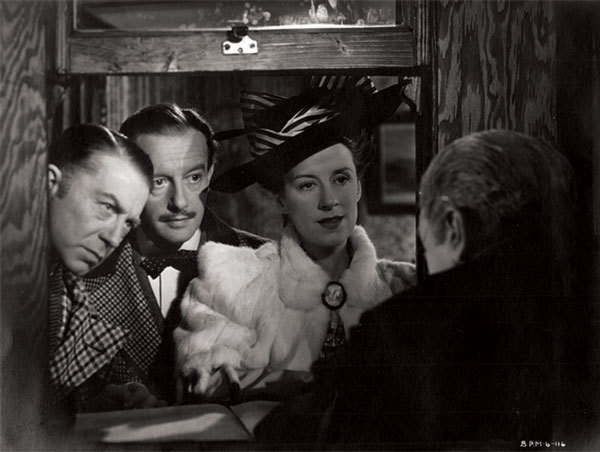
“On Approval” começa de maneira criativa com um narrador (E.V.H. Emmett) comparando os tempos modernos de 1939 – antes da guerra que estava então acontecendo – e a era Vitoriana. O narradora diz que a era Vitoriana foi muito melhor porque, entre outras coisas, as mulheres eram mulheres e não se esqueciam disso – embora os homens se esquecessem disso algumas vezes. Então nós e o narrador chagamos a um teatro, onde a peça “On Approval” está sendo encenada. Sim, este filme é uma peça dentro de um flashback dentro de um filme.

On Approval” starts in a creative way as a narrator (E.V.H. Emmett) compares the modern times of 1939 – before the then ongoing war – and the Victorian times. The narrator says the Victorian times were much better because, among other things, women were women and didn't forget that – even though men forgot it sometimes. Then we and the narrator arrive in a theater, were the play “On Approval” is being presented. Yes, this film is a play within a flashback within a film.


George (Clive Brook) é um mulherengo. Ele está em uma festa com seu amigo Richard (Roland Culver), que é apaixonado por Maria Wislack (Beatrice Lillie). Maria, que é viúva e tem 41 anos de idade, decide viajar com Richard durante um mês para fazer um teste: se ele foi aprovado, eles podem se casar. Enquanto isso, George zomba de Maria por causa da idade dela, tenta ajudar Richard e não percebe que Helen (Googie Withers) está apaixonada por ele.

George (Clive Brook) is a womanizer. He is attending a party with his friend Richard (Roland Culver), who is in love with Maria Wislack (Beatrice Lillie). Maria, who is widowed and 41, decides to take Richard out during a month “on approval”: if she approves of him, they can get married. Meanwhile, George mocks Maria for her age, tries to help Richard and doesn't see that Helen (Googie Withers) is in love with him.


Logo Richard e Maria partem para a Escócia para passar um mês fazendo o teste de casamento. Só há um problema: George decide acompanhá-los. Richard e George deveriam ficar em um hotel, mas eles mandam um telegrama falso para que o hotel aparente estar lotado e não haja lugar para eles. Helen descobre o plano e os segue até o hotel. Mas o hotel está realmente cheio, e os quatro têm como única opção se hospedar na propriedade de Maria.

Soon Richard and Maria leave for Scotland to spend a month in their marriage attempt. There is only one issue: George decides to go with them. Richard and George are supposed to stay in a hotel, but they send a fake telegram so the hotel will be apparently full and there won't be room for them. Helen discovers the plan and follow them to the hotel. But it happens that the hotel is indeed full, and all the four need to stay in Maria's property.


Durante o tempo em que estão juntos, com quase nenhuma ligação com o mundo lá fora, os quatro conhecem melhor uns aos outros. Eles também veem o pior e o melhor de cada um, e isso os faz mudar de opinião sobre suas paixões e sobre os relacionamentos de longa duração.

During this time they spend together, with almost no links to the outside world, the four get to know each other more. They also get to see the worst and the best of each other, and thus change their minds about passions and long-term relationships.


Um filme como “On Approval” só poderia ter sido feito na Inglaterra. Com o Código Hays a todo vapor nos anos 40, a maioria das frases com duplo sentido e as referências a sexo teriam de ser cortadas do filme se este fosse feito em Hollywood, e então o filme perderia boa parte de seu charme. De fato, a Legião da Decência Norte-Americana bem que poderia ser intepretada pelos criados de Maria, que deixam a casa quando suspeitam de que algo indecente está acontecendo apenas porque Richard tocou Maria e Helen tem uma camisola transparente.

A film like “On Approval” could only be made in England. With the Hays Code in full-on mode during the 1940s, most of the double entendres and the references to sex would have to be cut from the movie if it was made in Hollywood, and it would lose most of its charm. Indeed, the American Legion of Decency could well be portrayed by the servants of Maria's property, who leave the house as they suspect there is indecency going on among the guests only because Richard touches Maria and Helen has a transparent  nightgown.


O próprio Clive Brook adaptou a peça para o cinema e escolheu a década de 1890, e não a década original de 1920, como pano de fundo. Ele também produziu, dirigiu e protagonizou o filme. Seu George é egoísta e preguiçoso, e suas discussões com a Maria de Beatrice Lillie são deliciosamente ferinas. Beatrice Lillie, aliás, já foi considerada a mulher mais engraçada do mundo. Mesmo assim, ela fez apenas sete filmes, dedicando-se mais ao teatro, onde teve longa carreira.

Clive Brook himself adapted the play to the screen and chose the 1890s, and not the original 1920s, as the setting. He also produced, directed and starred in the film. His George is selfish and lazy and his banter with Beatrice Lillie's Maria is wonderfully catty. Beatrice Lillie, by the way, was once considered the funniest woman in the world. Nevertheless, she only appeared in seven feature films, spending the rest of her long career on stage.


Nos créditos, encontramos algo curioso: o responsável pela câmera é C. Friese-Greene, da família do quase esquecido pioneiro do cinema William Friese-Greene. O C é de Claude, que era filho do nosso pioneiro pouco conhecido. Infelizmente, Claude faleceu antes de “On Approval” estrear. Os figurinos são se Cecil Beaton, que fez um excelente trabalho: as roupas de Helen são lindas, em especial um vestido adornado com pérolas.

During the credits, something curious: the camera is C. Friese-Greene, from the family of almost forgotten film pioneer William Friese-Greene. The C stands for Claude, and he was the son of our little-known pioneer. Unfortunately, Claude passed away before “On Approval” was released. The costumes are by Cecil Beaton, and he did a wonderful job: Helen's gowns are gorgeous, in special one dress adorned with pearls.


O estúdio não gostou do filme, e “On Approval” ficou na prateleira por um ano e meio antes de estrear em 1944... e foi um imenso sucesso! Mesmo com o sucesso, Clive Brook nunca mais escreveu, dirigiu ou produxiu outro filme – e trabalhou apenas esporadicamente na TV dali em diante.

The studio didn’t like the film when it was finished, and “On Approval” was shelved for a year and a half until it finally premiered in 1944… and it was a huge hit! Even with the success, Clive Brook never wrote, directed or produced another film again – and worked only sporadically on TV from then on.


O site do TCM diz que “On Approval” “se parece com uma combinação maluca dos Irmãos Marx com Oscar Wilde” Eu não vejo muito dos Irmãos Marx no filme – um pouco de Groucho nos diálogos, um pouco mais de todos eles em uma estranha sequência de sonho que nos deixa em dúvida sobre o destino de nossos personagens por uns cinco minutos, pouco antes do final.

The TCM.com website says the “On Approval” “feels like a crazy combination of the Marx Brothers and Oscar Wilde”. I don’t see much of the Marx Brothers in it – a little Groucho in the dialogues, a bit more of them all in a strange dream sequence that leaves us guessing about the fate of our characters for about five minutes, until the ending.


“On Approval” apresenta uma ideia que mais tarde seria desenvolvida para dar origem a reality shows de sucesso. Agora, o mundo modern evoluiu tanto que mais pessoas podem ter seu período de teste com seus parceiros antes do casamento – com ou sem muitas câmeras e milhões de pessoas assistindo. E isso já mostra como “On Approval” é moderno e revolucionário.

“On Approval” presents one idea that would later be developed into successful reality shows. Now, the modern world has evolved so more people can have an “on approval” period with their partners before really tying the knot – with or without many cameras and millions of people watching. And this alone shows how modern and revolutionary “On Approval” is.

This is my contribution to the Made in 1944 blogathon, hosted by Robin at Pop Culture Reverie.


Thursday, January 31, 2019

Idílio Proibido (1956) / Hilda Crane (1956)


Nos anos 50, a sociedade norte-americana estava prestes a passar por grandes mudanças, mas ainda era muito conservadora. Mesmo assim, o divórcio começava a se tornar mais comum, em especial após a Segunda Guerra Mundial - como você pode ver AQUI. O embate entre a nova liberdade de escolher ficar ou não casada e as expectativas que a sociedade e a família colocavam sobre as mulheres é o tema principal de “Idílio Proibido” (1956), um filme interessante e obscuro.

In the 1950s, the American society was about to undergo big changes, it is still was very conservative. Yet, divorce was starting to become more common, in special after World War II - as you can see HERE. The clashes between a newfound freedom to choose to remain married or not and the expectations society and family put upon women are the main themes in “Hilda Crane” (1956), an interesting obscure movie.


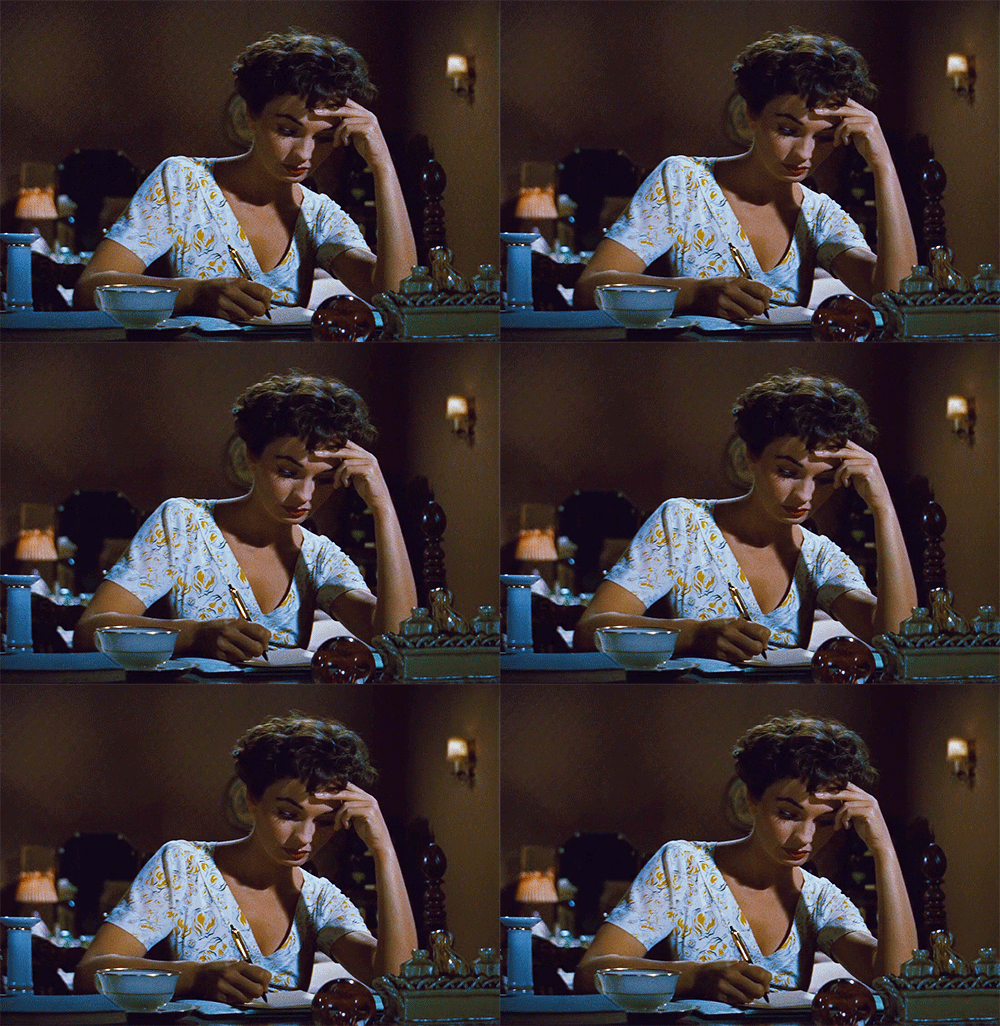
Hilda Crane (Jean Simmons) volta para casa depois de terminar um relacionamento e ser demitida. De repente, a mulher forte e independente se vê vivendo novamente com a mãe. Mais do que isso: Hilda já se divorciou duas vezes, e a sociedade a julga por isso.

Hilda Crane (Jean Simmons) has just returned home after ending a relationship and being fired from her latest job. All of a sudden a strong, independent woman sees herself living once again with her mother. More than that: Hilda has been married and divorced twice, and society judges her for that.


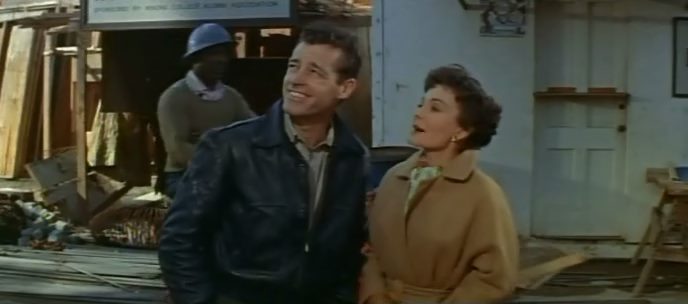
Demora pouco para que Hilda receba um pedido de casamento de Russell Burns (Guy Madison) - e é um pedido feito por carta! A mãe de Russell, a senhora Burns (Evelyn Varden) não gostou da ideia do filho. De maneira mal-educada, ela pergunta a Hilda e à mãe dela sobre os bens da família e os interesses que elas podem ter pelo casamento com Russell.

Soon Hilda receives a wedding proposal from Russell Burns (Guy Madison) - and the proposal comes through a letter! Russell’s mother, Mrs Burns (Evelyn Varden) is less than thrilled with her son’s move. In an impolite way, she asks Hilda and her mother about their possessions and their interests on Russell.


Ainda sem se decidir sobre Russell, Hilda aceita sair com o velho amigo de escola Jacques (Jean-Pierre Aumont). Ele ainda está ressentido porque o breve caso que eles tiveram não deu em nada e, mais do que isso, ele acredita que, por ela ser divorciada duas vezes, ela é agora uma mulher mais promíscua.

Still unsure about Russell, Hilda accepts to go out with a school friend and old flame, Jacques (Jean-Pierre Aumont). He is still bitter because the brief affair they had five years prior didn’t end well, and, moreover, he believes that, because she is twice divorced, she is more promiscuous.


Frustrado com seu encontro com Jacques, Hilda aceita o pedido de Russell. Obviamente, ela enfrentará muitos desafios: primeiro, ela não o ama, segundo, a mãe dele é uma forte candidata ao título de pior sogra do cinema, terceiro, Jacques ainda mexe com os sentimentos dela. Hilda está tão desanimada com o casamento que deixa que a mãe, Stella (Judith Evelyn), cuide de todos os preparativos.

Frustrated after her date with Jacques, Hilda accepts Russell’s proposal. Of course, she will face many challenges: first, she doesn’t love him, second, his mother is a strong contender for the title of worst mother-in-law of all movies, third, Jacques still confuses her feelings. Hilda is so not invested in the wedding planning that she lets her mother, Stella (Judith Evelyn), decide everything.


Hilda diz a Jacques que ela quer felicidade, filhos, e envelhecer ao lado de um marido que a ame. E ela quer tudo isso. Ela não se contenta só com uma dessas coisas. Ela não aceitará viver em um casamento infeliz com alguém que ela não ama só para ter filhos - como muitas mulheres faziam e ainda fazem. Ela não aceitará infelicidade para manter as aparências. Ela quer o pacote completo.

As Hilda tells Jacques, she wants happiness, children, and growing old with a husband that loves her. And she wants all that. She won’t settle for only one of those things. She won’t accept to live an unhappy marriage with someone she doesn’t love just in order to have children - like so many women did and still do. She won’t accept unhappiness to keep up appearances. She wants the whole package.


Este não conformismo peculiar mostra que Hilda é uma mulher moderna. Ela pode ter sonhos antiquados, mas não está disposta a sacrificar sua felicidade para consegui-los. Ela também diz que, na faculdade, queria viver a vida como um homem. Bem, já foi provado que a maioria dos pedidos de divórcio é feita pelos homens, e esse foi provavelmente o caso de Hilda.

This weird way of non-conformity shows that Hilda is a modern woman. She may have old-fashioned dreams, but she won’t sacrifice her own happiness to achieve them. She also says that, in college, she wanted to live life like a man. Well, it’s been proved that women file for divorce more often, and it was probably the case with Hilda.


Não é somente a sogra de Hilda que a vê com maus olhos - a mãe dela também tem vergonha do passado da filha e faz de tudo para manter as aparências, incluindo mentir e manipular. Hipocrisia também é um tema importante no filme.

Not only her mother-in-law sees Hilda through bad lenses - her mother is also ashamed of her daughter’s past and does anything to keep up appearances, including lying and manipulating her own daughter. Hypocrisy is another important theme in the film.


Jean Simmons é uma atriz pouco lembrada hoje, mas não deveria ser assim. Ela era linda e muito talentosa. Em “Idílio Proibido”, ela apresenta um corte de cabelo simples mas fabuloso, usa belas roupas e mostra seus grandes olhos brilhantes. Seus momentos de rebeldia são épicos, e é excitante quando ela desafia a mãe e a sogra. Jean Simmons merece mais reconhecimento não apenas por seus esforços em “Idílio Proibido”, mas também por ótimas atuações em filmes como “Hamlet” (1948) e “Spartacus” (1960).

Jean Simmons is often an overlooked actress, but she shouldn’t be. She was gorgeous and immensely talented. In “Hilda Crane”, she has a fabulous yet simple hairstyle, beautiful outfits and her eyes simply sparkle. Her rebellious bouts are epic, and it’s exciting whenever she confronts her mother or her mother-in-law. Jean Simmons deserves more recognition not only for her efforts in “Hilda Crane”, but also for the great performances she delivered in films like “Hamlet” (1948) and “Spartacus” (1960).

Jean Simmons as Varinia in "Spartacus"
O imenso peso de manter as aparências em geral cai apenas nos ombros das mulheres. A reputação de um homem é praticamente indestrutível, porém um passo em falso ou mesmo um boato são capazes de destruir a reputação de uma mulher e fazer com que os outros a chamem de vadia. E, para manter as aparências, algumas mulheres fazem de tudo, inclusive ferir os sentimentos das pessoas que amam. Esta é a lição de “Idílio Proibido” por que insistir para as mulheres manterem as aparências se o preço a pagar por “ser respeitável” é tão alto?

The huge weight of keeping up appearances falls usually only in the women’s backs. Men’s reputations are almost indestructible, while a misstep or even a gossip can destroy a woman’s reputation and make others see her as a tramp. And, in order to keep up appearances, some women can do anything, even hurting the ones they love. This is the lesson in “Hilda Crane”: why to insist that women keep up appearances when the price to pay for respectability is so high?

This is my contribution to the 90 Years of Jean Simmons blogathon, hosted by Virginie and Laura at The Wonderful World of Cinema and Phyllis Loves Classic Movies.


Monday, November 12, 2018

Grace Kelly: a cobertura na imprensa de um casamento real

Grace Kelly: a Royal Wedding in the press

Não importa onde moramos ou se apoiamos a monarquia. Sempre que um membro da família real – em especial da família real britânica – se casa, nós paramos para ver. Algumas pessoas ficam 100% focadas no casamento, assistindo a tudo sobre ele na TV e procurando por souvenirs na internet. Outras ficam só curiosas, e dão uma olhadinha nas escolhas fashion dos convidados. Todos amamos casamentos reais porque eles são o que temos de mais próximo dos contos de fada.

It does matter where we live or if we support the monarchy. Whenever a member of a royal family – in special the English royal family – gets married, we pay attention to the event. Some people may be 100% invested in the wedding, watching it live on TV and looking for souvenirs online. Others may just be curious, and take a look at the fashion choices of the guests. We all love royal weddings because they are the closest thing from fairytales we have.


Por isso, não há dúvida de que o “casamento do século XX” foi um casamento real. O problema é que temos dois fortes candidatos ao título: o casamento de Grace Kelly com o príncipe Rainier III de Mônaco e o casamento do príncipe Charles com a Lady Diana Spencer. Hoje falaremos sobre o casamento de Grace Kelly.

So, there is no doubt if “the wedding of the 20th century” was a royal one. The problem is that we have two strong contenders for “the wedding of the 20th century”: Grace Kelly’s wedding to Prince Rainer III of Monaco and the wedding of Prince Charles to Lady Diana Spencer. Today we’ll talk about Grace Kelly’s wedding.


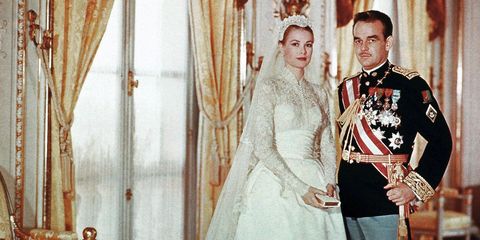
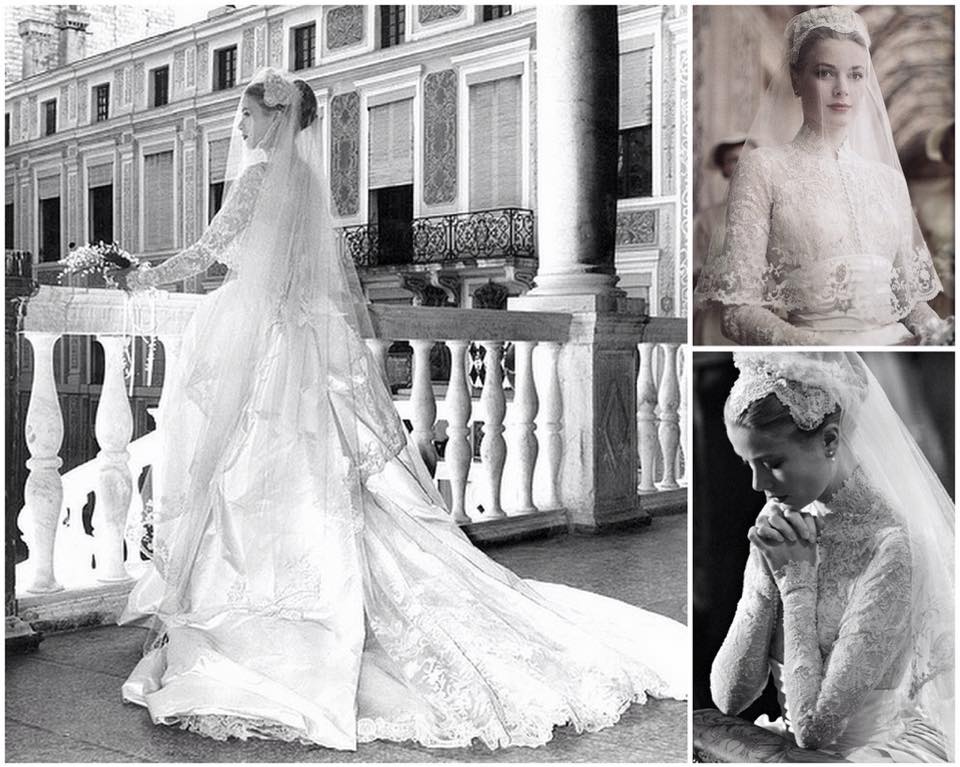
Em 19 de abril de 1956, o que aconteceu foi mais que um simples casamento real: foi a união de um membro da realeza do Velho Mundo, um príncipe, com um membro da nova realeza do Novo Mundo, uma superestrela de cinema. Nunca houve algo como isso antes – quer dizer, sim, Rita Hayworth se casou com um príncipe antes de Grace Kelly, mas seu marido era embaixador da ONU e filho de um sultão paquistanês, algo que não tem o mesmo status que a realeza europeia.
  
On April 19th 1956, what took place was more than a simple royal wedding: it was the union of a member of the Old Europe royalty, a prince, with a member of the New World new royalty, a movie superstar. There had never been anything like that – I mean, yes, Rita Hayworth was married to a prince before Grace Kelly, but her husband was a UN Ambassador and the son of a Pakistanis Sultan, which is not in the same status as European royalty.
 
Rita Hayworth and her royal husband
Por isso, o noivado de Grace Kelly, as preparações e, claro, a cerimônia foram manchete em jornais e revistas do mundo todo. Vamos ver como a imprensa cobriu os eventos:

So, Grace Kelly’s engagement, the preparations and of course the wedding made headlines in newspapers and magazines all over the world. Let’s take a look of how the press covered the events:


Hoje nós temos os filmes para TV do canal Lifetime para nos contar, usando atores desconhecidos, como William e Kate ou Harry e Meghan se conheceram, mas em 1956 havia outra maneira de contar o começo de um conto de fadas: artigos de revistas muito longos e detalhados.

Today we have Lifetime Movies to tell us, with the use of unknown actors, how William and Kate or Harry and Meghan met, but in 1956 there was another way to tell the beginning of the fairytale: very long and detailed magazine articles.


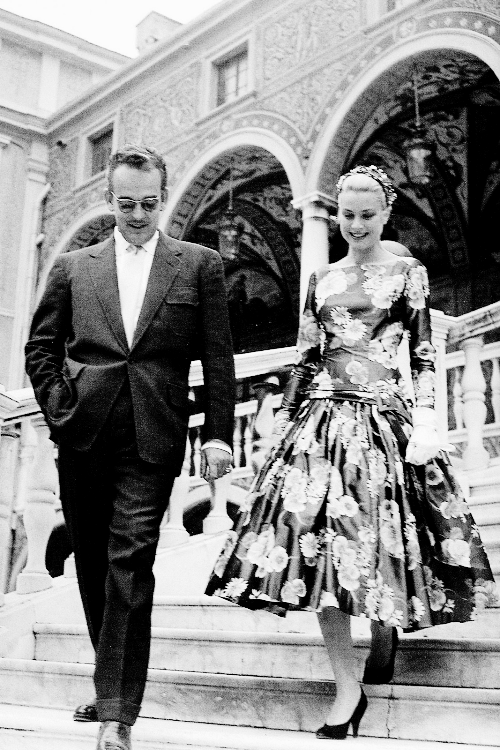
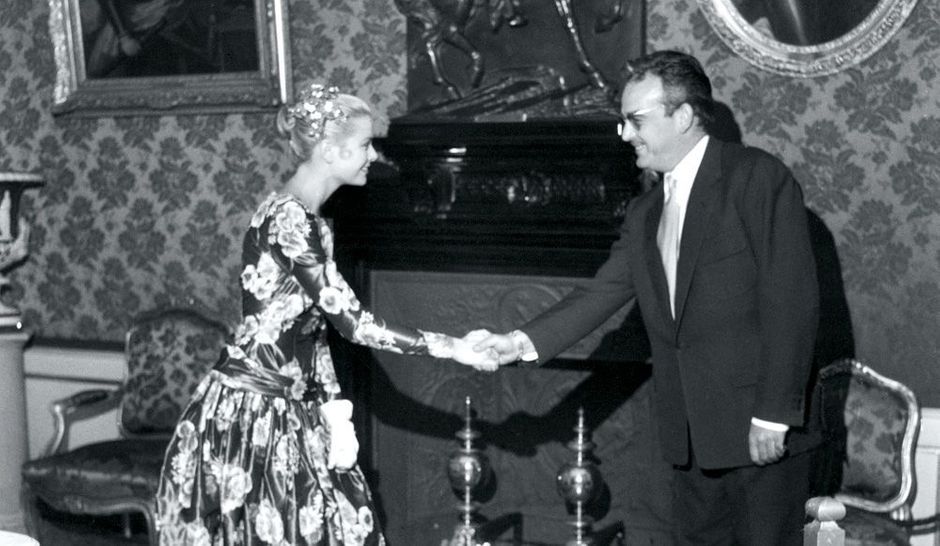
A revista Photoplay publicou dois artigos sobre como Rainier e Grace Kelly se conheceram. No artigo mais longo, escrito por Ruth Waterbury, ambos são descritos como pessoas muito independentes – o príncipe, por exemplo, só queria se casar se fosse por amor. Eles se conheceram em um breve ensaio fotográfico para a revista Paris Match feito durante o festival de Cannes. A partir daí a revista conta todas as paixões de Grace Kelly e as fofocas de Hollywood, para acabar onde o artigo começou: no anúncio do noivado.

Photoplay magazine ran two articles about Rainier and Kelly’s meeting and courtship. In the longest article, written by Ruth Waterbury, both are described as very independent people – the prince, for example, only wanted to marry for love. They first met in a brief photo shoot for the magazine Paris Match in Cannes. Then the magazine chronicles all of Grace Kelly’s loves and gossips in Hollywood, to end up where the article began: the announcement of the engagement.

When Grace met Rainier for the Paris Match shoot

O outro artigo da Photoplay foi escrito por Helen Bolstad. Tem basicamente o mesmo conteúdo, sobre o passado de Rainier e Grace Kelly até o noivado. Este artigo tem mais imagens.

The other article on Photoplay was written by Helen Bolstad. It’s basically the same content, about Rainier’s and Kelly’s past until the engagement. This article has many more images.


O jornal brasileiro Diário de Notícias do Rio de Janeiro falou sobre as preparações para o casamento. A nota diz que Grace Kelly acordou às 8 da manhã no palácio, assistiu à missa e supervisionou os preparativos durante a manhã. Os repórteres procuravam por detalhes para escrever nos jardins do palácio, enquanto a guarda desfilava.

The Brazilian newspaper Diário de Notícias do Rio de Janeiro (or News Diary) talks about the wedding preparations. It says Grace woke up at 8 am at the palace, went to the Mass and oversaw the preparations all morning long. The reporters look for news to write about in the palace gardens, while the Guard parades.


E o jornal Tribuna da Imprensa decidiu escrever brevemente sobre o reverendo que iria realizar o casamento:

And the newspaper Tribuna da Imprensa (or Press Tribune) decided to write briefly about the reverend that would officiate the wedding:


A revista American Motion Picture Herald fala dos planos para produzir especiais de TV sobre o casamento e como o evento fez o festival de Cannes ser adiado naquele ano:

The American Motion Picture Herald talks about plans to produce TV specials about the wedding and how the event postponed the Cannes film festival that year:


Outro jornal brasileiro, A Noite, publicou esta foto de Grace e Rainier depois da cerimônia civil e comentou sobre o bolo servido aos convidados:

Another Brazilian newspaper, A Noite (or The Night) published this photo of Grace and Rainer after the civil ceremony and talked about the cake they served the guests:


Finalmente, o jornal O Dia do Paraná falou da possibilidade de Grace Kelly seguir com a carreira de atriz – o pai dela havia dito que ela ainda estava pensando nisso – enquanto ela estava na lua de mel em um iate. O príncipe Rainier III não gostava da ideia de sua esposa voltar a Hollywood – e de fato ela não voltou.

Finally, this newspaper called O Dia do Paraná (or The Day, from the state of Paraná) talked about the possibility of Grace Kelly keeping on making films – her father said she was still thinking about it – while she was on her honeymoon on a yacht. Prince Rainier III didn’t like the idea of his wife going back to Hollywood – and in fact she didn’t.


O casamento também foi assunto de um especial de notícias da Pathé – visto abaixo – e um especial de 30 minutos da MGM. Mas isso é assunto para outra hora...

The wedding was also the subject of a Pathé newsreel – seen below – and a 30-minute MGM special. But this is subject for another time…


This is my contribution to the 4th Wonderful Grace Kelly blogathon, hosted by Virginie at The Wonderful World of Cinema and Emily at The Flapper Dame.


Related Posts Plugin for WordPress, Blogger...