} Crítica Retrô: flapper

Tradutor / Translator / Traductor / Übersetzer / Traduttore / Traducteur / 翻訳者 / переводчик

Showing posts with label flapper. Show all posts

Monday, January 1, 2018

Resoluções cinematográficas 2017 – Resultado / 12 classics for 2017 – results

Eu falhei.

I failed.

Pela primeira vez desde que me comprometi a cumprir esta tarefa hercúlea, três anos atrás, eu falhei e não assisti a todos os filmes da minha lista. E não foi minha culpa: eu simplesmente não consegui encontrar uma cópia de “Cilada Amorosa” (1929). Ele nunca saiu em DVD onde eu moro e eu não consegui encontrar o filme mesmo através de, hum, meios nem sempre legalizados. Mas eu não desisti: ainda estou procurando por “Cilada Amorosa” como quem procura o Santo Graal, e um dia eu assistirei ao filme e completarei esta lista.

For the first time since I took on this yearly Herculean task, three years ago, I failed to watch all the films on my list. And it was not my fault: I simply couldn't find a copy of “The Love Trap” (1929). It was never released on DVD where I live and it couldn't even be found in, er, less than legal ways. I haven't given up: I'm still looking for “The Love Trap” as one looks for a Holy Grail, and one day I intend to watch it and complete my list.

Agora, vamos esquecer minha vergonha por um momento e ler minhas impressões sobre cada clássico que eu vi pela primeira vez em 2017:

Now, let's forget my shame for a while and read my thoughts on each of the classics I saw for the first time in 2017:

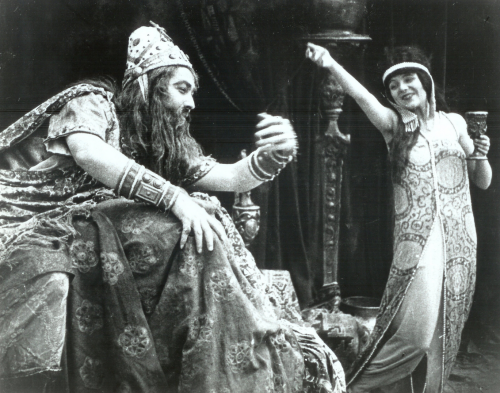
Judith of Bethulia (1914): Esta é a história bíblica de como Jerusalém foi salva quando a mística Judith (Blanche Sweet) seduziu e matou o príncipe Holofernes (Henry B. Walthall.) Não seo fã de Griffith, e não estava tão familiarizada com a história quanto o público de 1914 provavelmente estava, mas este filme me lembrou do estilo das novelas da Record.

Judith of Bethulia (1914): This is the biblical story of how Jerusalem was saved when mystical Judith (Blanche Sweet) seduced and killed prince Holofernes (Henry B. Walthall). I’m not a Griffith fan, and I was not as familiar with story as the 1914 moviegoers probably were, but this film reminded me of the production values of a corny biblical soap opera.
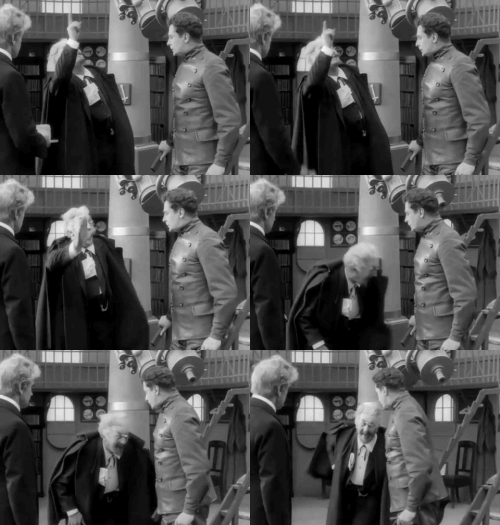
Himmelskibet (1918): É basicamente o que o título em inglês diz – uma viagem para Marte – mas é muito impressionante para algo feito em 1918. E é ainda mais surpreendente o fato de que eles acertaram o tempo que leva uma viagem da Terra à Marte – cerca de seis meses! Os efeitos especiais são muito bons, e você se surpreenderá ao descobrir como os marcianos vivem. Eu também adorei os nomes dos personagens em Latim – Planetaros, Corona, Dubius.

A Trip to Mars / Himmelskibet (1918): It’s basically that – A Trip to Mars – but very impressive for 1918. And it’s even more impressive that they got right the time to travel from Earth to Mars – about six months! The special effects are very good, and you’ll be surprised to find out how Martians live. I also loved the Latin names– Planetaros, Corona, Dubius.
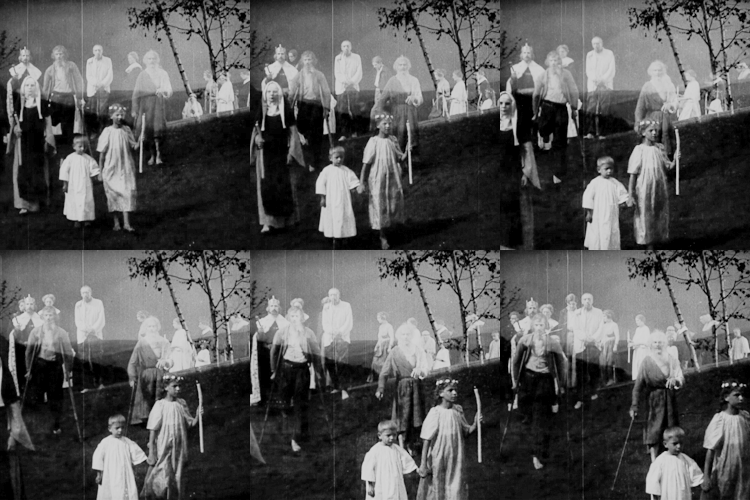
A Morte Cansada / Der Müde tod (1921): Este feito só poderia ter sido feito durante o Expressionismo Alemão. Em Hollywood, o filme teria um final feliz, mais facilmente digerível, mas nada realista. Na Alemanha, a história da mulher (Lil Dagover) que tenta salvar uma das três almas em diferentes lugares e épocas com o intuito de trazer seu amado de volta dos mortos é contada com perfeição – como se “Intolerância” (1916) tivesse sido bem feito.

Destiny / Der Müde Tod (1921): This film could only be made during the German Expressionism movement. In Hollywood, it would have been pushed to a palatable, but not realistic, happy ending. In Germany, the story of a woman (Lil Dagover) who tries to save one of three souls in different places and times to have her boyfriend back from the dead is perfectly developed – like an “Intolerance” (1916) done right.
L’Inhumaine (1924): A história envolve uma cantora fria, Claire (Georgette Leblanc) e seus muitos admiradores. Há um toque dramático e ao fim o filme se transforma em ficção científica. Mas os cenários são a verdadeira atração: idealizados por dois diretores de arte (o brasileiro Alberto Cavalcanti e o francês Claude Autant-Lara), os cenários são ousados, futuristas, assimétricos, cubistas, assustadores e tão impressionantes quanto os de “Metrópolis” (1927) – ou até um pouco mais.

The New Enchantment / L’inhumaine (1924): The story involves a cold singer, Claire (Georgette Leblanc) and her many admirers. There is a dramatic touch and then it becomes science fiction. But the sets are the real attraction here: designed by two art directors (Brazilian Alberto Cavalcanti and French Claude Autant-Lara), they’re bold, futuristic, cubist, asymmetric, awe-inducing and as impressive as the sets in “Metropolis” (1927) – maybe even more.

Uma Página de Loucura (1926): Este clássico japonês é contado sem intertítulos e é, por causa disso e de outras coisas, fascinante. O final é maravilhoso, e trata-se de um filme que você deve assistir muitas vezes para apreciá-lo por completo. Leia minha crítica completa AQUI.

A Page of Madness (1926): This Japanese classic is told without intertitles and is, because of this and other things, fascinating. The ending is wonderful, and it is one film you should watch many times to fully appreciate it. My full review is HERE.

Aurora / Sunrise (1927): Eu devo confessar que na metade do filme pensei ser estranho e até sexista o fato de que a esposa (Janet Gaynor) havia perdoado o marido (George O’Brien) e estava se divertindo muito com ele algumas horas depois de ele ter tentado matá-la. Mas então os 15 minutos finais me deixaram sem palavras. Que surpresa. Bravo, Murnau, você merece ser aplaudido de pé.

Sunrise (1927): I must confess that in the middle of the film I thought it was weird and even sexist the fact that the wife (Janet Gaynor) forgave her husband (George O’Brien) and was having the time of her life with him some mere hours after he tried to kill her. But then the final 15 minutes came and OH MY. What a plot twist. Bravo, Murnau, I ended up giving you a standing ovation.
Cilada Amorosa / The Love Trap (1929)

Ver para Crer / Why Be Good? (1929): Este filme tem um subtexto feminista e Colleen Moore arrasa na pista de dança. Ela é Pert Kelly, uma vendedora que adora festejar – e cuja reputação a prejudica quando o filho de seu patrão (Neil Hamilton) se apaixona por ela. Eu pretendo escrever mais sobre este filme.

Why Be Good? (1929): This film has a feminist subtext and Colleen Moore rocks some dance movements. She’s Pert Kelly, a salesgirl who loves to party – and whose reputation precedes her when the boss’s son (Neil Hamilton) falls in love with her. I intend to write more about this movie.

O Presídio / The Big House (1930): Este filme foi escrito por Frances Marion – a primeira mulher a ganhar um Oscar de roteiro e também a primeira mulher a ganhar um Oscar em categorias diferentes da atuação. É a história de Kent (Robert Montgomery), que dirigia embriagado e matou um homem atropelado, e seus companheiros de cela durões: Butch (Wallace Beery) e Morgan (Chester Morris). O filme também deu a Douglas Shearer o primeiro Oscar de Mixagem Som da história.

The Big House (1930): This film was written by the great Frances Marion – the first woman to win a Screenplay Oscar and also the first woman to win a non-acting Oscar. It’s the story of Kent (Robert Montgomery), who killed a man by driving drunk, and his though cell companions: Butch (Wallace Beery) and Morgan (Chester Morris). The film also gave Douglas Shearer the first Best Sound Mixing Oscar ever.
Glória e Poder / The Power and the Glory (1933): É Cidadão Kane oito anos antes de Cidadão Kane – ou quase isso. Este filme tem um excelente roteiro – obrigada, Preston Sturges! – e traz Colleen Moore naquele que é provavelmente seu melhor momento. Crítica completa AQUI.

The Power and the Glory (1933): It is Citizen Kane eight years before Citizen Kane – kind of. This film is beautifully written – thanks, Preston Sturges! – and showcases Colleen Moore at probably her best moment. Full review HERE.
A Mulher de Branco / Woman in White (1948): É místico, e se parece muito com um conto de fadas noir. O filme também trata de alienação e roubo. Crítica completa AQUI.

Woman in White (1948): It’s mystical, and it’s much like a noir fairy tale. It also involves alienation and robbery. Eleanor Parker is amazing. Full review HERE.
Papai é do Contra / Hobson’s Choice (1954): Charles Laughton está ótimo como o conservador Hobson, mas eu gostei especialmente de Brenda de Banzie como sua esperta filha mais velha e do brilhante John Mill como um funcionário talentoso porém ingênuo. Crítica completa AQUI.


Hobson’s Choice (1954): Charles Laughton is great as old-fashioned Hobson, but I especially loved Brenda de Banzie as his smart older daughter and brilliant John Mills as a talented but naïve employee. Full review HERE.

Friday, October 23, 2015

It (1927)

Existem alguns filmes que mudam a história do cinema para sempre. “It” não introduziu uma estética, mas levou uma jovem atriz ao topo de Hollywood. Existem filmes que nos ensinam algo. “It” não ensina a flertar, mas mostra como a conquista pode ser um jogo divertido – e como a vida pode ser encarada com leveza e uma dose de coragem. “It” não foi um filme revolucionário, mas conseguiu definir perfeitamente uma era. Se você quiser saber como viviam as flappers e como começou a independência feminina nos loucos anos 20, este é o filme!

There are certain movies that change film history forever. “It” didn’t introduce any aesthetical trait, but took a young actress to the top of Hollywood. There are certain movies that teach us something. “It” doesn’t teach how to flirt, but shows how flirting can be a fun game – and how life can be faced with lightness and a dosis of courage. “It” wasn’t a revolutionary movie, but it could perfectly define an era. If you want to know how flappers lived and how female independence started in the 1920s, this is the film to watch!

Betty (Clara Bow) é uma funcionária de uma grande loja que sabe bem o que quer. Seu objetivo é conquistar seu novo patrão, Cyrus Waltham (Antonio Moreno). Muito decidida e bastante esperta, ela convida Monty (William Austin), grande amigo de Cyrus, para um jantar chique no Ritz. Basta usar um vestido customizado e muito charme e pronto: Betty atrai a atenção de Cyrus.

Betty (Clara Bow) is a clerk at a deparment store and knows exactly what she wants. Her goal is to conquer her new boss, Cyrus Waltham (Antonio Moreno). With this in mind and lots of wit, she invited Monty (William Austin), Cyrus’ good friend, for a fancy dinner at the Ritz. By just using a DIY dress and lots of charms the magic is made: Betty calls Cyrus’ attention.

Monty estava à procura de uma mulher com “IT”, com sex appeal, e encontrou isto em Betty. Ela usou o pobre Monty (que, coitado, pensava ter também “IT”) para fazer charme para o patrão, e a estratégia funcionou. Na noite seguinte, Betty e Cyrus se divertem na praia, em um parque de diversões com brinquedos estranhíssimos (“social mixer”????).

Monty was looking for a woman with “IT”, with sex appeal, and found this in Betty. She used poor Monty (who, poor thing, thought he also had “IT”) to ignite jealousy in her boss, and the strategy worked. The following night, Betty and Cyrus have fun at the beach, in an amusement park with very strange attractions (“social mixer”????).

Além de sedutora, Betty tem um bom coração. Sua companheira de quarto, Molly (Priscilla Bonner) está doente, sem poder trabalhar, e precisa sustentar o filho pequeno. Quando duas senhoras aparecem querendo levar o bebê para o orfanato, Betty não pensa duas vezes: “O filho é meu e eu tenho emprego para sustentá-lo!”. Ela inventa uma mentira e salva a amiga, mas Monty ouve a confissão – e não apenas ele: um jornalista (o jovem e esquálido Gary Cooper) anota tudo e publica a história. A seguir temos confusões, lágrimas, corações partidos e um clímax em um iate.

Besides being a seductress, Betty has a heart of gold. Her roommate, Molly (Priscilla Bonner) is sick, without a job and doesn’t have the means to support her infant child. When two women appear wanting to take the baby to an orphanage, Betty doesn’t think twice: “The child is mine and I have a job to support him!”. With this lie she saves her friend, but Monty hears the confession – not only him, but also a journalist (a young and very slim Gary Cooper) takes note of everything and publishes the story. To follow we have confusion, tears, broken hearts and a climax in a yacht. 

Gary Cooper

O filme deve todo seu valor a Clara Bow. Ela é simplesmente adorável, e ainda demonstra talento quando precisa derramar algumas lágrimas. Linda, risonha e charmosa, ela parece uma garota moderna, e é impossível não se apaixonar ou não se inspirar por seu jeito. Decidida, corajosa, inteligente, Betty não mede esforços para conseguir o que quer, mas sem abandonar a doçura e o tom de brincadeira. Há momentos em que eu gostaria de ser mais como Betty, e levar a vida com um misto de leveza e ambição, determinação e feminilidade. Betty tem “IT”. Clara Bow tinha “IT”. Será que nem todos nascem com “IT”? Ou será que houve um momento em que a humanidade deixou o “IT” escapar?

The film owes everything to Clara Bow. Sh is simply adorable, and also shows a lot of talent when she needs to cry. Pretty, always laughing, and charming, she looks like a modern girl and it’s impossible not to fall in love or get inspired by her ways. Resourceful, brave, intelligent, Betty goes all the way to get what she wants, but without losing the tenderness and the playfulness. There are moments I’d like to be like Betty, and live life with a mix of lightness and ambition, determination and feminility. Betty has “IT”. Clara Bow had “IT”. Maybe not everybody is Born with “IT”? Or maybe there was a moment when mankind let “IT” slip away?

Uma frase em particular mostra como Betty é uma personagem moderna. Enquanto defende a amiga Molly, Betty é questionada sobre onde está o pai de seu suposto filho. A resposta? “Não te interessa!”. Não há heroína de comédia romântica mais incrível que Betty!

One sentence in particular shows how Betty is a modern character. As she’s defending her friend Molly, Betty is asked about where is her supposed son’s father. The answer? “That’s none of your business!”. There is not a single romantic comedy heroine more amazing than Betty! 


Clara Bow pode ser a “It Girl”, mas quem lucrou realmente com o filme foi a mulher que inventou o “IT” (ou pelo menos que popularizou o termo, já usado por Rudyard Kipling): Elinor Glyn, autora de best-sellers escandalosos. É através de um artigo de Glyn na revista Cosmopolitan (propriedade do amigo íntimo de Elinor, William Randolph Hearst) que Monty descobre o significado de “IT” no filme, e a própria autora aproveita para fazer uma breve aparição no jantar no Ritz e explicar o que é “IT”. E “IT” tem um preço: Elinor recebeu 50 mil dólares para que o filme fosse feito ao redor do seu conceito de “IT”.

Clara Bow may be the “It girl”, but the person who got rich with the movie was the woman who invented “IT” (or at least made the word, already used by Rudyard Kipling, popular): Elinor Glyn, the author of scandalous best-sellers. It is through one article by Elinor Glyn at the Cosmopolitan magazine (a property of her close friend Willian Randolph Hearst) that Monty gets to know the meaning of “IT” in the movie and the author herself has a cameo at the Ritz dinner to explain what is “IT”. And “IT” has a price: Elinor received 50 thousand dollars so a movie could be made around her concept of “IT”.   

Todos os olhares deveriam ir para Clara Bow, mas William Austin também atrai a atenção e é a fonte de muitas risadas. Nascido na Guiana em 1884, William Austin estudou na Inglaterra, fez negócios em Shanghai e estreou no cinema em 1920. Seu irmão, Albert Austin, trabalhava como coadjuvante nos filmes de Charles Chaplin. “It”, entretanto, não foi o filme mais famoso de William Austin. Em 1943, ao interpretar o mordomo Alfred em um seriado do Batman, William reformulou totalmente a aparência do personagem, e o Alfred dos quadrinhos foi remodelado com base em William Austin.

All the eyes should be directed to Clara Bow, but William Austin also calls the attention and generates many laughs. Born in Guyana in 1884, William Austin studied in England, was a businessman in Shanghai and debuted in movies in 1920. His brother, Albert Austin, was a supporting player in Chaplin’s movies. “It”, however, wasn’t Austin’s most famous film. In 1943, playing the butler Alfred in one Batman serial, William totally reformulated the character’s appearance, and the Alfred from comic books was completely remodeled having as the basis the appearance of William Austin.

William Austin tinha "IT" / William Austin had "IT"

Perdido durante várias décadas, “It” (o filme, e não o charme) foi reencontrado em Praga, atual República Tcheca, nos anos 60. Carl Davis apreendeu perfeitamente o tom de brincadeira da película, compondo uma trilha sonora adorável nos anos 80. “It” é precursor das screwball comedies e melhor que qualquer comédia romântica atual – mas, acima de tudo, uma prova de que o passado é muito mais próximo de nós do que imaginamos – e de que devemos sempre perseguir nosso “IT”.

Lost during many decades, “It” (the movie, not the charm) was found again in Prague, currently Czech Republic, in the 1960s. Carl Davis perfectly understood the playfulness of the movie, composing a lovely soundtrack in the 1980s. “It” is a forerunner of screwball comedies and better than any modern romantic comedy - but, above all, a proof that the past is much closer to us than we think - and that we all must look for our “IT”.   


This is my contribution to The Silent Cinema blogathon, hosted by Crystal at In the Good Old Days of Classic Hollywood and Lauren Champkin!

Related Posts Plugin for WordPress, Blogger...